The Agentic ROI Gap (2026): Why Gartner Says >40% of Agent Projects Cancel While Spend Explodes
# The Agentic ROI Gap (2026): Why Gartner Says >40% of Agent Projects Cancel While Spend Explodes
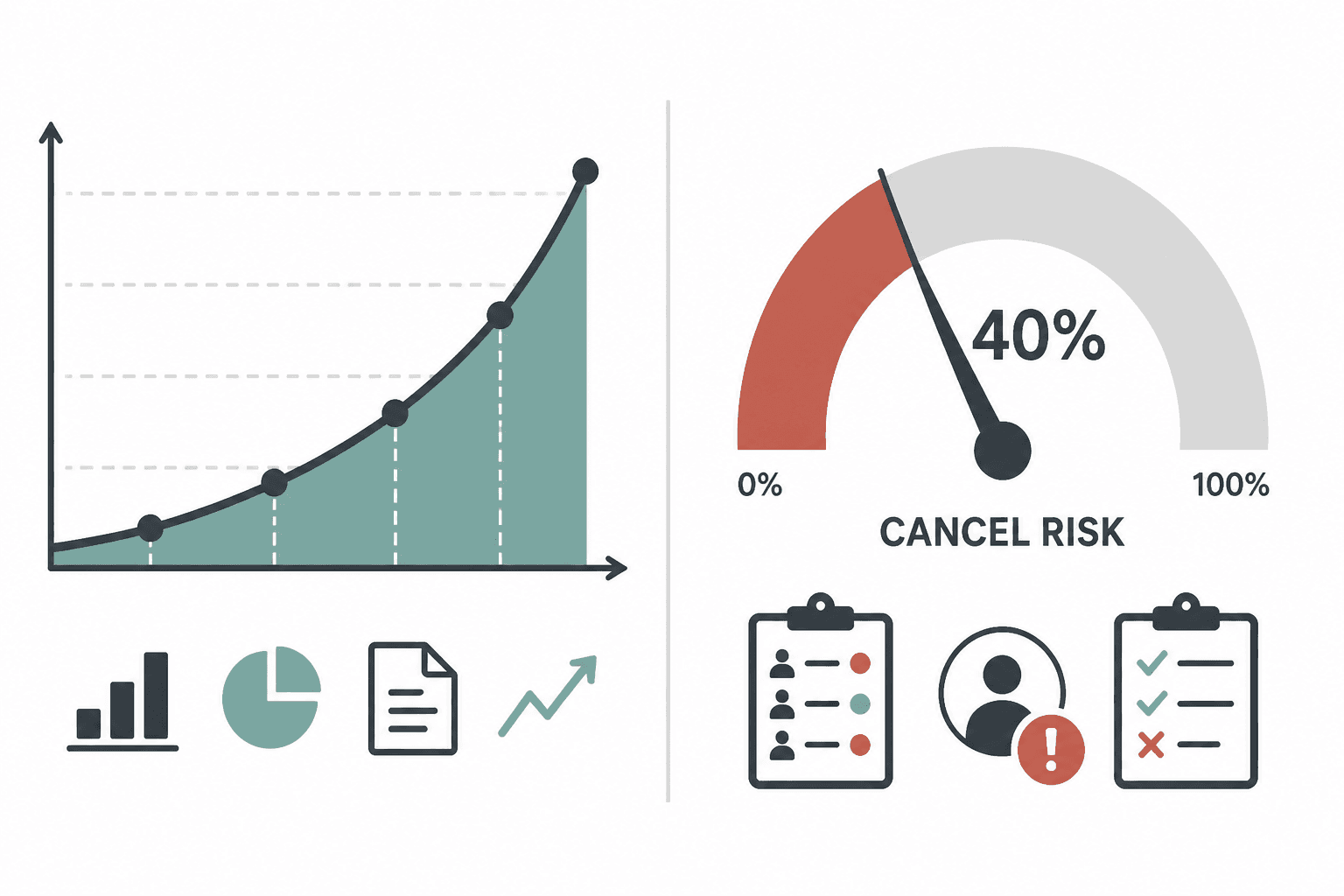
You are not imagining the contradiction. The same research ecosystem that forecasts exploding agent spend also predicts that more than 40% of agentic AI projects will be canceled by the end of 2027. Meanwhile McKinsey’s mid-2026 survey shows 89% of organizations using AI in at least one function - and only 37% reporting any positive EBIT contribution, with ~6% as high performers. MIT NANDA / MLQ put the P&L miss at 95% of GenAI pilots. Menlo finds only 16% of enterprise deployments are true agents (plan → act → observe → adapt).
This is the operator deep dive: what each number actually measures, why spend and cancellations can rise together, a copilots-vs-workflows-vs-true-agents map, and a buyer cancel-risk scorecard you can run before you fund the next “agent” SOW. Math first. Demo theater last.
Table of contents
TL;DR {#tldr}
Gartner (Jun 25, 2025 press): >40% of agentic AI projects predicted canceled by end of 2027 - causes named: escalating costs, unclear business value, inadequate risk controls. By 2028: 33% of enterprise apps include agentic AI (from <1% in 2024); ≥15% of day-to-day work decisions made autonomously via agentic AI. “Agent washing”: only ~130 vendors with real agentic capability among thousands claiming it (Reuters paraphrase of Gartner).
Spend still explodes in parallel boxes: Gartner full-stack AI procurement $2.59T in 2026f (+47%); models line $32.6B (+110% on agentic/multistep consumption). Secondary-attributed Gartner agent software path: $86.4B (2025) → $206.5B (2026) → $376.3B (2027) - label as secondary until primary PDF. Menlo agent platforms (buyer-side app layer): $750M in 2025. Do not blend these.
McKinsey State of AI 2026 (survey May 4-Jun 8, 2026; n=1,719; 97 countries): 89% use AI in ≥1 function; 37% any positive EBIT (flat YoY); ~6% high performers; high performers redesigned workflows ~75% vs ~25% others. Orgs >$1B scaling agents in ≥1 function: 40% (was 27%).
MIT NANDA / MLQ (2025): 95% of orgs getting zero measurable P&L return from GenAI pilots - not “AI doesn’t work.” Production impact ~5%. Enterprise-grade tools: 60% evaluated → 20% pilot → 5% production.
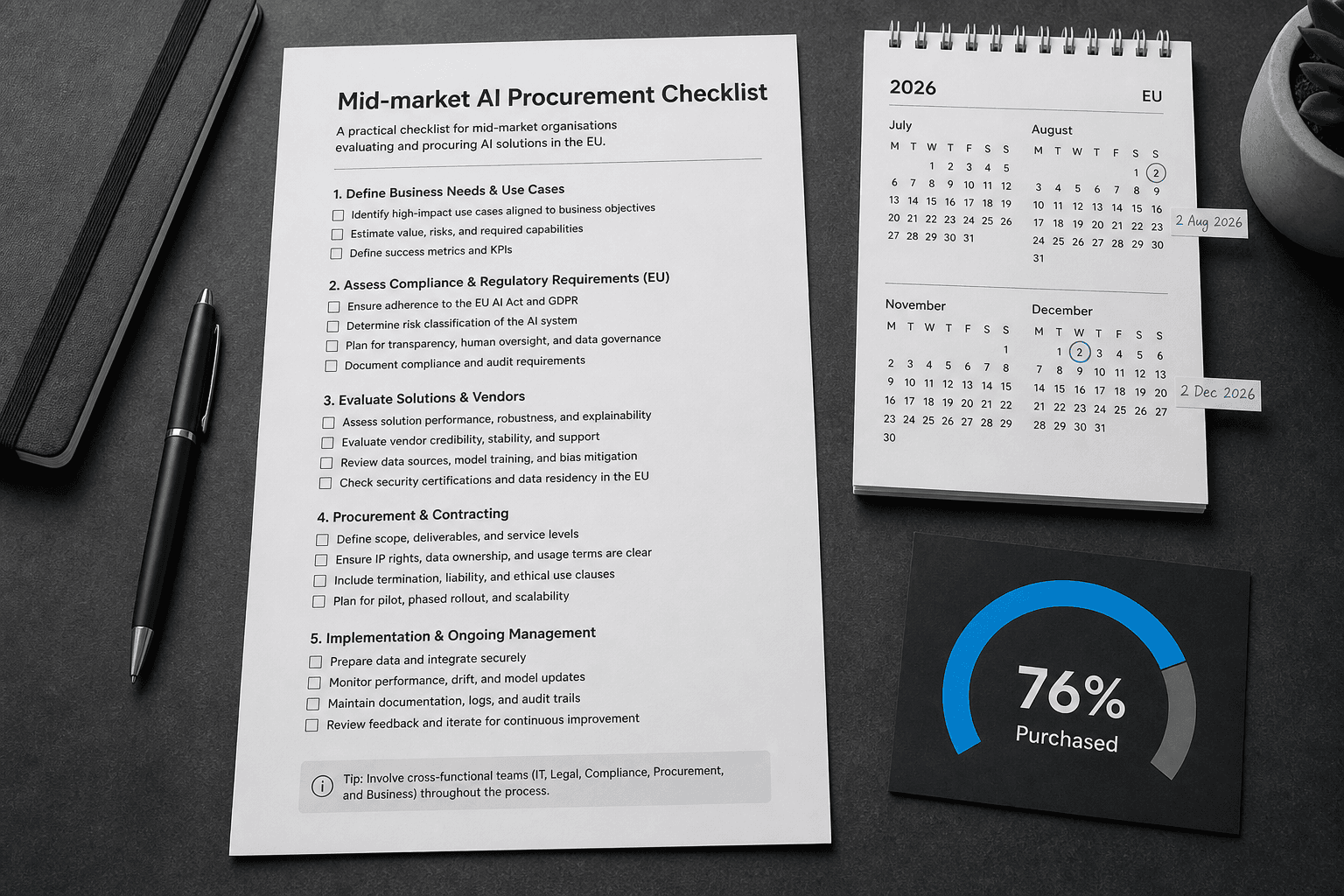
Menlo (Dec 2025): true agents only 16% enterprise / 27% startup deployments. Horizontal copilots still $7.2B (86% of horizontal). Buy > build: 76% purchased. AI deal → production 47% vs traditional SaaS 25%.
Buyer move: score cancel risk before you fund autonomy. If you cannot name the workflow redesign, the eval harness, and the kill criteria, you are buying a chatbot with a new noun.
The paradox in one frame {#paradox}
Boards see two headlines in the same week:
1. “Agent spend is the fastest-growing slice.”
2. “Most agent projects will be canceled.”
Those statements are compatible if you stop treating “agents” as one product and “ROI” as one metric.
| Layer | What is rising | What is lagging |
|---|---|---|
| Capex / procurement | Gartner full-stack AI spend $1.76T (2025) → $2.59T (2026f); infra $1.43T of 2026 | EBIT attribution (McKinsey 37% flat) |
| Model / multistep tokens | Gartner models $32.6B (+110% outlook) on agentic consumption | Unit economics without caching, batch, eval gates |
| Buyer GenAI apps | Menlo enterprise GenAI $37B (3.2×); agent platforms $750M | True agent share 16% enterprise |
| Pilot theater | McKinsey 89% using AI somewhere; MIT >80% explored ChatGPT/Copilot | MIT 95% no measurable P&L; McKinsey ~6% high performers |
| Vendor labeling | Thousands of “agentic” claims | Gartner/Reuters: ~130 real; cancel prediction >40% by 2027 |
Research dump controversy table (buyer-felt): Capex vs ROI gap - boards fund infra while EBIT attribution is flat (McKinsey 37%; MIT 95%; Gartner >40% cancel). Agent washing - budget wasted on rebranded chatbots (Gartner Jun 2025).
You do not fix this with more demos. You fix it with definitions, kill criteria, and workflow redesign - the same trait McKinsey associates with the ~6% high-performer cohort.
Hook 1 - Gartner: >40% agentic projects canceled by 2027 {#gartner-cancel}
Primary: https://www.gartner.com/en/newsroom/press-releases/2025-06-25-gartner-predicts-over-40-percent-of-agentic-ai-projects-will-be-canceled-by-end-of-2027
Reuters: https://www.reuters.com/business/over-40-agentic-ai-projects-will-be-scrapped-by-2027-gartner-says-2025-06-25/
| Prediction | Figure | Horizon |
|---|---|---|
| Agentic AI projects canceled | >40% | By end of 2027 (M37) |
| Causes named | Escalating costs, unclear business value, inadequate risk controls | - |
| Day-to-day work decisions made autonomously via agentic AI | ≥15% | By 2028 (from 0% in 2024) - M39 |
| Enterprise software apps including agentic AI | 33% | By 2028 (from <1% in 2024) - M38 |
| “Agent washing” | Most of thousands of “agentic” vendors lack true agentic capability (~only ~130 real - Reuters paraphrase of Gartner) | 2025 |
Operator read
This is a prediction, not a trailing cancel rate. Treat it as a underwriting prior: assume a large fraction of agent programs will fail budget scrutiny unless you design for value and controls up front.
The 33% / ≥15% by 2028 projections are why vendors still raise. Penetration can rise while project mortality stays high - different units (apps shipping agent features vs programs you fund internally).
Digital Applied also cites ~17% of orgs have deployed AI agents to date vs 60% expecting within two years - attribute carefully to Gartner vintage; use as directional, not as a substitute for the primary cancel press release.
Cancel causes → scorecard mapping
| Gartner-named cause | What you measure in diligence |
|---|---|
| Escalating costs | Token burn per successful task; session-hour / tool fees; human-in-the-loop cost; infra shadow spend |
| Unclear business value | P&L or operational KPI owner named; baseline vs pilot delta; time-to-value gate |
| Inadequate risk controls | AuthZ, audit logs, tool allowlists, eval harness, rollback, EU Art 50 / disclosure where relevant |
If your SOW has none of the right-hand column, you are in the cancel prior.
Hook 2 - Spend side: models, agent software, Menlo platforms {#spend}
Do not blend Gartner / IDC / Stanford / Menlo into one “AI market.” For the agent story, keep three labeled spend boxes separate.
A) Full-stack procurement (context, not “agent TAM”)
Gartner May 19, 2026 (Morningstar/Business Wire syndication): worldwide AI spending $2,595.7B in 2026f (+47% vs $1,764.9B in 2025). Models segment $32.6B in 2026 with outlook raised +110% on agentic / multistep consumption. Infrastructure $1,431.5B. Source table in the companion Three AI Markets piece / research dump §1.2.
B) Purpose-built AI agent software (secondary path - flag)
Digital Applied / CIO Dive-style coverage attributes to Gartner: purpose-built AI agent software $86.4B (2025) → $206.5B (2026) → $376.3B (2027) (~+139% then +82%). Treat as vendor-stated via secondary until confirmed in a Gartner primary PDF. Distinct from Gartner’s broader “AI Software” line ($453.2B in 2026).
C) Buyer-side agent platforms (Menlo)
Menlo Dec 2025: horizontal AI $8.4B; of that, copilots 86% ($7.2B); agent platforms 10% ($750M); personal productivity 5% ($450M). Enterprise GenAI total $37B. This is the honest “what buyers paid for agent-platform products in Menlo’s box” number - orders of magnitude below secondary “agent software” headlines because the boxes differ.
D) Other agent TAM forecasts (conflict expected)
| Publisher | Near-term | Longer-term |
|---|---|---|
| MarketsandMarkets | $7.84B (2025) | $52.62B (2030); CAGR 46.3% |
| BCC Research | $8B (2025) | $48.3B (2030); CAGR 43.3% |
| Information Matters | Central ~$40B (2026) (range $33-48B) | Base ~$140B (2030) |
| Bloomberg Intelligence | - | Agentic AI spend $286B by 2032; broad GenAI $2.3T by 2032 |
Writer rule: If your deck says “the agent market is $200B+ in 2026,” you are almost certainly on the secondary Gartner agent-software path or a broad BI frame - not Menlo’s $750M platforms, not MarketsandMarkets’ ~$8B. Label the publisher and scope or cut the slide.
Hook 3 - McKinsey 89% / 37% / 6% {#mckinsey}
Survey: Online, May 4 - Jun 8, 2026; n=1,719 in 97 countries; GDP-weighted; 36% from orgs >$1B revenue.
Coverage: Business Review / TechTimes summaries of McKinsey QuantumBlack *State of AI 2026: On the road to ROI*.
| Metric | Figure |
|---|---|
| Orgs using AI in ≥1 function | 89% (M33) |
| Scaled across organization | 44% (was 38%) |
| AI in ≥3 functions | 56% (was 51%) |
| Say AI increased productivity | 80% |
| Better decisions | 50% |
| Any positive EBIT contribution | 37% (flat vs 2025) (M34) |
| “High performers” / significant value | ~6% (M35) |
| High performers who redesigned workflows | ~75% vs ~25% others |
| Orgs >$1B scaling agents in ≥1 function | 40% (was 27%) |
| Smaller orgs agent scaling | ~22% (flat) |
Implication (from the research dump): Individual productivity ≠ enterprise P&L. Workflow redesign is the differentiator.
For agent programs specifically: large enterprises are scaling agents faster (40% vs ~22%), which also means more surface area for the Gartner cancel prior. Scaling without redesign is how you get “we have agents in four functions” and still sit in the 37% EBIT flatline.
KPMG context (separate series): Global AI Pulse planned AI investment weighted avg US$186M (Q1 2026) / US$188M (Q2 2026) among senior leaders - large-enterprise-weighted, not mid-market. Do not cite as “average company AI budget” without that caveat. Secondary TechTimes-style cuts have quoted only 8% reporting tangible ROI in one Pulse framing - prefer the KPMG PDF for any ROI claim.
Hook 4 - MIT NANDA: 95% with no measurable P&L {#mit}
Report: *The GenAI Divide: State of AI in Business 2025* (MIT Media Lab Project NANDA / MLQ)
URL: https://mlq.ai/media/quarterly_decks/v0.1_State_of_AI_in_Business_2025_Report.pdf
Methods (reported): ~150 leader interviews, ~350 employee survey, analysis of ~300 public deployments.
| Claim | Precise wording |
|---|---|
| 95% (M36) | Orgs getting zero measurable P&L return / pilots failing to deliver business impact - not “AI doesn’t work” |
| 5% | Integrated pilots extracting millions in value / reaching production impact |
| ChatGPT/Copilot exploration | >80% explored/piloted; ~40% report deployment - mostly individual productivity |
| Enterprise-grade tools | 60% evaluated → 20% pilot → 5% production |
| Build vs buy success | Externally sourced tools succeed more often (reported 67% success vs much lower for internal builds - use MLQ primary wording) |
Conflict with Menlo (resolved without hand-waving): Menlo argues boom (spend + conversion); MIT argues P&L impact rare. Both can be true if spend rises while EBIT attribution lags - which matches McKinsey’s flat 37%. You can have a 47% AI-deal-to-production conversion (Menlo) and still fail a CFO’s P&L test if “production” means “users click the sidebar” rather than “margin moved.”
When you quote 95%, say the full phrase: zero measurable P&L return. Dropping “AI fails 95% of the time” is how you lose the citation and the argument.
Hook 5 - Menlo: only 16% true agents {#menlo-agents}
Publisher: Menlo Ventures - *2025: The State of Generative AI in the Enterprise* (Dec 9, 2025).
Methodology: 495 U.S. enterprise AI decision-makers + bottoms-up model.
| Metric | Figure |
|---|---|
| True agents (plan→act→observe→adapt) | 16% enterprise / 27% startup deployments (M24) |
| Agent platforms (horizontal app $) | $750M (10% of horizontal) (M19) |
| Horizontal copilots | $7.2B (86% of horizontal) (M18) |
| Enterprise GenAI spend 2025 | $37B (M12) |
| Purchased vs built | 76% purchased (was 53/47 in 2024) (M25) |
| AI deal → production | 47% vs traditional SaaS 25% (M54) |
| PLG share of AI app spend | 27% (vs ~7% traditional); with shadow AI maybe ~40% |
Operator translation: Most of what your vendors call “agents” are still copilots or workflow automations with an LLM step. Menlo’s 16% is the honesty check. If your RFP scores every chatbot wrapper as “agentic,” you will overpay relative to the autonomy you actually receive - and you will land in Gartner’s cancel bucket when costs escalate without value.
Related Menlo color for underwriting: coding remains the clearest ROI category ($4.0B departmental; 50% of developers using AI coding tools daily; 15%+ self-reported velocity). If your first “agent” bet is an unbounded multi-tool enterprise agent with no eval harness, you skipped the category with the best evidence.
Copilots vs workflows vs true agents {#map}
Use this map in every vendor meeting. Force the vendor to point to a column.
| Dimension | Copilot | Workflow automation + LLM | True agent |
|---|---|---|---|
| Control loop | Human prompts; model responds | Trigger → fixed graph → optional LLM node | Plan → act → observe → adapt (Menlo definition) |
| Tool use | Limited / suggested | Pre-declared connectors | Dynamic tool selection inside policy |
| Failure mode | Bad answer in chat | Wrong branch / bad transform | Cascading actions; cost blowups; policy breaches |
| Menlo $ signal | Horizontal copilots $7.2B | Often sits across IT/automation + app spend | Agent platforms $750M; true-agent share 16% ent. |
| Gartner cancel risk | Lower (seat productivity) | Medium (integration debt) | Highest (cost + value + controls) |
| What “done” looks like | Weekly active use; time saved | Tickets closed; SLA met | KPI moved with audit trail |
Agent washing test (one question): “Show me the observe → adapt loop in production logs for a failed tool call.” If the answer is a slide, not a log, you are buying a copilot.
Gartner’s ~130 “real” vendors (Reuters paraphrase) is directionally the same point: nouns are cheap; loops are expensive.
Buyer cancel-risk scorecard {#scorecard}
Score each factor 0 (bad) / 1 (partial) / 2 (strong). Max 20. Interpret after the table.
| # | Factor | 0 | 1 | 2 | Evidence to demand |
|---|---|---|---|---|---|
| 1 | Definition honesty | Everything called “agent” | Copilot vs agent distinguished in SOW | True-agent loop documented (plan/act/observe/adapt) | Architecture + sample traces |
| 2 | Workflow redesign | “Bolt onto current process” | Minor SOP edits | Process redesigned (McKinsey high-performer pattern) | Before/after process map |
| 3 | KPI / P&L owner | “Productivity” only | Team metric, no $ | Named owner + baseline + target (MIT gap) | One-page value brief |
| 4 | Eval harness | Demo scripts only | Offline eval set | Online evals + regression gate on deploy | Eval set size, fail thresholds |
| 5 | Cost controls | Unlimited tools/tokens | Soft budgets | Hard caps, caching/batch, kill switch (Gartner cost cause) | Rate cards + alert policy |
| 6 | Risk controls | No tool allowlist | Partial authZ | Full authZ, audit, secrets isolation, rollback (Gartner controls cause) | Security review packet |
| 7 | Build vs buy clarity | Greenfield internal agent platform | Mixed without owner | Prefer purchased where Menlo/MIT favor external (76% purchased; MLQ external success signal) | Make/buy memo |
| 8 | Scope fence | “Enterprise-wide agent” | Multi-function year one | One function, one KPI, time-boxed | Charter ≤1 page |
| 9 | Data / permissions | Broad drive access day one | Segmented corpus | Least-privilege + permission mirroring where relevant | Access matrix |
| 10 | Kill criteria | None | Informal “see how it goes” | Dated kill/continue gates tied to KPI and cost | Calendar invites + thresholds |
Interpretation (operator heuristic - not a vendor guarantee):
| Score | Reading | Action |
|---|---|---|
| 0-8 | Cancel prior is your base case | Do not fund autonomy; fund a copilot pilot or kill |
| 9-14 | Survivable only with fences | Fund a time-boxed pilot; no multi-year platform bet |
| 15-20 | Underwritable | Fund with staged gates; still assume Gartner’s >40% industry cancel rate applies to peers who skipped this |
Run the scorecard before the vendor’s agent demo, not after. Demos optimize for columns you are about to ignore.
How to underwrite an agent program {#underwrite}
A practical sequence that respects the research without inventing new statistics:
1. Name the column - Copilot, workflow+LLM, or true agent. If Menlo’s 16% bar is the goal, say so explicitly.
2. Steal from the high performers - McKinsey: ~75% of high performers redesigned workflows vs ~25% others. Budget process redesign as a line item, not a hope.
3. Separate productivity from P&L - McKinsey 80% productivity claims can coexist with 37% EBIT. MIT 95% is about P&L measurement. Pick which success definition Finance will accept on day 90.
4. Prefer purchased systems of work where evidence says so - Menlo 76% purchased; MIT/MLQ reports higher success for externally sourced tools (67% success signal - use primary wording). Building your own “agent OS” is how costs escalate (Gartner cause #1).
5. Instrument tokens like cloud - Gartner raised the models outlook partly on multistep consumption. Session-hour fees (e.g., Anthropic Managed Agents $0.08 / session-hour on the pricing page) and tool calls compound. Cap before you scale.
6. Stage autonomy - Suggest → draft with approval → limited act → broader act. Jumping to autonomous decisioning toward Gartner’s ≥15% by 2028 vision without stages is how you buy the cancel headline early.
7. Write the cancel yourself - Pre-commit to Gartner’s three failure modes as exit tests. If costs escalate without value or controls, you cancel - on purpose - before the budget committee does it for you.
Watch out / when NOT {#when-not}
Watch out
1. Noun inflation - “Agent” on a pricing page ≠ Menlo true-agent loop. Score definition honesty first.
2. Blended market slides - Do not put secondary $206.5B agent software next to Menlo $750M platforms as if they were the same market.
3. Productivity theater - McKinsey 80% “increased productivity” is not 37% EBIT and not MIT P&L impact.
4. 95% misuse - Quote MIT as no measurable P&L return, not “AI doesn’t work.”
5. Unbounded tools - Inadequate risk controls are a named Gartner cancel cause. Tool allowlists are not optional bureaucracy.
6. Shadow AI - Menlo cites NBER WP 34255: ~27% of ChatGPT Plus usage work-related. Personal agents do not inherit your enterprise controls.
7. EU Art 50 - Transparency obligations enforceable from 2 August 2026 (marking grace to 2 Dec 2026 for Art 50(2)). Deployer/provider duties can interact with customer-facing agents; fines up to €15M or 3% turnover per EC FAQ - confirm legal for your case.
When NOT to fund a “true agent” program
You cannot name a single KPI owner who will defend the pilot at day 90.
Your first use case has no eval set and no rollback.
You are still early on copilots in the same workflow (capture Menlo’s $7.2B lesson: copilots still dominate horizontal spend for a reason).
Security will not approve tool access - do not “pilot quietly” with production credentials.
Your real need is search/RAG or a coding assistant - buy that category (see Related), not an agent platform.
Leadership wants “agents everywhere” in year one (McKinsey shows scaling ≠ value; Gartner shows cancel risk).
FAQ {#faq}
Did Gartner say most AI projects fail?
No. The Jun 25, 2025 press release predicts over 40% of agentic AI projects will be canceled by end of 2027, citing escalating costs, unclear business value, and inadequate risk controls. That is agentic programs, not all AI. Separately, Gartner also projects rising agentic penetration in apps (33% by 2028) and autonomous work decisions (≥15% by 2028).
How can agent spend explode if projects are getting canceled?
Different units. Vendor revenue and full-stack procurement can rise while internal programs die. Secondary Gartner agent-software path ($206.5B in 2026, labeled secondary) and Menlo’s smaller buyer-side $750M agent platforms can both move while your specific SOW fails the value test. Industry cancel rates and category spend are not opposites.
What do McKinsey’s 89%, 37%, and 6% mean together?
89% use AI in at least one function; 37% report any positive EBIT contribution (flat YoY); ~6% are high performers capturing significant value. Mid-2026 State of AI survey (n=1,719). Productivity claims (80%) sit above EBIT. Workflow redesign (~75% of high performers vs ~25% others) is the separator.
Is MIT’s 95% the same as Gartner’s >40%?
No. MIT NANDA/MLQ 95% refers to organizations getting zero measurable P&L return from GenAI pilots (2025 report). Gartner >40% is a prediction about agentic project cancellations by 2027. Compatible story: weak P&L → cancel or zombie pilot.
What does Menlo mean by “true agents” at 16%?
Plan → act → observe → adapt. Only 16% of enterprise deployments (and 27% of startup deployments) met that bar in the Dec 2025 Menlo report. Most “agent” deployments are still copilots or thinner automations. Horizontal copilots were $7.2B vs agent platforms $750M.
Should we build or buy agents?
Menlo: 76% purchased (up from 53% purchased in 2024). MIT/MLQ reports higher success for externally sourced tools (use primary 67% success wording). Building a platform can still make sense for differentiated workflows - but it raises Gartner’s cost and controls cancel risks if you treat greenfield as the default.
What is a good first agent bet?
Where evidence already exists: coding is Menlo’s strongest departmental GenAI category ($4.0B; 50% daily AI coding tool use; 15%+ velocity self-report). Unbounded multi-department “enterprise agents” without evals are how you buy the cancel headline.
References {#references}
All accessed September 2026:
1. Gartner newsroom (Jun 25, 2025) - Gartner Predicts Over 40% of Agentic AI Projects Will Be Canceled by End of 2027 (M37-M39)
2. Reuters (Jun 25, 2025) - Over 40% of agentic AI projects will be scrapped by 2027, Gartner says (agent-washing ~130 paraphrase)
3. Gartner (via Morningstar/Business Wire, May 19, 2026) - Worldwide AI Spending to Grow 47% in 2026 (full-stack + models +110%)
4. Digital Applied (Jun 12, 2026) - AI Spending Forecasts 2026: Gartner, IDC, Stanford Compiled (secondary agent-software path; deployment expectation color)
5. McKinsey QuantumBlack - *State of AI 2026: On the road to ROI* (survey May 4-Jun 8, 2026; n=1,719) via Business Review / TechTimes summaries (M33-M35)
6. MIT Media Lab Project NANDA / MLQ (2025) - The GenAI Divide: State of AI in Business 2025 PDF (M36)
7. Menlo Ventures (Dec 9, 2025) - 2025: The State of Generative AI in the Enterprise (M12, M18, M19, M24, M25, M54)
8. Menlo PDF - menlo_ventures_enterprise_ai_report-2025-123125.pdf
9. Bloomberg Intelligence press (Jun 4, 2026) - Generative AI market to $2.3T by 2032 / agentic $286B
10. MarketsandMarkets - AI Agents Market
11. BCC Research - AI Agent Market
12. Information Matters - Agentic AI market report Q1 2026 PDF
13. KPMG - Global AI Pulse Q1 2026 press; Q2 2026 PDF (M40)
14. European Commission - Transparency obligations under Article 50 AI Act FAQ (M51-M52)
15. Anthropic - Pricing (Managed Agents session-hour example)
16. Vantaige research dump -
/workspace/vantaige-ai-market-research-2026.md(compiled 2026-09-02; Appendix A rows cited above)
Related from Vantaige {#related}
Coming on Vantaige: The Three AI Markets Problem (2026) - Gartner $2.59T vs IDC hardware vs Stanford investment vs Menlo $37B (never blend).
Coming on Vantaige: Coding Ate Enterprise AI - Menlo $4B coding layer, Anthropic coding share, seat-vs-API TCO.
Coming on Vantaige: Buy, Don’t Build - Until Regulation Forces Receipts - Menlo 76% purchased + EU Art 50.
Niche guides: Glean vs Hebbia vs Perplexity Enterprise; Fin vs Decagon vs Sierra (CX agents) when your “agent” is actually customer support.
Tools: AI ROI Calculator, AI Stack Builder, AI Tool Finder.
---
One short email a week: the cancel risks that show up before the invoice, the scorecards we actually run, and the “when NOT” notes vendors skip. Subscribe at vantaige.io.
*Written as Aymen B for Vantaige.io - 2 September 2026 (ICT). Operator research note, not investment advice. Predictions are not guarantees; re-check primary links before you fund an agent SOW.*
Get the best new AI tools and guides, weekly
One short email a week. The tools worth trying, the guides worth reading, nothing else.
No spam. Unsubscribe anytime.
Aymen B
Contributing writer at Vantaige, covering the AI tools ecosystem.
Similar articles
Vantaige Launches the LLM VRAM Calculator: A Free GPU Compatibility Finder for Open-source and Open-Weight AI

Xiaomi MiMo-V2.6 Deep Dive: The 1-Trillion-Parameter Open-Source Titan Disrupting the Frontier