Usage-Based Pricing and Spend Limits for an AI App
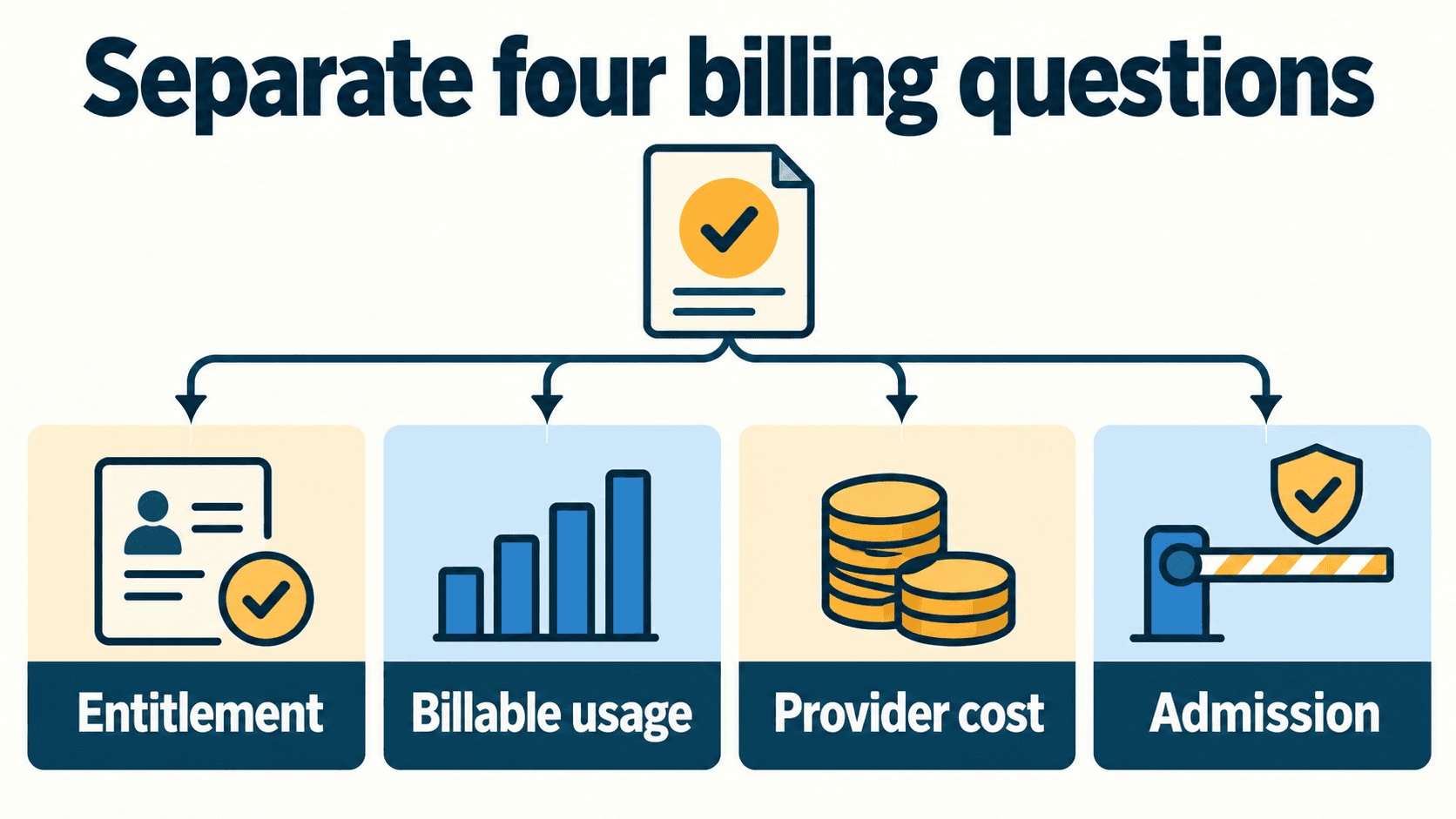
Define what the customer buys, meter that unit reliably, and control admission to new work separately from invoice generation. Customer charges, product entitlements and your provider costs are related records, but they are not interchangeable balances.
This guide uses a fictional document-summary product, a worked bill and a failure-drill specification. All prices and costs are illustrative teaching inputs to adapt to your actual vendor rates.
Choose a useful unit and explain the terms
A customer-facing unit might be a document processed, an accepted report, tokens consumed or compute time. Choose what fits the product and buyer. An inference API can legitimately sell tokens; an end-user document tool may be easier to understand in documents or tasks. There is no universally best pricing unit.
For the example, one unit is one distinct summary the customer marks accepted under the declared product rule. Retries do not create another customer unit. The provider can still charge for unsuccessful attempts, which belong in the internal cost ledger.
Before charging, define:
- What counts, including size/complexity bounds and acceptance behavior.
- Whether failures, retries, canceled tasks and partial work are billable.
- The billing period, included units, overage price and whether overage is permitted.
- How customers see usage, change limits, dispute a charge or request an adjustment.
- What happens when access, payment state or an allowance changes mid-task.
A customer may accept an output that later needs correction. Decide how that affects the unit and any adjustment; do not silently rewrite billing history.
Work through one fictional plan and bill
The example plan includes 500 accepted summaries per monthly period for USD 29, with optional overage at USD 0.08 per additional accepted summary. These are invented terms, not a vendor quote or recommended market price. The worked customer has authorized overage for this period.
| Item | Fictional rule or quantity | Amount, USD |
|---|---|---|
| Base subscription | 500 accepted summaries included | 29.00 |
| Accepted summaries in period | 1,200 distinct tasks | — |
| Overage quantity | max(1,200−500,0) = 700 | — |
| Overage charge | 700 × 0.08 | 56.00 |
| Example customer bill | Base plus overage | 85.00 |
Taxes, credits, discounts and other charges are outside this example. If any apply to your offer, include their actual treatment in the bill and customer explanation.
The worksheet separately assumes USD 30 in selected inference costs associated with accepted work plus USD 5 for other retry/rejected-work costs, with no overlap between those buckets. The difference is USD 50 before all excluded costs. The ratio 50/85 is 58.8%, but it is not company gross margin or net profit. Payment fees, hosting, storage, labor and other expenses have not been supplied.
Download the usage-pricing worksheet to replace these inputs. It contains computed values and formula descriptions, not an executable financial spreadsheet or a forecast of your business.
Keep four records distinct
| Record | Purpose | Important limit |
|---|---|---|
| Entitlement policy | Who may use which feature or quantity | A subscription label alone does not specify every product permission |
| Billable-usage ledger | What the customer owes under the terms | Must deduplicate the chosen logical billable event |
| Provider-cost ledger | What delivery cost, including retries and failed work | Customer refunds do not erase provider charges |
| Admission/reservation ledger | Whether new work fits a declared allowance | Estimates and unknown outstanding usage need explicit handling |
A customer can have unused included units while your internal provider allowance is exhausted. Conversely, a provider account can have money available while a particular customer is not entitled to more work. Check the appropriate constraints rather than treating one dashboard number as all four records.
Account identifiers must be mapped to authenticated principals and authorized operations. A tenant_id field does not enforce permissions by itself. Customers must not be able to mint credits, submit arbitrary billable quantities or modify internal balances through an untrusted client.
Design idempotent billable events
Use stable logical IDs and make deduplication part of the receiver's implementation. An ID does not create exactly-once processing on its own.
For this app, an accepted-task event should refer to the billing account, task, period and pricing/acceptance-rule versions. A delivery retry reuses the same event ID; a different event gets another ID. Persist the business state and event-dispatch intent together where appropriate, then reconcile delivery results.
If a receiver records “seen” before committing the intended effect and then crashes, a later duplicate must not be discarded as though the operation finished. Define pending, committed and recoverable states. For external side effects, design retries around the receiving service's actual idempotency support and retain evidence of uncertain outcomes.
Here is an application contract example, not a Stripe or Metronome HTTP payload:
{
  "event_id": "bill_event_demo_001",
  "billing_account_id": "account_demo_01",
  "task_id": "task_demo_017",
  "occurred_at": "2026-10-20T10:00:00Z",
  "unit": "accepted_summary",
  "quantity": 1,
  "pricing_version": "example_plan_v1",
  "acceptance_rule": "mark_accepted_v1"
}
The IDs are opaque strings, not UUIDs. The billing event contract describes the internal fields and producer responsibilities. Map them to the actual chosen platform. Authenticate the producer and protect transport; do not invent a signature string and treat it as evidence of authenticity.
Use current billing-platform documentation
Pattern 1: distinguish new integrations from existing Meters
Stripe's current usage-based billing guidance recommends Metronome as the starting point for new usage-based integrations and says basic Billing Meters remain supported for existing integrations. Its Metronome overview describes event ingestion, pricing, billing and reporting. Review the applicable compatibility and architecture requirements rather than assuming every existing implementation needs to migrate.
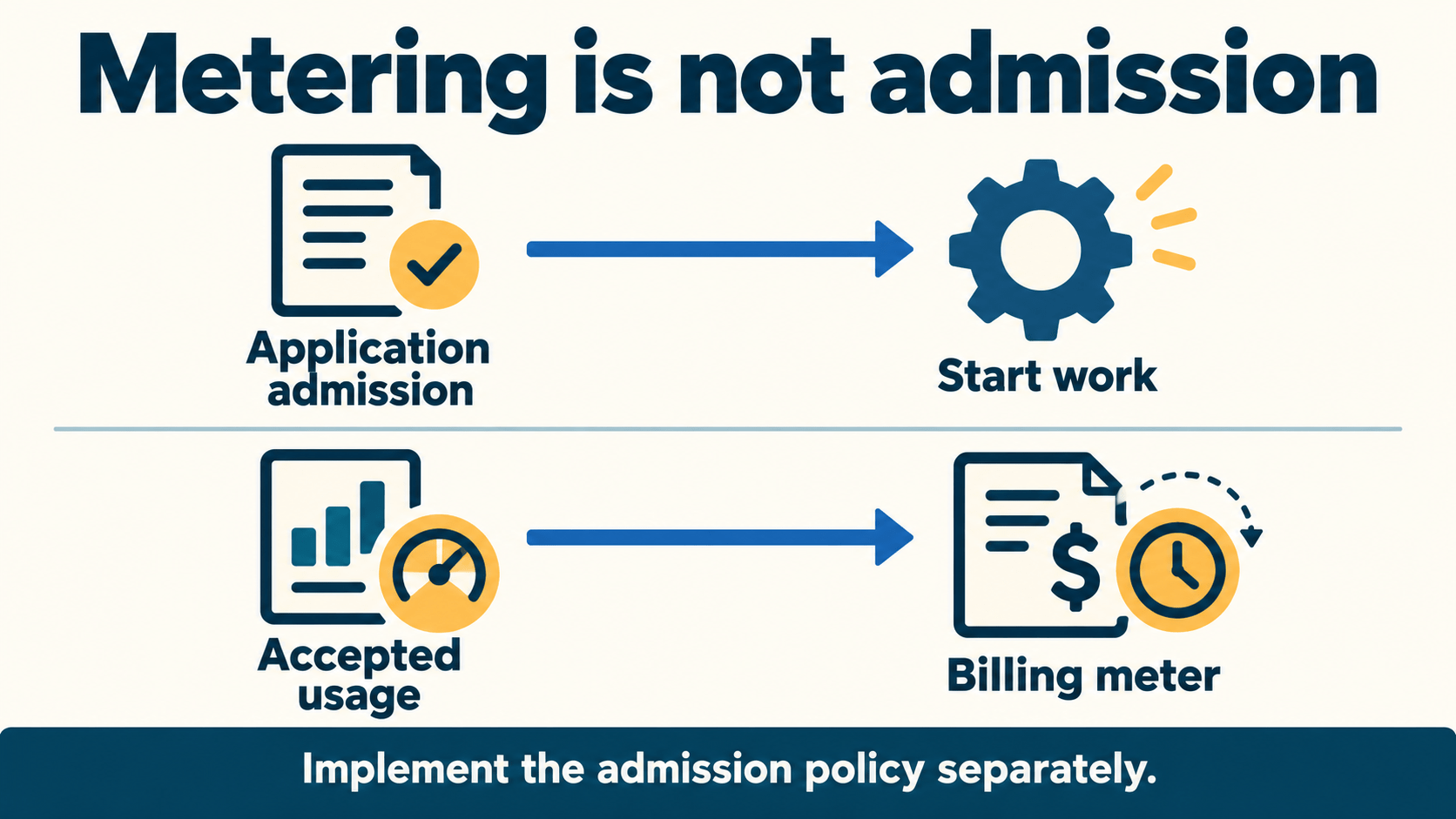
Pattern 2: keep asynchronous metering separate from admission
For existing basic Meters integrations, Stripe's recording-usage API guide documents asynchronous processing, event identifiers/idempotency and usage timestamps. Current documentation permits decimal usage values; our example's whole-summary unit is a product rule, not a platform integer-only restriction.
The guide also distinguishes accepting an event from including it on an invoice. Late usage may be accepted into meter summaries without changing a finalized invoice or appearing on the next one. Review the applicable invoice cutoffs, reconcile usage and handle adjustments through the supported process.
These documented methods do not establish that an external usage summary is an instantaneous admission gate for your app. Know what your selected service enforces and what your application must enforce itself.
Reserve an allowance before work starts
If several workers can start work together, checking the same remaining balance independently can over-admit. An admission decision and its reservation need an atomic boundary shared by the competing workers.
Conceptually:
within one admission transaction:
  verify account, entitlement and logical task state
  calculate required reservation in the declared allowance unit
  compare available allowance after all outstanding reservations
  deny or queue if insufficient
  otherwise persist reservation and dispatch intent
This is design pseudocode, not a complete database implementation. Record the unit clearly: product credits, a customer charge allowance or an internal cost allowance are different policies. Use appropriate numeric precision and currency handling.
If using an estimated provider-cost bound, account for the configured model, billable categories, tool calls and permitted retries. A rough estimate that can be exceeded is not a proven upper bound. If a defensible bound is unavailable, make the conservative admission policy and residual exposure explicit, and limit concurrency as appropriate.
Settle known usage; retain uncertainty
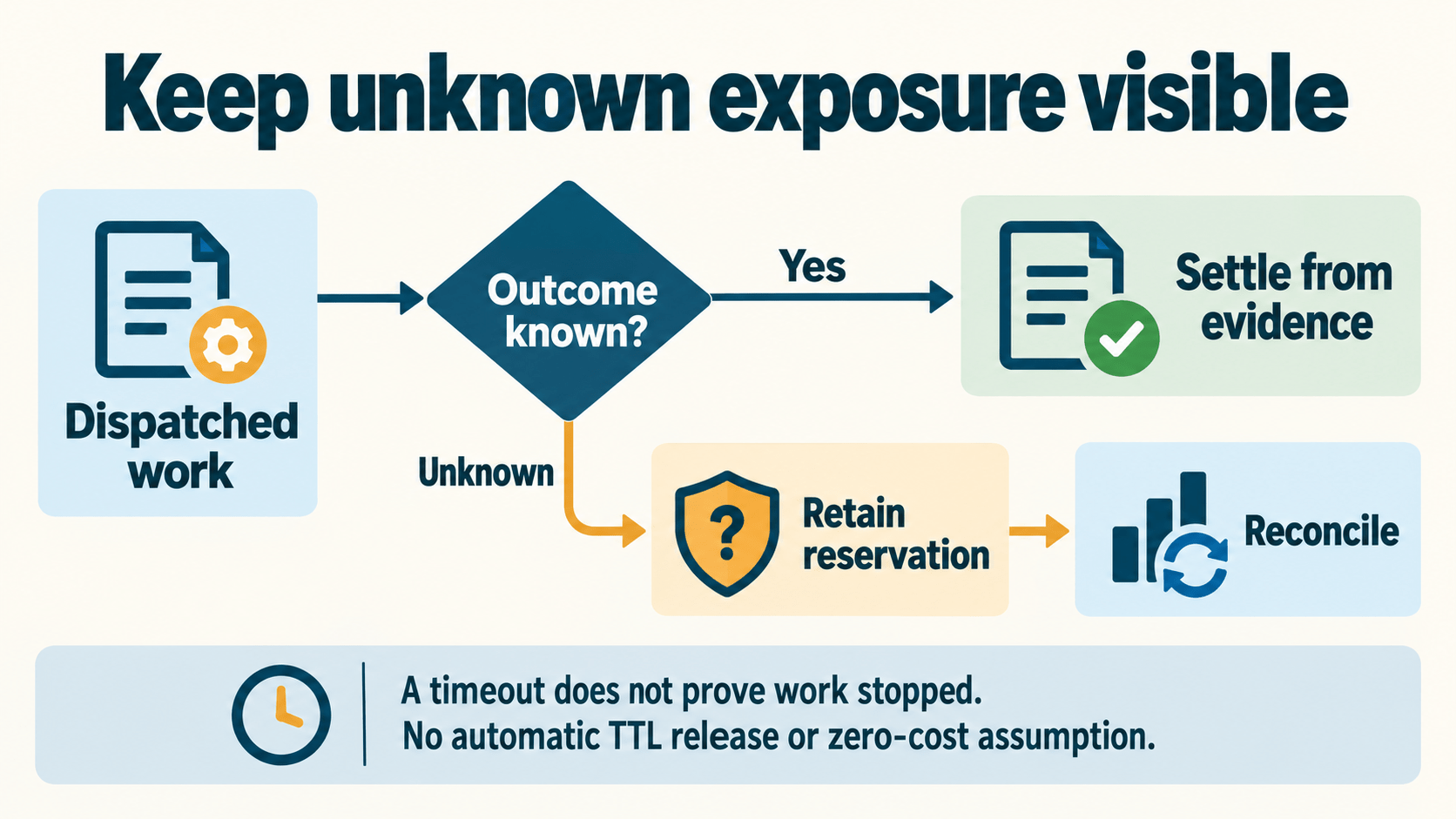
When final usage is known, record the actual eligible cost or units once and release only the unused reservation. Make settlement idempotent so a repeated callback cannot charge or release the same amount twice.
If the local client times out, the provider may still be processing or may have incurred charges. Keep that state pending reconciliation. Do not automatically release the entire cost reservation as zero merely because its time-to-live expired. A sweeper can flag stale reservations and investigate them; elapsed time does not establish that no bill exists.
If you can establish that work never started, release according to the declared policy. If it did start or remains uncertain, retain or conservatively settle the exposure until reconciliation justifies a change. Define an owner and recovery path so customers do not remain blocked by unexplained holds.
Handle retries, refunds and payment changes
Retries need traceable attempt records. They may consume additional provider resources even when one logical customer task is billed once. Do not reuse a fixed reservation blindly if another attempt can exceed its remaining bound; extend or create an additional allowance hold under the same atomic policy before admitting more exposure.
For our accepted-summary example, a failed unaccepted task produces no customer usage unit. That does not imply zero internal delivery cost. A product that sells computation or partial delivered steps can have different terms; explain those terms before use.
Keep monetary refunds, credit adjustments and usage corrections distinct. Link a correction to the original event and preserve an audit trail rather than deleting history. Reconcile a platform's actual state before assuming an invoice or entitlement changed.
Stripe's webhook documentation describes duplicate and out-of-order delivery. Its subscription guide describes asynchronous subscription activity. Verify incoming events and reconcile authoritative billing state; a checkout redirect or one event name alone is not a universal access policy. Define trials, grace periods, cancellation and failed-payment behavior for your product.
Distinguish an alert from enforced admission
An alert informs someone. An admission control decides whether another operation may begin. A customer bill cap limits the agreed customer charge. A provider account's spending behavior follows its own controls and outstanding work.
Show customers their current billable usage, included amount, allowed overage and any relevant pending state. State what a limit does to new and active work. Avoid promising immediate cancellation of remote execution or a refund of charges already incurred.
For batches, check the declared allowance at the appropriate scheduling boundary and retain completed outputs. If only part of a batch is admitted, report the completed, queued and unresolved portions accurately. Do not silently enable overage or raise a customer limit after an error.
Run the billing failure drill
Use the billing failure-drill specification with synthetic accounts and controller-owned stubs. No runnable service or live payment call is supplied, and all observations are not_run.
| Drill | Condition | Evidence to inspect |
|---|---|---|
| Concurrent admission | Two jobs compete while one reservation is held | One allowed hold; no double reservation under the declared fixture |
| Unknown provider outcome | Call times out after dispatch | Exposure remains accounted for until reconciled |
| Duplicate settlement/event | Same logical callback or delivery repeats | One committed effect, with recovery for unfinished processing |
| Out-of-order billing state | Delayed older event follows a change | Entitlement matches verified current state, not arrival order |
| Partial batch and adjustment | Work stops at allowance; one result is later credited | Accurate partial state and a linked, auditable adjustment |
Passing a stub test gives scoped evidence about the implemented policy, not a guarantee about every provider or financial outcome. Repeat relevant checks after changing pricing, billing adapters, retries or admission logic.
Use the worksheet and drill before charging customers. Start with the pricing worksheet, finalize the event contract, and document how the actual invoice, application state and provider bill will be reconciled.
Get the best new AI tools and guides, weekly
One short email a week. The tools worth trying, the guides worth reading, nothing else.
No spam. Unsubscribe anytime.
Aymen B
Contributing writer at Vantaige, covering the AI tools ecosystem.