AI Vendor Evaluation Checklist for an Enterprise Pilot
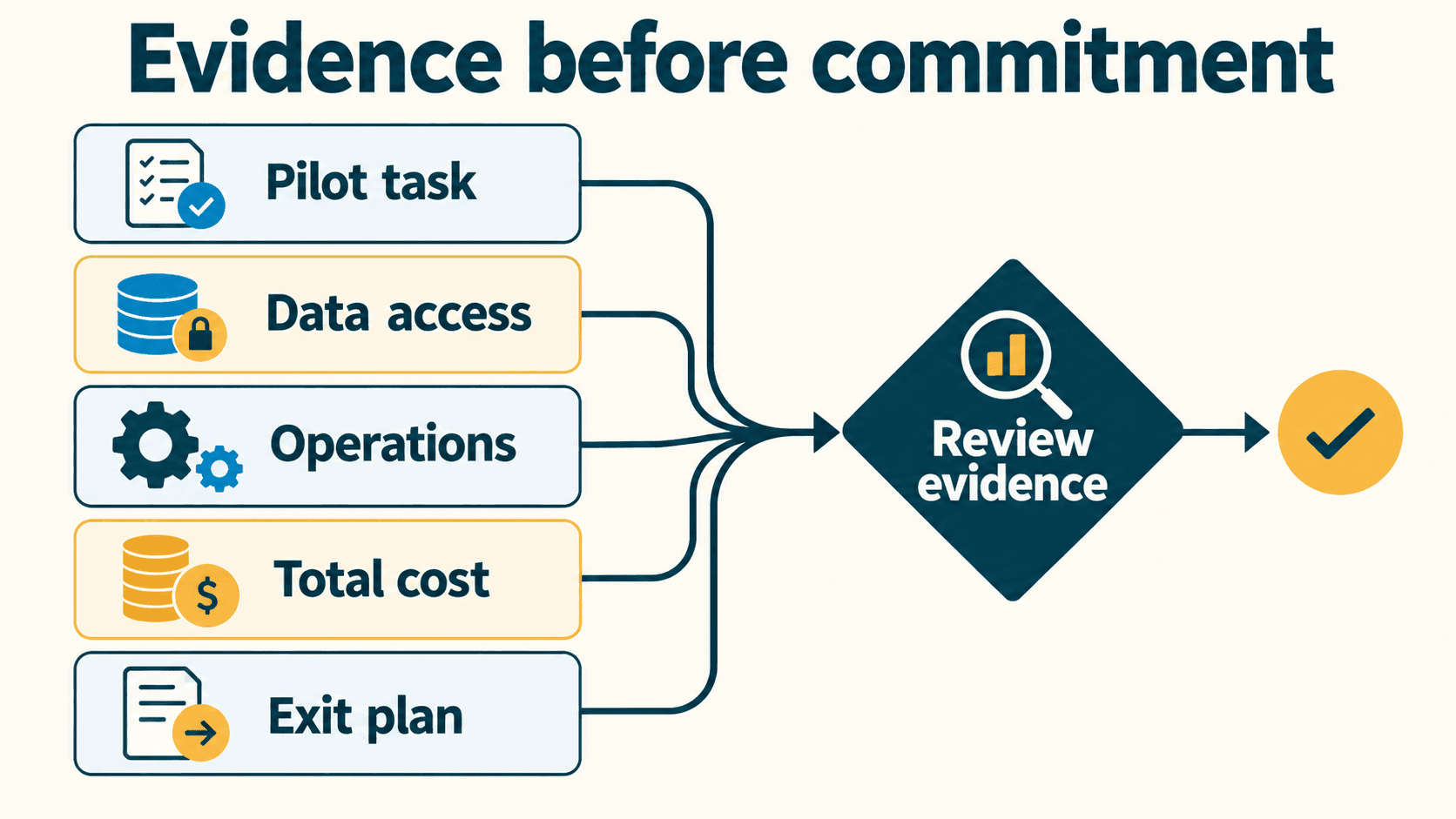
Evaluate an AI vendor against a defined business task, an evidence-request sheet and a bounded pilot before making a wider commitment. Separate mandatory requirements from preferences. A promising demo or a high average score cannot resolve an unanswered question about data access, operating responsibility or exit terms.
The checklist below works for a buyer selecting a product and for a founder preparing honest answers to enterprise questions. It includes downloadable evidence sheets and a fictional decision memo. No vendor documents, contract terms or pilot results are invented as verified evidence.
Define the decision before requesting a demo
Write one sentence describing the decision: “Should we run a limited internal product-documentation assistant for the support team?” That is more useful than “Which AI platform is best?” because it establishes the work and the people affected.
For our fictional example, the assistant answers questions from a supplied product-document set and links to the relevant version. It must acknowledge missing information and respect document access restrictions. It cannot change customer accounts or perform external actions.
| Pilot field | Fictional example or action to take |
|---|---|
| Business sponsor | Support lead owns the usefulness decision |
| Technical owner | Engineer owns integration, access tests and evidence |
| Initial dataset | 24 synthetic questions: 16 answerable, 4 unsupported, 4 restricted-access cases |
| Baseline | Measure the existing manual lookup workflow before comparison; no baseline supplied here |
| Duration and budget | Set a dated, authorized limit including internal effort; no paid trial started here |
| Accepted output | Supported answer, correct document/version, appropriate uncertainty and allowed access |
| Stop condition | Unauthorized document disclosure, uncontrolled action or exhausted authorized scope |
| Decision | Whether to progress to a defined next stage, not an automatic company-wide rollout |
The case counts are a chosen fixture design, not a recommended statistical sample size. A small pilot can find concrete defects but cannot establish performance for every future workload.
Name the people who can approve scope, data use and commercial commitment. In a small company, one person may hold several roles; make that visible and arrange a separate review for decisions that need it.
Download and use the evidence sheets
- Enterprise pilot checklist: requirements, priorities, verification methods, owners and unresolved results.
- Vendor evidence-request sheet: questions, answers, evidence references and review status.
- Fictional decision memo and reusable template: a filled hold decision followed by a blank structure to adapt.
Use the vendor evaluation checklist by copying it for one candidate and one intended configuration. Replace sample priorities with your own approved requirements before evaluating the vendor.
A useful evidence row contains the requirement, mandatory/preference classification, owner, vendor answer, evidence reference, actual checked date, status and unresolved issue. If no document has been received, write not_collected; do not create a plausible document title or mark a marketing answer verified.
| Evidence status | Meaning |
|---|---|
not_collected |
Required evidence has not arrived |
received_not_reviewed |
An answer or document exists but has not been assessed |
partially_supported |
Evidence covers part of the requirement, with a stated gap |
supported_for_scope |
The owner reviewed evidence for this configuration and requirement |
not_run |
A planned pilot or integration test has not executed |
fails_requirement |
Observed evidence conflicts with the declared requirement |
Keep an evidence reference and review rationale even for a supported row. A vendor claim, a contract commitment and an observed control test are different kinds of evidence.
Identify the product and its dependencies
Ask what you are actually buying. A polished application can depend on external models, hosting, search, embeddings, extraction or other services that affect its behavior and data path.
Request a diagram or clear description of:
- The product version and features included in the proposed configuration.
- Model/provider dependencies, fallback routes and which choices you control.
- Hosting and processing locations relevant to your data requirements.
- Supported integration interfaces and who maintains them.
- Operating ownership for updates, backups, incidents and capacity.
- Change notification, versioning, deprecation and migration arrangements.
Avoid assuming that every model version can be pinned or that a stated deployment location covers every dependency. Record what is supported and what the vendor has not answered. If change notice is mandatory for your organization, agree the actual terms rather than copying an arbitrary notice period from a generic checklist.
Two documented methods to adapt
The NIST AI RMF Core organizes risk-management work into Govern, Map, Measure and Manage. Use that method to connect ownership, intended use, evaluation evidence and the treatment of remaining risks. NIST explicitly distinguishes these functions from an ordered checklist; this article's procurement worksheet is an adaptation for a buying task, not a NIST certification.
Microsoft's externally released June 2022 Impact Assessment Template asks teams to document a system, its intended uses, affected stakeholders and review responsibilities. Adapt that pattern by defining who will use the documentation assistant, who could receive an incorrect answer and who can stop or change the pilot.
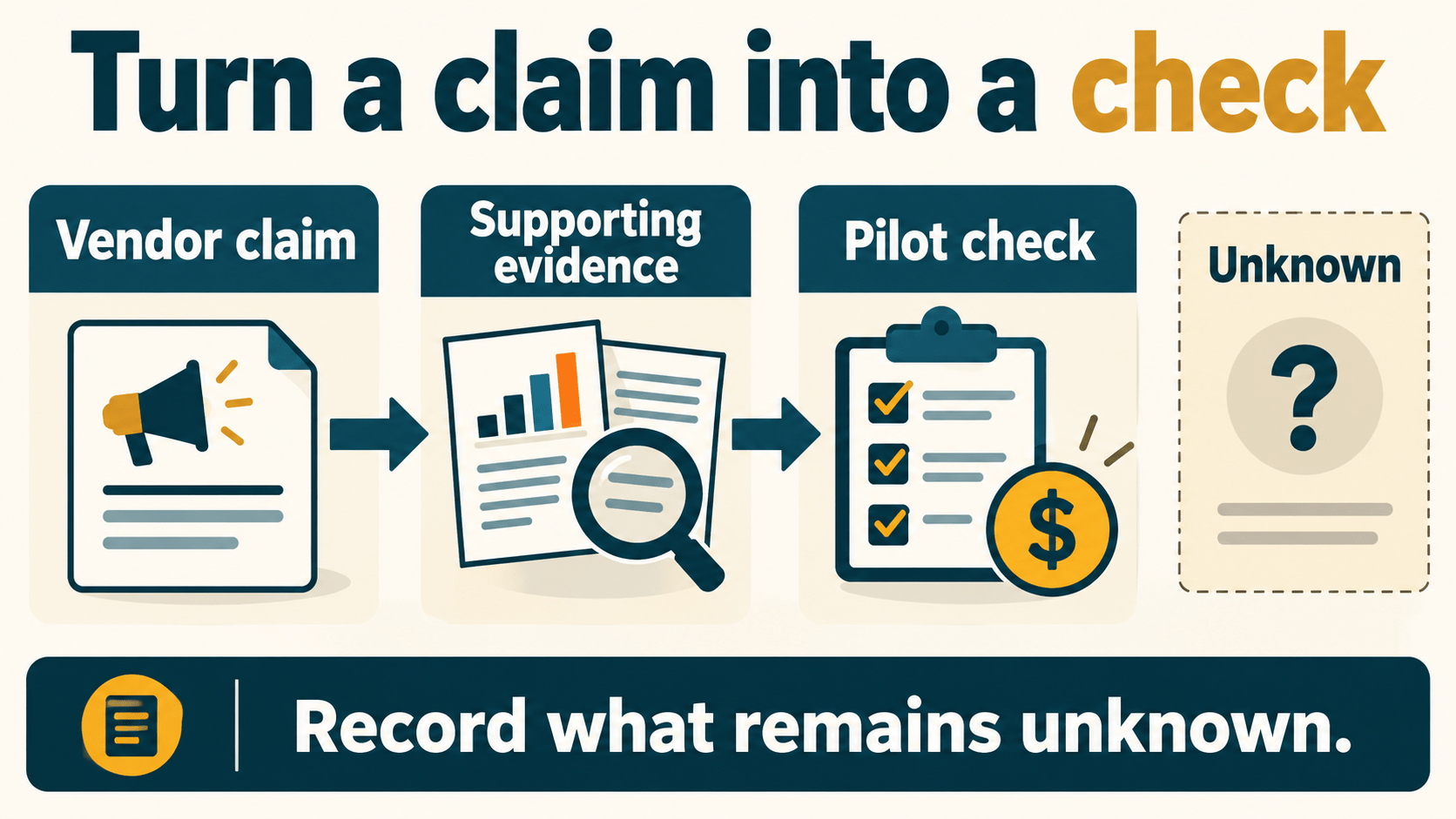
These documented assessment methods provide frameworks for structuring risk reviews; adapt them to evaluate how a specific vendor aligns with your requirements.
Ask precise questions about data and access
Send questions to an owner who can assess the answer. “Is it secure?” is too vague to produce a useful decision.
| Area | Evidence request | Question to resolve |
|---|---|---|
| Training use | Applicable product terms and downstream-provider treatment | Can inputs or outputs be used for training, and under what settings or exceptions? |
| Retention | Data-flow and retention description | What is kept in inputs, traces, caches, datasets, exports and backups? |
| Deletion | Procedure and applicable commitments | What can be deleted, when, and what remains or requires another process? |
| Subprocessors | Current relevant service list and change process | Which parties receive content for this configuration? |
| Authentication and access | Supported identity flows, role/key scope and test plan | Can intended users access only the allowed documents and actions? |
| Audit and incident support | Sample event schema, access and escalation procedure | Can the team investigate an incident and reach an accountable contact? |
Training use and retention are separate questions. An answer to one does not establish the other. Likewise, a self-managed component does not establish where its model calls, telemetry or connected tools send data.
Treat independent assurance material as evidence to review for the applicable product and scope, not as a substitute for your own requirements. Ask about missing controls or plan restrictions rather than inferring them from “enterprise” branding.
For the fictional documentation assistant, access checks should include two test users with different fixture permissions. Test retrieval and final answers, not only whether the interface hides a document title. A correct refusal message is insufficient if restricted text has already been returned through another route.
Use synthetic data first. Introducing real organizational data requires the appropriate approvals and a configuration supported by the reviewed evidence. No such approval is supplied by these worksheets.
Run a bounded task-quality pilot
Freeze the documents, questions, expected behaviors and application configuration before comparing candidates. Keep test IDs and version references so a later reviewer can reproduce the setup.
For the 24-case fictional design:
- Answerable cases: check that answers are supported by the supplied document version and include a usable reference.
- Unsupported cases: check that the assistant acknowledges missing information rather than inventing a feature or procedure.
- Restricted cases: check the configured user boundary and retain evidence of what retrieval and response paths returned.
- Dependency failure: add a controlled missing/unavailable-document variant of an answerable case and inspect uncertainty, handoff and recovery. Report that extra variant separately from the original 24-case count.
Record case-level outputs, labels, reviewer reasons and disagreements. A model judge can help with a rubric, but does not remove the need to validate the judgments. Where practical, review outputs without showing the candidate name and preserve enough context to assess them fairly.
Set release conditions before the results arrive. For this example, an observed restricted-document disclosure blocks progression. A quality target for answerable questions must be chosen by the sponsor in light of the task; this guide supplies no universal pass percentage.
Keep pilot outcomes not_run until a test occurs. Once measured, report counts and acceptance criteria alongside percentages. Missing results must not become zero scores, and a small evaluated set must not be described as proven production accuracy.
Budget the operating commitment
Ask for the actual proposed plan or quote, with its scope and date. Do not combine a public entry price with enterprise features whose eligibility has not been confirmed.
Include applicable:
- Platform fees, minimum commitments, seats and usage units.
- Model, tool, storage, transfer and other dependency charges.
- Integration, configuration and ongoing maintenance effort.
- Human review, exception handling and support.
- Overage behavior, renewal, termination and migration commitments.
Define the unit you need delivered. For the example, an accepted documentation answer meets the grounding, version and access criteria; a returned API response alone does not qualify. Include costs of retries and rejected outputs when calculating a delivery view. If none are accepted, cost per accepted answer is undefined, not free.
Separate one-time pilot/integration costs from ongoing operation and explain any fixed-cost allocation. A pilot's fully allocated expense per answer is not automatically the marginal cost of a scaled production service. Compare candidates using the same workload, quality rule and cost boundary.
An alert or quoted budget does not itself enforce a runtime limit. Establish who can authorize additional usage and what stops new work when the agreed scope is exhausted.
Test integration and leaving the service
An exit question is easier to resolve before the product becomes part of daily work. Request and, at the appropriate authorized pilot stage, test the relevant paths:
- Export a representative case, its content, metadata, review label and relationships.
- Revoke a test user's access and a test API credential; inspect the actual effect.
- Document deletion requests and their scope, exceptions and evidence.
- Exercise the chosen fallback, such as manual document lookup.
- Record what would need rewriting: prompts, connectors, schemas, evaluations, identity mapping or stored data.
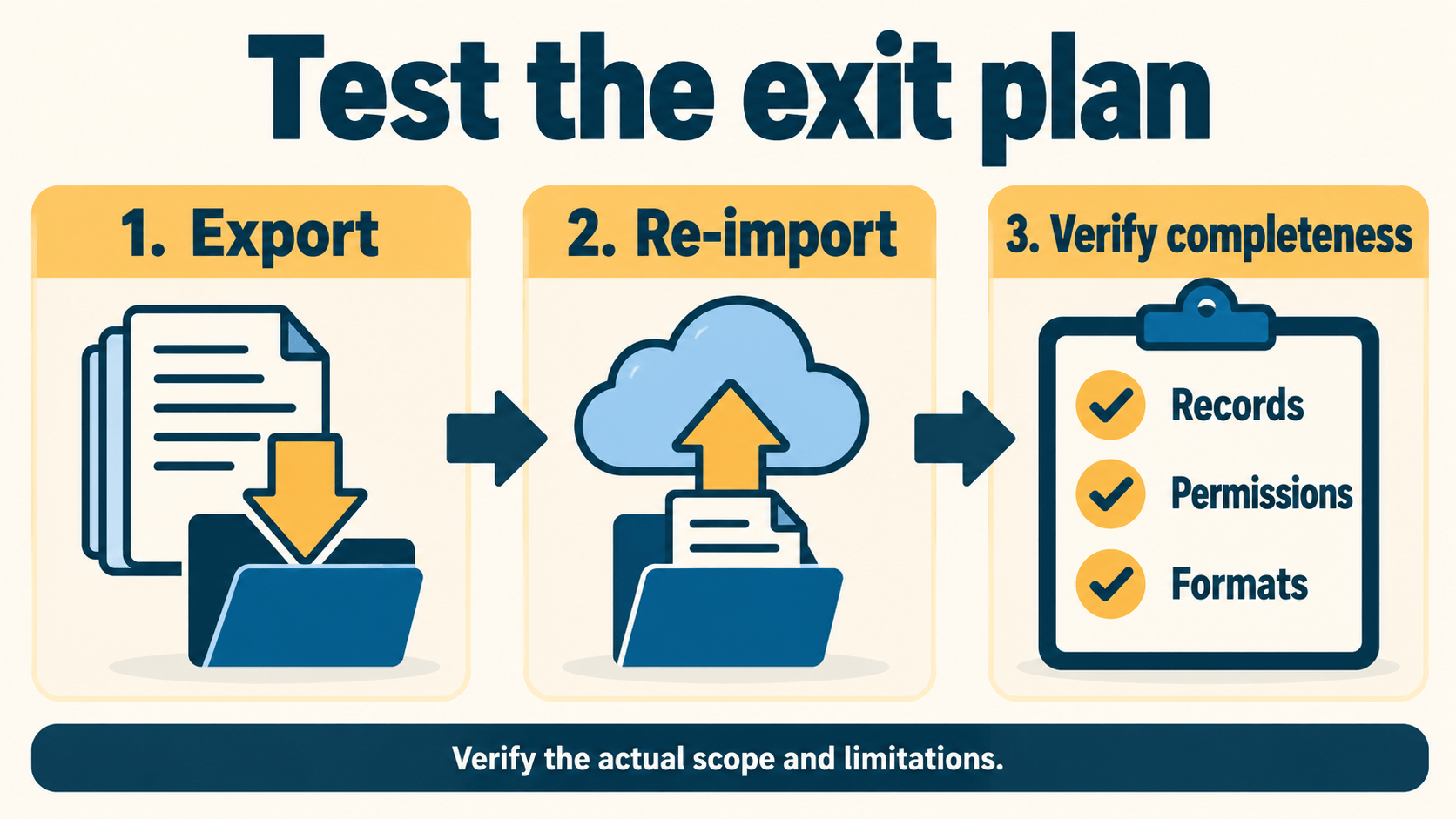
CSV or JSON export does not eliminate migration work. A file may omit relationships or use fields your next system cannot interpret. Likewise, a deletion statement is not evidence that every backup, export and downstream copy disappears immediately.
Use the evidence sheet to retain these distinctions. An untested export is not_run, even if a vendor says the API exists.
Put mandatory evidence ahead of a weighted score
Mandatory requirements are gates. If one fails or remains unresolved, the decision cannot become an unconditional go simply because convenience features scored well.
After mandatory requirements are satisfied, you can compare preferences. Here is an optional fictional weighting scheme:
| Preference | Weight |
|---|---|
| Reviewer usability | 30% |
| Integration fit | 25% |
| Operating effort | 20% |
| Cost predictability | 15% |
| Export convenience | 10% |
If you use ratings from 0 to 4, the preference score is the sum of weight × rating / 4, with weights expressed as percentage points. The weights total 100. Missing ratings remain unassessed; do not silently turn them into zero or reweight the other criteria without explaining it.
The downloadable memo provides a sample hold decision where retention/dependency evidence and access tests remain unresolved, illustrating how to document gating conditions before contract commitment. You can adapt the same memo to record a clearly bounded next step after your own evidence is reviewed.
Use the checklist as a buyer or a vendor
As a buyer, send the scoped evidence request, assign owners, run the permitted pilot and write a decision with conditions and a next review date. Revisit it after a material product, dependency, policy or use-case change.
As a founder answering enterprise questions, prepare truthful product diagrams, current terms, supported access controls, operating contacts and known limitations. State which features are available in the proposed configuration and which require work. “Not supported” or “evidence pending” is more useful than inventing an assurance document or promising a roadmap date you cannot commit to.
Vantaige's editorial process explains its approach to content evidence. If your specific requirements involve security tooling, its security and cybersecurity inventory is a discovery resource; a listing does not approve a vendor for your pilot.
Start with the vendor evaluation checklist. One defined task, one configuration and an owned list of unresolved questions give the next demo a practical purpose.
Get the best new AI tools and guides, weekly
One short email a week. The tools worth trying, the guides worth reading, nothing else.
No spam. Unsubscribe anytime.
Aymen B
Contributing writer at Vantaige, covering the AI tools ecosystem.