What to Build Around Your AI Product Before Taking Customers
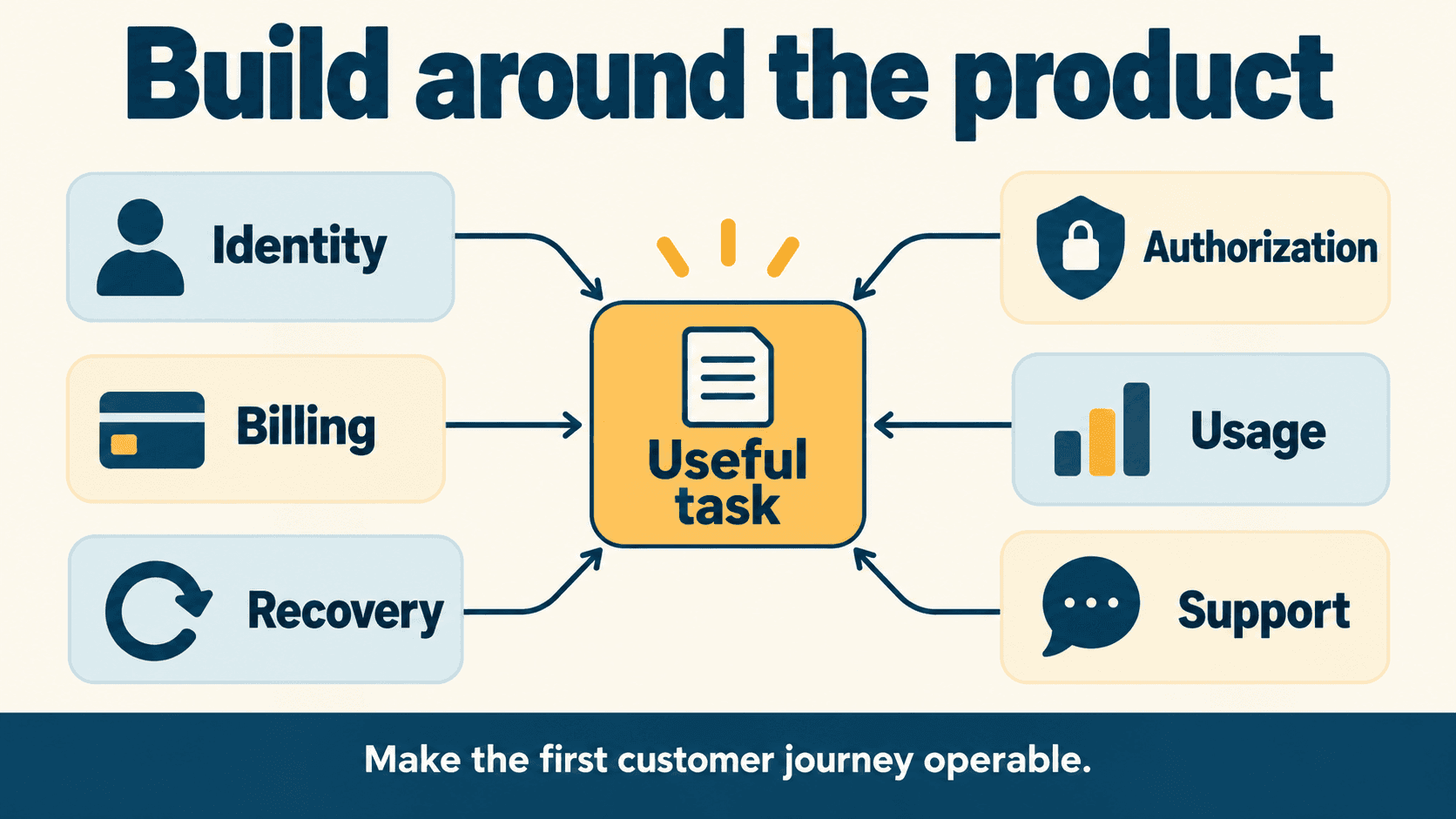
For a paid, hosted AI product, build the account, job, billing, usage, recovery and support paths around one useful customer task. Give each a clear owner and a way to check whether it works. A solo founder can keep this small; the important work is making state and failure behavior understandable.
This guide uses a fictional documentation-drafting app. A customer supplies an API specification, receives a Markdown draft and reviews it before use. The example does not promise a particular file size, completion time or generation quality. Adapt the priorities to your product: a free public demo and an enterprise app handling private team data have different requirements.
Use the founder operating backlog to choose your next three tasks. The accompanying drill provides a test specification to validate your own product before accepting customers.
Define the useful task and its failure states
For the documentation app, a useful result is a downloadable draft grounded in the supplied specification, with unsupported details identified for review. “The model returned text” is a different event.
Write the basic job lifecycle before adding more features:
requested → admitted → running → draft_available → accepted
                       ↘ failed / canceled / needs_review
These are proposed application states, not a vendor API schema. Define what each means. For example, a canceled browser request may leave a provider call running; a draft can exist without having passed the customer's acceptance check.
Give the logical job a stable ID and retries their own attempt IDs. Preserve enough state to tell a returning customer whether a job finished, failed or is still unresolved. Decide what retry means and whether it could repeat a billable action.
Establish the essentials before charging
For this example's paid multi-account app, prioritize these seven paths. They are readiness questions, not a requirement to buy seven products.
| Path | Build or configure | Check before relying on it |
|---|---|---|
| Account boundary | Identity plus authorization to projects, files and actions | Two synthetic users cannot access each other's work |
| Job state | Durable status, output reference and retry identity | Refresh/reconnect does not lose the task or duplicate an effect |
| Payment and access | Verified billing state mapped to your entitlement policy | Delayed, duplicate and failed events do not grant incorrect access |
| Usage admission | Account limits, concurrency policy and cost allowance | Competing requests cannot both spend the same remaining allowance |
| Failure handling | Bounded requests and a clear retry/handoff path | Customer sees an honest status without an endless retry loop |
| Data recovery | Retention and recovery appropriate to the stored work | An authorized restore drill can recover what you promise to preserve |
| Support | A contact route and response expectations you can meet | A test message reaches the person responsible |
A customer should also have a short getting-started path and clear input/output limitations. Longer documentation can grow from actual questions later.
Keep identity and authorization separate
Logging in identifies a user. It does not, by itself, establish which project or document that user can read or change.
Supabase's Row Level Security guide documents how database grants and row policies combine. In that documented pattern, review both the permitted table operations and the rows each principal can access. An existing grant alone does not bypass enabled RLS. Conversely, enabling a policy does not repair every other privileged route in the app.
Use the correct account or membership relationship for your data model; a tenant ID is not automatically a user ID. Keep privileged service credentials out of browser bundles and inspect how backend jobs and administrative tools access data. Test the actual principals and routes, including downloads and generated outputs.
Derive access from verified billing state
Stripe's subscription webhook guide describes asynchronous subscription changes. Use that documented pattern to keep your app's local entitlement state aligned with the applicable billing state. A checkout success URL alone should not authorize a paid feature.
Stripe's webhook documentation also explains duplicate and out-of-order delivery. Verify incoming events, make processing idempotent, and reconcile current state rather than assuming delivery order or sorting solely by event timestamps. A separate “check if processed” followed by a mutation can race; design deduplication and state updates to remain correct under concurrent delivery.
Define your policy for trials, failed payment, grace periods, cancellation and reinstatement. A failed invoice does not imply that every product must revoke access immediately. Make the customer-facing behavior match the policy you actually offer.
These documented implementation patterns illustrate how to structure webhook and access logic; implement and test them within your application before accepting live customer payments.
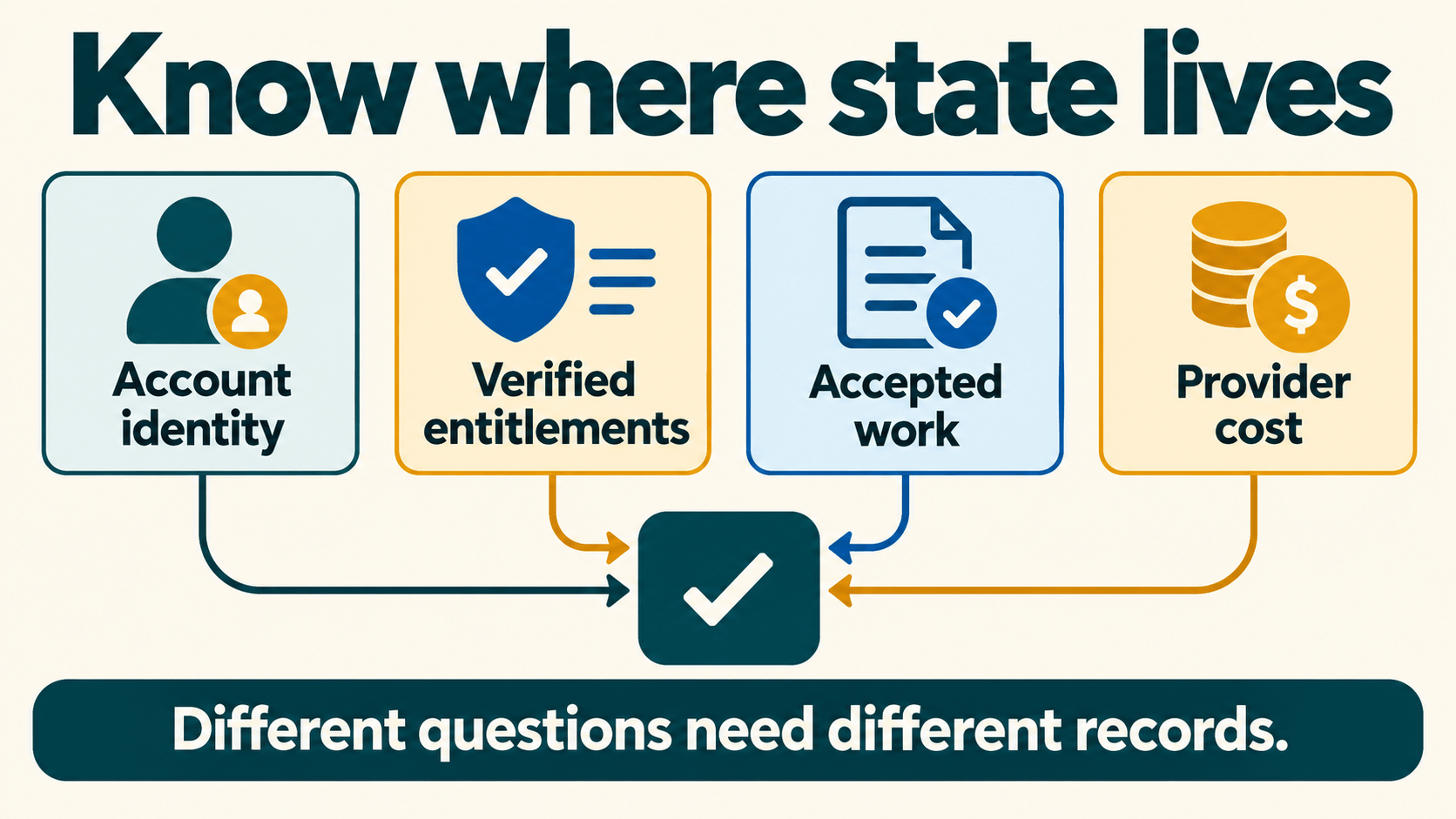
Know where authoritative state lives
For the fictional app, keep this source-of-truth map small enough to explain on one page:
| State | Authority in this design | Important distinction |
|---|---|---|
| User identity | Chosen identity system | Identity is separate from project permission |
| Projects and memberships | Application database | Background/admin routes need their own access review |
| Billing facts | Payment provider's applicable records | Local entitlements implement your product policy |
| Jobs and accepted outcomes | Application job records | Model completion is not customer acceptance |
| Usage and reservations | Application usage ledger, reconciled with provider records | Missing final usage remains unresolved |
| Errors and support history | Diagnostic/support records | Logs help explain a problem; they are not the billing authority |
Model-provider processing can have its own retention and operational behavior. Do not describe it as storing nothing unless the actual configuration and terms support that claim.
If this app uses the founder's secret provider key, calls using that secret belong behind the app's server-side boundary. Browser-local inference or a deliberate bring-your-own-key design needs a different documented boundary; it is not covered by that assumption.
Bound usage without promising an instantaneous cash cap
A token allowance, a customer plan entitlement and a provider's invoice are different things. Define the unit your customer receives and track the underlying delivery costs separately.
Before admitting work, check the account's remaining allowance and concurrent jobs. Where appropriate, reserve a bounded amount atomically so two workers cannot both consume the same balance. Set supported per-request limits, then settle actual usage and release unused reservation when the outcome is known.
Count retries and unresolved calls. A timeout does not prove the provider stopped work or charged nothing. Stop additional admission when the relevant allowance is exhausted or cannot be determined; keep outstanding usage visible for reconciliation.
Choose timeout and retry behavior for the actual task. There is no universal 25-second deadline or fixed retry count for all AI apps. Retry only when the operation and failure make that appropriate, with a bounded policy and a stable logical task identity.
Use the first week to close the most consequential gaps
The dates below are an example planning sequence. If a readiness item remains unresolved, the calendar does not make it safe to charge customers.
Before the first paid customer: define the accepted task, account boundaries, billing/access behavior, usage admission and support path. Exercise the relevant failure conditions and decide how valuable stored work will be recovered.
During the first week of permitted use: inspect failed jobs, reconciliation gaps and support requests. Confirm that alerts reach you and that a customer can reconnect to a job without triggering an unintended duplicate. Record what broke and fix the underlying state transition before adding another dashboard.
During days 8–30: improve the starting guide, classify recurring failures, refine feedback capture and document recovery/incident steps. Update limits or plans with a clear policy rather than silently changing what existing customers receive.
The downloadable backlog supplies priorities, dependencies, owners and completion evidence. Its status cells are planned, not evidence of completed implementation.
Make support and feedback operational
Publish a contact route where customers encounter the product. State a response window that reflects your capacity and the service you sell; do not copy a one-business-day promise merely because another company uses one.
Triage billing/access problems, failed work and feature requests separately. Keep enough identifiers to find the affected account and job without asking the customer to send private content unnecessarily.
A short “Was this usable?” question can connect feedback to the output. Record the question's meaning and distinguish a rating from task acceptance: a thumbs-up might express satisfaction with tone rather than factual correctness. Let users explain a problem, but avoid requiring a long survey before they can report failure.
Sentry's current alert documentation describes rule-based triggers, filters and actions, with available actions depending on integrations. That is one documented option for routing actionable errors to an owner. Whatever system you choose, test the notification path and tune it to problems you can act on. An alert does not repair an incident or enforce a usage limit.
Keep a short incident note: affected task, current user impact, what is known, owner, next action and next update. Promise only what you can support with evidence.
Decide what to build, buy or defer
Use this as a decision table, not a universal vendor stack:
| Capability | Practical starting choice | When to change it |
|---|---|---|
| Authentication and payment collection | Evaluate maintained services/libraries that fit your requirements | Specific identity, deployment or commercial constraints require another approach |
| Core AI workflow and acceptance rules | Own the product-specific behavior and its tests | Reuse a component when you can still explain its behavior and failure paths |
| Usage/entitlement enforcement | Make the app's policy authoritative and inspectable | A billing platform can help, but verify what it actually enforces |
| Error reporting | Use an existing tool or a small structured-log setup | Add capability when current evidence cannot explain a real problem |
| Feedback and support intake | Start with a simple route linked to account/job context | Add workflow when actual volume or ownership requires it |
| Team roles and procurement evidence | Implement what the intended customer needs | A team product may need roles before launch; a single-user app may not |
| Custom operational dashboards | Defer while a small repeatable review answers the questions | Build when a demonstrated decision cannot be supported efficiently |
Using a payment service does not automatically resolve taxes, all security obligations or your entitlement logic. Likewise, a managed database still needs access configuration and a recovery plan appropriate to the chosen service.
For the deployment layer, Hostinger and DigitalOcean cover small VPS and cloud hosting. Their Vantaige listings (Hostinger, DigitalOcean) show current entry plans. A managed host does not remove the need for a recovery plan.
Run a synthetic first-customer drill
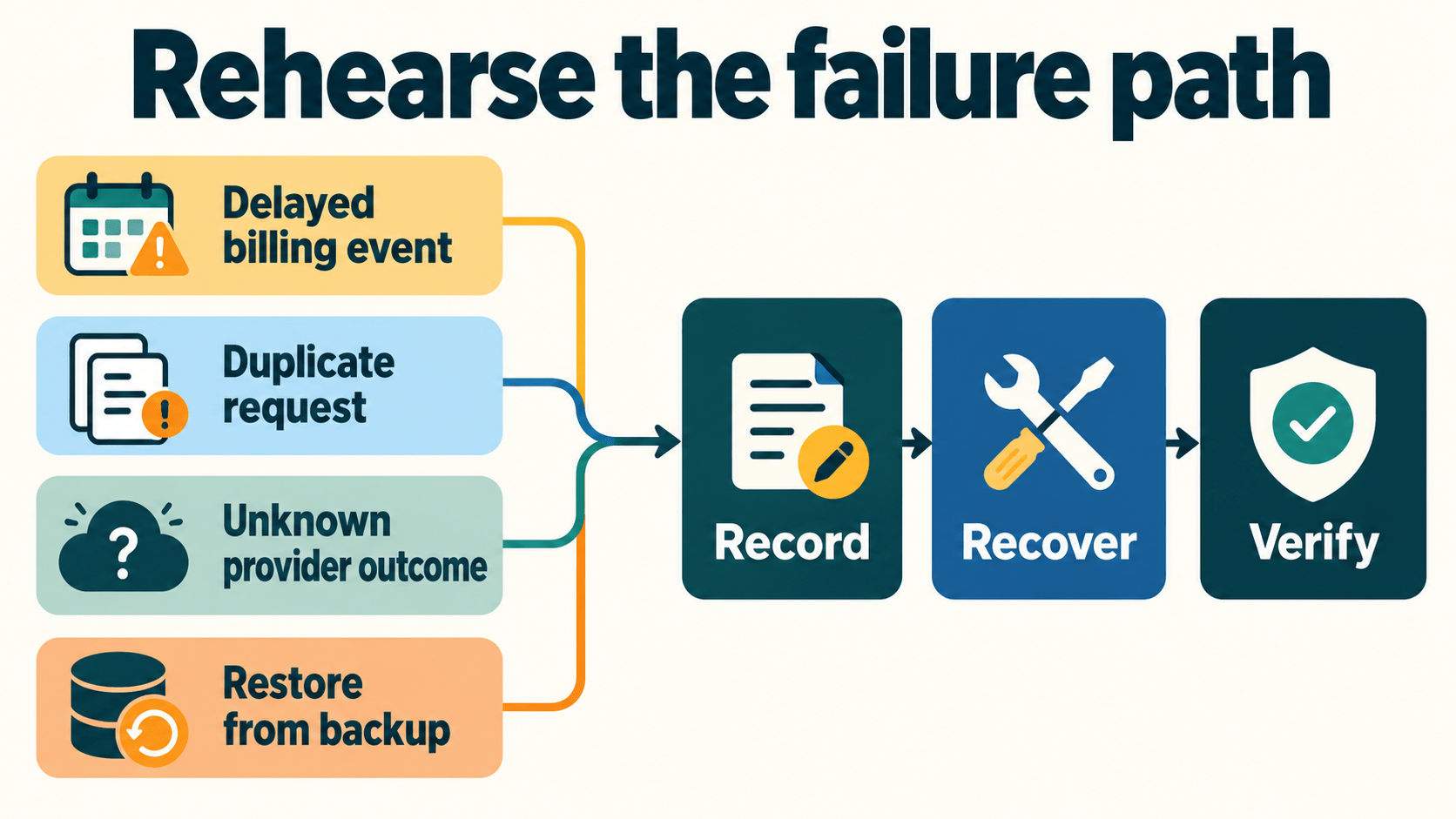
The drill specification uses a fictional app and controller-owned stubs. It provides no live endpoint, forged signature or claimed test output. All observations are not_run.
| Drill | Simulate | Evidence to collect |
|---|---|---|
| Billing replay | Duplicate delivery plus delayed older event | One intended effect and correct reconciled entitlement |
| Unresolved model call | Stub delay/failure and a customer retry | Bounded attempts, honest job state and retained unknown usage |
| Account boundary | Two synthetic principals request the same private fixture | Correct authorization result on each enabled route |
| Competing allowance requests | Two jobs contend for one remaining reservation | Atomic admission decision and no double reservation |
| Recovery and support | Restore a disposable fixture and send a test support message | Recovered content and confirmed owner receipt |
Passing an exercised drill gives scoped evidence about that setup. It does not prove every failure path or establish launch readiness on its own. Resolve remaining gaps with the owner responsible for the actual product.
Keep a weekly operating review
Download the founder operating backlog and first-customer drill. Then review these questions at a cadence appropriate to your service:
- Which jobs failed, remained unresolved or required repair?
- Are billing facts, access decisions and usage records consistent?
- Which customers had trouble reaching value or support?
- Are recovery evidence, dependencies and responsible contacts still current?
- Which one improvement would remove the most consequential recurring problem?
Pick your next three tasks from the answers. Keep the backlog short enough that you will actually maintain it.
Once the intended customer workflow and launch claims are supported by evidence, a product owner with a clear demo can review Vantaige's listing options as a relevant distribution step. Listing is separate from validating or operating the product.
Get the best new AI tools and guides, weekly
One short email a week. The tools worth trying, the guides worth reading, nothing else.
No spam. Unsubscribe anytime.
Aymen B
Contributing writer at Vantaige, covering the AI tools ecosystem.