Developer Onboarding: Docs and Demos That Help People Adopt Your Product
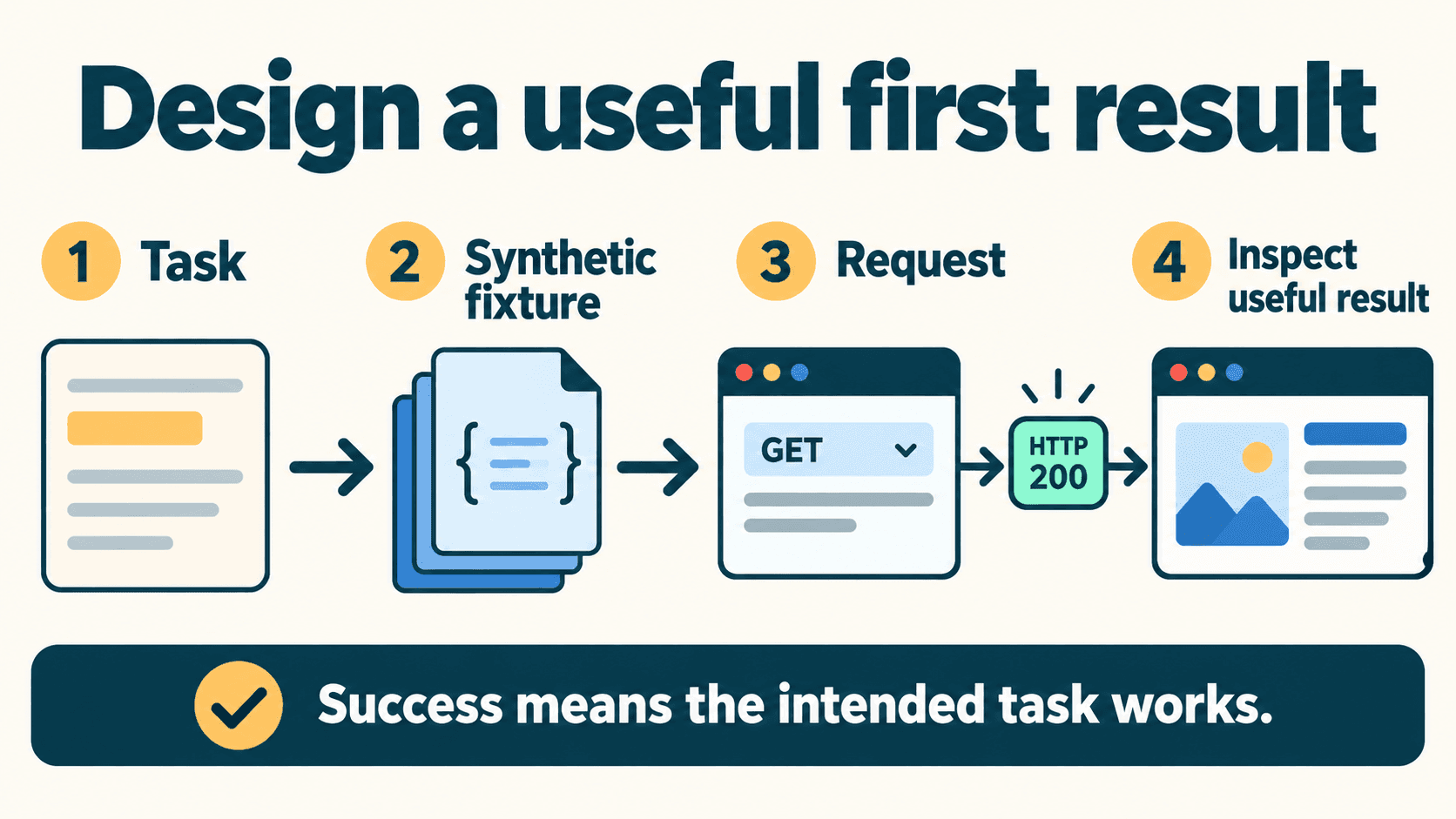
A useful developer quickstart takes someone from a stated prerequisite to a result they can inspect. For an AI product, that result should demonstrate the job the developer came to do: retrieve a relevant document, classify a sample request, or generate a response they can evaluate. An account signup or HTTP 200 alone does not establish adoption.
Start with one supported path. Show the sample input, required permissions, expected result, and recovery instructions together. Then connect that first result to reference documentation and a realistic next task.
This guide is for founders and small teams shipping APIs, SDKs, or developer tools. The fictional document API below is a design exercise, not a functioning service or a measured conversion case study.
Start with a result the developer can recognize
Write the finish line before writing installation steps. “Try our API” leaves readers guessing. A better instruction is: “Index this synthetic note, retrieve it with this question, and confirm that the returned passage contains the note's support-hours statement.”
That example needs two calls because a successful upload does not prove retrieval works. Another product might need one local command or an asynchronous job followed by a status check. Choose the smallest sequence that demonstrates value, rather than forcing every product into a one-command tutorial.
Define these acceptance criteria:
- Input: a small fixture you can distribute without customer information.
- Outcome: what the reader should see or inspect, including where generative output may vary.
- Completion: how to distinguish accepted, queued, finished, and failed work.
- Boundary: whether the exercise uses a local mock, a real sandbox, or a billable service.
Do not promise deterministic wording from a generative model. Verify the output's relevant properties instead. For example, a retrieval exercise can check the source document ID and require the answer to cite the supplied support-hours passage. A schema-valid but irrelevant answer should not pass that exercise.
Build the shortest supported quickstart
The Supabase Next.js quickstart offers a concrete documentation pattern: project setup, sample data, environment variables, a query, and a page where the result can be inspected. Its sample database access is deliberately public, and the guide separately identifies production requirements. The lesson is to make the sample's access model visible, rather than assuming a working tutorial is a production design.
For your own quickstart, put the following information beside the steps that need it:
| Part | What the reader needs | What your team should verify |
|---|---|---|
| Prerequisites | Supported runtime, OS constraints, account and network requirements | Exact versions you actually test |
| Cost and access | Whether a card, paid plan, model download, or permission is required | No hidden billable step |
| Request | One supported client, explicit variables, synthetic input | No secret embedded in source |
| Result | Expected fields and useful outcome | Distinguish a specification from observed output |
| Recovery | A likely failure and a safe way to retry | No accidental duplicate write or charge |
| Next task | A reference link and a small extension | Links match the documented version |
Lead with one language your users already use. Add tabs only when someone maintains and checks each variant. A short, tested example is more useful than five divergent snippets.
The downloadable quickstart template is a fillable specification. It deliberately contains no runnable request to an invented endpoint. Replace its fields with your own API contract and record an actual test before calling the resulting guide runnable.
Make output honest and inspectable
Separate three kinds of material in the docs:
- Expected output: a contract or representative shape.
- Observed output: a captured run with version, date, and environment.
- Mock output: simulated behavior that does not prove the hosted API works.
For an asynchronous API, show what the initial job ID means and how to check completion. For a streaming API, explain the event format and completion marker. For an AI response, show acceptable variation and a failed example as well as a polished answer.
Explain credentials where they are introduced
Do not make a newcomer infer secrecy from a variable name or key prefix. Label each credential's environment, permissions, creation location, and revocation path.
Stripe's API key documentation provides an attributable example: publishable keys can be exposed in client applications; restricted and unrestricted secret keys cannot. Stripe recommends restricted keys for most use cases, and webhook signing secrets are separate from API keys. Those are Stripe-specific key types, rather than a universal prefix scheme for every API.
For your own product, document the real permission boundary:
| Question | Example of the information to supply |
|---|---|
| Where can this credential run? | Backend only, local development only, or intentionally public client use |
| What can it do? | Read the sample collection; write only to the selected sandbox |
| What does it cost? | Mock only, included allowance, or actual metered calls |
| What happens if it leaks? | Revoke it here; replace it in these services; inspect these logs |
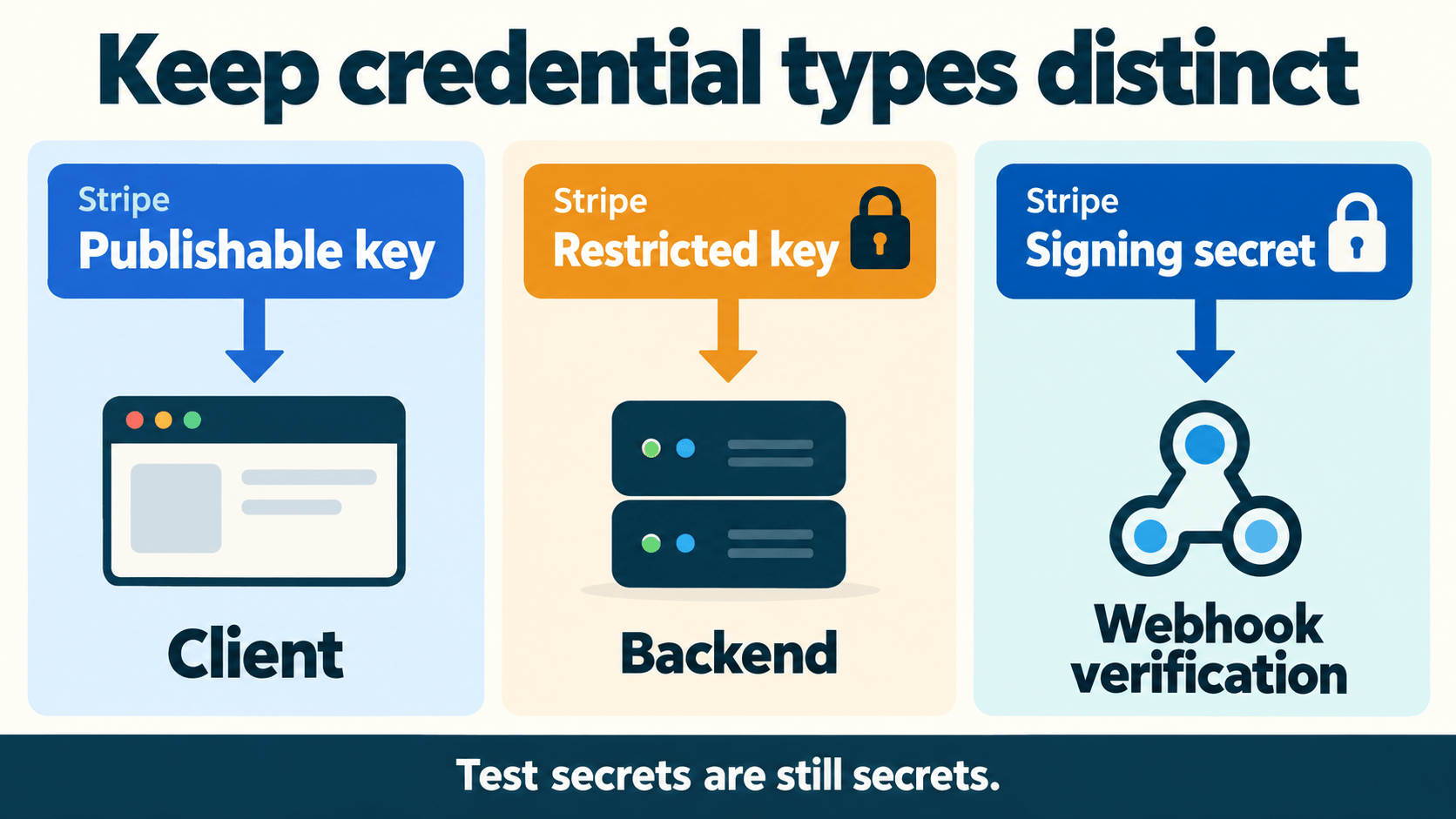
Use synthetic data and a sandbox or mock where feasible. If the product cannot offer an isolated sandbox, say so and provide a tightly scoped evaluation path with explicit costs. Do not describe a shared test environment as isolated unless you have established its boundaries.
A sample should never ask someone to paste a backend secret into browser code, commit a populated environment file, or post credentials in a support ticket. A test secret still needs protection. Key restrictions reduce exposure; they do not remove the need to handle the key as a secret.
Teach one failure and its recovery
Readers need a way forward when the happy path fails. Beside the main example, include a small troubleshooting table using your actual API's status codes and error identifiers.
| Symptom | What to check first | What a useful guide should explain |
|---|---|---|
| Authentication rejected | Selected environment and whether the credential was loaded | How to replace a missing or expired key without displaying it |
| Access denied | Resource ownership and granted permissions | Which permission is required and who can grant it |
| Invalid input | Payload against the documented schema | The invalid field and a corrected synthetic example |
| Rate limited | Published limits and retry instructions | Backoff guidance and any supported retry-after signal |
| Timeout after a write | Whether the request may already have completed | Status lookup and the API's actual idempotency behavior |
These are categories, not a claim that every service returns 401, 403, or 422 in the same circumstances. A retry should not blindly repeat an operation whose outcome is unknown.
For a controlled exercise, omit a required fixture field and inspect the documented validation response. Use a non-billable mock if the live exercise could create duplicate objects or charges. Explain how to restore the valid request afterward. A request identifier can help support investigate, but it should not be treated as proof of authorization or logged alongside secrets.
Organize docs around the next question
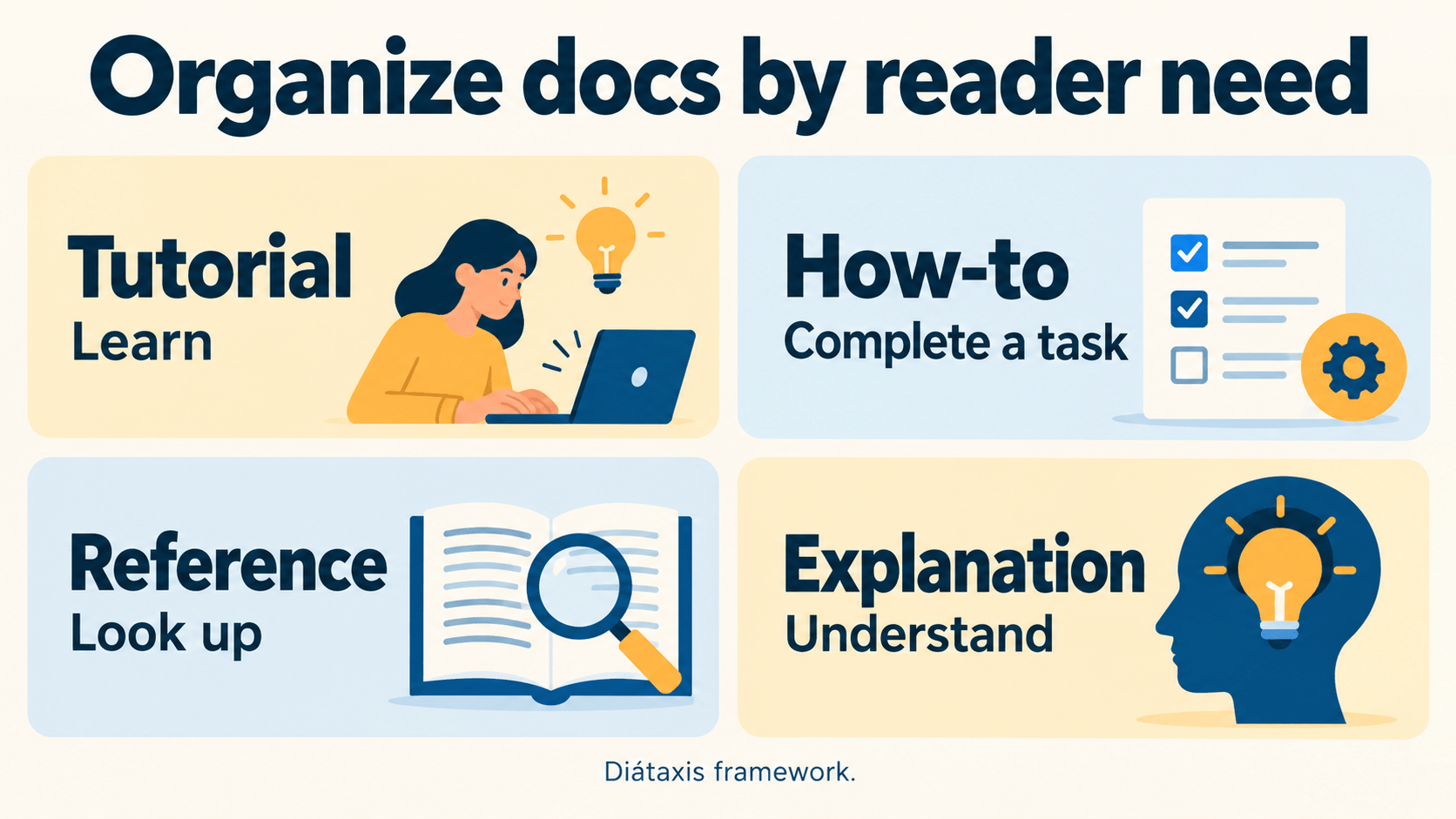
Diátaxis distinguishes tutorials, how-to guides, reference, and explanation. For a small team, that can become four clearly linked destinations:
| Reader's question | Documentation form | Example for a document API |
|---|---|---|
| Can I get a first result? | Tutorial | Index and retrieve one synthetic note |
| How do I complete a task? | How-to | Re-index a changed document |
| What fields are supported? | Reference | Request schema, limits, errors, and response fields |
| Why does it work this way? | Explanation | Retrieval choices, freshness, and access boundaries |
You do not need four large sites. Begin with the quickstart, the reference needed to complete it, one common follow-up task, and a brief explanation of an important tradeoff.
Link the reference at the relevant step. Put a short explanation beside a surprising behavior, with a link for depth. This lets the reader complete the task without losing access to the reasons behind it.
Choose a demo that answers a buying question
A demo should make a capability inspectable. A founder evaluating an SDK needs a different artifact from a procurement team reviewing access controls.
| Format | Good question to answer | Boundary to disclose |
|---|---|---|
| Browser mock | Does this workflow fit my problem? | No live API or model was exercised |
| Small starter repository | Can I reproduce this integration locally? | Required services, credentials, costs, and tested versions |
| Reference application | How do the pieces fit together? | Which production controls are implemented and which remain examples |
Give a starter one purpose. Include a fixture, setup instructions, a clearly marked environment example, and the expected result. If it has a mock mode, make that mode visible in the interface and logs. Do not use a simulated fast response as evidence of model latency.
Avoid adding an entire framework stack just to demonstrate one endpoint. Conversely, do not promise “zero setup” when the reader needs an account, model download, or local runtime. List those dependencies before the first command.
A fictional onboarding teardown
Consider a fictional document API whose landing page sends readers to a general reference index. Its sample uses an unexplained secret, returns only a job ID, and gives no instruction for checking whether indexing completed.
A revised path could address each uncertainty:
| Existing friction | Proposed change | Evidence to collect |
|---|---|---|
| Reader cannot choose an entry point | Link one “index and retrieve a note” tutorial | Whether intended readers select it |
| Credential scope is unclear | Show the actual sandbox permission and secret handling | Whether readers provision the right access |
| Job accepted is mistaken for finished | Add status lookup and a useful retrieval check | Whether the fixture is successfully retrieved |
| Failure sends the reader to support | Add a validation example and recovery step | Whether readers recover without sharing payloads |
| No useful next task | Link the changed-document how-to | Whether developers return for a relevant task |
This is a proposed redesign, not an observed uplift. Test it with a fresh reader and a clean supported environment. Record where they hesitate, which step fails, and whether the final output solves the stated task. Fix the largest reproducible obstacle before adding more examples.
Measure useful completion and return use
Choose the unit before calculating a funnel: developer, workspace, or application. A regenerated API key is usually not a new developer. Anonymous documentation visits also cannot automatically be joined to authenticated usage.
For an initial measurement specification, use:
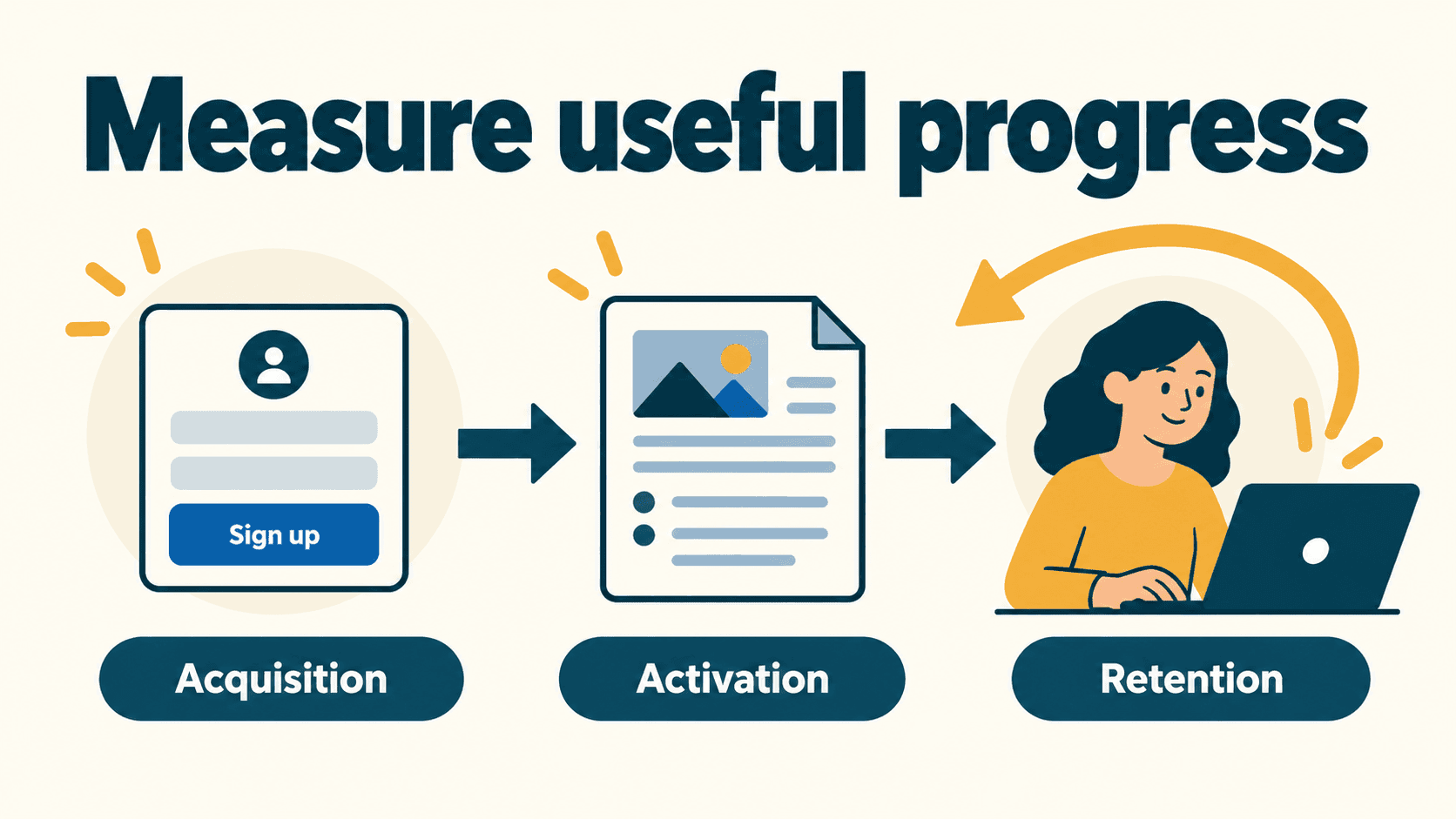
- Time to first useful result: elapsed time from authenticated onboarding start to the first result that satisfies the tutorial's acceptance criteria. Report the completion count and unfinished population alongside the median among completers.
- Completion rate: eligible onboarding starters who achieve that result within a chosen observation window, divided by starters whose full window has elapsed.
- Repeat useful use: completed developers who perform a qualifying task during a stated later window. Define the task, window, and maturity rule before comparing cohorts.
Those are definitions your team must implement, not universal thresholds. Separate sandbox exercises from actual integration use and exclude internal test accounts explicitly. A successful HTTP response can be an intermediate event without being the activation event.
The onboarding event contract proposes an allowlisted event design to guide your implementation. It excludes keys, prompts, request bodies, and raw URLs from proposed properties; transport logs, identity linkage, retention, deletion, and access controls still need separate review. Hashing an identifier does not by itself make it anonymous.
Keep examples accurate as the product changes
Assign an owner and record the last verified API and dependency versions. Test a bounded selection of executable snippets in an isolated, non-destructive environment with suitable cost controls. Do not blindly execute every documentation block: some are output, pseudocode, destructive examples, or paid operations.
Check internal anchors and important external links on a schedule suited to your release pace. When behavior changes, update the quickstart, sample repository, reference, and recovery instructions together. Choose migration and deprecation policies that match your commitments; an arbitrary 90-day rule is not a universal standard.
Use the developer onboarding checklist at the next release. Mark untested items as untested, rather than inferring they work from a previous version.
Improve one onboarding path this week
Download the quickstart template, choose one task your intended customers care about, and fill in its prerequisites, useful result, cost boundary, and recovery path. Have a fresh reader try the resulting verified example. Use the observed friction to decide what to fix next.
Get the best new AI tools and guides, weekly
One short email a week. The tools worth trying, the guides worth reading, nothing else.
No spam. Unsubscribe anytime.
Aymen B
Contributing writer at Vantaige, covering the AI tools ecosystem.