LLM Serving Buyer’s Guide: API, Serverless or Dedicated?
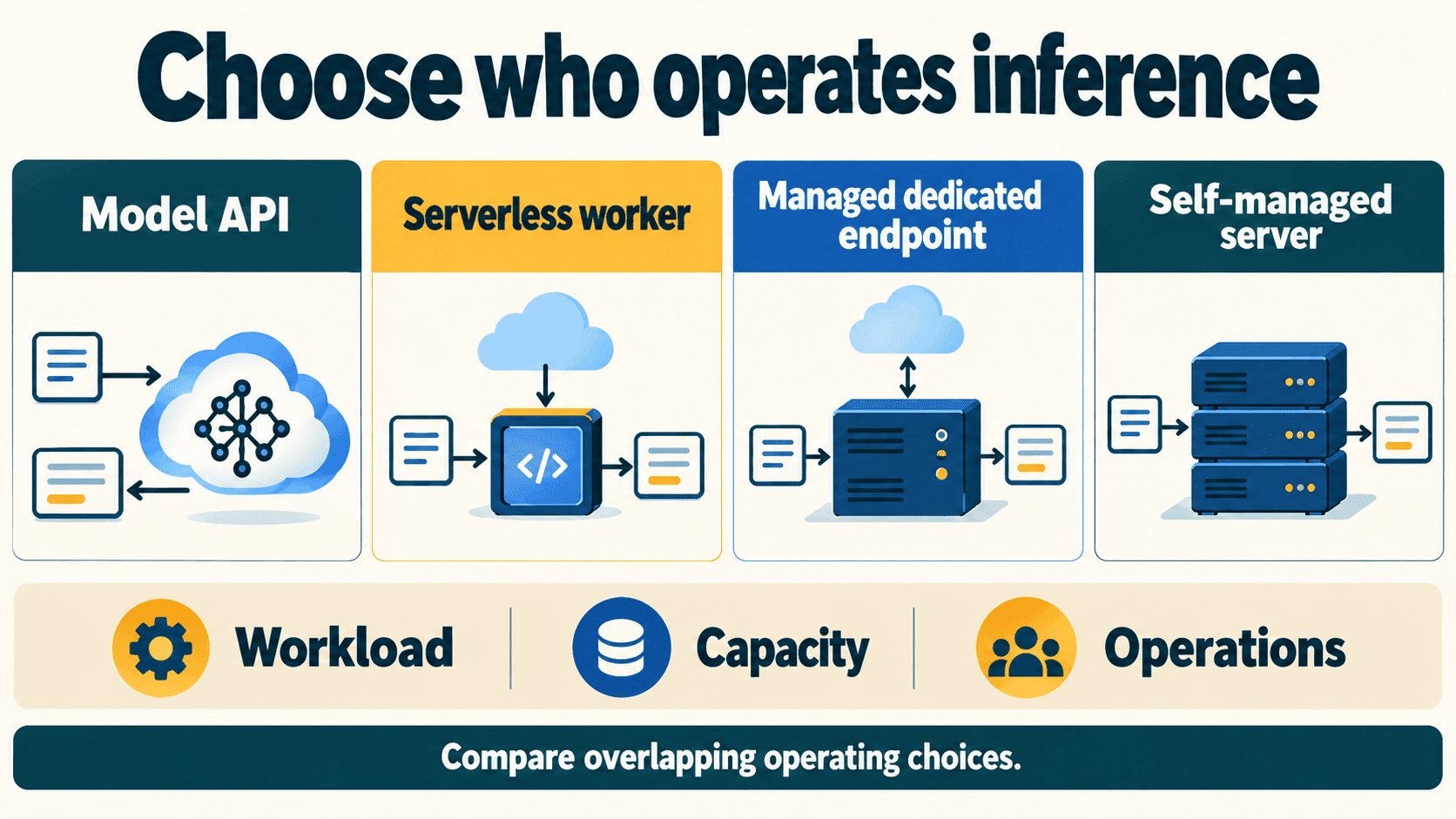
Choose the model and workload requirements first, then compare operating responsibility, latency and complete cost. A model API may be the simplest starting point; a custom endpoint may be necessary for your weights, runtime or deployment boundary. The useful choice is the service you can operate and afford while delivering acceptable results.
“Model API” describes an interface or commercial offer. “Serverless” and “dedicated” describe deployment and allocation choices. They can overlap: a managed endpoint can expose a model API and still autoscale or scale to zero.
This buyer guide provides a four-way decision matrix, a requirements/quote worksheet and an unrun pilot specification. It does not report provider benchmarks or negotiated prices.
Start with two workload profiles
Write down when requests arrive, what a successful response contains and how long the caller can wait. Average daily request count alone can hide the burst that determines capacity.
The following profiles are synthetic requirements examples, not tested capacity recommendations.
| Requirement | Bursty interactive app | Scheduled document batch |
|---|---|---|
| Customer job | Draft a useful reply to a supplied support ticket | Extract expected fields from supplied records |
| Arrival pattern | Short bursts during an active working window | A known batch with a completion deadline |
| Initial load case | One request, then a controlled twelve-request burst | One job, then four concurrent jobs |
| Important latency | Time to first useful output and total response time | Total batch completion time and retry behavior |
| Acceptance | Relevant draft meeting the task rules | Correct values and required output structure |
| Idle periods | Include an overnight or other representative idle gap | Include the gap between scheduled batches |
Set your own latency, quality and spend limits before a pilot. These example concurrency values are starting cases to adapt, not a claim about what any GPU or API can sustain.
Record model constraints explicitly
Specify the exact model or acceptable model set, revision when available, input/output lengths, required features and license constraints. For a custom deployment, also record runtime compatibility, dtype or quantization, accelerator support and context settings.
If providers cannot serve the same model/configuration, compare the service-and-model pair as a buying decision. Do not describe its latency difference as a pure infrastructure benchmark.
Compare four operating approaches
The table is a decision framework, not a promise that every provider in a category has identical terms.
| Approach | Useful when… | What you operate | What to verify in the offer |
|---|---|---|---|
| Hosted model API | An available model meets the task and you want less serving infrastructure | Application logic, keys, request handling and outcome checks | Billing units, quotas, features, data terms and capacity commitments |
| Serverless GPU endpoint | You need a custom worker or supported model/runtime with variable demand | Your worker/image and application configuration; platform responsibilities vary | Worker lifecycle, startup/waiting charges, warm settings and storage |
| Managed dedicated endpoint | You need controlled capacity or a supported custom deployment with managed infrastructure | Model/runtime choices, replica policy and application integration | Allocation, scaling, network options, initialization/idle costs and support boundary |
| Self-managed serving | Your team needs and can maintain the selected serving stack | The software and operations assigned to you by the hosting arrangement | Hardware/runtime fit, maintenance, availability, backups, network and all charges |
A hosted API can have reserved-capacity or additional service charges. A managed endpoint may support scale-to-zero. A cloud GPU VM still depends on its infrastructure provider. Read the exact offer instead of treating these labels as guarantees.
Start with the least operational work that meets the requirements
For an early product, a working API candidate may let you validate the task before building serving infrastructure. That is a hypothesis to check against its model capabilities, limits and price—not a guarantee of unlimited scaling or zero operational work.
For custom weights, specialized runtime features or a required deployment boundary, shortlist an endpoint or self-managed option that actually supports them. A dedicated allocation does not automatically establish physical isolation, consistent latency or a particular retention policy.
Understand cold starts and warm capacity
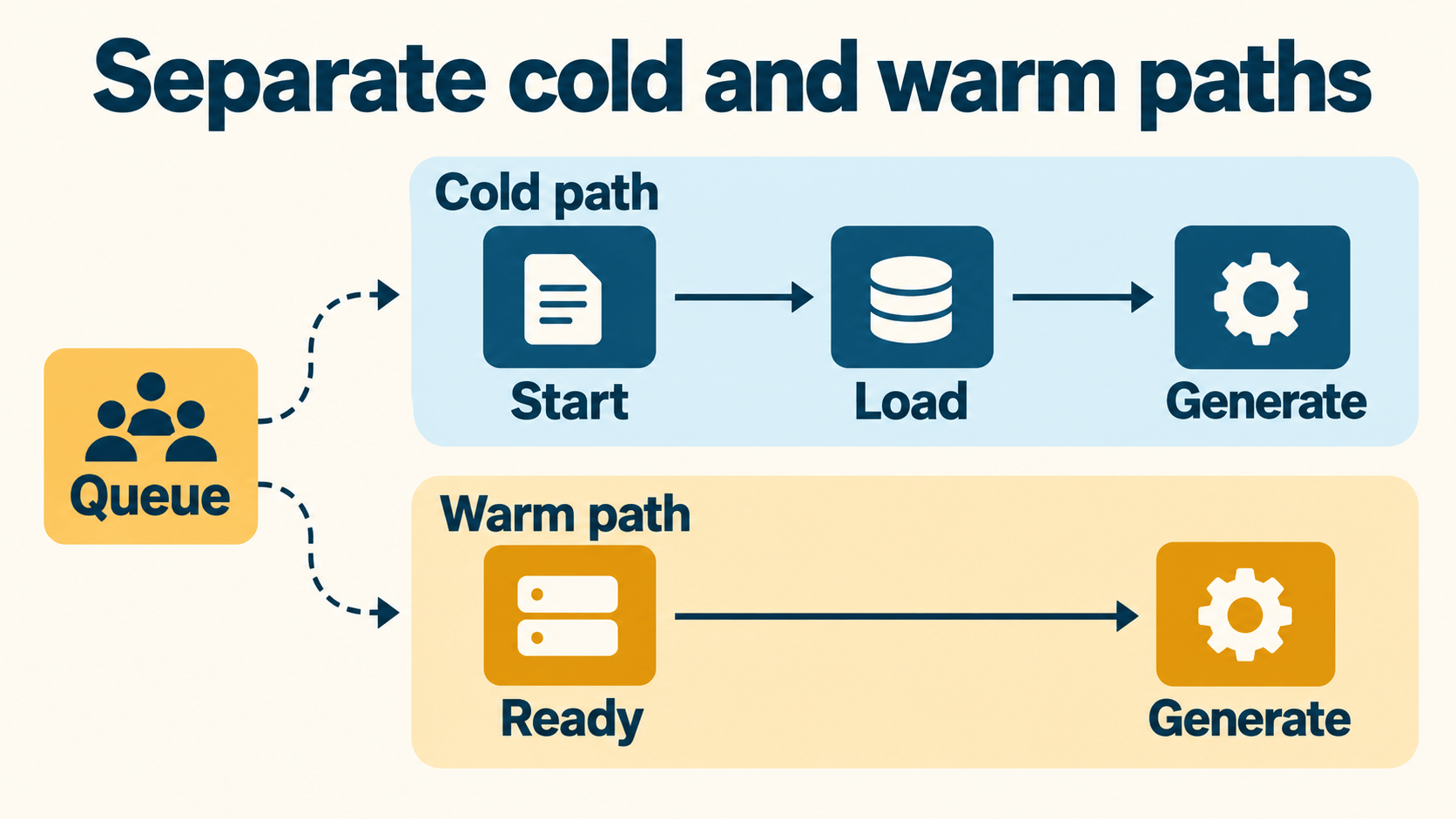
Scale-to-zero can reduce idle allocation while introducing startup work when demand returns. Keeping replicas warm changes that trade-off. Neither setting eliminates outages, exhausted capacity or application errors.
Documented pattern: Hugging Face scheduled replicas
Hugging Face’s current Inference Endpoints autoscaling guide describes minimum/maximum replicas, scale-to-zero and a daily schedule. A team can plan warm capacity for its active window and a different idle policy outside it. Warm replicas are billed while kept active.
The guide also explains startup responses and a scale-up waiting header. That mechanism does not override every timeout in your application or network. Verify the complete caller path. Older documentation paths describe different defaults, so use the current guide and your endpoint’s actual settings. Current autoscaling documentation.
Documented pattern: Runpod container workers
Runpod documents packaging a handler and dependencies into a worker image, then deploying it to an endpoint. Its worker model lets you separate application code from the platform-managed worker lifecycle. Queue-based and HTTP load-balancing endpoints have different request behavior; choose the one your application needs. Worker deployment pattern, Serverless overview.
Runpod’s pricing guide, modified 15 October 2026, distinguishes Flex and Active workers. It describes billing from worker start to full stop, including initialization, execution and the waiting period before scale-down. Image pulls and cached-model downloads normally happen while scaled down and are not billed as running worker time. Do not assume every preparation step has the same billing treatment. Current billing lifecycle.
These documented implementation patterns illustrate how endpoints scale; deploy and benchmark candidate endpoints under your own application's traffic pattern to measure actual cold-start latencies.
Two providers to price directly are RunPod and Vast.ai; their Vantaige listings (RunPod, Vast.ai) summarise the current starting points. Confirm both against your own workload profile.
Measure what the customer experiences
A useful pilot checks correctness and failure recovery as well as speed.
| Measure | Definition to record | Common comparison mistake |
|---|---|---|
| First useful output | Time from request submission to the first meaningful generated content | Timing an empty streaming event as the first token |
| End-to-end latency | Time until the complete usable response arrives | Comparing streaming and non-streaming calls as equivalent |
| Queue/startup time | Waiting before useful processing begins, where observable | Reporting warm calls while ignoring idle wake-up |
| Throughput | Completed accepted tasks per time window at a stated concurrency | Comparing raw tokens/sec across different models or output lengths |
| Quality | Task-specific correctness, completeness and output validity | Treating valid JSON as proof its values are correct |
| Failure behavior | Errors, timeouts, retries and duplicate-work handling | Counting a timed-out but billed attempt as free |
Preserve raw observations and the sample size. A few calls do not establish a stable p95 latency or a service-level guarantee. Report what you measured, under which configuration, and what remains unknown.
Concurrency and memory need the actual configuration
For custom inference, model weights are only part of the memory budget. Context, concurrent sequences, KV cache, runtime workspaces and other allocations can change capacity. Quantization and model architecture also matter.
Use the VRAM calculator as a planning aid, then verify the selected configuration under the intended workload. A model’s parameter count and a GPU’s advertised memory are not enough to predict a specific out-of-memory result.
For hosted APIs, record the actual account/endpoint request and token limits and the support arrangement for capacity changes. An API interface does not imply that bursts are accepted without limits.
Build a complete quote comparison
Download the requirements and quote worksheet. It contains structured questions and quote_required inputs, not invented vendor rates.
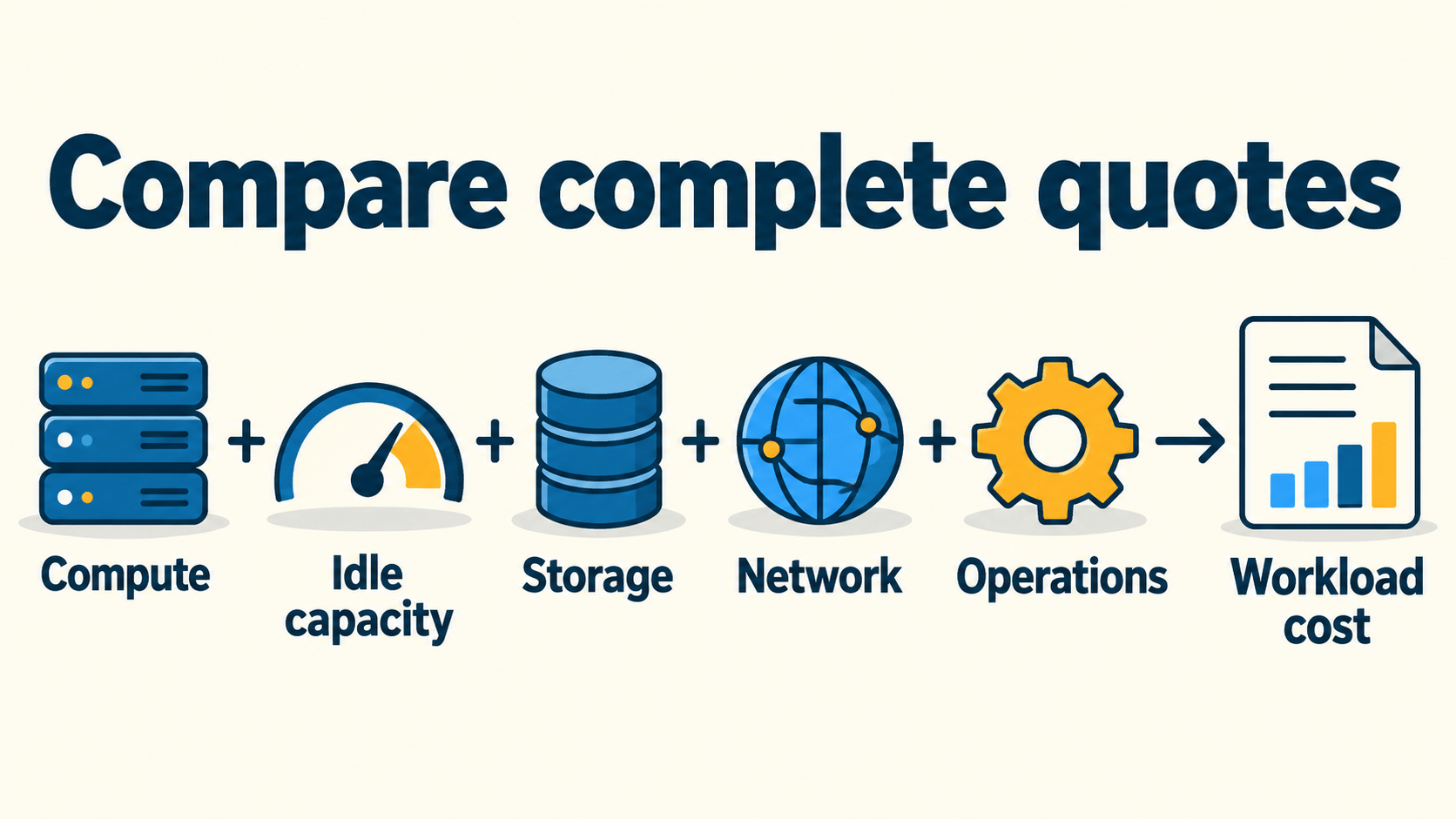
Collect the offer date, exact product/tier, model or hardware configuration, region, currency, billing granularity, commitment and expiry. Then ask about costs that may sit outside the headline unit:
- Input/output processing and any relevant cache or batch billing rules.
- Startup, warm replicas, waiting periods and minimum allocations.
- Persistent storage, model/container storage and associated services.
- Networking and data transfer under the actual offer.
- Observability, backups, support and required platform features.
- Engineering time for setup, upgrades, incidents and continuing maintenance.
Unknown charges stay unknown until you have evidence. “Not mentioned on the landing page” does not mean included or free.
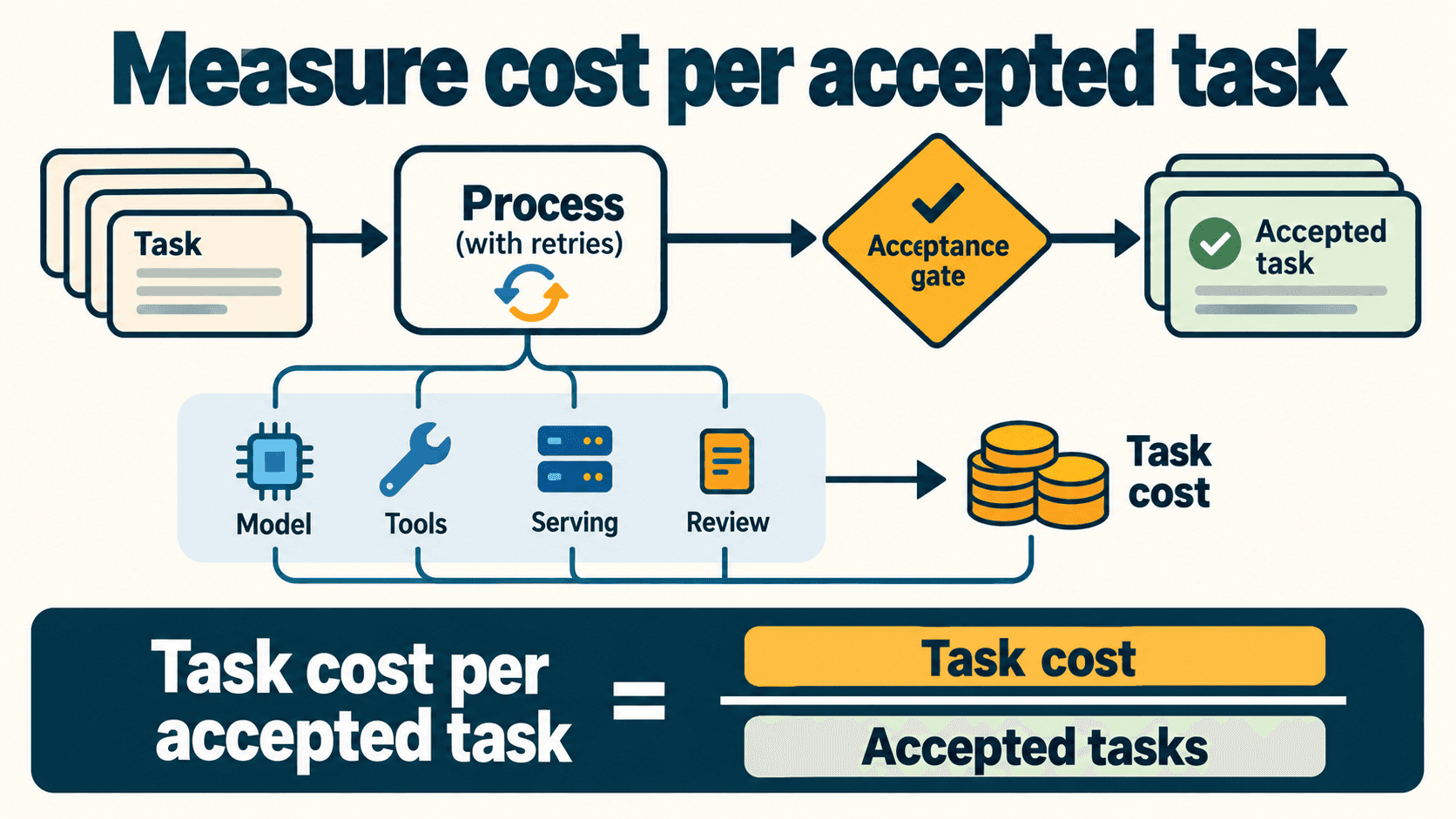
Use accepted outcomes as the denominator
For the same evaluation window, compare:
complete serving cost = applicable service and infrastructure charges
                      + allocated engineering/operating effort

cost per accepted task = complete serving cost / accepted task count
Include failed attempts and the retries needed to produce an accepted result. Avoid double-counting usage already included in an allocated plan charge. If no task is accepted, report the spend and failure count; the per-accepted-task cost is undefined.
There is no universal utilization percentage where dedicated capacity becomes cheaper. The break-even point depends on throughput at your required quality, utilization, idle policy, prices and operating effort. Calculate scenarios from the quotes and pilot rather than applying a generic 25% or 50% rule.
Define the data and operating boundary
Ask each candidate to describe the exact endpoint arrangement, not just its marketing category.
| Question | Evidence to collect |
|---|---|
| Where do requests execute? | The configured region and deployment/network arrangement |
| What is retained? | Applicable prompt/output, application-state, logging and backup terms |
| Which parties process data? | Relevant provider/subprocessor and connected-service information |
| What access is enforced? | Credential scopes, network policy and supported administrative controls |
| Who handles failures and updates? | The written responsibility/support boundary |
| What can you move later? | Model artifacts, runtime configuration, data export and API differences |
A private network, self-managed server or “dedicated” label does not establish zero telemetry or all required isolation. Trace the actual software and services. API compatibility can help integration, but it does not guarantee identical streaming, tool calls, errors or model behavior.
Run a bounded pilot before a larger commitment
Download the pilot specification and synthetic task fixtures. These are proposed test materials. Adapt them to the candidate API; the fixture format is not a vendor endpoint payload.
- Confirm one accepted result. Use the same task, expected values and output requirements across candidates where possible. Record any model/configuration differences.
- Observe warm and idle-wake behavior. Follow the provider’s documented lifecycle and record the actual state. Do not assume a short pause proves the service scaled to zero.
- Increase load within a declared budget. Start small, then run the chosen burst or batch cases while observing queueing, errors and accepted throughput.
- Inspect recovery. Record timeouts, request IDs and retries. Verify the provider’s actual status/idempotency behavior rather than assuming a client-generated ID prevents duplicate work.
- Reconcile usage and cost. Compare provider records and your own logs using the same evaluation window.
Use the unrun pilot log to capture results. Keep test accounts, keys and data out of public artifacts. A pilot should have an owner, approved spend limit and stop condition before requests begin.
Shortlist by constraints and choose the next check
| Situation | Sensible first comparison |
|---|---|
| Solo founder validating a task | A fitting model API versus the effort of a custom deployment |
| Bursty application needing custom weights | Serverless worker settings versus managed endpoint scaling and warm capacity |
| Sustained production workload | Measured dedicated/managed capacity versus the actual API offer at equivalent outcomes |
| Restricted deployment requirements | Candidates that can substantiate the exact data, network and operating boundary |
Use the deployment choice matrix to document fit and exclusions. Eliminate candidates that cannot meet a mandatory requirement before comparing estimated savings.
Once your workload, quote questions and pilot criteria are clear, compare providers for your workload. Bring the worksheet to the comparison so the next step is a specific compatibility or pricing check, not a guess based on a low advertised GPU rate.
Get the best new AI tools and guides, weekly
One short email a week. The tools worth trying, the guides worth reading, nothing else.
No spam. Unsubscribe anytime.
Aymen B
Contributing writer at Vantaige, covering the AI tools ecosystem.