HubSpot Breeze vs Salesforce Agentforce (2026): RevOps AI Cost Reality
# HubSpot Breeze vs Salesforce Agentforce (2026): RevOps AI Cost Reality
You do not need another “AI will transform revenue” essay. You need a way to turn published credit math into a forecast your CFO will not laugh at.
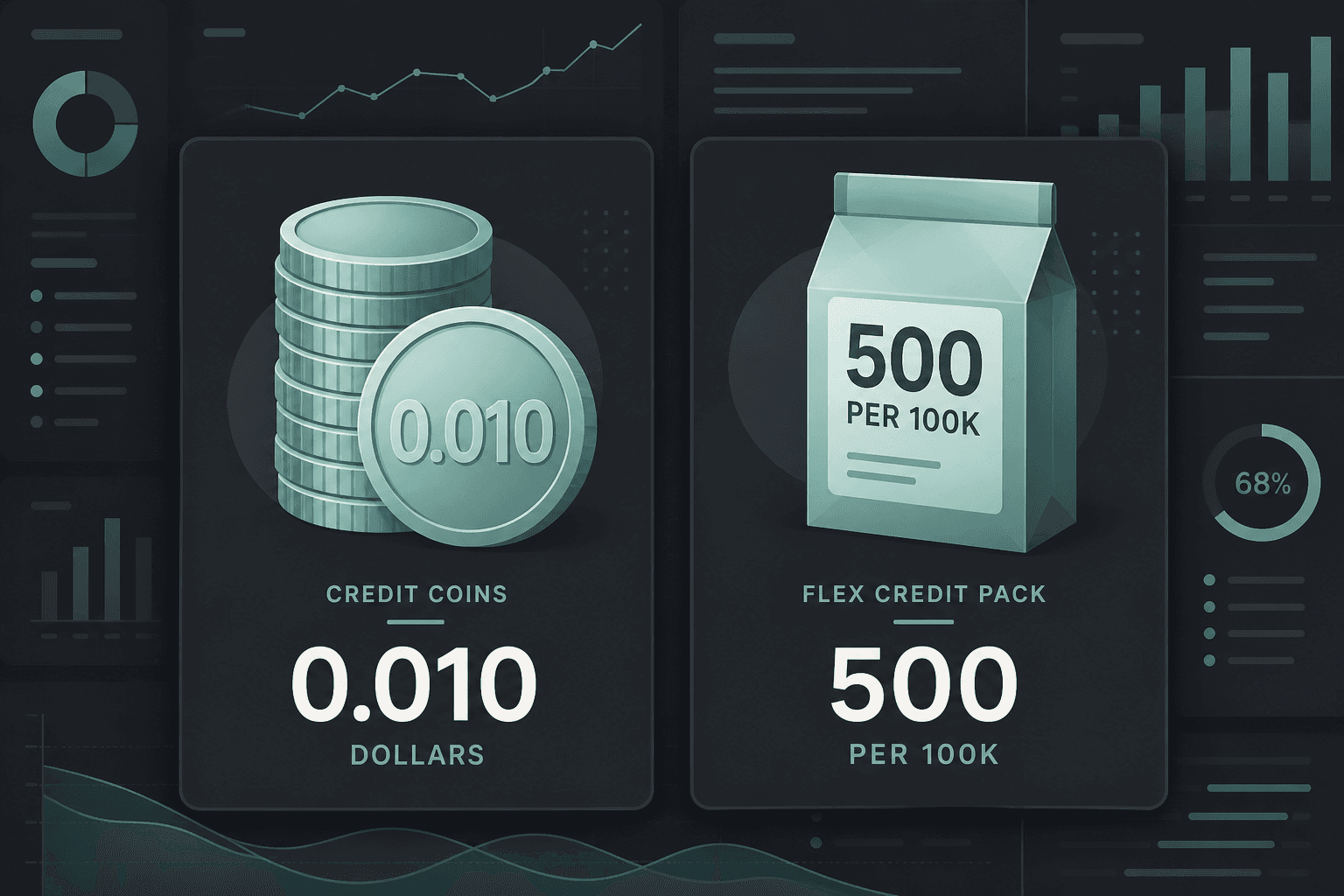
As of September 2, 2026, both HubSpot and Salesforce sell agentic features on consumption meters that sit on top of seats. HubSpot calls the meter HubSpot Credits ($0.010 per credit). Salesforce sells Flex Credits ($500 per 100,000 credits) and a flat $2 per conversation meter - and you generally cannot run both meters in the same org.
This is a RevOps cost guide. It uses list prices from vendor pages and rate cards, shows a TCO method (not a promised ROI %), and labels anything that is plan-dependent or illustrative. No invented savings. No “cut your stack 40%” theater.
Some product links may earn a commission. That does not change the verdict. Vantaige also lists CRM AI tools in the directory; weigh that bias if you see a listing.
Table of contents
1. TL;DR
10. FAQ
11. References
TL;DR
HubSpot Credits cost $0.010 each (packs of 1,000 for $10, or pay-as-you-go). Included monthly credits scale by hub/edition (examples from HubSpot’s product catalog: 500 / 3,000 / 5,000 on many Starter / Professional / Enterprise hub purchases; Data Hub / Customer Platform grants can be higher - check your account).
Breeze agents (published rate-sheet actions): Customer Agent 50 credits per resolved text conversation → $0.50 at list credit price; Prospecting Agent 100 credits per lead recommended → $1.00; Data Agent 10 credits per prompt/response on a record → $0.10. Built-in assistants that do not consume credits stay on the seat bill.
Agentforce list meters: Flex Credits $500 / 100k → $0.005/credit; standard action 20 credits → $0.10/action; Voice action 30 credits → $0.15; Conversations meter $2/conversation (customer-facing). Help Agent Resolutions appear on the Aug 2026 Flex rate card at 400 credits in production ($2.00 at list Flex math). Flat employee add-on $125/user/mo; Industries $150; Agentforce 1 Editions from $550/user/mo with 2.5M Flex Credits per org/year (list page).
TCO rule:
seats + mandatory onboarding + credit/conversation usage + data platform prerequisites + admin/implementation labor. Compare vendors on that sum, not on a single agent sticker.Watch out: unused credits do not roll over (both ecosystems); Flex vs Conversations is org-exclusive; success-based HubSpot agent charges rise when the agent works; Salesforce implementations often need Service/Sales Cloud maturity first.
What you are actually buying
| Layer | HubSpot “Breeze” world | Salesforce “Agentforce” world |
|---|---|---|
| Agent brand | Breeze agents (Customer, Prospecting, Data, Content/Custom betas) | Agentforce agents (customer-facing + employee-facing) |
| Consumption currency | HubSpot Credits | Flex Credits or Conversations (not both in one org) |
| Seat substrate | Hub seats (Marketing / Sales / Service / etc.) | Salesforce edition + optional Agentforce add-ons / user licenses |
| Control plane | Credit limits, pause, usage workspace | Digital Wallet, alerts, buying models (Pre-Purchase / Pre-Commit / PayGo on Flex) |
| Free-ish on-ramp | Included monthly credits on seats-based plans; agent trials per product notes | Salesforce Foundations at $0 with builder tools; promotional Flex allotments vary by program - confirm in-account |
Breeze is CRM-native AI inside HubSpot. Agentforce is CRM-native agents inside Salesforce. Cross-shopping them only makes sense when your RevOps stack is at a fork - or when finance asks why two AI meters exist after a merger.
Published pricing: HubSpot Credits
Credit unit (public)
From HubSpot’s Credits page and Product & Services Catalog (verify live - catalogs move):
| Item | Published figure |
|---|---|
| Credit list price | $0.010 USD per credit |
| Capacity pack | $10 per 1,000 credits |
| Pay-as-you-go overage | $0.010/credit (HubSpot states invoicing in increments of 10 credits) |
| Rollover | No - unused credits expire at month end |
| Spend controls | Global and feature-level limits; pause features |
Included credits (catalog examples)
HubSpot’s catalog describes included credits that are additive across products you purchase. Representative rows commonly cited from the catalog:
| Purchase context | Starter | Professional | Enterprise |
|---|---|---|---|
| Smart CRM / Marketing / Sales / Service / Content / Revenue Hub (per catalog table) | 500 | 3,000 | 5,000 |
| Data Hub or Customer Platform* | 500 | 5,000 | 10,000 |
\*Confirm the asterisked packaging and your exact SKUs in-account. Your included balance is authoritative - not this table.
Service Hub list seats (annual billing, public pricing page): Professional $90/seat/mo (+ required Professional onboarding fee $1,500 one-time); Enterprise $150/seat/mo (+ $3,500 onboarding). Customer Agent requires the service surface that unlocks it (Professional/Enterprise in HubSpot’s service materials).
Agent rate sheet (published catalog actions)
| Feature | Billable action | Credits | USD at $0.010/credit |
|---|---|---|---|
| Customer Agent | Resolve one conversation (text channels) | 50 | $0.50 |
| Prospecting Agent | Recommend outreach for one lead | 100 | $1.00 |
| Data Agent | Generate response to one prompt for one record | 10 | $0.10 |
| Content Agent (Beta) | Generate one piece of content | 1000 | $10.00 |
| Custom agents (Beta) | Per action unit | 1 per unit | $0.01 per unit |
HubSpot’s own Credits FAQ example matches Customer Agent: 50 credits ($0.50) when it resolves without a human. Escalations that do not complete the resolution action do not consume that resolution charge - you still pay seats and any channel costs.
Operator implication: Customer Agent cost scales with successful resolutions. Better deflection → higher credit burn. That is honest outcome pricing; it is also why “savings” are not automatic.
Published pricing: Salesforce Agentforce
Primary meters (public pricing page)
| Meter / SKU | List price (USD) | What it covers |
|---|---|---|
| Salesforce Foundations | $0 | Builder, Prompt Builder, Agent Script, coworker/vibes entry points (per pricing page) |
| Flex Credits | $500 per 100,000 credits | Actions across Agentforce use cases; Digital Wallet visibility |
| Conversations | $2 per conversation | Customer-facing agents; flat per conversation |
| Agentforce User License | $5/user/mo | Broad employee access; requires Flex Credits; metered |
| Agentforce add-on | $125/user/mo | Unmetered employee usage for Sales/Service/Field Service (list) |
| Agentforce Industries add-on | $150/user/mo | Industry clouds unmetered employee usage (list) |
| Agentforce 1 Editions | from $550/user/mo | Add-on included + 2.5M Flex Credits per org per year (list) |
| Help Agent Resolutions (pricing matrix column) | $2 shown on pricing comparison | Aligns with resolution-shaped billing; confirm SKU with AE |
Critical Salesforce rules from the same page:
Flex Credits and Conversations are not supported in the same org.
Unused Flex Credits do not roll into the next subscription term.
Overage on Flex: Salesforce states no overage penalty - usage above entitlement bills at contracted rate in arrears; use Digital Wallet alerts.
Flex credit multipliers (rate card, updated Aug 18, 2026)
Salesforce’s Flex Credits Rate Card (working version dated 08.18.2026) lists production multipliers including:
| Usage type | Production multiplier | List $ at $0.005/credit |
|---|---|---|
| Standard / Custom Agentforce Action | 20 | $0.10 |
| Standard / Custom Voice Action | 30 | $0.15 |
| Help Agent Resolutions | 400 | $2.00 |
| Sandbox actions | Lower multipliers (e.g. 16 / 24 for actions/voice) | Cheaper test burn |
Prompt tiers (BYO LLM / Salesforce-enabled foundational LLMs) consume smaller credit counts (rate card shows 2 / 4 / 16 style prompt multipliers - read the live PDF for the row that matches your prompt class).
Break-even intuition (list math only): a conversation that takes N standard actions costs N × $0.10 on Flex. The flat Conversations meter is $2. So ~20 standard actions is the rough crossover versus $2 - before voice, prompts, and Help Agent Resolutions. Salesforce’s own FAQ frames Flex as flexible/scalable and Conversations as flat pricing optimized for external agents; your AE should model both on your action traces.
Side-by-side meter comparison
| Question | HubSpot Breeze | Salesforce Agentforce |
|---|---|---|
| Atomic unit | Credit ($0.010) | Flex Credit ($0.005) or Conversation ($2) |
| Support resolution-shaped charge | Customer Agent 50 credits = $0.50 | Help Agent Resolutions 400 Flex = $2.00 list; or $2 Conversations meter |
| Sales prospecting-shaped charge | Prospecting Agent 100 credits = $1.00/lead recommended | Build with actions on Flex; or seat add-ons for employee agents - model per design |
| Employee unmetered option | Not the same SKU shape; seats + credits | $125/user/mo add-on (list) |
| Org-level meter exclusivity | Single HubSpot Credit pool | Flex xor Conversations |
| Rollover | No | No (Flex) |
| Transparency | Rate sheet in catalog + credits FAQ | Pricing page + Flex rate card PDF |
| Typical prerequisite | Relevant Hub Professional/Enterprise | Mature Salesforce cloud + admin capacity |
Do not compare $0.50 to $2 and declare a winner. One is a resolved HubSpot Customer Agent turn on text channels; the other may be a conversation or a Help Agent Resolution inside a different CRM architecture. Same English word, different meters.
TCO method (use this, not a savings promise)
Skip vendor ROI calculators until you can fill this sheet with your numbers.
Step 1 - Seat substrate (annual)
Seat_TCO = (price_per_seat × seats × 12) + onboarding_fees + mandatory_add_ons
HubSpot example inputs (public list): Service Hub Pro $90/seat/mo annual; onboarding $1,500.
Salesforce: start from your existing Sales/Service Cloud contract - Agentforce rarely replaces that line; it adds.
Step 2 - AI usage (monthly → annual)
HubSpot:
AI_month = max(0, (credits_used − credits_included)) × 0.010
with credits_used = Σ (actions × credits_per_action) from the rate sheet.
Salesforce Flex:
AI_month = (actions × 20 + voice_actions × 30 + help_resolutions × 400 + prompt_credits) × 0.005
or simply flex_credits_used × 0.005 if you meter in credits.
Salesforce Conversations:
AI_month = customer_conversations × 2.00
Step 3 - Hidden-but-real costs
Add line items even if marketing omits them:
Data platform / enrichment / storage entitlements you must enable for quality grounding (quote-dependent on Salesforce Data Cloud and HubSpot data add-ons - do not invent).
Implementation partner or internal admin months.
Knowledge base / playbook authoring time.
QA sampling hours (weekly).
Channel fees (SMS, WhatsApp, voice telephony) billed outside AI credits.
Step 4 - Quality denominator
Never divide cost by “conversations started.” Divide by good outcomes you define:
Effective_$ = Annual_TCO / count(outcomes that pass QA)
Examples of denominators: resolved without reopen in 72h; SAL-accepted meetings from Prospecting Agent leads; cases closed in-policy without compliance incident.
Step 5 - Decision rule
Ship or expand only if Effective_$ is below your fully loaded human cost for the same outcome *and* quality gates pass. If quality fails, the AI line item is expensive even at $0.00 credits.
That is the whole method. No magical “% savings” required.
Worked examples (illustrative)
Replace volumes and rates with yours. Figures use list credit math only.
Example H1 - HubSpot Customer Agent heavy month
Assumptions (illustrative): Service Hub Professional, 5 seats, 3,000 included credits, 800 Customer Agent resolutions, 50 Prospecting leads recommended, negligible Data Agent.
| Line | Math | Amount |
|---|---|---|
| Seats (monthly) | 5 × $90 | $450 |
| Credits used | (800 × 50) + (50 × 100) = 45,000 | - |
| Included | 3,000 | - |
| Billable credits | 42,000 × $0.010 | $420 |
| Monthly seats + AI | $870 | |
| Onboarding (amortize 12 mo) | $1,500 / 12 | +$125 |
| Month-1-like fully loaded (amortized) | ~$995 |
Effective AI-only cost per resolution if you attribute all overage to Customer Agent (rough): still near $0.50/resolution on the agent meter, but all-in effective cost per resolution is higher once seats and onboarding are included - as it should be.
Example S1 - Agentforce Flex, short customer conversations
Assumptions (illustrative): 2,000 customer conversations/month, average 3 standard actions each, no voice, no Help Agent Resolutions row.
| Line | Math | Amount |
|---|---|---|
| Actions | 2,000 × 3 = 6,000 | - |
| Flex credits | 6,000 × 20 = 120,000 | - |
| Flex $ | 120,000 × $0.005 | $600 |
| Compare Conversations meter | 2,000 × $2 | $4,000 |
Under these illustrative action depths, Flex list math ($600) beats Conversations ($4,000). If each conversation averaged 25 actions, Flex would be 2,000 × 25 × $0.10 = $5,000, and Conversations at $4,000 would win on list math. Trace your logs before you pick a meter.
Example S2 - Help Agent Resolutions row
If you bill on the rate-card Help Agent Resolutions multiplier (400 credits):
1,000 resolutions × 400 × $0.005 = $2,000 → $2.00 each at list.
That is the same sticker as the $2 conversation price point - but only when that usage type applies. Confirm with Salesforce which meter your Help Agent actually burns.
Example X - False comparison to avoid
“HubSpot is $0.50 and Agentforce is $2, so HubSpot is 4× cheaper.”
Invalid unless the unit, CRM substrate, and success definition match. Run the TCO sheet instead.
When HubSpot wins / when Salesforce wins
HubSpot Breeze tends to fit when
Your system of record for GTM is already HubSpot.
You want outcome-priced support/prospecting agents with a simple credit ledger.
RevOps can manage spend with feature pauses and credit caps without an AE for every change.
Service Hub Professional/Enterprise is already justified by help desk needs - AI is incremental.
Salesforce Agentforce tends to fit when
Salesforce is the system of record and Flow/Apex/MuleSoft integrations are real assets.
You need employee agents and customer agents under one Agentforce umbrella.
You will staff Salesforce admin + architect time (this is not optional).
You want Digital Wallet governance across many agent types, or Agentforce 1 Edition bundling.
Neither “wins” when
Your CRM data is garbage - both agents will sound confident and be wrong.
You refuse to fund QA.
You buy both meters “just in case” after an acquisition without consolidating processes.
Watch out / when NOT
Watch outs
1. Success tax on HubSpot agents. More resolutions → more credits. Forecast at target resolution rate, not at today’s 10% pilot rate.
2. Included credits are a cushion, not a plan. 3,000 credits = 60 Customer Agent resolutions at 50 credits each. A serious support queue blows through that quickly.
3. Flex xor Conversations. Picking wrong locks org economics; switching means SKU swaps with your AE.
4. No rollover. December unused credits do not fund January campaigns - on either platform.
5. Seat gravity. AI stickers look small next to 20 Salesforce or HubSpot seats. Model the substrate first.
6. Implementation fiction. Calendar time is part of cost of capital. A six-month Agentforce rollout has a real opportunity cost even if licenses are discounted.
7. Channel fees outside credits. SMS/voice carriers still invoice.
8. Beta SKUs. Content Agent / Custom agents credit weights can change - reread the catalog before budgeting a content farm on credits.
When NOT to expand Breeze agents
You are on legacy HubSpot pricing without seats-based credits and have not migrated - confirm eligibility.
Prospecting Agent at $1/recommended lead will spam your SDR capacity; cap daily leads first.
Your Service Hub seats are already a political fight - fix adoption before adding AI burn.
When NOT to expand Agentforce
Foundations demos impressed executives but Data / Flow prerequisites are missing.
You cannot staff Digital Wallet ownership - surprise Flex invoices will land.
You only need a FAQ bot; a lighter helpdesk agent may match the job at lower operational complexity.
Legal blocks LLM grounding patterns your architecture requires - resolve compliance before consumption commits.
When NOT to trust any ROI slide
The slide uses list human cost without occupancy, shrinkage, or QA.
The denominator is “messages sent” instead of accepted business outcomes.
Discounted enterprise pricing is assumed without a signed order form.
FAQ
How much does HubSpot Customer Agent cost per resolution?
Published catalog/FAQ math: 50 HubSpot Credits per resolved text conversation. At $0.010/credit that is $0.50, charged when the agent resolves without a human - plus your Service Hub seats and any overage beyond included credits.
How much is a Salesforce Flex Credit?
List price $500 per 100,000 credits = $0.005 per credit. A standard Agentforce action is 20 credits ($0.10). Voice actions are 30 credits ($0.15) per the Aug 2026 rate card.
Is Agentforce $2 per conversation or Flex Credits?
Both exist as list options. Conversations = $2 each for customer-facing agents. Flex Credits = action-based consumption. They are not enabled together in the same org. Choose with a trace of actions per conversation.
Do HubSpot Credits roll over?
No. HubSpot states unused credits expire at period end. Salesforce Flex Credits likewise do not roll to the next subscription term.
Which is cheaper for support deflection?
If you only compare published resolution-shaped stickers, HubSpot Customer Agent’s $0.50 list credit math is lower than Agentforce’s $2 conversation / 400-credit Help Agent Resolution list math. Real TCO still depends on seats, implementation, and quality. Run the worksheet; do not stop at stickers.
Does Agentforce require Data Cloud?
Grounding quality often pushes teams toward broader Salesforce data products. Treat Data Cloud or equivalent entitlements as a possible prerequisite cost - get it on the order form explicitly rather than assuming Foundations alone is enough for production accuracy.
How should RevOps govern these meters?
Pick one owner. Set hard caps (HubSpot feature limits; Salesforce Digital Wallet alerts). Review weekly credit burn against outcome QA, not against vanity automation rates. Kill agents that fail QA even if “deflection” looks high.
References
1. HubSpot, “HubSpot Credits” ($0.010/credit; Customer Agent 50 credits / $0.50 example; PAYG). https://www.hubspot.com/products/artificial-intelligence/credits - accessed September 2026.
2. HubSpot, Product & Services Catalog (included credit tables; Credits Rate Sheet actions: Customer 50, Prospecting 100, Data 10). https://legal.hubspot.com/hubspot-product-and-services-catalog - accessed September 2026.
3. HubSpot, Service Hub pricing (Professional $90/seat/mo annual; Enterprise $150; onboarding fees). https://www.hubspot.com/pricing/service - accessed September 2026.
4. Salesforce, “Agentforce Pricing” (Flex $500/100k; Conversations $2; add-ons; Foundations; exclusivity FAQ). https://www.salesforce.com/agentforce/pricing/ - accessed September 2026.
5. Salesforce, “Working Version Flex Credits Rate Card 08.18.2026” (action 20, voice 30, Help Agent Resolutions 400). https://www.salesforce.com/en-us/wp-content/uploads/sites/4/assets/pdf/agentforce/Flex-Credits-Rate-Card-08.18.2026.pdf - accessed September 2026.
6. Salesforce, “Salesforce Introduces New Flexible Agentforce Pricing” (May 15, 2025 press context for Flex launch math). https://www.salesforce.com/news/press-releases/2025/05/15/agentforce-flexible-pricing-news/ - accessed September 2026.
7. Vantaige directory, Salesforce Agentforce. https://vantaige.io/ai-tool/salesforce-agentforce - accessed September 2026.
Related from Vantaige
Intercom Fin vs Decagon vs Sierra (2026): Outcome Pricing vs Enterprise Agents - CX-specialist agents when the system of record is the helpdesk, not the CRM.
Salesforce Agentforce - directory overview of Agentforce positioning.
AI Customer Support Automation: Cut Tickets 50% (2026) - deflection program design that still matters after credits.
AI ROI Calculator - browser-side labor/payback worksheet to pair with the TCO method above.
AI Agents for Business: 12 Things You Can Automate (2026) - bounded automations before you turn on org-wide agents.
Get the best new AI tools and guides, weekly
One short email a week. The tools worth trying, the guides worth reading, nothing else.
Subscribe
No spam. Unsubscribe anytime.
Get the best new AI tools and guides, weekly
One short email a week. The tools worth trying, the guides worth reading, nothing else.
No spam. Unsubscribe anytime.
Aymen B
Contributing writer at Vantaige, covering the AI tools ecosystem.