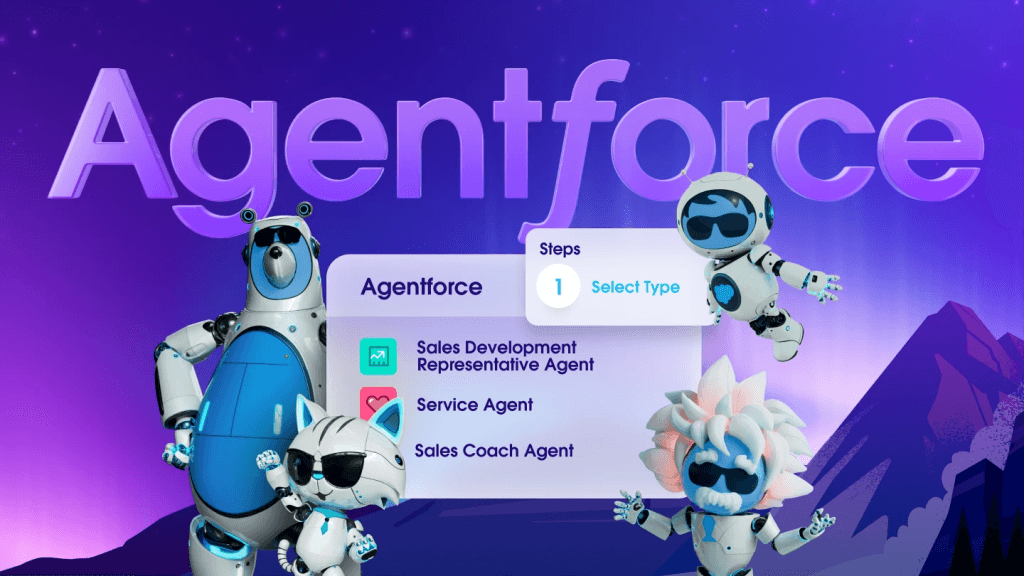
Salesforce Agentforce is an enterprise AI agent platform built natively into the Salesforce ecosystem, enabling autonomous agents for customer service, sales, and marketing workflows. Pricing starts at $2 per conversation.
Salesforce Agentforce is an enterprise AI agent platform built directly into the Salesforce CRM ecosystem. Announced at Dreamforce in September 2024 by CEO Marc Benioff and made generally available on October 25, 2024, it lets organizations build and deploy autonomous AI agents that handle customer service, sales pipeline management, marketing execution, and internal workflows without requiring a human for every interaction. The platform sits at the intersection of Salesforce's decades of CRM data and the current wave of large language model capabilities, and it has shipped four major named releases in under 18 months.
Core capabilities include pre-built agent types for Service, Sales, and Marketing roles, a proprietary Atlas Reasoning Engine for autonomous decision-making, grounding in Salesforce Data Cloud via retrieval-augmented generation, and a low-code agent builder that connects to Flow, Apex, and MuleSoft integrations. Agentforce 360, released in October 2025, added cross-platform human-agent handoff infrastructure and expanded data connectors across the Salesforce stack. Pricing runs $2 per conversation for external-facing customer agents, or via Flex Credits ($0.005 per credit) for more complex multi-step internal workflows. Teams often combine Agentforce with Intercom Fin patterns for escalation logic or benchmark the approach against purpose-built customer service agents like Decagon.
What Salesforce Agentforce actually is in May 2026
Agentforce reached its fifth major iteration in roughly 18 months. The original GA release (October 2024) handled basic service deflection. Agentforce 2.0 (December 17, 2024, GA February 2025) added a pre-built skills library, Slack deployment, and advances in agentic reasoning and RAG. Agentforce 2dx (March 2025) enabled proactive, trigger-based agents that operate outside the traditional chat window, firing on CRM events rather than waiting for a user to initiate. Agentforce 3 (June 23, 2025) focused on governance, visibility, and interoperability after thousands of enterprise deployments exposed control gaps at scale. Agentforce 360 (October 2025) positioned itself as the first platform designed to unify humans and AI agents in a single trusted system.
The underlying engine is the Atlas Reasoning Engine, Salesforce's proprietary decision layer that maps incoming topics to available agent actions. Agents retrieve context from Data Cloud using RAG and vector search. Out-of-the-box agent types cover Service Agent (handles Tier-1 customer support, case routing, knowledge retrieval), Sales Agent (manages lead nurturing, follow-up sequences, quote generation via CPQ integration), and Marketing Agent (executes campaigns, personalizes outreach, manages audience segmentation). Custom agents can be built with natural language instructions, Flow Builder automation, or Apex code for enterprise-specific logic.
Salesforce runs its own help portal on Agentforce in production: roughly 130,000 conversations per month, with 5-7% escalating to human agents and case volume reduced by approximately 27,000 per month since deployment, according to a six-month review published by Salesforce Ben in 2025.
Where Agentforce sits versus Microsoft Copilot Studio and Sierra
The honest comparison between these three platforms comes down to ecosystem depth, architectural flexibility, and deployment model, not just feature surface area.
Microsoft Copilot Studio uses Azure OpenAI Service models (accessed through Azure AI Studio), querying data through Microsoft Graph connectors and Azure AI Search without requiring data to be replicated into a separate vector store. It extends via Bot Framework and Visual Studio Code, and its governance layer runs on Entra ID and Microsoft Purview rather than CRM permission inheritance. Baseline capabilities are bundled into Microsoft 365 E3/E5 plans. The key architectural difference is horizontal breadth: Copilot Studio agents traverse the entire enterprise stack (Excel, Teams, SharePoint, Power BI, Azure) and are not coupled to a CRM data model. Agentforce wins on vertical depth within Salesforce workflows; Copilot Studio wins when agents need to span documents, meetings, analytics, and code environments simultaneously. Many large enterprises run both. For organizations already invested in Salesforce, pairing with Microsoft Copilot for internal productivity workflows covers the horizontal gap.
Sierra (sierra.ai) takes a different architectural bet: it is model-agnostic, allowing organizations to select OpenAI, Anthropic Claude, or Meta Llama as the LLM layer at deployment time. There is no proprietary reasoning engine. Sierra operates as a managed service, meaning complex agent workflows require Sierra's own engineering team rather than internal developers. Pricing starts around $150,000 per year with outcome-based billing, putting it squarely in Fortune 1000 territory. It has no SMB tier and no self-hosted option for regulated industries. Agentforce is considerably cheaper for Salesforce-native orgs at $2/conversation and offers more internal self-sufficiency through low-code tools. Sierra offers deeper conversational reasoning for complex multi-branch support trees and the flexibility to swap LLM providers without platform lock-in. Salesforce-committed enterprises should evaluate Agentforce first. Consumer brands with complex, high-volume support operations and no CRM dependency should price Sierra. For teams exploring the broader field, ZoomInfo Copilot covers a similar sales intelligence angle at a different price point.
"Most are not ready for Agentforce. Not even close. Agentforce might be the future. But thousands of customers need help in the present." -- Connie Hazendonk, Salesforce Trainer, LinkedIn post after Agentforce World Tour London, 2025
How AI actually works inside Agentforce
The Atlas Reasoning Engine interprets an incoming user message, maps it to a topic (a defined intent category), then selects the appropriate action sequence from the agent's configured action library. Actions can be pre-built Salesforce operations (look up a case, update an account, create a task), Flow automations, Apex custom code, or MuleSoft API calls to external systems. The agent executes the action chain and returns a response grounded in real CRM data rather than generic LLM output.
Data grounding runs through Data Cloud, which serves as the vector database for semantic search. This is where the pricing complexity begins: Data Cloud is a separate Salesforce product with its own licensing. Organizations that want fully grounded, context-aware agents need to budget for both Agentforce credits and Data Cloud credits. The Agentforce 1 Edition ($550+/user/month) bundles 1 million Flex Credits per year and 2.5 million Data 360 Credits per year, which is one way to package both together.
Voice integration adds another pricing layer. Service Cloud Voice with Amazon Connect runs $50-200/user/month depending on included call minutes. These stacked costs are why the headline $2/conversation figure often surprises organizations when the full infrastructure invoice arrives.
Agentforce 2.0 introduced agentic reasoning improvements that let agents handle more complex multi-step tasks without dropping context. Agentforce 3 added a governance console that lets admins track agent decisions, audit action histories, and set guardrails on what agents can and cannot do autonomously, addressing the most common enterprise risk objection from the first year of deployments.
The friction users keep raising
The Salesforce community's honest reaction to Agentforce's first 18 months has been mixed. Implementation complexity tops every list of complaints. Getting consistent and accurate agent behavior requires clean CRM data, proficiency in prompt engineering, Apex development, MuleSoft API integration, and Flow configuration. The Trailhead training catalog has struggled to keep pace with the pace of releases.
"I have yet to configure Agentforce in a way that is helpful. Learning Agentforce requires much better training than Trailhead can offer." -- 23-year Salesforce veteran, Reddit r/salesforce, 2025
The mandatory help portal incident in September 2025 crystallized the gap between Salesforce's confidence in the product and the community's actual experience. On September 29, 2025, Salesforce removed the search bar from its help portal and replaced it with Agentforce as the sole navigation method. Salesforce MVP Tom Bassett filed a formal IdeaExchange request, writing that Agentforce "can produce unreliable results and takes longer to find the information you need." Reddit threads reported the AI giving repetitive or inaccurate answers. Salesforce defended the removal by citing low search engagement (1.7% of sessions). Under sustained community pressure, the search bar was restored on November 14, 2025, seven weeks later. The incident is now a frequently-cited cautionary note in Salesforce admin circles about deployment without quality thresholds.
Pricing complexity is a second recurring frustration. What began as a clean $2/conversation model evolved into a hybrid of Flex Credits, Data Cloud credits, voice telephony licensing, and per-user add-ons. A LinkedIn poll by Salesforce Ben in 2025 found that 50% of respondents believed Agentforce had not moved past the hype cycle, with only 11% confirming active use by themselves or their teams.
Other patterns from forum threads: ROI is hard to model before running pilots (hesitation to commit to large contracts), multi-step workflows run noticeably slow compared to deterministic Flow automation, and the Data Cloud dependency significantly increases the true cost of enterprise-grade deployments.
Who Agentforce is for
Agentforce is the right choice for enterprise organizations with mature, well-governed Salesforce deployments. The sweet spot is a company running Service Cloud or Sales Cloud with at least one dedicated Salesforce administrator and reasonably clean CRM data. Customer service operations targeting Tier-1 deflection, sales teams wanting automated pipeline nurturing and CPQ integration, and marketing teams running high-volume personalized outreach at scale are the documented production use cases. Organizations exploring AI-powered sales assistance should also evaluate ZoomInfo Copilot for intent data enrichment alongside Agentforce for workflow execution.
Skip Agentforce when: your organization does not have an existing Salesforce investment, your CRM data is inconsistent or ungoverned, you are an SMB without Salesforce admin capacity, or you need agents that span across non-Salesforce enterprise systems. If your primary use case is internal productivity across documents, meetings, and code, Microsoft Copilot and Copilot Studio cover that territory more economically. If you need a model-agnostic managed agent service for complex consumer support with outcome-based pricing, Sierra is the more appropriate comparison.
Agentforce's trajectory is clearly upward: four major releases, a growing partner ecosystem, and Salesforce's full organizational weight behind it. But the gap between the product's ambition and the readiness of most customer data environments means that honest results in 2025-2026 have been earned in narrow, well-defined workflows, not the broad autonomous enterprise deployments Benioff describes at conferences.
User Reviews
No reviews yet. Be the first to share your experience!
Sign in to write a review.
Related articles
Guides and articles related to Salesforce Agentforce.
HubSpot Breeze vs Salesforce Agentforce (2026): RevOps AI Cost Reality
AI Agents for Business: What They Actually Are and 12 Things You Can Automate Today
AI Agent Use Cases: 5 Industries Transformed in 2026
How AI Agents Work: Architecture & Implementation Guide (2025)
Turn Any AI Agent Into a Superagent: The 12-Integration Stack (2026)