Intercom Fin vs Decagon vs Sierra (2026): Outcome Pricing vs Enterprise Agents
# Intercom Fin vs Decagon vs Sierra (2026): Outcome Pricing vs Enterprise Agents
You are not choosing “the best AI support bot.” You are choosing a billing unit, a deployment path, and a definition of “resolved.” Get those three wrong and the sticker rate is theater.
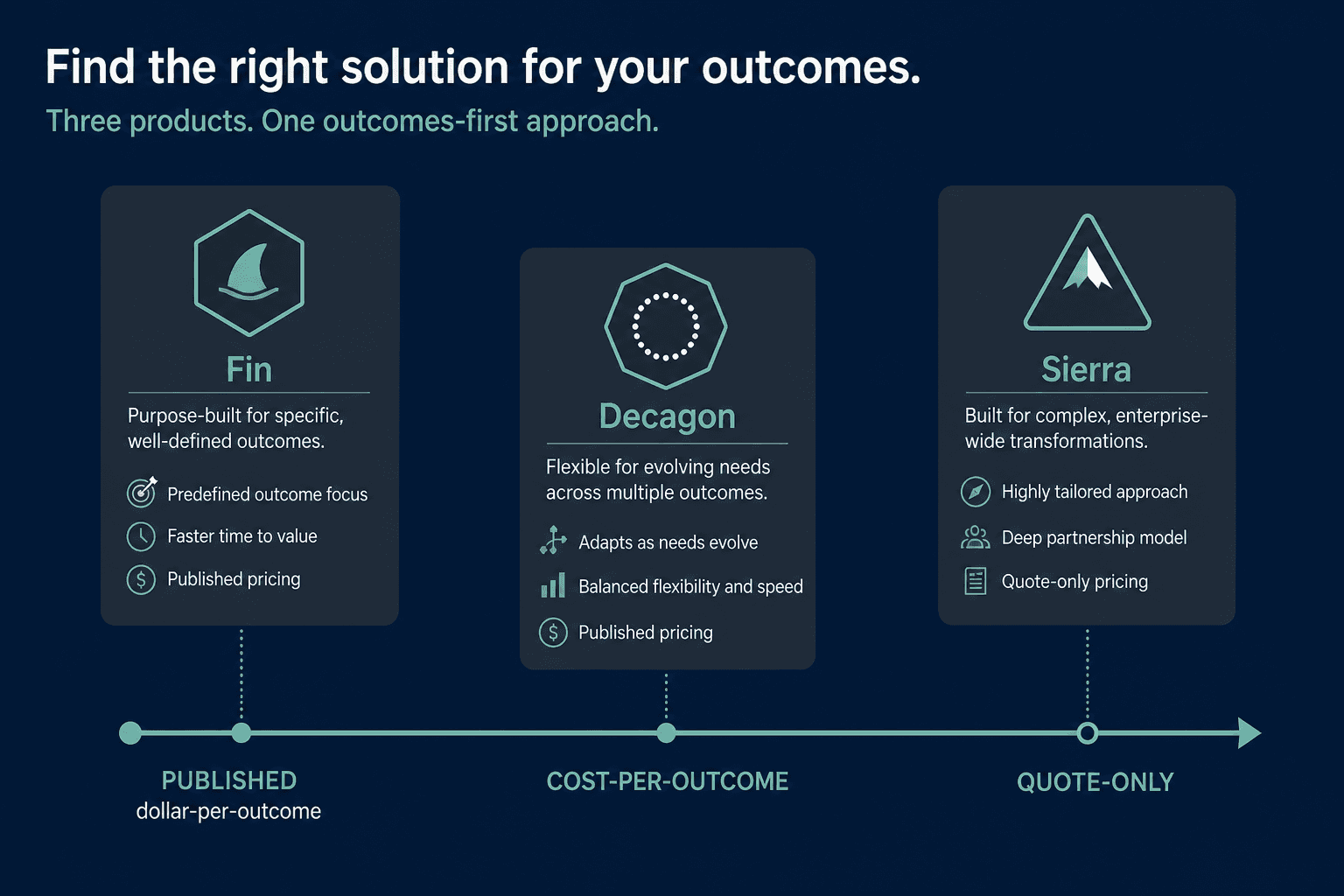
As of September 2, 2026, Intercom Fin publishes outcome pricing at $0.99 per billable outcome. Decagon and Sierra sell enterprise agents on outcome- or usage-aligned contracts with no public rate card. That asymmetry is the whole story: Fin lets you model a monthly bill before a sales call; the other two force you to negotiate the meter itself.
This guide is operator math, not a vendor bake-off with a fake winner. We quote published numbers where they exist, label third-party contract ranges as unofficial estimates, and tell you when to buy vs when to keep building on your helpdesk.
Some product links may earn a commission. That does not change the verdict. Vantaige also lists tools in the directory; weigh that bias if you see a listing.
Table of contents
1. TL;DR
10. FAQ
11. References
TL;DR
Fin = self-serve / fast path. Public meter: $0.99 per outcome (resolution, procedure handoff, disqualification). Sales qualification outcomes are $9.99. On Intercom you also pay seats ($29 / $85 / $132 per full seat/mo billed annually on Essential / Advanced / Expert). Standalone Fin on another helpdesk: $49/mo base including 50 outcomes, then $0.99 overage - confirm live on Intercom / Fin help.
Decagon = enterprise AI concierge (chat / email / voice). No public pricing. Third-party procurement reads (Vendr cited across multiple 2026 teardowns) put annual contracts roughly in the ~$95K-$923K band with medians often cited near ~$386K-$433K. Treat every dollar as an estimate until you have a quote.
Sierra = Agent OS for branded CX agents. Publicly evangelizes outcome-based pricing (pay when a defined outcome succeeds; escalations typically not charged). No published $/outcome. Third-party year-one budget chatter often starts mid-six figures including implementation - again, estimate, not list price.
Pick Fin when you need transparent unit economics, a knowledge-base-fed agent, and weeks-not-quarters to production. Pick Decagon / Sierra when you need deep actioning across backend systems, multi-channel brand agents, and you already budget for a six-figure CX platform.
Watch out: “assumed resolution” billing (Fin), opaque “resolution” definitions in enterprise contracts, stacking seats + outcomes, and treating a chatbot as a substitute for knowledge-base work.
The three products are not the same job
Map the product to the job before you map the price.
| Product | Who sells it | Primary job | Buying motion |
|---|---|---|---|
| Intercom Fin | Intercom (also Fin.ai / helpdesk overlay) | AI agent that resolves support (and some sales/ecom) conversations from your content + procedures | Self-serve trial + published outcomes; seats if you live on Intercom |
| Decagon | Decagon.ai | Enterprise “AI concierge” with Agent Operating Procedures (AOPs), multi-channel, ops tooling | Sales-led, annual contract, no public price page |
| Sierra | Sierra.ai (Bret Taylor / Clay Bavor) | Branded Agent OS that takes actions in your systems across chat, SMS, WhatsApp, email, voice, ChatGPT | Sales-led, outcome-priced custom contracts |
Fin is a productized CX agent with a public meter. Decagon and Sierra are enterprise agent platforms that compete on depth of actioning, ops, and brand control. Comparing only “resolution rate screenshots” is how you buy the wrong stack.
If your ticket volume is mostly FAQ deflection and your knowledge base is already clean, Fin’s job matches. If your agent must refund, change plans, originate transactions, or hold a Fortune-scale brand voice across voice + chat with heavy guardrails, you are in Decagon/Sierra territory - or a serious build.
What “outcome” means on each platform
Outcome pricing is only as honest as the definition. Read the meter before you celebrate alignment.
Fin (published)
Intercom’s help docs (updated through mid/late 2026) define billable outcomes roughly as:
| Outcome type | Published price | Counts when |
|---|---|---|
| Resolution | $0.99 | After Fin’s last answer, customer confirms help or does not ask for more help (includes assumed resolution after inactivity) |
| Procedure handoff | $0.99 | Fin completes a Procedure you configured to end in a human/workflow handoff |
| Disqualification | $0.99 | Fin for Sales: prospect fails qualification criteria |
| Qualification | $9.99 | Fin for Sales: prospect matches criteria and is routed (book call / trial / self-serve, etc.) |
Important Fin rules you will feel on the invoice:
One outcome per conversation, even if Fin answers multiple questions.
Customer-asked human escalation and many default escalations are not billed as outcomes.
Assumed resolutions are billed. If the customer leaves after Fin answers without requesting more help, that can be $0.99. Configure frustration/escalation rules if that pattern will inflate your bill.
Greeting-only replies and clarifying questions that time out without an answer are generally not billable outcomes.
Voice / high-volume / specialized Fin pricing is contact sales - not the public $0.99 table.
Decagon (not published)
Decagon does not publish a rate card. Public materials emphasize Agent Operating Procedures (natural-language workflows), testing/observability, and unified chat/voice/email. Procurement write-ups consistently describe usage-based billing with a choice shaped as per-conversation or per-resolution, plus an annual commitment - but rates are quote-only.
Until Decagon is on a signed order form, treat any “~$0.99/conversation” or “~$0.50/resolution” figure floating on competitor blogs as hearsay. Ask for: meter definition, what counts as resolved, how multi-touch threads are counted, voice multipliers, and whether failed attempts bill.
Sierra (model published, rates not)
Sierra’s own outcome-pricing essay is explicit: you pay for defined business outcomes (resolved query, saved cancellation, upsell, etc.); if unresolved, in most cases there is no charge. They also acknowledge blended deals (e.g., greeter/routing on conversation count + complex work on outcomes).
What they do not publish: the dollar rate per outcome, platform floors, or implementation fees. Bret Taylor has publicly framed the pitch as “pay for a job well done.” Your job in diligence is to lock outcome taxonomy in the contract - not to assume Fin’s $0.99 economics transfer.
Published and estimated pricing (as of Sep 2026)
Fin + Intercom (published)
| Component | Public figure | Notes |
|---|---|---|
| Fin outcome (resolution / procedure handoff / disqualification) | $0.99 | Chat/email with Intercom per help docs |
| Fin qualification (sales) | $9.99 | Intercom Fin for Sales |
| Essential / Advanced / Expert seats (annual) | $29 / $85 / $132 per full seat/mo | From Intercom pricing page; monthly billing higher |
| Copilot add-on | $29/agent/mo annual ($35 monthly) | Optional inbox assistant |
| Pro add-on | From $99/mo | Ops/quality tooling; Operator credits at $0.01/credit overage per Intercom FAQ |
| Fin standalone on other helpdesk | From $0.99/outcome; ~$49/mo base with 50 included outcomes (Fin help) | No Intercom seats required; minimum commitment applies |
| Trial | 14-day free trial (no card) | Confirm current trial terms in-product |
Decagon (third-party estimates - not official)
| Signal | Figure commonly cited in 2026 teardowns | Label |
|---|---|---|
| Public list price | None (pricing page effectively absent / demo-gated) | Fact |
| Vendr-cited annual contract range | Roughly ~$95K-$923K | Third-party estimate |
| Vendr-cited medians (sources disagree) | Roughly ~$386K or ~$433K | Third-party estimate |
| “Platform fee ~$50K” claims | Appears in competitor/teardown posts | Unverified estimate - ask Decagon |
| Per-conversation / per-resolution unit rates | Not published | Require quote |
Sierra (third-party estimates - not official)
| Signal | What is public vs estimated | Label |
|---|---|---|
| Pricing model | Outcome-based; blended allowed | Public (Sierra blog) |
| $/outcome | Not published | Quote-only |
| Company scale context (press/third-party) | High ARR / large 2026 funding round narrative | Context only - not your price |
| Year-one budget chatter in analyst/blog teardowns | Often mid-six figures including implementation | Estimate - not a list price |
Rule: if a number is not on intercom.com/pricing, Fin help, sierra.ai docs, or your order form, it is not a planning-grade input. Use estimate bands only for “are we even in the right category?” conversations.
Worked monthly bills (illustrative only)
These scenarios show how the math compounds. They are not predictions of your resolution rate or enterprise discounts.
Assumptions you must replace with your data: conversation volume, autonomous resolution rate, whether you already pay Intercom seats, and whether sales qualifications apply.
Scenario A - 2,000 customer conversations / month, 50% Fin-resolved, team already on Intercom Advanced (8 full seats)
| Line item | Math | Monthly |
|---|---|---|
| Seats | 8 × $85 | $680 |
| Fin outcomes | 1,000 × $0.99 | $990 |
| Subtotal (ex add-ons) | $1,670 |
If the same 1,000 resolutions ran on standalone Fin with the published base plan shape ($49 including 50 outcomes + $0.99 overage):
50 included + 950 × $0.99 = $49 + $940.50 = $989.50 Fin-only - plus whatever you still pay Zendesk/Salesforce/etc. for the helpdesk. Do not “save” the Intercom seats in your head if you still need the inbox.
Scenario B - Same 1,000 resolutions, but you also get 40 sales qualifications
| Line item | Math | Monthly |
|---|---|---|
| Resolutions | 1,000 × $0.99 | $990 |
| Qualifications | 40 × $9.99 | $399.60 |
| Fin usage only | $1,389.60 |
Qualification outcomes are an order of magnitude more expensive than support resolutions. If Fin for Sales is in scope, model that meter separately.
Scenario C - Enterprise RFP where Decagon/Sierra are in play
You cannot honestly print a monthly bill from public data. What you *can* do:
1. Take your annual CX automation budget band (example placeholder only): if procurement peers cite ~$100K-$400K+/yr for similar agents, divide by 12 for a rough monthly envelope.
2. Convert to effective $/resolved conversation using *your* expected autonomous volume - not the vendor’s best logo slide.
3. Compare that effective rate to Fin’s $0.99 *plus* your seat stack *plus* implementation time cost.
If Fin’s all-in effective cost is already under your fully loaded human handle cost for tier-1, and quality QA holds, the enterprise platform has to win on capability, not on “AI magic.”
Capability matrix that actually changes the RFP
| Dimension | Fin | Decagon | Sierra |
|---|---|---|---|
| Price transparency | High (published outcomes) | Low (sales) | Low (sales) |
| Time to first production agent | Hours-weeks (content + procedures) | Weeks-months (enterprise onboard) | Weeks-months (enterprise onboard) |
| Helpdesk overlay | Yes (Intercom-native + other helpdesks) | Layers on enterprise CX stack | Deep system integrations; brand agent |
| Workflow authoring | Procedures / guidance in Fin | AOPs in natural language (vendor claim) | Ghostwriter / Agent OS tooling (vendor claim) |
| Channels | Chat, email; voice via sales path | Chat, email, voice (positioning) | Chat, SMS, WhatsApp, email, voice, ChatGPT (positioning) |
| Actioning depth | External actions + handoffs; strength is content+procedures | Concierge workflows across lifecycle | Transactional actions in customer systems (refunds, plan changes, etc. - per public customer stories) |
| Ops / QA surface | Analyze funnels; Pro/Operator add-ons | Testing, observability, experimentation suite | Explorer, monitors, experiments, observability |
| Best-fit buyer | SMB-mid-market; clear KB; need unit economics | Enterprise volume; needs agent ops + multi-channel | Large brand CX; outcome contracts; deep integrations |
None of the “vendor claim” rows are a substitute for a scoped POC. They tell you what to test, not what to believe.
Buy vs build: a decision tree without the hype
Buy Fin (or Fin-class outcome agents) when:
Tier-1 is dominated by questions already answered in help center / macros.
You can staff a weekly knowledge + QA loop (this is the real cost).
You need a published meter for finance.
You will not fund a six-figure platform before proving deflection.
Buy Decagon or Sierra when:
The agent must execute multi-step policies against live systems (billing, memberships, logistics), not just retrieve docs.
Brand, voice, and compliance review require an enterprise delivery team.
Multi-channel (especially voice) is load-bearing, not a roadmap slide.
Your CFO already accepts opaque enterprise software - and you will negotiate outcome definitions like SLAs.
Build (or assemble) when:
Your workflows are unique enough that half the enterprise SOW is custom anyway.
You already have orchestration (n8n / Temporal / internal agents), retrieval, and eval harnesses.
You need data residency or tool-allowlist controls the SaaS agent will not grant.
Volume is low: paying platform floors for a few thousand conversations a month is how you invent burn.
A blunt heuristic: if your first milestone is “deflect password resets and shipping FAQs,” do not start with a Fortune-50 agent OS. If your first milestone is “agent can modify subscriptions under policy without a human,” Fin may still work via procedures - but pressure-test action reliability before you bet the roadmap.
Watch out / when NOT to buy
Watch outs (all three)
1. Resolution theater. Vendors optimize the metric that bills. Demand a sample of “resolved” transcripts and a human QA pass rate you define.
2. Assumed success. Fin bills assumed resolutions; enterprise contracts can hide similar assumptions. Align CSAT / reopen rates with the billing definition.
3. Seat + usage stacking. Fin on Intercom is seats plus outcomes. Enterprise agents still sit on Salesforce/Zendesk/Genesys costs. TCO is the stack, not the AI line item.
4. Voice multipliers. Voice is rarely the chat rate. Fin Voice is sales-priced; Decagon/Sierra voice belongs in the SOW explicitly.
5. Knowledge debt. No agent fixes a rotten help center. Budget content work or your “AI project” becomes an expensive router to humans.
6. Procurement FOMO. Decagon/Sierra media narratives (valuation, Fortune logos) are not a business case. Your conversation mix is.
When NOT to buy Fin
Your “AI” requirement is really workforce WFM / QA / QM - buy the right contact-center suite.
Monthly autonomous volume is so low that $0.99 × outcomes + seats exceeds a part-time human for the same queue (run *your* wage math).
You need strict data controls Intercom’s posture does not meet - validate security review before trial optimism.
Sales qualification at $9.99 will dominate the bill and a cheaper routing tool already works.
When NOT to buy Decagon or Sierra
You cannot name a six-figure annual envelope and an owner for a multi-month rollout.
You only need FAQ deflection - you will overpay for platform depth you will not use.
Legal will not accept a negotiated outcome definition - you will fight every invoice.
You expected self-serve tomorrow morning. These are not swipe-the-card products.
When NOT to build
You have no eval harness, no transcript QA, and no on-call for tool failures.
Leadership wants a demo in two weeks and “build” is code for unscoped R&D.
Your only differentiator would be wrapping the same LLM APIs without policy tooling.
How to run a fair 30-day bake-off
1. Freeze a gold set. 200-500 real tickets, tagged by intent, with the “correct” resolution path annotated by your best agents.
2. Define billable success yourself. Example: customer confirms or no reopen in 72 hours and no negative CSAT. Compare that to each vendor’s billable event.
3. Measure three rates: autonomous resolution (your definition), escalation quality, and reopen/defect rate - not just “contained.”
4. Price the pilot honestly. Fin: read outcome counts daily. Enterprise: insist on a capped pilot fee and a written meter.
5. Include human cost. Time spent writing procedures/AOPs/SOPs is part of TCO.
6. Kill criteria in writing. e.g., “If reopen rate > X% or effective $/good resolution > Y, we stop.”
FAQ
Is Intercom Fin cheaper than Decagon or Sierra?
On published unit price, Fin’s $0.99/outcome is knowable on day one; Decagon and Sierra are not. Whether Fin is cheaper for you depends on seats, volume, resolution quality, and whether you need enterprise actioning. A mid-market FAQ workload often favors Fin’s meter. A multi-channel, transaction-heavy brand agent often lands in quote-only territory regardless of Fin’s sticker.
Does Fin only charge when it truly resolves the issue?
Fin charges for defined outcomes. Resolutions include confirmed and assumed cases (no further help requested after Fin’s answer). Procedure handoffs you configured are also billable. Customer-requested escalations and many default escalations are not. Read Intercom’s outcome article before you forecast.
Why won’t Decagon or Sierra publish pricing?
Enterprise agents are scoped per channel mix, integration depth, and outcome taxonomy. Both companies sell through sales. Opacity is a procurement cost: budget time for RFPs and reference calls, not just a pricing-page screenshot.
Can I use Fin with Salesforce or another helpdesk?
Yes - Intercom markets Fin for existing helpdesks (including Salesforce) with outcome pricing and a minimum monthly commitment, without Intercom seats. Confirm current connectors and the live minimum in Fin/Intercom docs.
Should I build my own support agent in 2026?
Build when orchestration, retrieval, and eval are already strengths and the workflow is uniquely yours. Otherwise start with a metered product (Fin-class), prove deflection economics, then revisit enterprise platforms or a build for the residual complex intents.
What is the difference between per-conversation and per-resolution pricing?
Per-conversation bills when the agent touches the thread (resolved or not - exact rules vary). Per-resolution / outcome bills when a success definition is met; failures ideally cost $0 on the AI meter (you still pay humans). Fin’s public model is outcome-based. Decagon is described by third parties as offering either shape. Sierra markets outcomes, with blended conversation pricing possible for low-value turns.
How do I compare effective cost across vendors?
Compute:
(AI subscription + usage + incremental seats + implementation amortized + KB/QA labor) / (conversations that meet YOUR success definition).
Ignore logo slides. Use the same denominator for every vendor.
References
1. Intercom, “Pricing” (Fin outcomes from $0.99; seat tiers). https://www.intercom.com/pricing - accessed September 2026.
2. Intercom Help, “Fin AI Agent outcomes” (outcome types, $0.99 / $9.99). https://www.intercom.com/help/en/articles/8205718-fin-ai-agent-outcomes - accessed September 2026.
3. Fin Help Center, “Fin pricing: Outcomes” ($0.99; $49 base / 50 resolutions example). https://fin.ai/help/en/articles/13975800-fin-pricing-outcomes - accessed September 2026.
4. Decagon, product site (platform positioning; demo-led commercial motion). https://decagon.ai/ - accessed September 2026.
5. Sierra, homepage (outcome-based pricing positioning; Agent OS). https://sierra.ai/ - accessed September 2026.
6. Sierra, “Outcome-based pricing for AI agents” (model definition; blended pricing note). https://sierra.ai/uk/blog/outcome-based-pricing-for-ai-agents - accessed September 2026.
7. Vendr marketplace / secondary citations of Decagon contract bands (median/range figures vary by scrape date - treat as third-party estimates, verify on Vendr). https://www.vendr.com/marketplace - accessed September 2026.
8. Vantaige directory, Intercom Fin listing (context). https://vantaige.io/ai-tool/intercom-fin - accessed September 2026.
Related from Vantaige
AI Customer Support Automation: Cut Tickets 50% (2026) - deflection math and knowledge-base work that still decides ROI after you pick a vendor.
Intercom Fin AI Agent - directory listing with positioning notes.
Salesforce Agentforce - when the CRM-native agent path is the real alternative to a CX specialist.
HubSpot Breeze vs Salesforce Agentforce (2026): RevOps AI Cost Reality - companion RevOps pricing teardown (Flex Credits vs HubSpot Credits).
AI Agents for Business: 12 Things You Can Automate (2026) - bounded jobs worth automating before you buy an agent OS.
Get the best new AI tools and guides, weekly
One short email a week. The tools worth trying, the guides worth reading, nothing else.
Subscribe
No spam. Unsubscribe anytime.
Get the best new AI tools and guides, weekly
One short email a week. The tools worth trying, the guides worth reading, nothing else.
No spam. Unsubscribe anytime.
Aymen B
Contributing writer at Vantaige, covering the AI tools ecosystem.
Similar articles
Vantaige Launches the LLM VRAM Calculator: A Free GPU Compatibility Finder for Open-source and Open-Weight AI

Xiaomi MiMo-V2.6 Deep Dive: The 1-Trillion-Parameter Open-Source Titan Disrupting the Frontier