Launch an AI Product: A Qualified Distribution Experiment
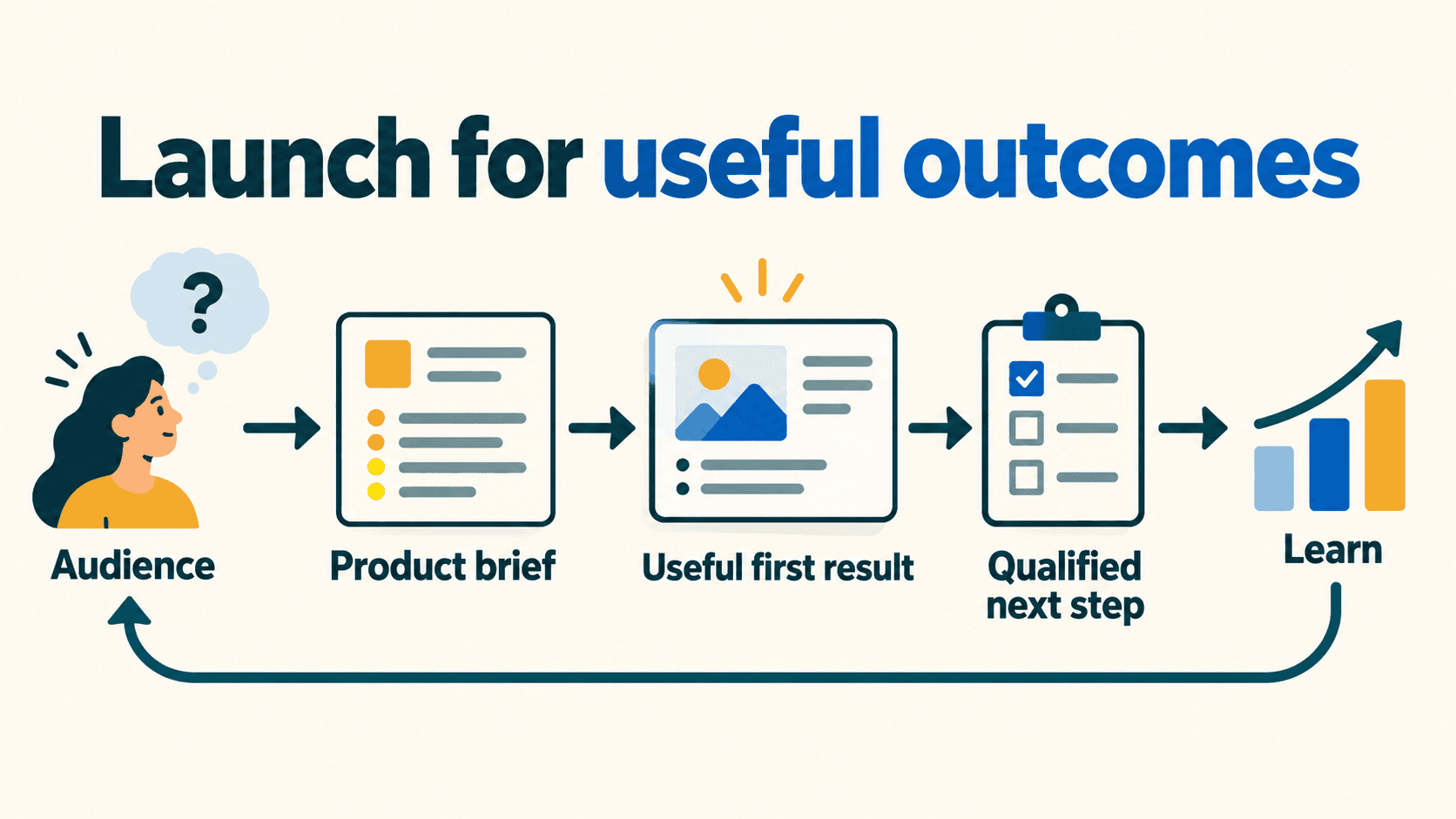
Choose a specific buyer task, test a small set of channels, and measure whether visitors complete that task. A launch can produce useful feedback, product adoption, sales conversations or purchases. Decide which outcome you need before treating a busy traffic chart as a successful launch.
This guide gives founders and AI product teams a two-week experiment with a product brief, channel worksheet and clear continuation rules. Two weeks is an illustrative planning window, not a universal sales-cycle benchmark. Enterprise evaluations and search discovery may need longer observation.
Vantaige operates the directory and paid listing offer discussed below. The experiment works whether you use our directory, another platform or your own content.
Define a useful visitor before choosing a channel
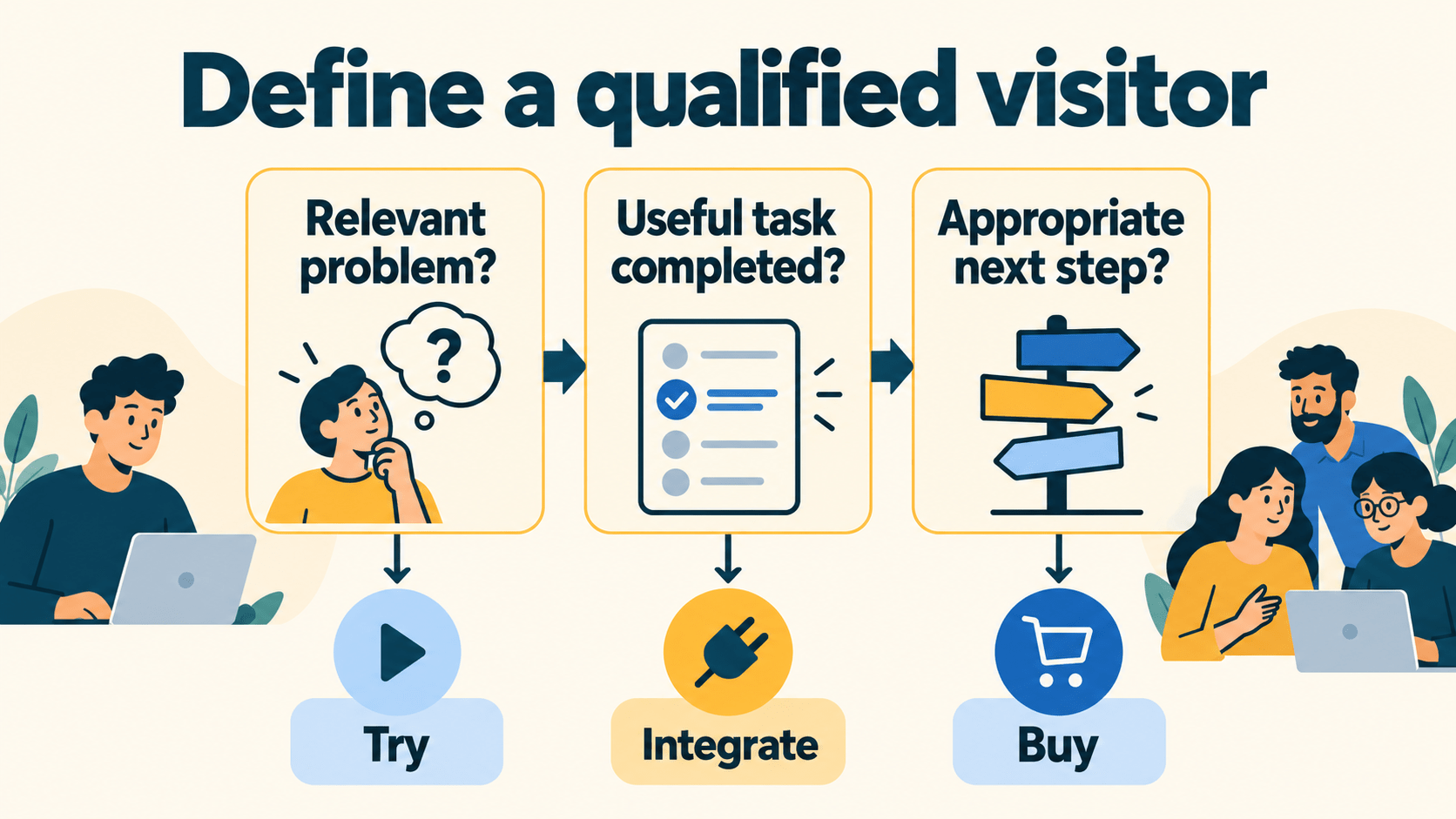
Qualification starts with fit for the product’s job, not a visitor’s title. A developer can be the user, the person selecting an API, a founder paying for it or an enterprise buying-team champion. A consumer can be an excellent customer for a consumer product.
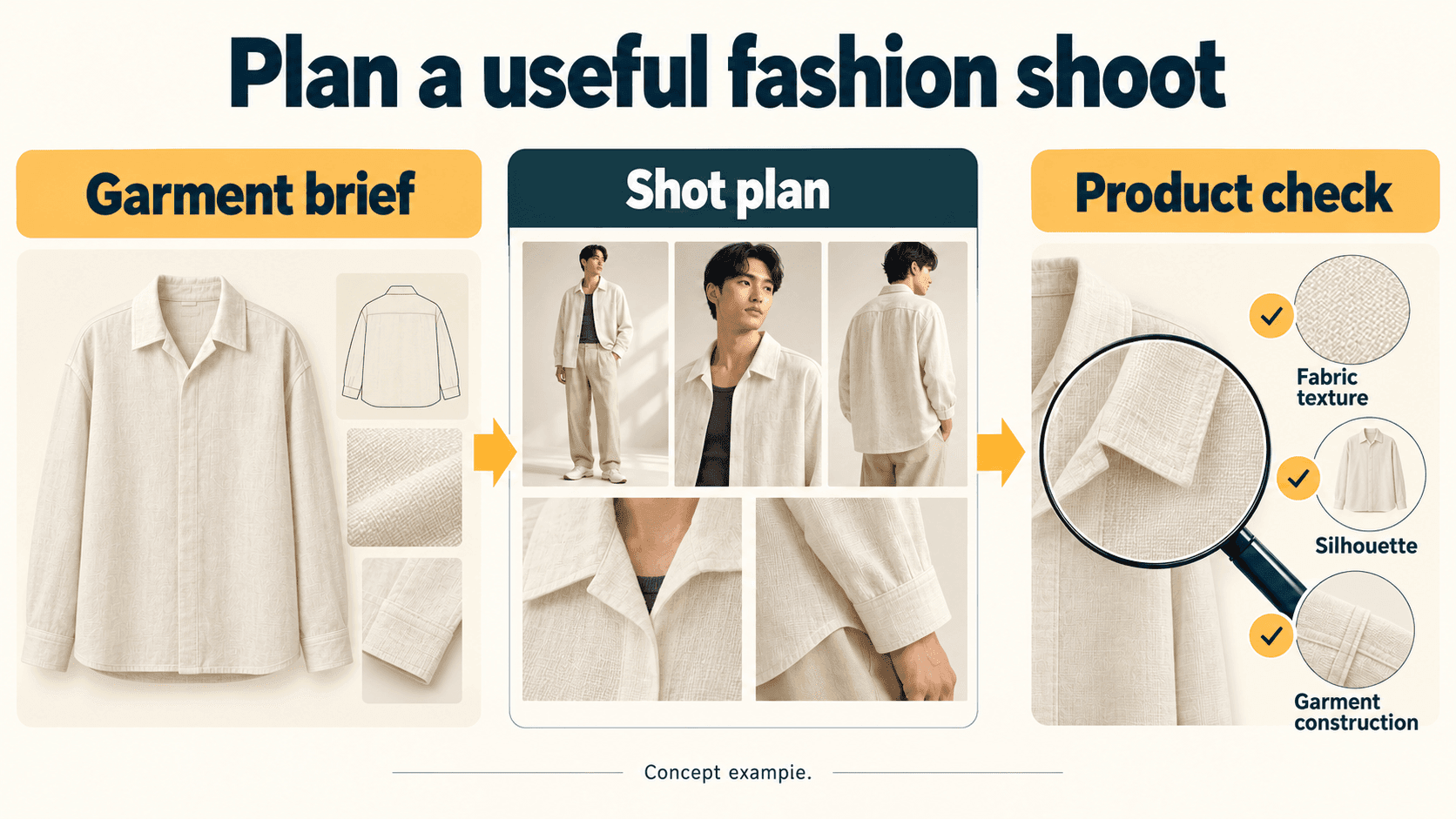
For an invoice-extraction API, a builder connecting accounting software may be more relevant than an executive browsing a general AI list. For a fashion prompt library, a boutique owner planning a collection may be more relevant than an engineer inspecting the underlying image model.
| Reader | Evidence of potential fit | Appropriate next action |
|---|---|---|
| Individual user or creator | Has the task your product supports | Try a representative example |
| Developer or solo founder | Needs the capability in an app or workflow | Read integration docs and run a sample |
| Startup or business team | Has recurring work, an owner and relevant requirements | Evaluate the workflow or discuss a pilot |
| Enterprise champion | Needs evidence for a buying or technical review | Share the relevant evaluation materials |
| Unrelated service solicitation | Is pitching services rather than evaluating your product | Keep separate from customer enquiries |
A short visit or personal email address does not establish poor fit. Use observed actions and information people choose to provide, rather than guessing intent from a job title or arbitrary dwell-time cutoff.
Pick one activation and a separate commercial milestone
For this guide, DocuPulse is a fictional invoice-extraction product. Its proposed customer task is turning a sample invoice into a checked structured record.
- Candidate activation: a visitor completes the sample workflow and exports a record matching the supplied expected fields.
- Qualified enquiry: a person describes a relevant recurring workflow, intended integration and a concrete evaluation question.
- Paid outcome: a verified order or subscription in the authoritative billing system.
The activation event is a working hypothesis about early value. It becomes a retention signal only if later evidence supports that relationship. Keep a sample run, commercial enquiry and paid order as distinct outcomes.
Choose a small channel mix by audience and effort
Start with one channel where people already look for your kind of product, one place where practitioners discuss the problem, and one useful resource people can evaluate. Add a partner channel when the integration already works and there is a plausible audience.
| Channel | What you contribute | Good fit when… | What to observe |
|---|---|---|---|
| Relevant directory | Accurate profile, pricing context and demonstration | Readers compare tools for this job | Attributable arrivals and useful product actions |
| Practitioner community | A working example and a useful technical explanation | Members discuss the problem and the format is allowed | Actual trials, questions, feedback and enquiries |
| Integration or partner audience | A usable connector, recipe or joint workflow | The audience already uses the surrounding stack | Successful evaluations and integration interest |
| Practical tutorial or starter | A reproducible solution with clear limits | People need implementation help | Completed tasks and later repeat use |
Set your own effort budget. Preparing a profile and building an integration have different costs; a channel’s maintenance burden matters as much as its launch-day attention.
For owned distribution, beehiiv covers newsletters and Hypefury covers social scheduling. Their Vantaige listings (beehiiv, Hypefury) show current plans. Choose one channel and one owner before adding another.
Learn from concrete published patterns
Supabase’s 25 March 2021 Launch Week announcement arranged several product releases across a week. The useful pattern is coordinating a sequence of substantive releases and explanations. It is vendor reporting about its launch format, not evidence that your product will receive similar results. Supabase Launch Week.
Vercel’s public Chatbot repository offers an open-source starter built with Next.js and the AI SDK, with documentation and setup instructions. A runnable starter lets developers inspect an approach and try a useful implementation. The repository demonstrates the asset format; it does not prove a conversion rate or a customer-acquisition advantage. Vercel’s Chatbot starter.
Check the platform’s rules before choosing the format
Show HN expects something you made that other people can try. Its guidance distinguishes a usable project from a signup page or promotional landing page, and discourages soliciting votes. For a developer-facing AI product, prepare a genuine demonstration and be available to discuss it. Show HN guidelines.
Product Hunt’s posting guide describes a direct product link, clear product information, gallery assets and a maker comment. It also says a separate hunter is not required. These are documented preparation patterns, not guarantees of featuring or traffic. Product Hunt posting guide.
Prepare one product brief and adapt the presentation
A useful brief answers six questions:
- Who has the problem, and what are they trying to finish?
- What does the product accept and return?
- What can a visitor try with representative sample data?
- What limitations will matter during evaluation?
- What do the pricing and data-handling terms actually say?
- What should an interested reader do next?
For the fictional DocuPulse example, the promise is “extract the listed fields from a sample invoice, then review and export the record.” Do not add an accuracy percentage, integration, retention policy or supported language unless your real product evidence supports it.
Download the product-brief template, or read our guide to writing a product brief.
Match the next step to the reader
A builder may need a sample request and an inspectable response. A team lead may need workflow requirements and a route to a pilot. A person comparing tools may need examples, limitations and pricing before creating an account.
You do not need a new landing page for every channel. Use the most relevant existing page when it fulfills the promise, and create a dedicated page only when the reader’s task warrants it. Keep intermediate actions—opening docs, cloning a repository or creating a key—separate from completing the core product task.
Set up a worksheet with consistent outcome definitions
Record the audience hypothesis, asset, owner, effort budget, publication date, destination, observation window and decision rule before the experiment begins. Leave unobserved outcomes blank or marked “not run.”
Download the channel experiment template. It contains prepared planning rows, not invented results.
For comparisons, use the same activation definition and compatible counting units. If you deduplicate visitors, count activated visitors on the same basis. If you cannot join anonymous sessions reliably, report the available measures separately and explain the gap.
A small synthetic example
These numbers are fictional teaching data for generic channels. They are not vendor performance claims. Each row uses the same fourteen-day window and the same completed sample-task definition.
| Generic channel | Tracked visitors | Visitors completing the sample task | Qualified enquiries | Verified orders | Effort hours |
|---|---|---|---|---|---|
| Relevant directory | 40 | 8 | 2 | 0 | 3 |
| Practitioner community | 100 | 10 | 1 | 0 | 6 |
| Integration audience | 30 | 9 | 3 | 1 | 5 |
| Practical tutorial | 50 | 10 | 2 | 0 | 8 |
In this synthetic example, task-completion rates are 20%, 10%, 30% and 20%. One integration-channel order is encouraging, but does not establish a stable acquisition cost or prove that the channel caused the purchase. The other channels may still provide useful learning.
Download the synthetic results separately so your real experiment sheet starts clean.
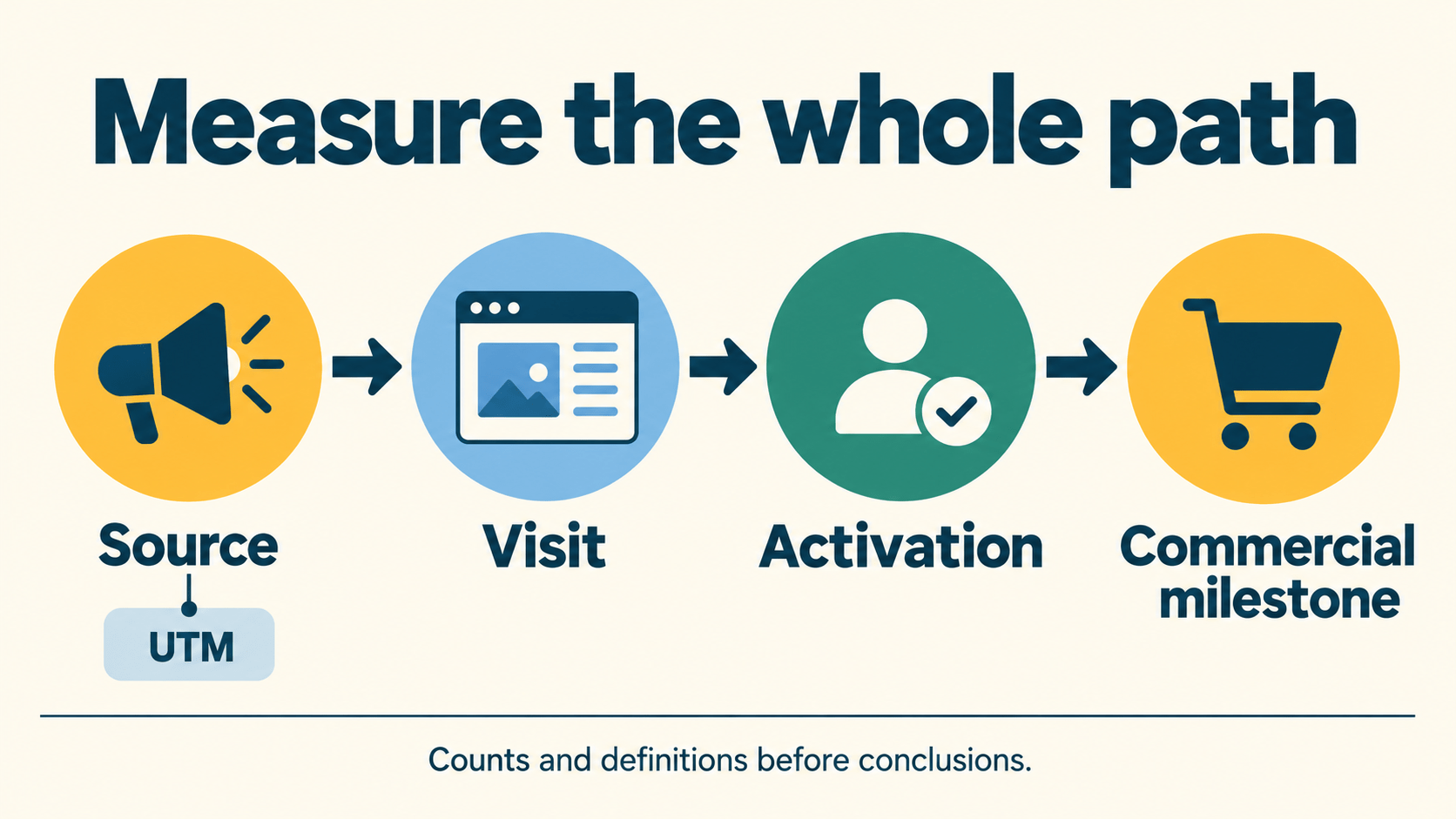
Track sources without promising perfect attribution
Use consistent utm_source, utm_medium and utm_campaign values where you control links and the platform permits them. Google’s guidance explains how campaign parameters appear in acquisition reporting and notes that values are case-sensitive. Keep personal information out of campaign URLs. Google Analytics campaign URL guidance.
Record the relevant product event and reconcile commercial outcomes against your enquiry or billing records. Consent choices, blocked analytics, missing referrers, repeat visits and cross-device evaluation can prevent a complete join. A campaign tag does not overcome those limits.
Keep these milestones separate:
- Submission and editorial acceptance.
- A public listing and search-engine indexing.
- An AI answer citing the product and an attributable website visit.
- A useful product action, qualified enquiry and verified order.
A crawler request is not a qualified visitor. A branded search increase can be worth investigating, but it does not by itself attribute customers to a specific post. Our guide to reading a submission report explains the delivery distinctions.
Run the launch in a bounded cycle
Before the observation window
Choose the buyer task, finish the demonstration, check the links, and confirm that you can observe the chosen useful action. Assign an owner to each channel. Read its rules and prepare a truthful message that fits the permitted format.
During the window
Record when each asset actually becomes available. A delayed directory review should not be treated as fourteen days of live exposure. Answer relevant questions, fix broken onboarding and log meaningful product feedback alongside counts.
Keep major product changes in your notes. If you fix a failing upload halfway through the experiment, early and late visitors did not experience the same product.
At the review
Compare results with the rules you wrote beforehand. For this example, a reasonable next decision might be:
| Evidence | Next action |
|---|---|
| Relevant people complete the task and ask concrete follow-up questions | Run a small follow-up and examine repeat use |
| Visitors fit the audience but fail at the same onboarding step | Fix that step before increasing promotion |
| An asset is live but attracts unrelated needs | Change the message, destination or channel hypothesis |
| The channel consumes its effort budget with little relevant activity | Pause active work and document what you learned |
| Too few observations or an incomplete exposure window | Extend observation or mark the result inconclusive |
There is no universal “good” activation percentage for every AI product. A tiny launch sample can guide the next experiment; it does not establish long-term retention, customer value or a scalable acquisition cost.
Evaluate paid listings as a defined deliverable
Before paying a directory or distribution provider, ask what is delivered, when the placement period begins, what editorial decisions remain discretionary and what reporting you will receive.
| Question | Evidence to request |
|---|---|
| What surfaces and duration are included? | Current written package description |
| Is the product approved before it becomes live? | Eligibility and editorial terms |
| How is the placement identified to readers? | Sponsored disclosure and qualified advertising links |
| What proves delivery? | Actual public URL and placement dates |
| What proves indexing or an AI citation? | Separate observation of that result; accessibility or schema is insufficient |
| What happens if delivery fails? | Applicable written remedy and refund terms |
Use the service-evidence checklist to keep promises, delivered items and observed outcomes separate. A paid-link relationship can be qualified with sponsored or nofollow; an ordinary editorial link does not universally require either. Google’s link qualification guidance.
The current Vantaige example
The public listing offer, checked 28 October 2026, shows Verified at USD 25 once, Featured at USD 49 for thirty days or USD 99 for ninety days, and Spotlight at USD 189 for ninety days. The listed packages differ in review priority and sponsored surfaces; Spotlight includes a sponsored story. Check the current page and terms for the exact package you want.
Vantaige’s listing terms describe advertising and editorial-review services. Payment does not buy approval, a ranking, traffic, conversions or search-engine indexing. The placement period starts when the applicable approved placement is published. Treat this as a potential channel to evaluate, not a promised customer outcome.
If directory discovery fits your product and you have a working demonstration and accurate brief, review the listing offer for your product. To compare destinations first, read where to list your AI tool.
Get the best new AI tools and guides, weekly
One short email a week. The tools worth trying, the guides worth reading, nothing else.
No spam. Unsubscribe anytime.
Aymen B
Contributing writer at Vantaige, covering the AI tools ecosystem.