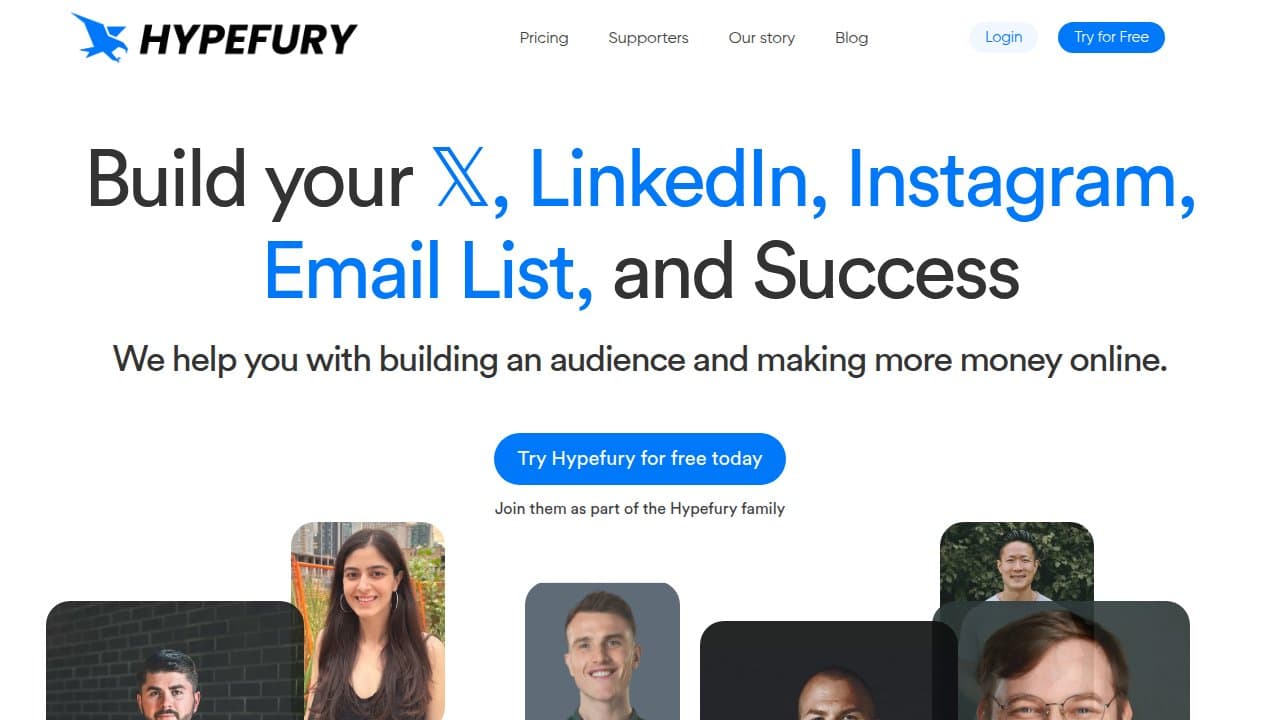

Hypefury is a scheduling and automation platform built for X/Twitter creators and solopreneurs. It handles thread queuing, evergreen reposting, auto-plugs on viral posts, cross-posting to six platforms, and Gumroad sales automation from one dashboard.
Hypefury is a social media scheduling and automation platform built by Samy Dindane and Yannick Veys, two indie hackers who launched the product in late 2019 after Samy built the initial MVP in three days. The tool is designed for creators, solopreneurs, and personal-brand builders who treat X/Twitter as their primary growth channel and need a way to batch content, automate engagement triggers, and push that content across Instagram, LinkedIn, Threads, Facebook, Bluesky, TikTok, and Mastodon without managing each platform separately. Hypefury now claims to have helped over 100,000 people build online audiences, with more than 5 billion impressions generated through scheduled posts.
The platform's core loop is built around three automation pillars: scheduling (thread queues, time-optimized posting, evergreen recycling of top posts), engagement (autoplugs that auto-comment your product link when a post crosses an engagement threshold, Auto-DM campaigns, keyword tracking), and cross-platform distribution (tweet-to-Reels conversion, one-click LinkedIn and Instagram repurposing). A viral inspiration panel pulls high-performing posts from across 15 niches so you can remix proven formats. Gumroad integration lets you automatically promote digital products on posts that go viral, turning audience moments into revenue without watching a dashboard. All four paid plans include a 7-day free trial; there is no free tier.
What Hypefury actually is in June 2026
Hypefury launched as a Twitter-only scheduling tool in 2019 and has since expanded its platform support significantly. As of mid-2026, it supports X/Twitter, LinkedIn, Instagram, Threads, Facebook, Bluesky, TikTok, and Mastodon. The X/Twitter layer remains the most deeply engineered: you can schedule full threads, set posts to auto-repost at intervals you control, trigger autoplugs (auto-replies) when engagement hits a threshold you define, and run Auto-DM campaigns to welcome new followers or distribute lead magnets. The other platforms receive solid cross-posting support, but X-specific automations like autoplugs and evergreen cycling are not replicated elsewhere.
The post-inspiration gallery deserves mention because it addresses a real friction point: most scheduling tools assume you already have ideas. Hypefury ships a curated library of high-performing post structures across niches including finance, fitness, marketing, and tech, so you can pick a proven hook and rewrite it in your own voice. It is not AI-generated content in the modern sense; it is template-based inspiration, which is honest and avoids the generic-output problem that plagues pure AI writing tools. If you want to pair AI generation with Hypefury's scheduling, you do that outside the tool and paste the result in.
In January 2023, Twitter's sudden API ban for third-party client apps (Tweetbot, Echofon, Twitterrific) caused significant alarm among Hypefury's user base. Co-founder Yannick Veys published a detailed public response explaining why Hypefury was not at risk: scheduling apps that drive posting activity generate ad impressions and serve Twitter's business interests, while client apps that strip ads out of the reading experience do not. The distinction held. Hypefury's API access was not revoked, and the platform continued operating without disruption. The company used the moment to clarify its positioning as a creation and growth tool, not a consumption replacement.
"Hypefury shaves hours off my day. I can skip days and know content posts when away." - Dovid F., Marriage Therapist, Capterra, July 2023
"Hypefury does one thing, but it does it really well!" - Nikhil W., Founder, Marketing and Advertising, Capterra, January 2022
Where Hypefury sits versus Taplio and Buffer
The two most common comparisons users make when evaluating Hypefury are against Taplio (a LinkedIn-native tool) and Buffer (a general-purpose scheduler). The differences are mechanical, not cosmetic.
Taplio is a LinkedIn-exclusive platform. It runs a GPT-4-based writing assistant that generates post drafts in multiple styles, includes a built-in CRM with lead database and contact lists, and offers automated LinkedIn outreach and follow-up sequences. Taplio's analytics are deep on LinkedIn engagement: follower growth curves, post reach by content type, profile visits tied to specific posts. Hypefury has no CRM, no outreach automation, and no AI writing engine. If LinkedIn is your primary professional channel and you need to both create content and run lead-generation workflows from one tool, Taplio is the more complete solution. If X is your main platform and LinkedIn is secondary, Hypefury's cross-posting covers the basic use case without the Taplio price premium.
Buffer operates on a per-channel pricing model (starting around $6 per channel per month) and supports ten platforms including Facebook, Instagram, X, LinkedIn, Pinterest, TikTok, YouTube, Mastodon, Bluesky, and Threads. It also offers a functional free plan covering three channels. Buffer treats all platforms with roughly equal feature depth and is a strong choice for social media managers who post consistently across many networks and need clean team collaboration. The tradeoff is that Buffer has no X-native automation layer: no autoplugs, no evergreen recycling, no Auto-DM campaigns, no Gumroad integration. It schedules posts and measures results but does not engineer growth levers the way Hypefury does. For X-first creators who want automation, Buffer is too passive. For multi-platform teams who want simplicity and a free entry point, Buffer wins on breadth and cost.
Users who need both often pair Hypefury for X growth automation with a separate tool like Buffer or Hootsuite for the remaining platforms, accepting some duplication to get best-in-class automation on their primary channel. Taplio users sometimes reach for Publer as a budget multi-platform layer alongside their LinkedIn work.
How automation actually works inside Hypefury
The autoplugs system is the most distinctive feature. You write a reply once (for example, a link to your newsletter or a short pitch for your course), set an engagement threshold (say, 30 likes or 10 retweets), and Hypefury monitors your posts and auto-posts that reply whenever the threshold is crossed. This surfaces your offer exactly when a post is already gaining traction, which is when audiences are most receptive. The system runs continuously in the background without requiring you to watch your feed.
Evergreen reposting works similarly. You mark posts as evergreen, set a minimum gap (e.g., "never repost more than once every 30 days"), and Hypefury pulls from your best-performing backlog to fill scheduling gaps. This solves the blank-calendar problem that kills most creators' consistency streaks. The algorithm weights by engagement, so your genuinely high-performing posts surface more often than weaker ones.
The tweet-to-Reels conversion (available from the Creator plan upward) takes a text post and renders it as a formatted image or video clip ready to post to Instagram, TikTok, or LinkedIn. The conversion is template-based, not dynamic video generation, so what you get is a text-on-background card with your branding. It is sufficient for creators who repurpose quotes and threads but will not satisfy video-native content strategies. Teams building richer video content typically use Hypefury for X and reach separately for tools like ManyChat for Instagram DM automation or Taplio for LinkedIn depth.
The Gumroad integration deserves its own mention because it is genuinely unusual in the scheduling category. You connect your Gumroad store, define which products to promote, and set rules for when Hypefury should add a product plug as a reply to a high-performing tweet. This turns organic virality into revenue opportunities automatically. No competing general scheduler offers this natively.
Friction points users keep raising
The Starter plan at $29 per month is widely described as underequipped for real growth work. It limits you to one X account, one month of scheduling runway, 100 daily Auto-DMs, and engagement with only 30 other users. Most creators who intend to use the automation features meaningfully end up on the Creator plan at $65 per month. The jump from $29 to $65 is significant for solo creators still building their audience, and the review community consistently flags this gap as one of Hypefury's structural weaknesses.
Analytics depth comes up frequently. Hypefury shows post-level performance and highlights your top content, but it does not track follower growth curves, audience demographics, or the kind of cohort analysis available in dedicated analytics tools or even in X's native analytics. Users who need to report social media performance to clients or stakeholders typically export data manually or run a separate analytics layer.
Auto-DM automation sits in a grey zone. Hypefury's own documentation acknowledges that aggressive Auto-DM use can trigger X's spam filters. The platform says it works within X's API terms and coordinates with X representatives, but multiple user reviews note that the 100-DM daily Starter cap and the platform's own caution messaging suggest this feature carries real account risk if misconfigured or overused. One Trustpilot reviewer noted: "For auto-DMs it's terrible. Don't recommend if you're a serious account that needs to do more than 50 DMs a day."
Multi-platform parity is a recurring theme. Instagram, LinkedIn, and Threads receive cross-posting support, but the X-native automation features (autoplugs, evergreen recycling, keyword-triggered DMs) do not carry over. Users who expected equal depth on LinkedIn are often surprised. Hypefury is honest about this in its marketing, but the expectation mismatch still generates complaints.
AI content generation is absent. Hypefury offers post-inspiration templates but does not generate drafts. Users who want AI-assisted writing must bring content in from a separate tool. This is a real limitation compared to newer schedulers that bundle writing assistance. That said, many creators prefer this separation: they write in one focused environment and schedule in another.
Who Hypefury is for
Hypefury is the strongest fit for creators and solopreneurs who have committed to X/Twitter as their main distribution channel and want to spend less time manually posting while maximizing the reach of content that already performs. Coaches, consultants, course creators, and newsletter writers who monetize through digital products get particular value from the Gumroad integration and autoplugs system, which essentially automate the product-promotion part of their social media workflow.
Agencies managing multiple X accounts for clients benefit from the Business and Agency tiers, which raise X account limits to 10 and 15 respectively and include expanded Auto-DM capacity. The content calendar view and scheduled thread management are solid for client-facing work, though the lack of a team collaboration layer or client approval workflow means larger agencies still supplement with a project management tool.
Skip Hypefury if LinkedIn is your primary platform (use Taplio instead), if you need genuine multi-platform depth without a platform hierarchy (consider Buffer or Hootsuite), if your budget is constrained and you need a free entry point (Buffer's free plan covers three channels), or if you need AI-assisted content drafting built into your scheduling workflow. Also skip it if you are building your entire strategy on automated DMs: the Auto-DM feature is useful in moderation but not reliable as a primary outreach channel given X's enforcement patterns.
User Reviews
No reviews yet. Be the first to share your experience!
Sign in to write a review.
Related articles
Guides and articles related to Hypefury.

The Personal AI Productivity Stack (2026): One Tool Per Job, Nothing Extra

AI Instagram Reels Factory: 30 Reels/Day on Autopilot (2026)

AI Agents for Business: What They Actually Are and 12 Things You Can Automate Today

The AI Content Automation Stack: 7 Tools That Run a Full Blog Without a Team

Replace 6 SaaS Subscriptions With 4 n8n AI Agents (2026)