The Perplexity Due-Diligence Prompt Library: 10 Prompts That Surface Red Flags (2026)
The Perplexity Due-Diligence Prompt Library: 10 Prompts That Surface Red Flags (2026)
You open the deck. The company looks clean. But a single sourced finding from a well-aimed search can change the meeting entirely. Perplexity is useful for diligence because every answer ships with clickable citations you can verify in 30 seconds. This library gives you 10 paste-ready prompts a diligence team runs before a second-round meeting, covering litigation, leadership track record, talent churn, customer concentration, regulatory exposure, IP risk, growth-math, market timing, moat, and unit economics.
TL;DR
Generic "summarize this company" prompts miss adversarial signals entirely
Each of the 10 prompts targets one specific red flag category with sourced output
Always cross-check Perplexity's answer against a second source and save the citation link
A clean result is data, not confirmation: it means either genuinely low risk or the wrong question
Perplexity replaces early-pass desk research, not the lawyer or the banker
Why does a generic "give me a summary" prompt miss everything?
A neutral summary prompt tells Perplexity to be helpful and balanced, so it returns a balanced answer: products, funding, team highlights, market position. It has no adversarial framing, so it does not hunt for the things that kill deals. You need to ask for the bad thing specifically, or the model will not surface it.
The second problem is sourcing. A summary prompt often triggers synthesis without citations: you get a paragraph that sounds authoritative but points nowhere. Perplexity is built to show its work, and it does, but only when the question forces it to retrieve recent, specific facts rather than synthesize general knowledge. The prompts below are written to trigger retrieval mode: they ask for named events, dated filings, or quoted claims, which forces the model to find a source or say it cannot.
Third: surface-level summaries do not distinguish between a founder who exited one company well and one who left three with unpaid creditors. The framing in the prompt is what sharpens the output. Read our Perplexity research workflow guide for more on how prompt framing changes retrieval behavior.
What are the 10 due-diligence prompts, and what red flag does each one catch?
Each prompt below is paste-ready. Replace the bracketed placeholder with the company name. The table shows the exact prompt, the category it covers, and the specific red flag it is designed to surface. After the table, each prompt is explained with context on what a worrying answer looks like.
# | The prompt (paste-ready, replace [COMPANY]) | Red flag it catches |
|---|---|---|
1 | "List every lawsuit, regulatory action, or government investigation involving [COMPANY] since 2018. For each, include the filing date, the plaintiff or agency, the status, and a source link." | Undisclosed litigation, regulatory sanctions, pattern of disputes |
2 | "Search for any companies previously founded, led, or backed by [FOUNDER NAME]. For each, note whether it succeeded, failed, was acquired, or had controversy. Include dates and source links." | Serial failure patterns, fraud allegations, misrepresented exits |
3 | "Find recent news, LinkedIn posts, Glassdoor reviews, or press coverage indicating layoffs, executive departures, or rapid employee turnover at [COMPANY] since 2022. Include dates and sources." | Culture breakdown, quiet exodus before a distress event |
4 | "Search for any public reporting, analyst notes, or press coverage indicating that [COMPANY] has one customer or a small group of customers accounting for a large share of its revenue. Include sources." | Customer concentration risk, dependency on a single buyer |
5 | "What regulatory, legislative, or policy changes at the federal or state level could negatively affect [COMPANY]'s business model in the next three years? List the specific rules and the agency. Include sources." | Regulatory headwinds that compress margins or block the model |
6 | "Find any patent infringement claims, intellectual property disputes, or trade secret litigation involving [COMPANY] as plaintiff or defendant since 2015. Include case names, courts, and source links." | IP ownership risk, litigation drag, moat that is contested |
7 | "[COMPANY] claims [X% growth / Y ARR / Z user count]. Find any independent analyst, journalist, or investor commentary that questions or contradicts these growth claims. Include dates and source links." | Inflated metrics, channel stuffing, vanity numbers dressed as traction |
8 | "Who are [COMPANY]'s three largest direct competitors, and what does recent coverage say about market share shifts between them? Are there any reports of the market shrinking or consolidating? Include dates and sources." | Bad timing: entering a declining or already-consolidated market |
9 | "Find any analyst, investor, journalist, or industry expert who has argued that [COMPANY]'s competitive advantage is weaker than claimed, or that a larger player could replicate it easily. Include the argument and source." | Thin moat: defensibility is claimed but not independently supported |
10 | "Find any public reporting, investor letters, or analyst coverage that questions [COMPANY]'s unit economics: CAC, LTV, payback period, gross margin, or burn rate. Include the specific concern raised and a source link." | Unit-economic gaps: growth funded by subsidy, not by a real margin |
A few notes on using the table. Prompt 7 requires you to fill in the specific claim being checked (the growth number or metric the company advertises). Prompt 9 works best when you already know the company's stated moat from its own materials, so the question has something to push against. For private companies, prompts 3, 4, and 10 rely on press coverage and Glassdoor-style sources rather than filings, so expect lower coverage than for public companies.
If you do diligence across multiple asset classes, the finance and legal AI tools directory lists additional tools that pair well with Perplexity for document review and contract analysis.
What is the pairing pattern: prompt, cross-check, extract the link?
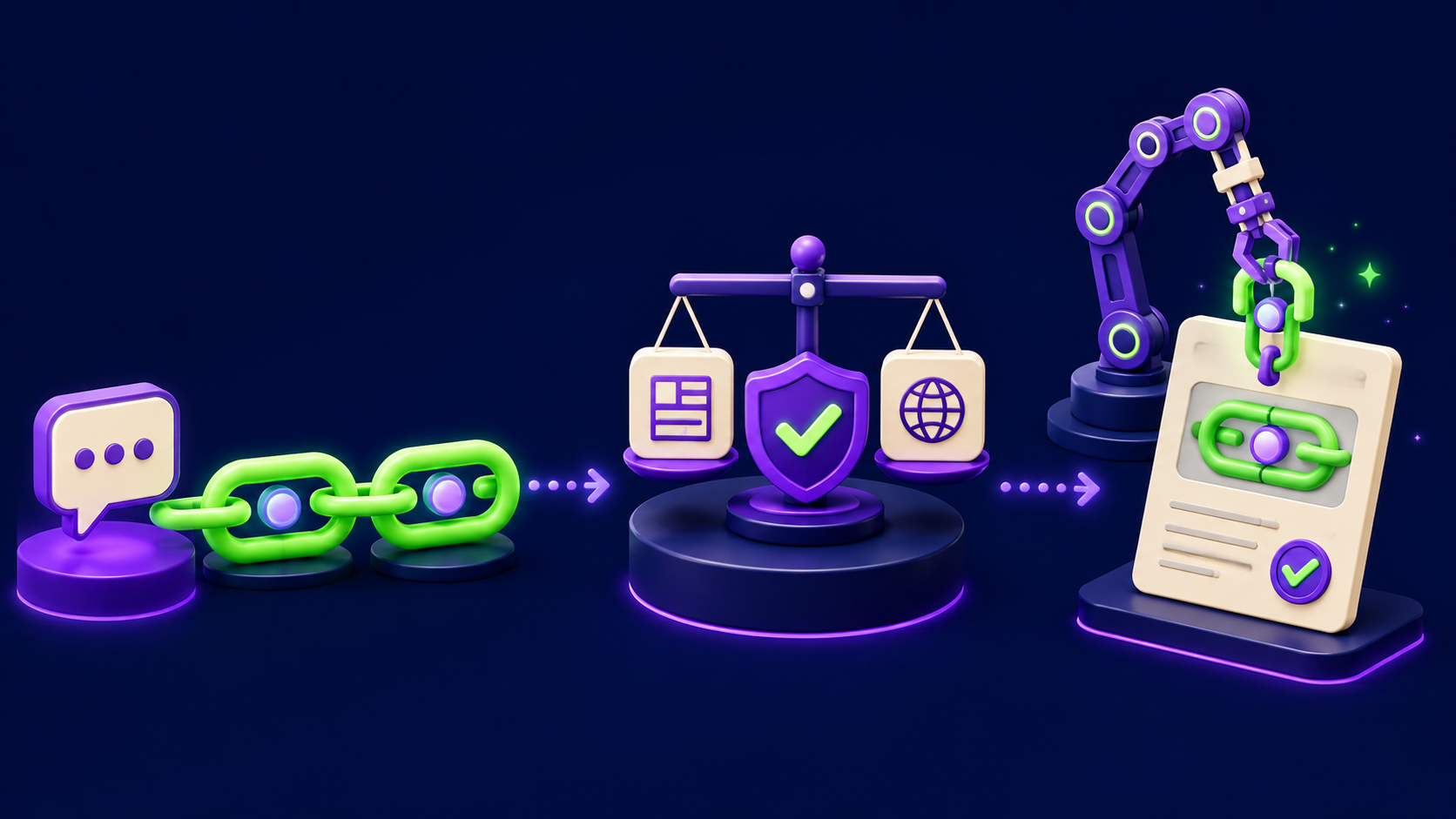
Running the prompt is step one. A Perplexity answer with a citation is a lead, not a conclusion. The discipline that makes a finding defensible is the three-step pairing pattern: run the prompt, open the top cited source and verify the claim yourself, then save both the Perplexity URL and the primary source URL in your diligence log.
The sequence for each prompt:
Run the prompt in Perplexity and note the answer and the citation list.
Open the most relevant citation. Confirm the specific fact Perplexity stated is actually present in the source. If Perplexity says "the company faced an SEC investigation in 2021" and the linked article says "the company received an SEC inquiry letter" those are different risk levels.
If the source is a court filing or SEC document, go to the primary database (SEC EDGAR at sec.gov, PACER for federal court records) and pull the actual document. The news article is the lead; the filing is the fact.
Log the finding as: prompt used, Perplexity answer summary, primary source URL, date of source, your one-line interpretation. That structure makes every finding attributable in a memo.
The reason this matters: Perplexity cites real sources but occasionally misattributes a detail to the closest relevant article rather than the original filing. You catch that in step 2. One quick check takes 60 seconds and separates a finding you can put in a memo from one you cannot. Teams that skip step 2 and paste Perplexity summaries into diligence memos are outsourcing verification to a language model, which is not what Perplexity is designed for.
What does it mean when the prompt finds nothing?
A clean result is real information, but it requires interpretation. There are two very different situations that produce an empty-looking answer, and conflating them is a common diligence error.
The first situation: the company is genuinely clean on this dimension. No filed suits, no documented executive departures, no analyst questioning the growth math. That is useful to know, and you note it as low signal-to-noise on this prompt. The second situation: the company is private, small, or simply under-covered. Perplexity retrieves from the open web. A 40-person B2B SaaS company may have zero press coverage of its customer concentration because no journalist has written about it. The clean result means "nothing findable on the public web," not "nothing to find." Private-company diligence requires primary sources (reference calls, data room review, rep-and-warranty insurance underwriting) that Perplexity cannot replace.
A useful check: after running a prompt that returns nothing, search the company name in quotes on Google News with a date filter. If Perplexity and Google News both return nothing, you have triangulated the absence. If Google News turns up something Perplexity missed, note the gap and pull the source manually. Clean results from Perplexity on public companies with significant press coverage are more meaningful than clean results on private or micro-cap companies.

What does a worked example run look like?
The following example uses a clearly illustrative company to show the full sequence without fabricating claims about any real business. Call it "Acme Platform Corp," a hypothetical mid-stage B2B SaaS company raising a Series B. The goal: run prompt 7 (growth-math sanity check) and show the complete output-to-memo step.
Prompt you paste into Perplexity:
"Acme Platform Corp claims 3x year-over-year ARR growth and 200% net revenue retention. Find any independent analyst, journalist, or investor commentary that questions or contradicts these growth claims. Include dates and source links."
Hypothetical Perplexity output (illustrative, not real): Perplexity returns two citations. One is a January 2026 TechCrunch article noting that a competitor reported declining NRR in the same vertical. The second is a LinkedIn post from a former Acme customer who switched platforms citing pricing pressure that does not match a 200% NRR claim.
Step 2, cross-check: You open the TechCrunch article. It covers the competitor, not Acme directly. That is a market signal, not a company-specific red flag. You note it as "vertical NRR compression possible, not company-confirmed." You open the LinkedIn post. It is public and dated. You screenshot it and log the URL.
Step 3, your log entry: "Prompt 7 (growth-math sanity). No direct analyst contradiction of Acme's claimed metrics. Indirect signal: competitor NRR declining in same vertical (TechCrunch, Jan 2026, URL). Customer attrition post (LinkedIn, Mar 2026, URL). Recommend requesting NRR cohort data in data room and asking reference customers about expansion behavior."
That is the full loop: prompt, source, verify, log, next action. This is how one Perplexity session turns into a defensible diligence finding rather than a summary you would be embarrassed to cite in a memo. For context on what operators charge to build AI-assisted research workflows like this, the 2026 AI automation rate card has market benchmarks.
Need a diligence research workflow built for your team?
Vantaige builds AI-assisted research and automation workflows for investors, operators, and legal teams, including Perplexity-based diligence pipelines that log findings directly into your deal tracking system. Talk to us about a free automation audit and we will map exactly where AI can replace desk hours in your current process.
FAQ
Does Perplexity replace a lawyer or investment banker in due diligence?
No. Perplexity replaces the early-pass desk research that would otherwise take a junior analyst several hours: news sweeps, public litigation searches, executive background checks against press coverage. Lawyers review actual contracts and filings. Bankers model financials with data room access. Perplexity surfaces leads that tell you which primary sources to pull and which questions to ask in the management meeting.
Is Perplexity Pro worth it for diligence work specifically?
Yes, for serious diligence use. The Pro tier uses more capable underlying models, accesses more recent indexing, and allows more queries per day. For a one-time check on a single company, the free tier covers the basics. For ongoing deal flow where you are running 10 prompts per company across 5 to 10 companies per week, Pro reduces query limits from a bottleneck to a non-issue.
How do I know whether to trust a Perplexity source?
Open the citation and read it yourself. The question is not whether you trust Perplexity but whether the source it cites is authoritative. A SEC EDGAR filing, a court docket, a well-known financial journalist's byline, and a random blog post all require different levels of skepticism. Perplexity's value is finding the source quickly; your judgment determines whether the source holds up.
Can Perplexity read SEC filings directly?
Perplexity can retrieve and summarize content from publicly indexed SEC filings on sec.gov. It does not replace direct EDGAR searches for complete filing sets (every 10-K, proxy, or 8-K for a company). For public companies, run the Perplexity prompt to get a summary lead, then go to SEC EDGAR directly and pull the actual document to verify the specific language. EDGAR full-text search (efts.sec.gov) lets you search inside filings by keyword.
What about private companies with limited public coverage?
Private companies with limited press coverage return weaker Perplexity results. The prompts still work, but a clean result is less meaningful: it often means the company is simply under-covered, not genuinely clean. For private-company diligence, use Perplexity for what exists (founder backgrounds, any press, any regulatory notices that are public), and rely more heavily on primary sources: reference calls, data room documents, rep-and-warranty diligence processes, and LinkedIn for employment history verification.
How accurate are Perplexity's citations?
Perplexity cites real URLs and generally attributes claims correctly, but it does occasionally pull a fact slightly out of context or attribute a claim to the nearest relevant article rather than the original filing. The rate of misattribution is low enough that Perplexity is useful for desk research, but high enough that you should not paste its summary into a diligence memo without verifying the source yourself. The three-step pairing pattern in this article (prompt, open source, log) closes that gap.
Can I run these prompts for vendor diligence, not just investment diligence?
Yes. The prompts work for any company you are vetting: a critical software vendor, a potential acquisition, a hiring decision for a senior executive, or a new channel partner. Adjust the framing slightly. For a vendor, prompt 5 (regulatory headwinds) might focus on data-privacy compliance for a company that will handle your customer data. For a potential employer, prompt 3 (talent churn) and prompt 2 (founder track record) are the highest-value starting points.
What is the right order to run the 10 prompts?
Start with the deal-breaker categories first: prompt 1 (litigation), prompt 2 (founder track record), and prompt 6 (IP disputes). If any of those return substantive findings, you may not need the rest before deciding whether to continue. Then run prompt 7 (growth-math sanity) and prompt 10 (unit economics) before any financial modeling work. Save prompts 3, 4, 5, and 8 for the deeper pass once the table-stakes checks are clear.
Related from Vantaige
References
Perplexity AI, product documentation and how Perplexity retrieves and cites sources. perplexity.ai
U.S. Securities and Exchange Commission, EDGAR full-text search system for public company filings. sec.gov
a16z, public writing on due diligence frameworks and what venture investors check before leading a round. a16z.com
Sequoia Capital, public diligence and company building guides used by operators and investors. sequoiacap.com
Get the best new AI tools and guides, weekly
One short email a week. The tools worth trying, the guides worth reading, nothing else.
No spam. Unsubscribe anytime.
Aymen B
Contributing writer at Vantaige, covering the AI tools ecosystem.
Similar articles
TAM SAM SOM Market Sizing With Perplexity: The Sourcing Pattern That Survives Pushback (2026)
How to Research a New Industry Fast: The 30-Minute Perplexity Template (2026)