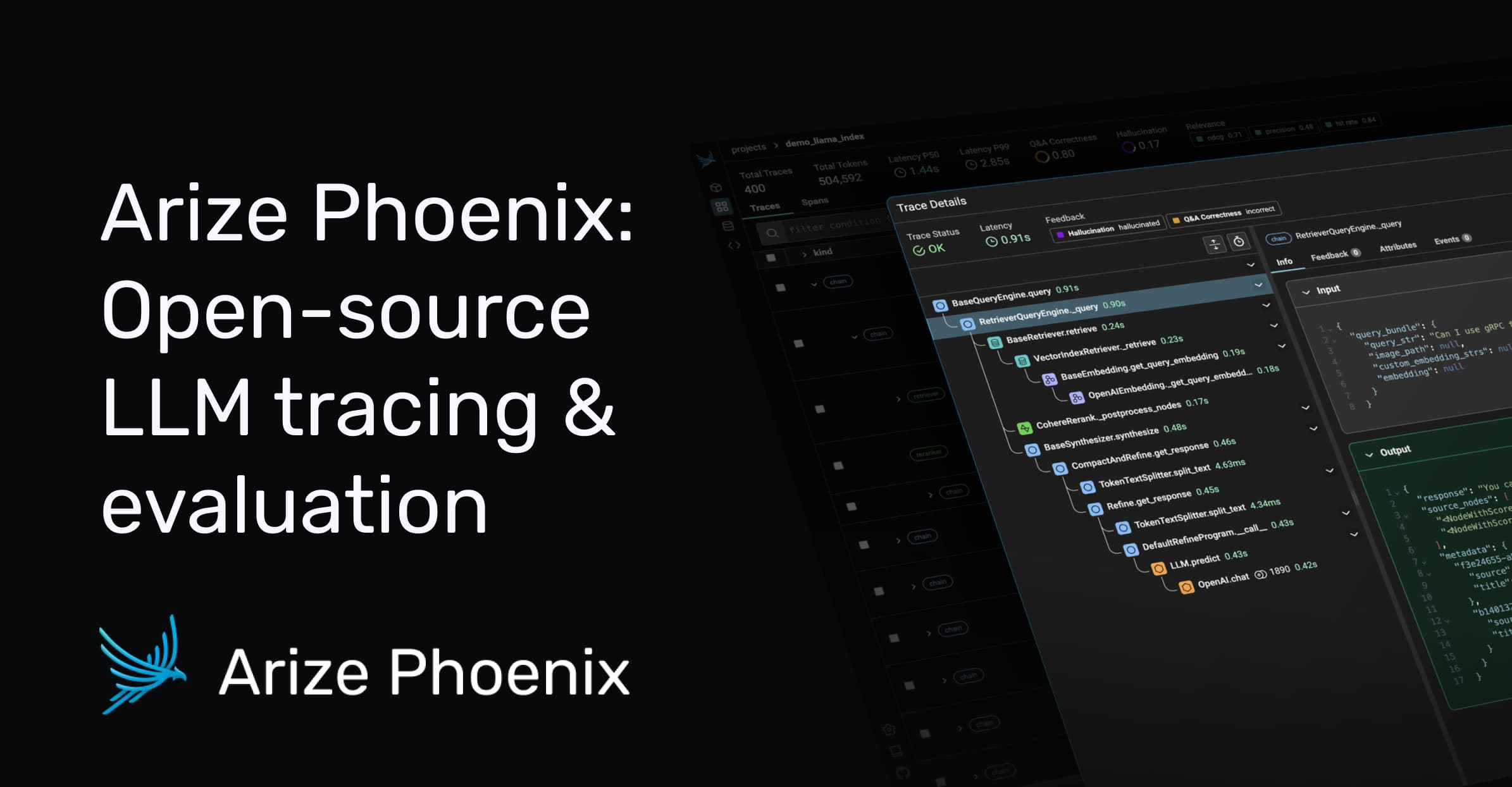
Arize Phoenix is an open-source, OpenTelemetry-native observability and evaluation platform for LLM apps and agents. It traces every call, scores it with 50+ built-in evaluators, and self-hosts for free, which makes it the standard pick for vendor-neutral teams.
Arize Phoenix is an open-source observability and evaluation platform for LLM applications and AI agents, built by Arize AI, the San Francisco company that started in 2020 as a machine-learning monitoring tool. It exists to solve a specific kind of blindness: LLM and agent failures, hallucinations, bad retrievals, prompt regressions, and runaway tool loops, are nearly invisible without instrumentation. Phoenix captures every step of a model call as a trace, scores it with built-in evaluators, and gives engineers a workflow to find and fix the failures. The architectural decision that defines it is that Phoenix is built on OpenTelemetry and the OpenInference conventions, so it works with whatever framework or provider you already use, and you can self-host the whole thing for free.
Phoenix ships tracing as span trees of prompts, retrievals, tool calls, tokens, and latency, more than 50 research-backed LLM-as-judge evaluators that return explanations rather than bare scores, datasets and experiments for systematic before-and-after comparison, prompt management, and embedding-drift analysis inherited from Arize's ML roots. A built-in AI agent called PXI can debug traces and iterate on prompts inside the tool, and Phoenix ships a Model Context Protocol server so coding assistants can query traces directly. It is free under the Elastic License with an optional hosted Phoenix Cloud, while the separate commercial Arize AX platform adds enterprise features. Arize raised a $70 million Series C in February 2025, so the project is not a side experiment.
What Arize Phoenix instruments in June 2026
The core loop is instrument, trace, evaluate, iterate. You add a couple of lines using an OpenTelemetry-compatible library, and Phoenix records every span of an LLM call chain, then lets you run evaluators over those spans to grade faithfulness, relevance, hallucination, toxicity, and more. Because the evaluators return explanations, you see why a span was flagged, not just that it was. Traces export into datasets, datasets feed experiments, and experiments let you compare a new prompt or model against a fixed benchmark. The embedding-analysis view, a holdover from Arize's monitoring heritage, clusters outliers and detects drift, which is genuinely useful for RAG systems. This momentum is backed by real money: Arize's $70 million Series C, announced on February 20, 2025 and led by Adams Street Partners with M12, Datadog, and PagerDuty participating, was billed as the largest investment in AI observability to date, with Phoenix already at more than two million monthly downloads.
Phoenix versus Langfuse and Braintrust
The cleanest way to place Phoenix is against the two tools teams weigh it against.
"If you're on LangGraph, LangSmith is the right choice. If you're framework-agnostic, Langfuse. If eval rigor is the priority, Arize Phoenix." Engineering observability retrospective, March 2026.
Langfuse is MIT-licensed where Phoenix uses the Elastic License, which matters if you want to resell or embed the tool, something Phoenix's license forbids and Langfuse's permits. Langfuse also moved to a ClickHouse backend and was acquired by ClickHouse in January 2026, giving it analytical scale past the roughly 200-million-span ceiling Phoenix's PostgreSQL store hits, and it offers full feature parity between cloud and self-host. Phoenix counters with deeper evaluation primitives and ML-heritage drift detection. Braintrust takes the opposite philosophy, an eval-first, CI/CD-native, proprietary SaaS with no free self-hosted tier, where Phoenix is OpenTelemetry-first and self-host-first. Braintrust wins for teams that want evals as a merge-blocking quality gate; Phoenix wins for teams that need vendor-neutrality and free self-hosting.
The open-source line, and where Arize AX begins
Phoenix open-source is free with no span or retention caps, self-hosted on your own PostgreSQL via Docker or Kubernetes. Phoenix Cloud adds a free hosted option for smaller teams. The paid product is a different thing: Arize AX, which starts with a free tier at 25,000 spans per month, moves to AX Pro at $50 per month for 50,000 spans with overage at $10 per additional million, and tops out at AX Enterprise with SOC 2, HIPAA, self-hosting with data residency, and online evaluations on live traffic. The catch worth knowing is that graduating from Phoenix to AX is a new sales contract, not a transparent tier bump, and AX's span-based pricing climbs fast on agent workloads where one user action can spawn hundreds of spans. Teams comparing eval platforms should also weigh Weights and Biases, whose Weave product covers similar ground from an experiment-tracking lineage.
Where Phoenix strains
The most concrete limit is scale. The span-tree UI that makes small traces readable becomes unwieldy on large agent runs, and the PostgreSQL backend has a real ceiling.
"We peaked at about 200M spans and a little over 2TB, and our phoenix deployment is more or less non functional." Dillon D., Arize community forum, 2025.
Beyond raw scale, Phoenix shows span trees rather than readable conversation transcripts, which slows multi-turn agent debugging, and its access model is engineering-only, so product managers or domain experts cannot upload datasets or review results without Python and engineering help. The evaluators are useful for trend monitoring but not infallible, with the hallucination judge documented at around 82% agreement with human labels and a 12% false-positive rate, so they should inform decisions rather than make them automatically. Built-in support for evaluating full multi-turn trajectories also lags single-prompt evaluation.
Who Phoenix suits, and who outgrows it
Phoenix is an excellent fit for ML and AI engineers who want self-hosted, vendor-neutral observability at no platform cost, for teams with data-residency requirements that keep traces on-premises, for multi-framework shops that benefit from OpenTelemetry instrumentation, and for anyone who values deep evaluation primitives with statistical rigor. Teams already on Arize AX use Phoenix as the local-development complement.
It is the wrong tool for non-technical stakeholders who need no-code review workflows, for extreme trace volumes beyond what self-managed PostgreSQL handles unless you move to AX Enterprise, and for LangChain-first shops that get more from LangSmith's deep per-node integration. Teams that want automated CI/CD gates that block deployments are better served by Braintrust or Opik, and anyone who wants to resell or embed the observability layer should choose a permissively licensed option like Langfuse, since the Elastic License prohibits that.
User Reviews
No reviews yet. Be the first to share your experience!
Sign in to write a review.
Related articles
Guides and articles related to Arize Phoenix.

The Personal AI Productivity Stack (2026): One Tool Per Job, Nothing Extra
Grok 4.3 API for Agents (May 2026): Pricing, Benchmarks, Migration

AI Security Tools for Small Teams (2026): The Stack That Doesn't Need a SOC

Nous Hermes 4: The Self-Hosted Open-Weight Agent Brain (2026)
AI User Testing in 2026: The Tools That Test Your Product While You Sleep