How to Research a New Industry Fast: The 30-Minute Perplexity Template (2026)
How to Research a New Industry Fast: The 30-Minute Perplexity Template (2026)
You walk into a discovery call knowing almost nothing about the client's vertical, and the prospect senses it in the first five minutes. The questions you ask sound generic, the vocabulary is slightly off, and trust evaporates before you have pitched anything. The fix is a repeatable 8-question research template you run in Perplexity before every call, which gets you from zero to credible in about 30 minutes. According to Perplexity's own documentation, the tool draws on live web sources and cites them inline, which matters when you need current information on a fast-moving vertical.
TL;DR
Eight targeted questions cover every dimension a client cares about
Run 3 sources per question, including one skeptical or contrarian source
Compress findings into a one-page brief your team reads in under 5 minutes
The same template works across manufacturing, healthcare SaaS, fintech, and any other vertical
AI research speeds discovery; the calls it replaces are manual LinkedIn crawls and outdated PDFs
Why is the first call where deals die?
You sound like an outsider when you ask questions the client expects any serious vendor to already know. The prospect's mental model is: if they do not know our world, they will waste our time. That judgment forms in the first three to five minutes and is hard to reverse.
Sharp discovery questions require fluency in the client's language, their org chart, their current problems, and the pressures their industry faces right now. You cannot fake that fluency in real time. You have to build it before the call, and most people skip that step because they do not have a fast, structured way to do it. The template below is that structure.
The consequence of skipping is concrete. You end up in a conversation about your capabilities rather than their problems. Deals that start there rarely close, because you are selling into a gap rather than a felt need. The 30 minutes before the call is the highest-value time in the sales cycle.
What are the 8 questions in the industry research template?
The eight questions below cover every angle a client cares about. Run each one as a separate prompt in Perplexity. The table shows the question, what you learn, and exactly how the answer changes your call.
Question | What you learn | How you use it on the call |
|---|---|---|
1. What is the market size and overall shape of this industry in 2025-2026? | Total addressable market, growth rate, geographic concentration, whether the industry is growing or contracting | Opens the call with a shared frame. "You are operating in a market that X analysts peg at roughly Y" signals you did your homework. |
2. Who are the top 5 to 10 players and what is their current competitive posture? | Incumbents, challengers, recent M&A, who is losing share and who is gaining it | Lets you ask "where do you sit relative to [named competitor]?" instead of "who are your competitors?" |
3. What regulations or compliance requirements govern this industry right now? | Licensing, reporting mandates, recent enforcement actions, pending legislation | Avoids proposing solutions that violate compliance constraints. Shows you understand their legal environment. |
4. What does the buyer's typical org chart look like? | Decision-maker titles, budget ownership, procurement process, typical committee composition | You can map your current contact to the org and ask precise questions about who else is involved. |
5. What is the typical vendor and technology stack in this vertical? | Systems they likely already run (ERP, CRM, industry-specific platforms), integration constraints | You can ask "Are you on [platform X]?" instead of "what systems do you use?" and build instant credibility. |
6. What language and jargon does this industry use? | Acronyms, terms of art, metrics they track (e.g., CAR in insurance, ARR in SaaS, OEE in manufacturing) | Use their vocabulary throughout the call. Nothing signals outsider status faster than using the wrong term for a standard concept. |
7. What are the top 3 pains or operational problems this industry faces right now? | Talent gaps, margin pressure, supply chain issues, technology debt, market-access barriers | Opens with "We often hear from [industry] leaders that [pain] is the top priority right now. Is that true for you?" Already a discovery question. |
8. What near-future shifts are most discussed in this vertical (next 12-24 months)? | Regulatory changes coming, technology shifts, consolidation waves, macro factors | Positions you as someone thinking about their future, not just their present problem. Creates urgency conversations. |
For a deeper walkthrough of how to build research prompts that pull cited, current answers, see the Perplexity research workflow tutorial. The short version: treat each of the 8 questions above as a standalone prompt, not a list you paste in together. Perplexity answers one focused question better than eight bundled ones.
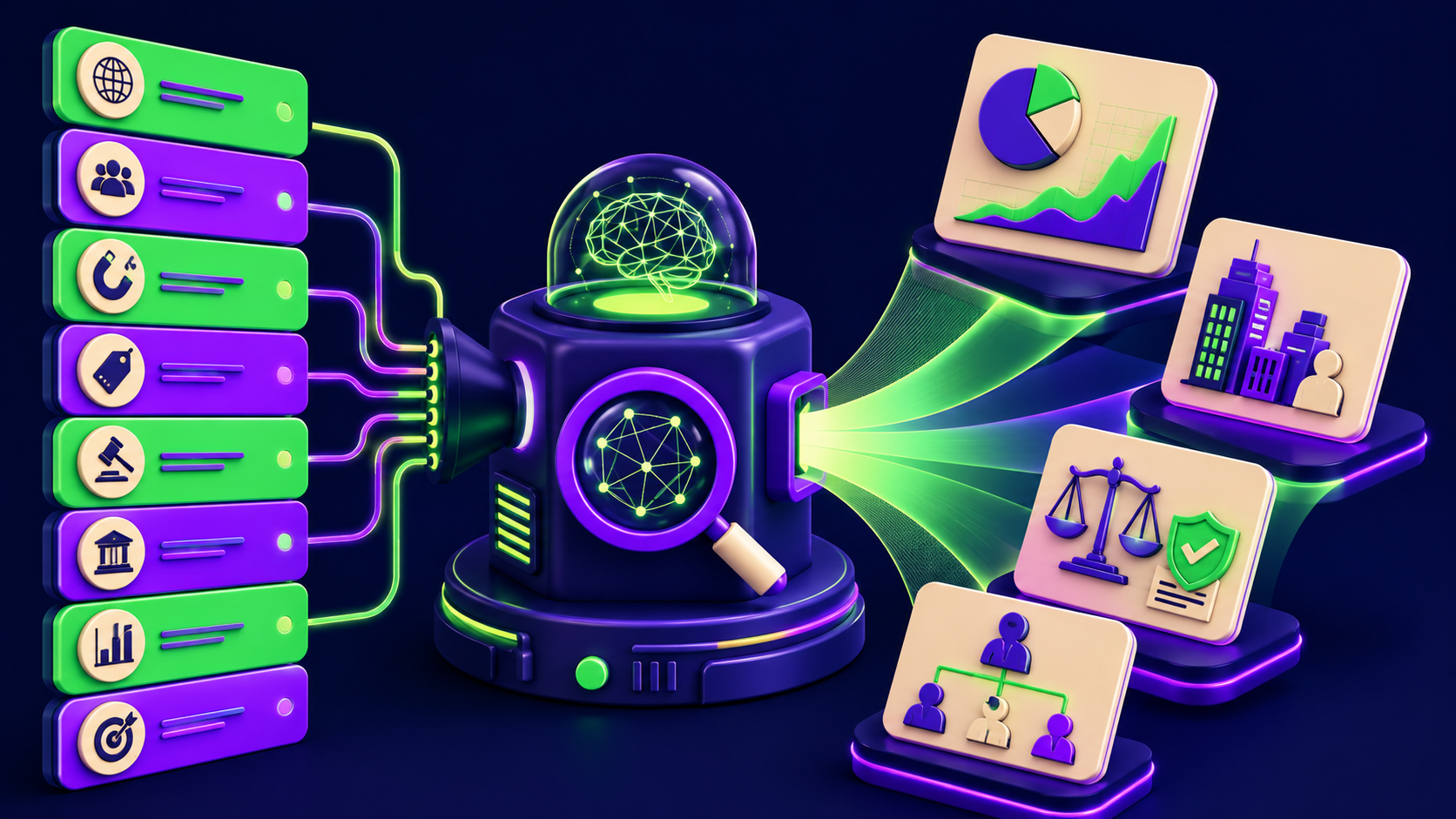
The 8 paste-ready prompts
Copy each prompt, replace [INDUSTRY] with the specific vertical (e.g., "healthcare revenue cycle management" or "independent pet supply retail"), and run in Perplexity with Focus set to Web or News for currency.
Prompt 1: "What is the total market size and growth rate for [INDUSTRY] in 2025-2026? Include geographic concentration and whether the market is consolidating or fragmenting. Cite sources."
Prompt 2: "Who are the top 5 to 10 companies in [INDUSTRY] right now? Describe their current competitive posture, recent M&A activity, and who is gaining or losing market share. Cite sources."
Prompt 3: "What are the key regulations and compliance requirements that govern [INDUSTRY] in 2025-2026? Include any recent enforcement actions or pending legislation that operators are watching."
Prompt 4: "What does the typical buyer org chart look like in a mid-market [INDUSTRY] company? Who owns budget for [your service category], who are the technical gatekeepers, and what does the procurement process look like?"
Prompt 5: "What is the standard technology and vendor stack for a mid-market [INDUSTRY] company in 2025? List the ERP, CRM, and any industry-specific platforms that are most commonly deployed."
Prompt 6: "What are the most important acronyms, terms of art, and key performance metrics used in [INDUSTRY]? Include at least 10 terms a consultant entering this space should know."
Prompt 7: "What are the top operational problems, cost pressures, and strategic pain points for [INDUSTRY] companies in 2025-2026? Be specific, not generic."
Prompt 8: "What shifts are [INDUSTRY] executives most focused on over the next 12 to 24 months? Include regulatory changes, technology disruptions, and market-structure changes already underway."
What is the cross-check step?
Running three sources per question, and deliberately including one contrarian or skeptical voice, protects you from the single biggest failure mode of AI research: a confident, coherent answer that is out of date or one-sided.
For each of the 8 questions above, after you get Perplexity's answer, run two additional checks. First, go to a data-backed source like Statista or IBISWorld for market-size figures, which tend to be more precisely sourced than general web synthesis. Second, find one article or analyst note that pushes back on the dominant narrative. If the consensus says the market is growing at 15 percent annually, find the skeptic who explains why that projection is optimistic. Your client likely knows the counterargument. If you do not, you look like you read only press releases.
The cross-check takes about 5 extra minutes and turns a competent brief into a credible one. It also protects you in regulated industries where a single outdated regulatory fact can derail a call entirely.
What deliverable format does your team actually read?
A one-page industry brief, not a 20-tab document, is the deliverable that gets used. The goal is a single page your team reads in under 5 minutes before a call, not a research archive. Longer is not better; longer is unread.
Structure the one-pager in this order: market snapshot (3 sentences: size, growth, shape), key players (5 names and one phrase about each), regulatory watch items (bullet list of 3 at most), org chart (a 4-box sketch: economic buyer, technical buyer, champion, blocker), likely tech stack (5 to 8 platforms), jargon cheat sheet (10 terms max), top 3 pains, and one near-future shift to bring up. That is the whole brief. If it exceeds one printed page, you have not edited it.
Teams that try to share a 30-page document before a call read none of it. The constraint of one page forces you to decide what matters, which is itself valuable preparation. The brief also makes a good leave-behind if you adapt it for the client: "here is how we thought about your market before we arrived" builds immediate trust.
For consultants and agency owners managing multiple active clients at once, the AI tools for business hub has a curated shortlist of tools that handle brief creation, document summarization, and client research at scale.
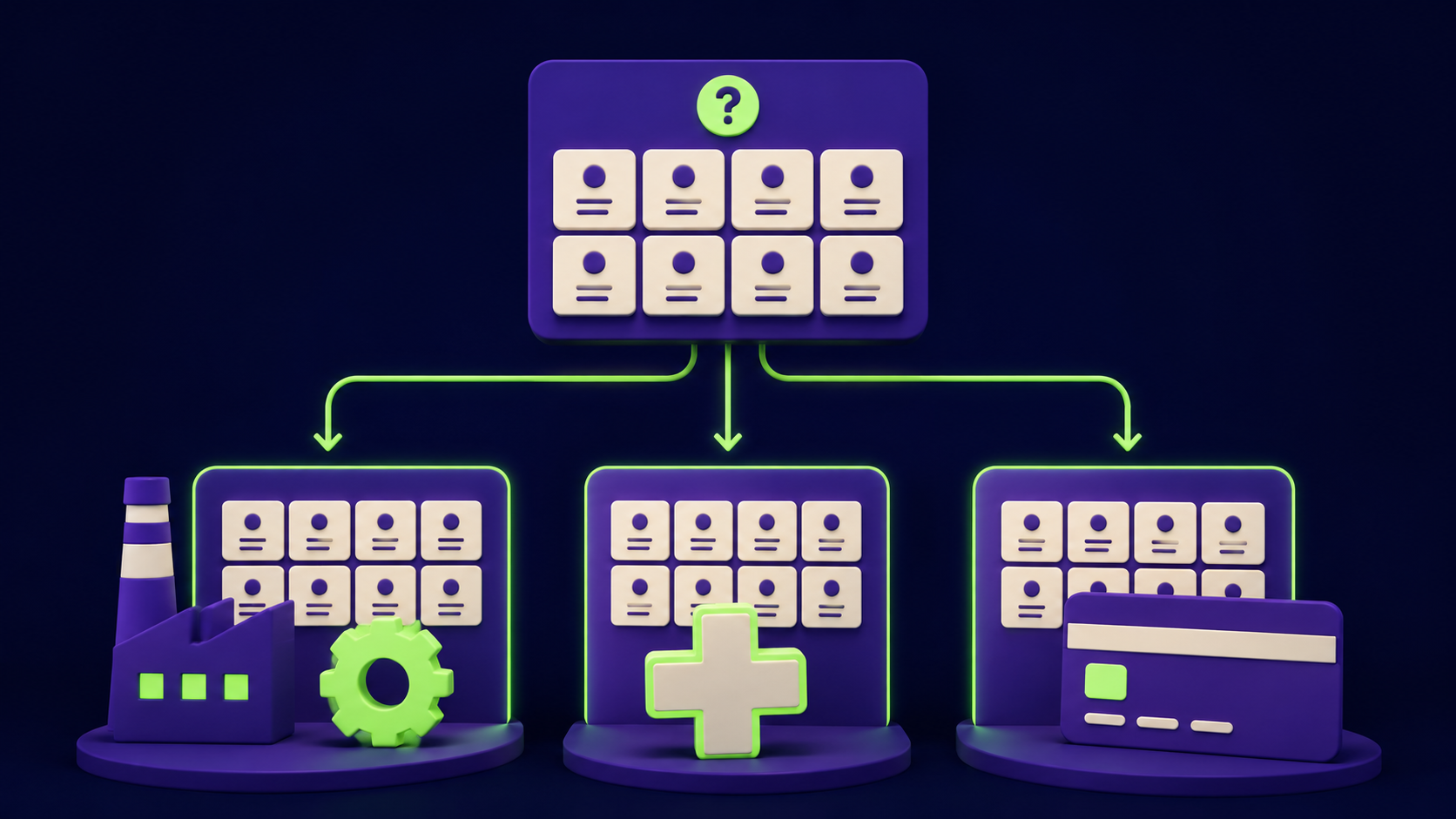
How does the same template produce different answers across verticals?
The template is constant; the inputs and outputs are not. Walking through three verticals shows how the same 8 questions surface very different call-ready intelligence depending on the industry.
Manufacturing (industrial components supplier)
Market shape: highly fragmented, with consolidation driven by private equity. The buyer org chart has a VP of Operations or plant manager as the economic buyer, not a CTO. The typical tech stack includes an ERP (SAP or Oracle EBS in larger shops, Epicor in mid-market), a CMMS for maintenance, and often a legacy MES that nobody wants to replace. The key jargon includes OEE (overall equipment effectiveness), MTBF (mean time between failures), and SKU rationalization. The current pain is skilled-labor scarcity driving interest in any automation that reduces headcount dependency. The near-future shift is reshoring pressure from tariff volatility, which is accelerating domestic capex.
How this changes the call: you open with "we're hearing from plant managers that labor availability is the single biggest constraint on throughput right now" rather than a generic capabilities pitch. You ask about their ERP by name. You use OEE as a natural unit of measure for improvement.
Healthcare SaaS (revenue cycle management software)
Market shape: consolidating fast, with a handful of large platforms (Waystar, Change Healthcare, Veradigm) absorbing point solutions. The buyer has a dual org structure: a VP of Revenue Cycle or CFO owns the business decision, but an IT director or CISO owns the security review, and both must sign off. The regulatory environment is dense: HIPAA, the No Surprises Act, and CMS reimbursement rule changes in 2025 are all live concerns. The tech stack involves the EHR as the system of record (Epic, Cerner, or Meditech depending on health system size), with the RCM platform sitting downstream of it. Key jargon: days in AR, denial rate, clean claim rate, prior authorization burden. The current pain is denial rate increases from payer rule changes and the shortage of certified coders. The near-future shift is AI-assisted prior auth, which CMS is actively watching.
How this changes the call: you do not pitch "AI automation" generically. You ask specifically about their denial rate trend and whether they are seeing prior auth turnaround times increase. You reference HIPAA compliance as a baseline expectation, not a differentiator, and you ask how their EHR vendor is positioning on AI so you know whether you are supplementing or competing.
Fintech (B2B payments infrastructure)
Market shape: two-tier structure, with licensed money transmitters (Stripe, Adyen, Braintree) at the infrastructure layer and a large ecosystem of vertical SaaS companies building payment features on top. The buyer for an infrastructure deal is a VP of Engineering or Head of Payments; for a software-layer deal, it is a CPO or CTO. Regulatory concerns include PCI DSS compliance, state money-transmitter licensing if the client is processing directly, and FinCEN reporting requirements. The typical stack at a fintech startup includes a payment processor, a KYB/KYC vendor, and often a banking-as-a-service layer (Unit, Treasury Prime). Key jargon: interchange, net revenue retention, take rate, chargeback ratio, TPV (total payment volume). Current pain: fraud rates rising with real-time payment adoption, and rising infrastructure costs as interchange optimization becomes harder. Near-future shift: FedNow adoption curves and how instant payment rails change the economics of float-based revenue models.
How this changes the call: you ask about their TPV and take rate early, because that frames the size of problem you are solving. You use "chargeback ratio" as a unit of pain. You reference FedNow as the lens through which they are thinking about infrastructure decisions in the next 18 months.

FAQ
How current is the data Perplexity returns?
Perplexity indexes live web sources and returns citations, so the freshness depends on what has been published recently. For fast-moving topics (regulatory changes, funding news, M&A), it is typically within days. For structural market data (total market size, org-chart norms), the underlying reports may be 12 to 24 months old. Always check the cited source date before quoting a number on a call. Statista and IBISWorld reports are often one to two years old but methodologically rigorous; treat them as baselines, not current figures.
Can I trust AI-generated research for a regulated industry like healthcare or fintech?
As a starting point, yes. As your only source, no. For regulated verticals, use the AI brief to orient yourself and build your question list, then verify any compliance-specific claim directly against the authoritative source: CMS.gov for Medicare/Medicaid, CFPB or FinCEN for financial regulations, or the relevant state agency. A wrong regulatory claim on a call with a compliance officer is a credibility disaster. The template is a research accelerator, not a compliance reference.
Is Perplexity Pro worth it for this workflow?
The free tier works for orientation. Pro adds deeper search, more sources per query, and the ability to upload documents for context. If you are running the 8-question template for multiple clients per week, Pro pays for itself in the time saved finding and reading multiple tabs manually. The step-by-step feature comparison is in the Perplexity tutorial.
How do I avoid getting generic answers?
Specificity in the prompt forces specificity in the answer. Replace "healthcare" with "outpatient behavioral health billing software." Replace "manufacturing" with "Tier 2 automotive stamping suppliers in the US Midwest." The more precise the vertical label, the more precise the output. Also, add "be specific, not generic" and "cite sources" at the end of each prompt. Both phrases measurably improve answer quality on research tasks.
How deep should I go before a first call?
The 8-question brief is calibrated for a 30-minute first call with a prospect you have never met. It is not meant to make you an expert; it is meant to make you sound like you understand their world well enough to ask good questions. Deeper expertise comes from doing the work in the vertical. If you are pursuing a multi-year engagement, add one more round of research after the first call, focused on company-specific intelligence rather than industry-level orientation.
What should I never rely on AI for when researching a client's industry?
Never rely on AI for specific financial figures about a private company (it will hallucinate revenue and headcount), for legal interpretations of regulations (it can describe what a law says, not how it applies to your client's situation), or for personnel information like who specifically owns budget at a named company. For those three categories, use LinkedIn for personnel, the company's own press releases and 10-K filings for financials, and a licensed attorney or compliance specialist for legal interpretation.
Can this workflow replace a dedicated industry analyst or a consultant who knows the vertical?
No. It replaces the two to four hours of ad-hoc searching and tab-reading most people do badly or skip entirely. A genuine vertical expert brings pattern recognition from dozens of similar engagements, nuance about which published data is reliable versus marketing, and relationships that surface unpublished intelligence. The template gets you to a credible first call. Expertise takes years. Use the template to earn the right to the conversation; use the conversation to build the expertise.
What if the industry is very niche and Perplexity returns thin results?
Narrow the vertical, then broaden your sources. If "industrial steam trap manufacturers" returns thin results, try "steam trap industry supply chain" or "valve and flow control equipment market." Trade associations are often the best source for niche verticals: their annual reports and conference agendas reveal the industry's real concerns. Search for "[industry] association annual report" or "[industry] trade journal" to find primary sources Perplexity may not have indexed deeply.
Related from Vantaige
Want a research and discovery system built for your team?
Vantaige builds AI-powered client research and discovery workflows for consulting teams and agencies: automated brief generation, CRM-connected industry profiles, and pre-call intelligence delivered without manual lookup. Book a free automation audit and we will show you what a 30-minute template looks like when it runs automatically before every call.
References
Perplexity AI, product documentation and research capabilities. perplexity.ai
Statista, industry and market data platform. statista.com
IBISWorld, industry market research reports. ibisworld.com
Harvard Business Review, discovery and consultative selling research. hbr.org
Get the best new AI tools and guides, weekly
One short email a week. The tools worth trying, the guides worth reading, nothing else.
No spam. Unsubscribe anytime.
Aymen B
Contributing writer at Vantaige, covering the AI tools ecosystem.