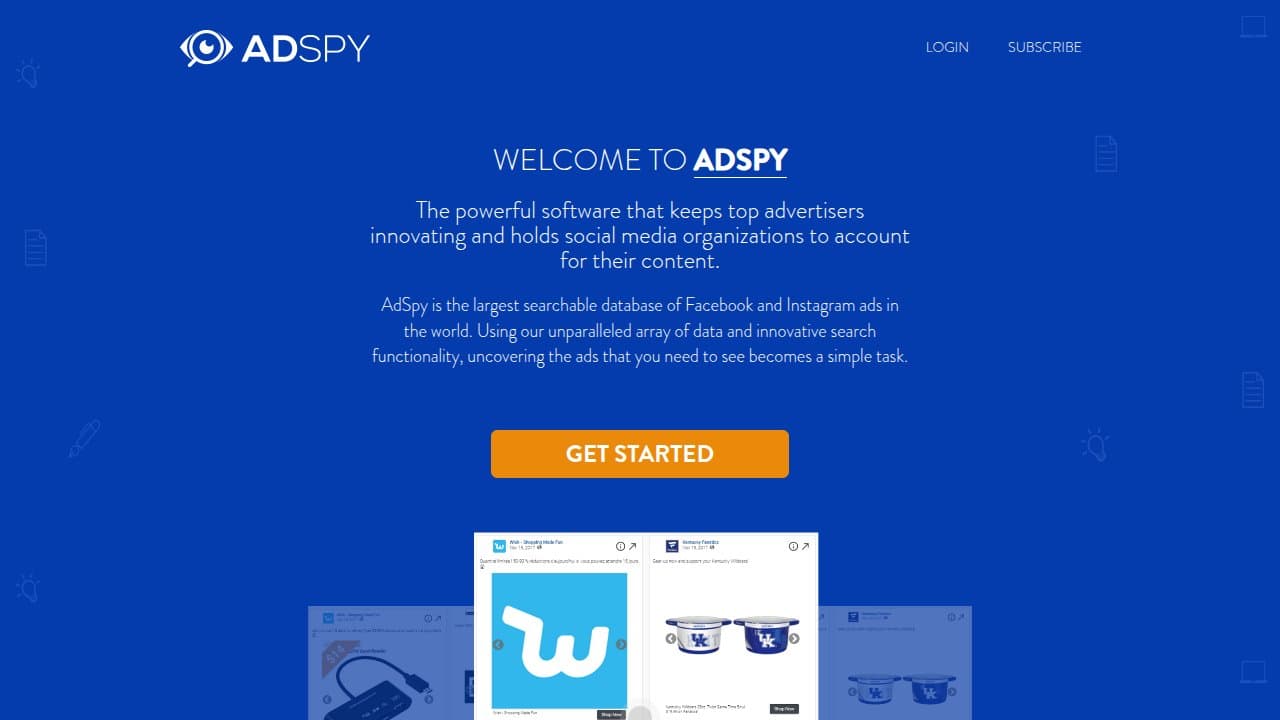
AdSpy gives media buyers, affiliate marketers, and e-commerce operators searchable access to 202 million Facebook and Instagram ads across 225 countries. One flat-rate plan covers the full database including affiliate network filtering, comment search, and landing page capture.
AdSpy is a Meta ad intelligence platform built by affiliate marketers, for affiliate marketers, dropshippers, and media buyers who need deep visibility into what is running on Facebook and Instagram. The tool indexes over 202 million ads from 29 million advertisers across 225 countries and 88 languages, making it one of the largest commercially available databases of Meta advertising data in the world. It operates on a single flat-rate pricing model at $149 per month with no tiered plans, which means every subscriber gets the same full access regardless of usage level.
The platform's core capability is its search engine: users can filter ads by text, advertiser name, URL, engagement volume, creation date, media type, demographics, and landing page technology. A distinctive feature is affiliate network filtering, which allows users to search by affiliate network (ClickBank, MaxBounty, and others) and affiliate ID. This is particularly valuable for affiliate marketers researching which offers competitors are promoting and which creative angles are converting. Additional features include comment search (searching inside ad comment sections by keyword), landing page capture that bypasses cloakers, demographic targeting data, and a Shopify/WooCommerce technology filter on landing pages. API access is available for teams that want to pull data programmatically.
What AdSpy actually is in May 2026
AdSpy's product positioning is deliberately narrow. It covers Facebook and Instagram only, with no TikTok, YouTube, Pinterest, or Google Ads data. That focus is both its strength and its most cited limitation. By concentrating on two platforms, AdSpy has built significantly more depth in Meta ad intelligence than most multi-platform competitors can match: 30-plus search filter categories, affiliate network filtering that goes down to the individual offer ID level, comment mining across its entire database, and landing page captures that preserve creative context even after advertisers take pages down.
The database is updated continuously. The platform crawls new Facebook and Instagram ads globally and adds them to the searchable index. Users get up to 100,000 ad views per month under the standard plan. The interface is web-based only. There is no mobile app. API access is confirmed as a feature for teams building integrations or running bulk data pulls against the database.
The company behind AdSpy is a bootstrapped operation with no disclosed external funding. Its UK entity (ADSPY LIMITED, Companies House no. 12881138) was incorporated in September 2020, though the product predates that entity. In October 2023, the UK entity received a First Gazette notice for compulsory strike-off, which was suspended in November 2023 after the company filed the required paperwork to remain active. That same entity was subsequently dissolved by compulsory strike-off in March 2026 per the final gazette notice. The product at adspy.com continues to operate as of May 2026, suggesting the operating business runs through a separate entity or jurisdiction.
Where AdSpy sits versus Minea and Pipiads
Minea is the clearest alternative for anyone researching product-market fit across multiple platforms. Where AdSpy covers Facebook and Instagram, Minea indexes five platforms: Facebook, Instagram, TikTok, Pinterest, and Snapchat. Minea's database refreshes eight times per day and includes influencer tracking, competitor store analysis, and estimated profit data on products. It starts at $49 per month with a free plan available, making it roughly one-third the price of AdSpy for broader coverage. The mechanical trade-off is database depth on Meta: AdSpy's 202 million Meta-only ads represent more granular Facebook and Instagram data than Minea's cross-platform database, which spreads its index across five networks. For a pure Meta buyer who does not need TikTok or Pinterest data, AdSpy's search depth per platform query is meaningfully better.
Pipiads was purpose-built for TikTok from the ground up, which shapes every design decision in the product. Its TikTok database holds 50 million-plus ads with over 1 million new ads added daily. Pipiads includes TikTok Shop analytics, TikTok Shop rankings, live streaming ad analysis, influencer analytics, and a 300 million product database built specifically around TikTok's commerce ecosystem. It also covers Facebook as a secondary platform. AdSpy does not have a single TikTok ad in its index. For any e-commerce operator whose paid acquisition strategy runs across both Facebook and TikTok, Pipiads solves the cross-platform problem that AdSpy cannot. AdSpy's advantage over Pipiads is in Meta depth and affiliate network filtering: Pipiads does not replicate AdSpy's ability to filter by ClickBank offer ID or MaxBounty affiliate network, which is a genuine workflow difference for affiliate marketers.
"Price and learning curve can be drawbacks" - John W., Capterra, March 2025
The comparison is straightforward. AdSpy is the right tool for a media buyer or affiliate marketer whose work lives entirely on Meta and who needs maximum filter granularity for affiliate offers. Minea suits researchers who need cross-platform product discovery. Pipiads suits operators whose primary channel is TikTok or who need TikTok and Facebook in one subscription. None of these tools overlaps the others completely, and many users in the dropshipping and affiliate marketing communities subscribe to two simultaneously. You can also compare AdCreative.ai for the creative generation side of the workflow, which pairs well with intelligence tools like AdSpy.
How the research workflow actually runs inside AdSpy
Three workflows come up repeatedly in practitioner documentation and user reviews.
The first is affiliate offer research. A media buyer enters a ClickBank offer ID into AdSpy's affiliate network filter, pulls every active ad promoting that offer, sorts by running duration (long-running ads indicate profitability), and then examines the captured landing pages to reverse-engineer the funnel structure and creative angle. This specific affiliate ID filtering depth is not replicated in most competing tools.
The second is dropshipping product validation. A researcher types a product description into AdSpy's text search, applies a "Shopify" filter under landing page technology, and sorts by likes to surface high-engagement ads. The demographic targeting data attached to each ad shows which age groups and geographies the advertiser is hitting, which helps validate product-market fit before committing to inventory. AdSpy captures this targeting data attached to individual ads rather than requiring a separate platform lookup.
The third is comment sentiment mining. AdSpy allows searching inside ad comment sections by keyword, not just the ad text itself. Searching "where can I buy" or "does this actually work" across a competitor's ad comment threads surfaces real consumer objections and purchase intent signals that are invisible in the ad creative alone. Multiple reviewers cite this as one of AdSpy's most underutilized and differentiating features.
For teams managing email retargeting alongside paid social, AdSpy pairs naturally with tools like Klaviyo or Omnisend to convert the audience intelligence gathered in research into segmented email sequences.
The friction users keep raising
The most consistent complaint is the price-to-platform ratio. At $149 per month with Meta-only coverage, AdSpy costs more than tools offering five-platform coverage. As TikTok has become a major e-commerce acquisition channel, this limitation has become harder to justify for operators who run ads across multiple networks.
Customer support is the second recurring theme. AdSpy's Trustpilot rating sits at 2.4 out of 5 as of 2026. The negative reviews cluster around two issues: charges that continued after cancellation requests were submitted, and account lockouts where users received no response to support emails for extended periods. Yarik M., reviewing on Capterra in April 2023, wrote: "There no service, they don't Answer to emails." This is not a minority complaint. The pattern appears in reviews across multiple platforms from 2021 through 2025.
"It's well made, really easy to use, and has tons of useful features" - Edgars E., Capterra, December 2021
Data inconsistency is a third reported issue. Some Capterra reviewers note duplicate results appearing in searches and difficulty relocating ads found in previous sessions. The database refresh cadence is not publicly documented, and several reviewers cite cases where ads they had previously found became unsearchable in later sessions.
The interface is dated relative to modern competitors. This is not a functional problem but it shows up as a usability friction point for users accustomed to the more polished dashboards of newer tools like Minea or Pipiads.
A secondary pricing concern is the absence of any lower tier. AdSpy's take-it-or-leave-it approach means that a solo marketer running a handful of tests per month pays the same $149 as an agency processing thousands of ad lookups weekly. Competitors have introduced starter tiers at $49-$77 per month to capture budget-sensitive users, but AdSpy has not followed. Whether this is a deliberate positioning choice or a product constraint is unclear, but the single-plan model is a recurring point of friction in the reviews.
Who AdSpy is for
AdSpy is best suited for experienced Meta media buyers and affiliate marketers running Facebook and Instagram campaigns at enough scale to justify the cost. The affiliate network filtering, comment mining, and landing page capture are genuinely differentiated for this audience. Agencies managing multiple Meta ad accounts who need systematic competitive intelligence on a Meta-only basis will find the database depth valuable.
Skip AdSpy if you are running a multi-platform acquisition strategy that includes TikTok, Pinterest, or YouTube. The $149 price becomes harder to rationalize when you still need a second or third tool for non-Meta channels. Skip it if you are early-stage with a limited budget: the tool rewards experience and prior knowledge of ad funnels. A beginner without established frameworks for reading ad intelligence data will not extract meaningful value quickly enough to justify the price. And if responsive customer support matters to your workflow (for billing changes, account questions, or access issues), the Trustpilot evidence suggests this is a genuine gap in the service.
For operators who are specifically Meta-focused, running affiliate offers or Shopify dropshipping, and comfortable with an older interface, AdSpy remains one of the most comprehensive ad intelligence platforms available in 2026 for that specific use case.
User Reviews
No reviews yet. Be the first to share your experience!
Sign in to write a review.
Related articles
Guides and articles related to AdSpy.

How to Make Money Selling AI UGC Content for Brands (2026)

AI Instagram Reels Factory: 30 Reels/Day on Autopilot (2026)
Does API Cost More Than a Subscription for Claude Opus 4.8, GPT-5.5, and Grok?
Google Vision AI Explained (2026): Pricing Per 1,000 Units, Free Tier, and Alternatives

Grok 4.3 API for Agents (May 2026): Pricing, Benchmarks, Migration