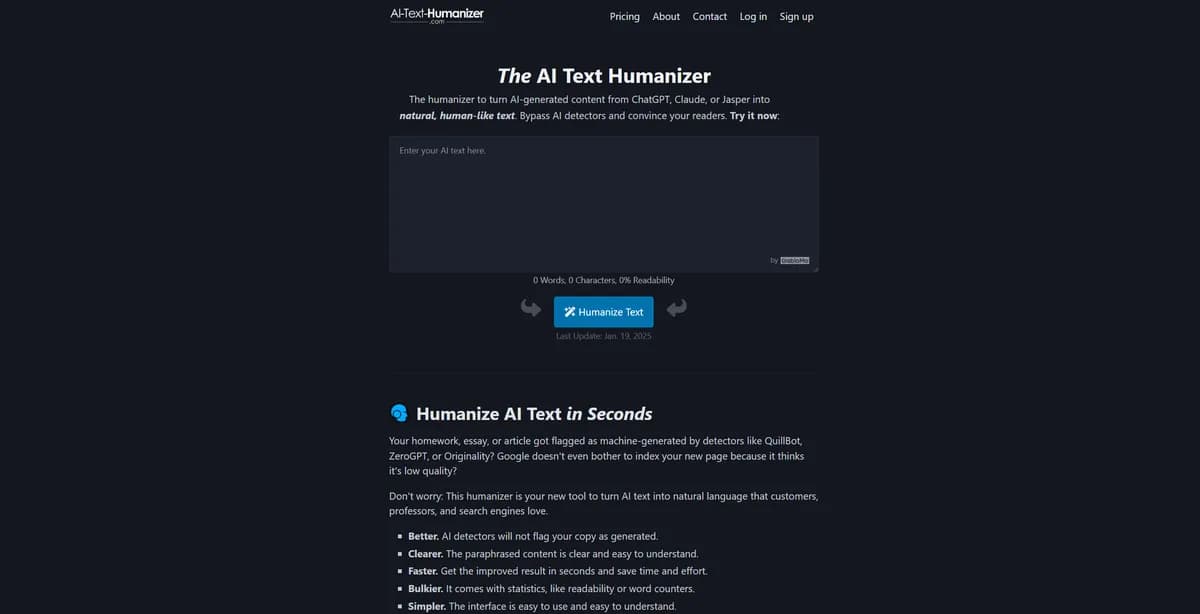

AI Text Humanizer rewrites machine-generated text to bypass detection systems like GPTZero and Originality.ai. Built for content creators and students, it restructures sentences across 30 languages. Strict word limits on lower pricing tiers restrict its use for long-form content.
What is AI Text Humanizer?
Over 70 percent of digital publishers run incoming submissions through AI detection software. AI Text Humanizer, built by the developer AI Text Humanizer, rewrites machine-generated text to evade these scanners. Content creators and students use this AI writing tool to make standard LLM outputs read like natural human writing.
The software targets specific detection algorithms used by GPTZero and Originality.ai.
It restructures sentences and swaps vocabulary to lower AI probability scores. But it introduces grammatical quirks that require manual editing.
- Primary Use Case: Bypassing AI detection systems for blog posts and academic essays.
- Ideal For: Solo content creators and digital marketers.
- Pricing: Starts at $12 ($12/mo billed annually) – A basic entry point with strict 600-word limits.
Key Features and How AI Text Humanizer Works
Detection Evasion and Rewriting
- Humanization Engine: Restructures sentences to mimic human writing patterns, limited by your plan’s word count.
- AI Detection Bypass: Targets detectors like GPTZero and Copyleaks to lower AI probability scores.
- Multiple Modes: Offers Standard and Advanced rewriting levels to balance readability and bypass strength.
- Context Retention: Maintains the original meaning of the input text without semantic drift.
Language and Processing Options
- Multi-language Support: Processes text in over 30 languages including Spanish and French.
- Bulk Processing: Allows users to process multiple documents simultaneously in a single session.
- Grammar Correction: Checks rewritten text for basic grammatical errors before final output.
- Plagiarism Check: Scans the final output against web sources to ensure uniqueness.
AI Text Humanizer Pros and Cons
Pros
- Achieves high bypass rates against major detectors like GPTZero and Originality.ai during standard testing.
- Maintains original context and meaning without significant loss of core information.
- Includes a permanent free tier offering three requests per month for occasional users.
- Supports over 30 languages to assist global content marketing teams with localized copy.
Cons
- Strict word limits on the Basic plan cap inputs at just 600 words per request.
- Grammatical awkwardness requires manual proofreading after processing.
- The $36 per month Ultra plan costs more than many general-purpose AI writing assistants.
- Lacks native integrations outside of the web interface and the provided API.
Who Should Use AI Text Humanizer?
- Solo Content Creators: Bloggers can use the Basic plan to humanize short articles before publishing.
- Global Marketing Teams: Agencies benefit from the 30 supported languages to localize AI-translated copy.
- Budget-Conscious Students: The free tier offers enough capacity for short essay paragraphs, though the 250-word limit is tight.
- Not for Novelists: Fiction writers generating long chapters will find the 3,000-word maximum on the Ultra plan too restrictive.
AI Text Humanizer Pricing and Plans
The platform uses a freemium model with strict usage caps.
The Free tier is a real permanent plan, not a trial. It gives users three requests per month with a maximum of 250 words per request. This limit restricts the free version to short emails or single paragraphs.
The Basic plan costs $12 per month when billed annually or $18 monthly. It includes 80 requests per month and raises the limit to 600 words per request. (I found the 600-word limit on the Basic plan frustrating for standard blog posts, forcing me to split articles into chunks.)
The Pro plan costs $18 per month annually or $27 monthly. This tier provides 200 requests and allows 1,200 words per input. This level suits standard web articles and short academic papers.
The Ultra plan costs $36 per month annually or $48 monthly. It offers unlimited requests and a maximum of 3,000 words per input. The price point puts it in direct competition with full-suite AI writers.
How AI Text Humanizer Compares to Alternatives
Similar to Undetectable AI, this tool focuses on beating specific scanners like GPTZero. Undetectable AI offers granular controls for readability levels and target audiences. AI Text Humanizer provides a simpler interface but lacks those specific tone adjustments. Both tools struggle with grammar, requiring a final human review.
Unlike StealthWriter, AI Text Humanizer includes built-in plagiarism checking on its standard outputs. StealthWriter excels at generating multiple variations of a single rewritten text. AI Text Humanizer gives you one optimized output per request. Users who want options might prefer StealthWriter, while those who want a single quick result will favor AI Text Humanizer.
The Verdict for Solo Content Marketers
AI Text Humanizer delivers on its core promise of lowering AI detection scores. Solo marketers publishing short blog posts will get the most value from the Basic plan. The multi-language support makes it useful for teams localizing content across different regions.
But users writing long-form guides should look elsewhere. The strict word limits make processing a 5,000-word article tedious. If you need to humanize massive documents, Undetectable AI offers better bulk handling for long texts.
Looking ahead, detection algorithms will become stricter over the next 12 months. Tools like AI Text Humanizer will have to shift from simple vocabulary swapping to structural paragraph rewriting to stay relevant.
User Reviews
No reviews yet. Be the first to share your experience!
Sign in to write a review.
Related articles
Guides and articles related to AI Text Humanizer.

Undetectable AI Review (2026): What It Does, What It Costs, and 7 Alternatives
The AI Content Automation Stack: 7 Tools That Run a Full Blog Without a Team

Wix Logo Maker Review (2026): Real Costs, the Edit Catch, and AI Alternatives

Perplexity AI Tutorial: Maximize Your Research Workflows

The Personal AI Productivity Stack (2026): One Tool Per Job, Nothing Extra