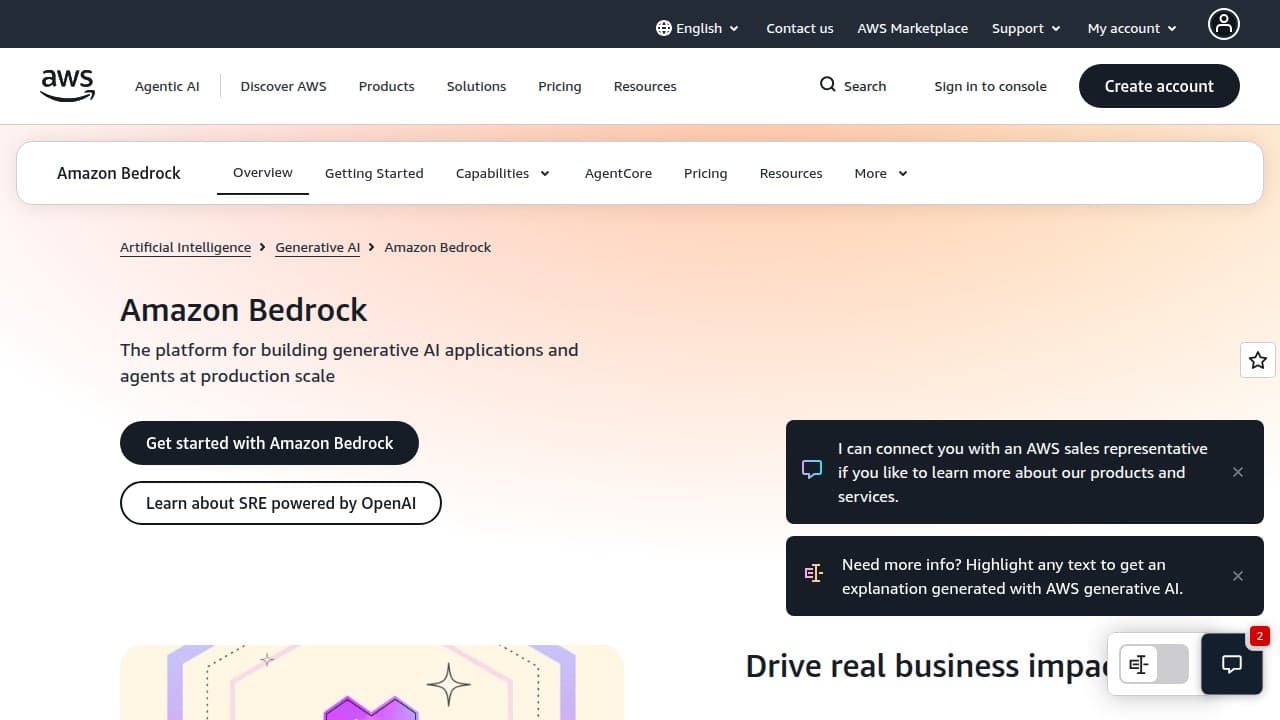

AWS Bedrock is Amazon's managed AI platform giving enterprise teams API access to Claude, Llama, Mistral, Amazon Nova, and more through one service, with built-in IAM security, RAG, agentic infrastructure, and content safety controls.
Amazon Bedrock is a fully managed AI service from Amazon Web Services that provides unified API access to foundation models from multiple providers: Anthropic (Claude), Meta (Llama), Mistral AI, Amazon (Nova, Titan), Cohere, AI21 Labs, and Stability AI. Launched in general availability in September 2023, it has since grown to power generative AI for more than 100,000 organizations worldwide. The defining difference from direct model APIs is the AWS wrapper: every request goes through IAM authentication, every charge flows through your existing AWS billing account, and AWS contractually prohibits using your data to train models. For teams already standardized on AWS infrastructure, Bedrock is the path of least resistance to production-grade AI.
Beyond raw model access, Bedrock ships a stack of managed services that sit on top of inference. Bedrock AgentCore handles deploying and operating multi-step agents at production scale. Knowledge Bases provides a managed RAG layer with auto-indexing, semantic retrieval, and agentic subquery routing against documents stored in S3. Guardrails enforces content safety policies using formal logic checks, claiming to block up to 88% of harmful content and validate responses with up to 99% accuracy. Model Distillation creates smaller, faster derivatives of larger models, with AWS citing up to 500% speed gains and 75% cost reductions. Intelligent Prompt Routing automatically directs requests to the best-performing model given your cost and latency targets. Cross-Region Inference handles failover across AWS regions automatically. The combination makes Bedrock a full AI infrastructure layer, not just a model catalog.
What AWS Bedrock actually does in April 2026
Bedrock's model catalog as of April 2026 spans the widest range of any managed cloud AI service. On the Anthropic side, Claude Opus 4.7 became available on April 20, 2026, with a full 1-million-token context window, Adaptive Thinking (dynamic token budget allocation based on query complexity), and high-resolution image support for charts and dense documents. Claude Opus 4.5, 4.6, and 4.7 are all available via global cross-region inference, routing automatically to available capacity across US, European, and Asia Pacific regions at up to 10,000 requests per minute per account.
Amazon's own Nova family, launched at re:Invent 2024, now includes four capability tiers. Nova Micro handles text at $0.035 per million input tokens, the most cost-efficient option in the catalog. Nova Lite adds image and video understanding at $0.06 per million inputs. Nova Pro handles complex multi-modal reasoning at $0.80 per million. Nova Premier serves the most demanding tasks. Beyond text, the Nova suite covers Nova Canvas (image generation), Nova Reel (video), and Nova Sonic (speech-to-speech). This makes Bedrock the only managed cloud platform where Amazon competes directly as a model maker alongside the third-party providers it also hosts.
Bedrock's Guardrails layer deserves specific attention because it operates model-agnostically. It runs as a separate policy layer between your application and any model in the catalog, applying the same content filtering, PII detection, prompt injection blocking, and factual validation rules regardless of which model is serving the request. For regulated industries, this is a meaningful architectural advantage: one Guardrails configuration applies across Claude, Nova, and Llama without per-model reconfiguration.
Where AWS Bedrock sits versus Vertex AI and Azure OpenAI
The three major managed cloud AI platforms each anchor to a different primary strength, and the differences are mechanical, not just marketing.
Vertex AI (Google Cloud) is the strongest option for teams whose data workflows center on BigQuery. Vertex integrates BigQuery directly for training data pipelines and model evaluation in a way that requires no manual wiring. Its fine-tuning interface gives full control over training parameters with distributed training capabilities, whereas Bedrock's fine-tuning is a managed interface covering a limited model subset. Vertex's built-in model monitoring includes drift detection and feature attribution out of the box. Bedrock's equivalent requires custom CloudWatch instrumentation. On model access, Vertex focuses on the Gemini family and Google-adjacent open models via Model Garden; Bedrock carries a broader third-party catalog including Anthropic, Meta, and Mistral, though neither carries the other's flagship first-party models.
Azure OpenAI Service is the only path to OpenAI's GPT models under enterprise SLAs. Bedrock does not carry GPT-4o or any OpenAI model. The catalogs are mutually exclusive, which makes the Bedrock-vs-Azure comparison straightforward for teams with a strong GPT dependency: Azure is the only answer. For teams flexible on model family, Azure's Regional PTU (Provisioned Throughput Units) can deliver up to 40% cost savings versus pay-as-you-go pricing at high volumes, particularly attractive for GPT-heavy workloads. Azure's authentication integrates with Azure Active Directory and the broader Microsoft 365 ecosystem natively; Bedrock integrates with AWS IAM and Organizations. The choice often reduces to: which cloud is your primary infrastructure home?
"Nothing screams 'production-ready AI platform' like needing a comprehensive guide just to handle all the times it tells you to go away." - Corey Quinn, Last Week in AWS newsletter, 2025
Bedrock's mechanical advantage over both is multi-vendor model breadth with single-vendor billing and security governance. If you need Anthropic's latest Claude and Meta's latest Llama in the same application, routed and billed under one IAM-governed AWS account, Bedrock is the only managed option that delivers this cleanly.
What the production deployment reality looks like
Bedrock's on-paper capabilities hold up in practice for AWS-native teams with established accounts and enterprise support tiers. The friction arrives along two axes: account age and scale.
New AWS accounts face throttle limits that are, by any realistic measure, too low for serious development. Default quotas as of 2025 are as low as 2 requests per minute for Claude models on fresh accounts, while established accounts on the same models see 200+ rpm. The gap is documented but the resolution requires opening a support ticket, demonstrating your use case to an AWS representative, and waiting for a manual quota increase. There is no self-serve quota expansion path. For startups and individual developers, this makes early prototyping genuinely painful in a way that competing services do not replicate.
At scale, Bedrock's multi-tenant infrastructure introduces latency variance that provisioned throughput solves but at significant cost. The minimum Provisioned Throughput commitment starts around $15,000 per month, which is positioned correctly at enterprise scale but leaves a gap for teams running production workloads at moderate volume.
The Knowledge Bases RAG service works well for straightforward document retrieval but operates as a managed black box. Chunking strategies are fixed, indexing parameters are not exposed, and teams requiring precise control over retrieval behavior regularly abandon the managed solution in favor of custom pipelines using Pinecone or OpenSearch. The service accelerates getting to a proof-of-concept but often hits walls before production quality retrieval is achieved.
"CloudWatch gives you raw logs and basic metrics like InvocationLatency, but it lacks LLM-specific context." - TrueFoundry, Amazon Bedrock Review 2026
Observability is the third production friction point. CloudWatch captures latency and error rates but does not understand conversations, agents, or token cost attribution at the application layer. Teams running production AI workloads typically add LangFuse, Datadog's LLM observability layer, or TrueFoundry to get cost-per-conversation, trace-level debugging, and per-team spend tracking. AWS added IAM principal-based cost attribution in April 2026, which helps attribute costs across teams, but per-request LLM context remains a gap in native tooling.
Who AWS Bedrock is built for
Bedrock's strongest fit is enterprise and mid-market organizations that are already deep in AWS infrastructure. Teams running S3, Lambda, IAM Organizations, and VPCs gain immediate value: there are no new vendor relationships to manage, no API keys to rotate, no separate vendor agreements to execute. Everything is AWS. Compliance teams in regulated industries (healthcare, finance, government) benefit from Bedrock's contractual data non-use guarantees and the ability to run inside an existing FedRAMP or HIPAA-eligible AWS environment without extending the compliance boundary to a new vendor.
The multi-model catalog makes Bedrock the right answer for teams that need model flexibility over time: the ability to run Claude for high-complexity reasoning, Nova Micro for cost-sensitive high-volume tasks, and Llama for open-weight use cases, all under one billing umbrella and governed by one security policy. Bedrock Guardrails' model-agnostic design is specifically valuable here, since compliance filters applied once cover the entire catalog.
What AWS Bedrock is not
Bedrock is not a good starting point for developers new to AWS who want to quickly experiment with frontier models. The setup complexity is real and well-documented: Simon Willison described onboarding as requiring approximately 17 steps including IAM policy creation and access key configuration, "horrifyingly difficult" compared to getting an Anthropic or OpenAI API key. Combined with the new-account throttle floors, the first few hours on Bedrock are consistently the worst part of the experience.
Bedrock is not a path to OpenAI models. If your application depends on GPT-4o or any OpenAI-family model, Azure OpenAI Service is the only managed enterprise option. Bedrock's catalog does not include any OpenAI models and there is no indication this will change.
Bedrock is not a production-grade observability platform out of the box. It is not a semantic caching layer - identical queries generate identical inference costs every time. It does not include built-in model fallback logic; if Claude returns a 500 error, your application handles the retry or it fails. Teams serious about production reliability will need to instrument Bedrock with additional tooling to reach operational maturity, which adds engineering cost that competitors' more integrated offerings sometimes avoid.
Skip Bedrock when your team is not already committed to AWS, when you primarily need OpenAI models with Microsoft compliance guarantees, or when you need fast low-friction prototyping without spending a week configuring IAM policies and filing quota increase tickets.
User Reviews
No reviews yet. Be the first to share your experience!
Sign in to write a review.
Related articles
Guides and articles related to AWS Bedrock.
Grok 4.3 API for Agents (May 2026): Pricing, Benchmarks, Migration
Does API Cost More Than a Subscription for Claude Opus 4.8, GPT-5.5, and Grok?
GPT-5.5 Instant vs Claude Opus 4.7: 2026 Routing Matrix
Google vs OpenAI vs Anthropic Agents: The May 2026 Platform Showdown
Claude Code vs Cursor vs Codex vs Devin vs Replit Agent 3: 2026 Scorecard