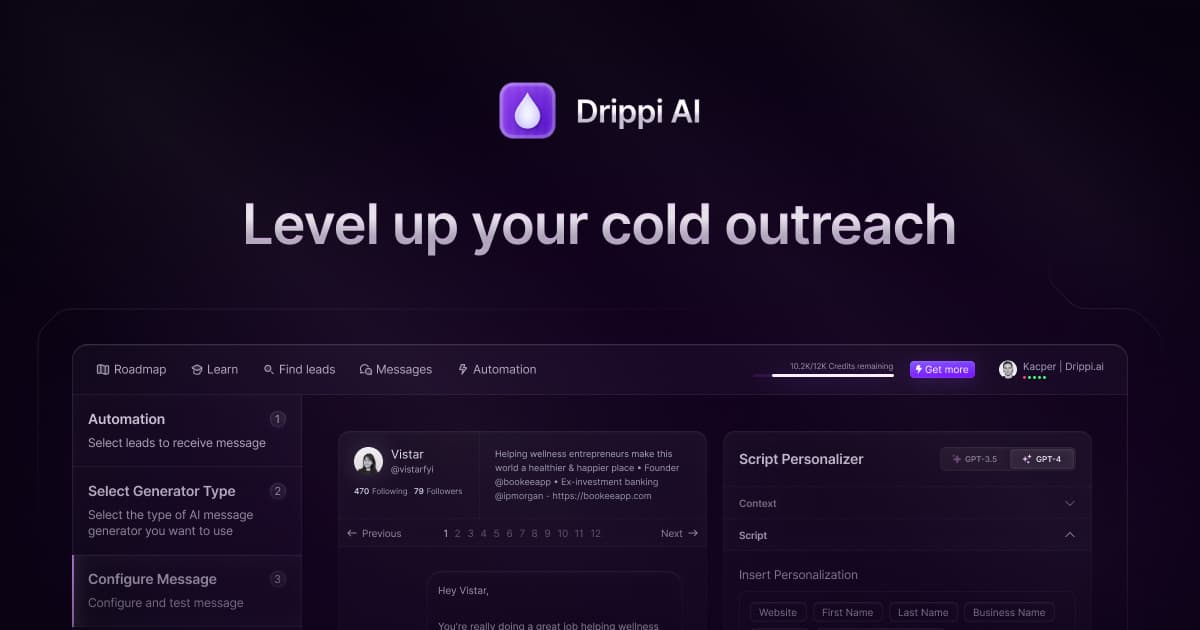

Drippi automates AI-personalized cold DMs on Twitter/X, scraping prospect lists and generating messages based on each user's bio, pinned tweet, and recent activity. Built for agencies and solo operators running X-native outreach at scale.
Drippi is an AI-powered cold outreach platform built entirely around Twitter/X direct messages. Founded in 2021 and run by a bootstrapped seven-person team, the company reached $770K in annual recurring revenue by mid-2025 without outside funding. It solves a specific problem: sending cold DMs at volume without losing the personalization that makes them worth reading. Generic "hey I loved your content" openers get ignored; messages that reference a prospect's specific tweet from last Tuesday do not. Drippi's AI closes that gap at scale.
The platform combines lead scraping, AI profile analysis, DM sequencing, follow-up automation, and inbox management in one workflow. Users filter prospects by follower count, bio keywords, tweet frequency, and engagement signals, then let the AI generate personalized openers using each account's bio, recent posts, and linked website. Core features include automated engagement warming (likes and comments before the DM lands), a credit-based messaging system with daily send limits, campaign analytics tracking reply rates and conversions, and inbox filters that auto-classify inbound replies by intent. An API lets agencies integrate Drippi into existing outbound stacks. In February 2026, Drippi launched X Navigator, a companion lead enrichment product that matches cold email and LinkedIn contact lists to Twitter/X handles using a database of over 250 million profiles.
What Drippi actually is in May 2026
Drippi operates as an outreach agent for Twitter/X. The setup is sequential: you define an ideal customer profile using filters (founder, CEO, SaaS, 1,000-50,000 followers, active in last 30 days), the platform scrapes a lead list from follower graphs, hashtag interactions, or keyword bios, then the AI reads each profile and generates a unique opening message for every contact. The message personalization goes beyond name-swapping. If a prospect tweeted last week about struggling to find UGC creators, Drippi's AI surfaces that and builds the opener around it.
Three plan tiers cover most use cases. The Individual plan at $100/month covers one X account with 2,000 DM credits and 200 X Navigator credits. Agency plans start at $248/month and scale to 30 connected accounts with priority support and full API access. Enterprise at $2,000/month adds a dedicated success manager and custom volume pricing for larger client rosters. A seven-day free trial with 250 messages is available without a card.
The February 2026 X Navigator launch marked a meaningful product expansion. Previously, Drippi users had to build their prospect lists natively from Twitter/X. X Navigator allows outbound teams to upload CSVs from Apollo, Clay, or LinkedIn Sales Navigator and enrich them with verified Twitter handles. This positions Drippi less as a standalone Twitter DM tool and more as the Twitter channel layer inside a multichannel outbound stack.
One notable platform dependency: users need Twitter Blue (X Premium) subscriptions to send DMs to users who do not follow them. Without Premium, outreach is restricted to followers. This adds roughly $8-22/month per connected account in platform overhead not reflected in Drippi's pricing.
Where Drippi sits versus Taplio and Reply.io
Taplio is the comparison most commonly raised by B2B marketers, but the tools do not overlap in any meaningful way. Taplio is a LinkedIn-native platform combining AI post generation trained on 500 million LinkedIn posts, a 3-million-contact lead database, connection automation, and DM sequencing, all on LinkedIn's infrastructure. Drippi does none of that. It has no LinkedIn support, no content creation features, and no post scheduling. The platforms serve different networks. If your buyers are on LinkedIn, Drippi is the wrong tool. If they are on Twitter/X, Taplio does not help you. For agencies with buyers on both platforms, the tools run in parallel rather than competing for the same budget line.
Reply.io represents a more fundamental architectural difference. Reply.io is an email-first sales engagement platform where Twitter/X is one optional touchpoint inside a multichannel sequence. Its Jason AI agent handles prospect sourcing, sequence generation across email, LinkedIn, calls, and SMS, plus reply classification and CRM sync (Salesforce, HubSpot, Pipedrive). The multichannel plan starts at $89/user/month. For an SDR team running high-volume outbound with manager reporting, quota tracking, and CRM integration requirements, Reply.io is the correct category. Drippi has no CRM sync, no email capability, no calling, and no team hierarchy. It is a specialized DM tool, not a sales engagement platform. Users who need one of these do not need the other, though Drippi's API allows it to feed replies into a broader stack like Reply.io handles.
Klenty sits in the same email-first engagement category as Reply.io, with AI-adaptive cadences and a built-in parallel dialer. Starting at $50/user/month, Klenty's architecture is built for SDR teams where a manager needs visibility into each rep's pipeline and cadence performance. Neither Klenty nor Instantly AI or Smartlead AI treat Twitter/X as a primary channel. Drippi is the most capable tool in its specific lane: X-native DM outreach with AI personalization. The constraint is that the lane is narrow.
"Drippi has been a game-changer for my outreach. The product shines not only through its intuitive DM interface but also through its consistently evolving feature set. What really sets them apart is their exceptional customer support." - Verified Trustpilot reviewer, December 2024
How automation actually works inside Drippi
The AI personalization pipeline runs in three stages. First, Drippi fetches the prospect's public Twitter data: bio, pinned tweet, most recent five to ten posts, and the homepage URL if listed in their profile. Second, the AI model (ChatGPT-backed) reads this context and identifies a specific hook from the prospect's recent activity. Third, it writes a message opener that references that hook and connects it to the user's pitch. The resulting message reads like something a human would write after spending three minutes on the prospect's profile, which is the point.
Two automation types are available. Cold DM automation sends to any qualifying prospect matching the filter criteria. New Follower automation triggers a DM immediately when a new account follows the user, which works well for inbound lead conversion. Follow-up sequences add one to two additional messages if no reply lands within a set number of days.
Automated engagement warming is available as a pre-DM step. Drippi can automatically like or comment on a prospect's recent tweets before the DM goes out, theoretically warming the account relationship before the cold ask. Whether this materially improves reply rates is debated in reviews; the effect is hard to isolate.
The inbox management layer auto-classifies inbound replies using AI intent detection (interested, not interested, referral, not now) and allows filtering by classification. For agencies managing multiple client accounts, this prevents high-value replies from getting buried. API webhooks let positive-intent replies trigger notifications or create records in external tools.
The friction and reliability concerns users keep raising
Account banning risk is the most serious recurring concern. In 2024, multiple Trustpilot reviewers reported personal X accounts being suspended after running Drippi campaigns. The most direct complaint came from a user identified in Drippi's company response as Batu:
"Absolutely terrible. They wasted our time 3 weeks solving the bugs on their platform and once we went live with our outreach campaign, our personal accounts got banned." - Batu, Trustpilot, 2024
Drippi's standard response to these complaints is that Twitter/X controls all account enforcement decisions and that account safety depends on message quality and user behavior, not the tool itself. This is technically accurate but practically cold comfort for users who lose active client accounts. The risk is real and not unique to Drippi; any automation tool on X faces the same enforcement environment. Users are well-advised to run campaigns on dedicated warm accounts rather than primary business accounts.
In 2024, Drippi also went through a documented period of API instability. The Twitter/X DM API changes that year broke connections for multiple tools, and Drippi users reported sequences stopping mid-campaign. A reviewer named Lloyd wrote: "Unreliable product, constant disconnects. Its a waste of time and money until they can develop past the constant issues." The Drippi team acknowledged these issues publicly on Trustpilot and stated they had migrated to an X-chat integration that resolved the disconnection problems. Later 2024 reviews are generally more positive on stability, suggesting the fix held.
A third documented issue: in at least one case a Trustpilot reviewer specifically called out a feature, "auto DM campaigns based on tweet interactions," as something shown in Drippi's marketing videos and visible in the product UI, but which a support rep told them was not actually a supported feature. The reviewer described it as the worst customer support experience they had encountered. This type of gap between marketing presentation and actual product capability is a yellow flag for a tool at this price point.
Pricing transparency is a minor but real friction. Third-party review sites indexed from 2023 and 2024 still list prices of $76-$115/month. The actual Individual plan as of May 2026 is $100/month, with Agency starting at $248/month. Users who find Drippi through older reviews may budget incorrectly.
Who Drippi is for
Drippi works best for solo operators, freelancers, and small agencies whose target buyers are active on Twitter/X and where DMs are a viable first contact. The clearest fit cases include B2B service providers pitching to founders and startup CEOs (who are disproportionately on Twitter), UGC creators prospecting brand accounts, consultants running personalized outreach to niche communities, and outbound agencies wanting to add a Twitter DM channel alongside existing email sequences.
The X Navigator addition in February 2026 is a meaningful use-case expansion for outbound agencies. If you already have a cold email list built in Apollo or Clay and want to reach those same contacts where none of your competitors are messaging them, X Navigator's handle enrichment makes Drippi a complement to existing outbound infrastructure rather than a standalone tool requiring its own list-building from scratch.
Skip Drippi when your ICP is primarily on LinkedIn rather than Twitter. Skip it when you need multichannel orchestration, CRM sync, or team-level reporting. Skip it when you cannot afford to risk X account warnings on high-value accounts. It is not an enterprise sales engagement platform and is not designed to replace Reply.io, Klenty, or similar tools. It is a focused, single-channel instrument: effective if Twitter/X is your buyers' channel, useless if it is not.
User Reviews
No reviews yet. Be the first to share your experience!
Sign in to write a review.
Related articles
Guides and articles related to Drippi.

How to Build an AI Outbound Stack From Scratch: The Complete 2026 Playbook

Build and Sell AI Automations as a Service: The Operator Playbook (2026)

How Clay Actually Works: Waterfall Enrichment and Signal Prospecting Explained

AI SDR vs Human SDR: The Real Cost, Performance, and What Nobody Tells You

The Signal-Based Outbound Playbook: Use Intent Data to Raise Reply Rates