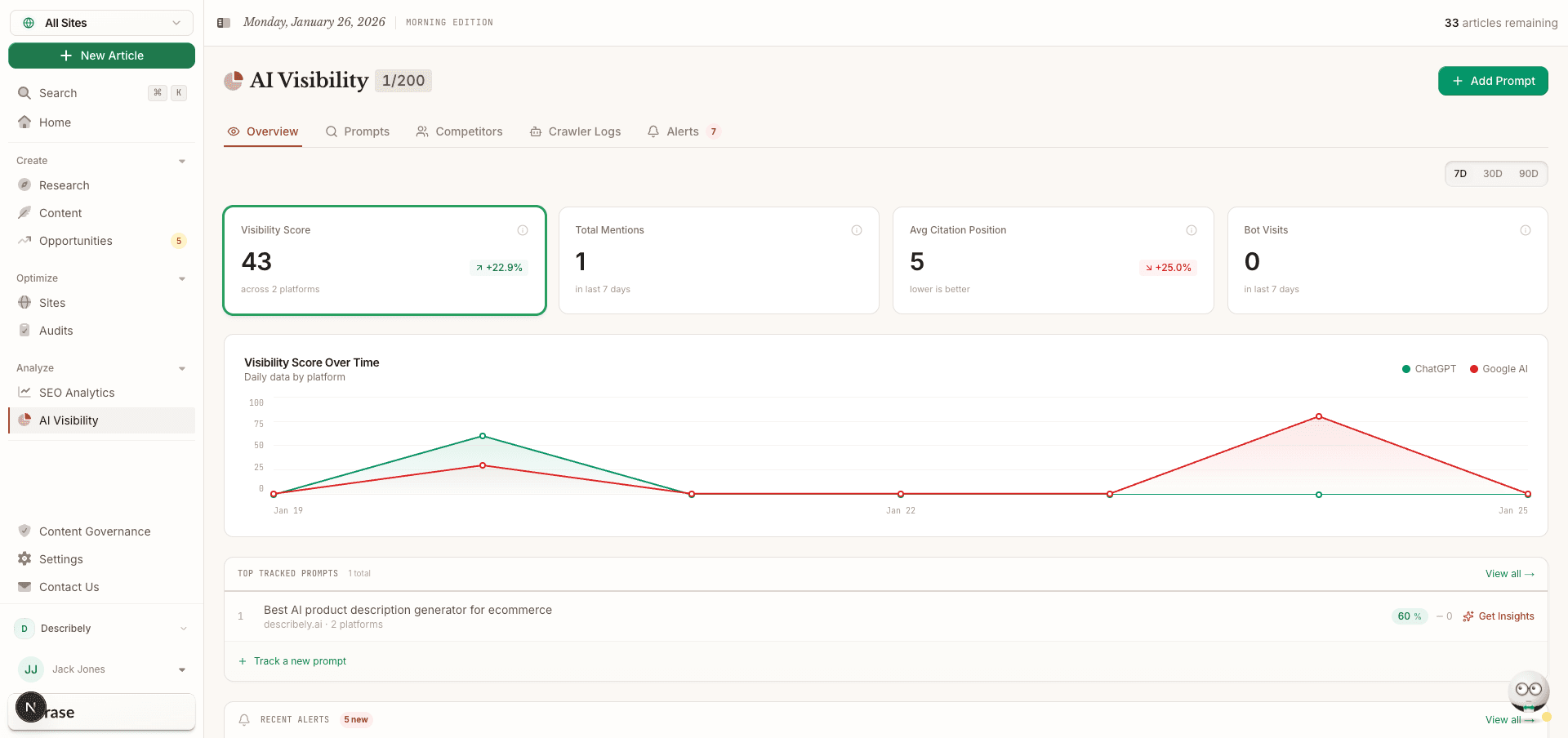

Frase is an agentic SEO and GEO platform that analyzes top-ranking competitors, generates content briefs in 30 seconds, and scores your writing against both traditional search and AI platform visibility. Built for content teams producing 5-20 articles a month.
Frase is an SEO content optimization platform built by Tomas Ratia and Robbie Britt, founded in Boston around 2017. It solves a specific problem for content marketers: the research-to-draft pipeline takes hours of manual SERP analysis that most teams skip or compress. Frase compresses that pipeline by automatically crawling the top 20 ranking pages for a keyword, extracting the topics, headings, and questions competitors answer, and building a structured content brief in under 30 seconds. The platform has expanded significantly since its early brief-generation roots, adding an AI writer, real-time content scoring, and as of August 2025, a GEO (Generative Engine Optimization) scoring layer that evaluates how likely your content is to get cited by AI answer engines like ChatGPT, Perplexity, and Google AI Overviews.
The platform's core workflow covers five stages: keyword research and opportunity detection, SERP analysis, content brief generation, AI-assisted drafting, and real-time optimization scoring. The AI writer generates drafts using natural language processing against your brief, with templates for over 30 content types and access to 100+ community-built templates. The Topic Score system benchmarks your article's keyword coverage against the top-ranking competitor pages, showing which terms are missing and how far you are from the competitive threshold. A Google Search Console integration surfaces pages ranking in positions 5-20 as quick-win refresh targets. Integrations with WordPress and Google Docs allow teams to optimize inside their existing CMS workflows. The platform also offers an API, site audit capabilities, and as of February 2026, an AI Agent system with 80+ skills that can execute research-to-publish workflows via natural language instructions.
What Frase writes in April 2026
Frase is a research-and-optimization-first tool that handles the full content lifecycle from keyword targeting through publishing. On the research side, it pulls from Google's People Also Ask, Reddit, Quora, and the top 20 SERP results to surface the questions your audience is actually asking and the topics competitors are covering. The content brief pulls all of this into a structured document with suggested headings, keyword clusters, average competitor word counts, and recommended link counts.
On the writing side, Frase generates content using an OpenAI GPT-based model. The AI writer handles expansion (continuing from existing paragraphs), rewriting (sentence-by-sentence or paragraph-level), and transition generation between sections. It supports over 30 native templates covering formats like blog posts, product descriptions, FAQs, and meta descriptions. Teams can also create custom templates to enforce specific brand voice or structural requirements. The 2026 platform rebuild introduced an agentic layer, the Frase AI Agent, that executes multi-step workflows such as detecting a content gap, drafting an optimized article, scoring it against competitors, and flagging it for review, all through natural language instructions rather than requiring manual navigation through each tool.
Integrations include WordPress, Google Docs, Google Search Console, and Chrome. The API gives development teams access to the brief generation and content scoring pipeline programmatically. Enterprise clients including Oracle, Coursera, and GitLab use the platform at scale with white-label options and dedicated support.
Where Frase sits versus Surfer SEO and Clearscope
Frase, Surfer SEO, and Clearscope target the same market but operate on meaningfully different architectures. Understanding the mechanical differences matters because each tool's approach determines what it's actually good at optimizing for.
Surfer SEO runs a SERP analyzer that examines competitor page prominence metrics and delivers word-level optimization targets. Surfer's Content Editor is built around NLP term density scoring with continuous real-time updates and a multi-keyword analysis booster that helps a single article rank for several related keywords. Surfer's Chrome Extension operates directly inside WordPress and Google Docs without switching tabs. Pricing starts at $49/mo (annual), but AI platform visibility tracking requires the Standard tier at $99/mo annually. Surfer goes deeper on keyword-level competitive analysis and NLP term scoring; as of 2026, it lacks Frase's GEO scoring and AI citation tracking. For teams focused on traditional Google rankings with high keyword density precision, Surfer is more granular. For teams needing both traditional SEO and AI search visibility at a lower price, Frase holds the advantage.
Clearscope uses IBM Watson's natural language processing to reverse-engineer top Google results and suggest topical terms based on competitive analysis. Clearscope assigns content scores based on word count benchmarks, readability, and keyword usage relative to competitor pages. Its enterprise model includes unlimited user seats on all plans, making it economical for large content teams at scale. Entry pricing starts at $170/mo (Essentials), roughly 4x Frase's Solo plan. Clearscope has no AI writing component and no GEO or AI search tracking. It is optimized for high-stakes pillar content where topical authority and ranking at position 1 justifies the premium. Frase suits teams publishing at moderate volume; Clearscope serves enterprise teams where scoring accuracy outweighs speed and cost.
"Before Frase, we could maybe do one post a week. Now we can confidently do three to four a week for each client, and know it's competitive." - Agency content director, via Rankability research, 2025
"The brief generation is genuinely faster than doing SERP analysis by hand." - Lilian Makena, content strategist, March 2026
What real users keep hitting
Frase's AI writing output is the most consistent complaint across reviews published in 2025 and 2026. The research and brief generation earns genuine praise; the AI writing rarely does. Victoria Kurichenko, an SEO expert and founder of Behind Rankings, published an AI-generated article via Frase and tracked its search performance. The AI-written article ranked for 5 keywords with an average position of 23. Her manually written comparison article ranked for 17 keywords with 30 organic clicks. Her conclusion: "Human writing wins in this race." Multiple reviewers note that the AI generates incomplete paragraphs, bizarre phrasing, and requires several rounds of editing before the content is publishable. One reviewer described the output as looping the same text repeatedly at higher word counts.
Pricing transparency has been a recurring frustration, particularly for users who signed up under the older plan structure. Before the 2026 rebuild, the full AI writing capability required a $35/mo Pro Add-on on top of the base plan, pushing the realistic cost from $45/mo to $80/mo. While the 2026 rebuild changed the plan architecture, the entry Solo plan limits users to 4 AI articles per month, meaning high-volume content producers need to step up to the $49/mo Starter plan immediately.
The lifetime deal controversy is a notable trust issue in the community. AppSumo customers who purchased lifetime access reported on October 17, 2024, that migrating from the beta version to the production platform severely reduced their plan limits: from 3 users to 1 user, and from unlimited AI words to 4,000 words per month. One verified purchaser characterized it as a bait-and-switch and stated the deal had promised "all future updates." The broader complaint from lifetime customers is that years of stagnation were followed by a platform rebuild that placed improvements behind a new subscription rather than honoring the original promise.
A Reddit thread in r/seogrowth from 2025 asking "Are you guys still using content optimization tools like Frase, Surfer, Scalenut?" drew critical responses. Several commenters argued that keyword density-based content scoring tools "make content less readable" and "don't account for LLMs and Rankbrain friendliness." This reflects a broader critique of the category, not only Frase, but Frase's mid-tier positioning means it catches the critique more sharply than premium alternatives.
Where Frase earns its place
Frase's content brief generation is the feature that consistently earns it the most genuine praise. The ability to go from a target keyword to a structured competitive brief in under 30 seconds, complete with headings from the top 20 ranking pages, common questions from Reddit and Quora, and topic clusters from People Also Ask, is a real productivity gain that independent reviewers have documented concretely. Matthew Metcalfe, co-founder of Two Tickets Anywhere, documented 63% of his blog posts ranking on the first page of Google after adopting Frase, and estimated approximately one hour saved per article in research time across 100+ posts.
The August 10, 2025 GEO scoring launch was a genuine differentiating moment for Frase. The feature evaluates content across three axes: Authority (citations and outbound links to credible sources), Readability (reading level complexity), and Structure (heading organization and snippet-ready formatting). Combined SEO and GEO scoring in a single Optimization tab makes Frase directly useful for content teams navigating a search environment where AI-referred sessions jumped 527% year-over-year in H1 2025. Tools like Surfer SEO and Clearscope had no equivalent GEO tracking as of the same period.
The Google Search Console integration adds practical value that brief generators without it lack. Frase clusters ranking keywords from GSC and surfaces pages sitting in positions 5-20, giving content teams a prioritized refresh queue rather than requiring manual analysis of which existing pages to update. For teams already publishing regularly, this turns Frase from a creation tool into a maintenance tool as well.
Users can also pair Frase with other tools in their stack. Kripesh Adwani, who used Frase for 6 months across 100+ documents, noted that Frase's lack of query limits makes it practical for high-volume content operations when supplemented with MarketMuse for precision keyword analysis. Tools like NeuronWriter and Scalenut cover similar research-to-optimization workflows, while Jasper and Copy.ai focus more heavily on AI writing volume at the expense of the SEO research layer that Frase centers its workflow on.
Who should and shouldn't use Frase
Frase works best for content marketers and SEO writers publishing 5-20 articles per month who want to compress research time without paying Surfer SEO or Clearscope prices. Agencies managing content calendars across multiple clients get the most leverage from the brief generation speed and the ability to assign structured briefs to freelance writers with clear optimization targets. The GEO scoring makes it specifically relevant for teams tracking brand visibility in AI search alongside traditional rankings.
The tool earns its keep for users who treat the AI writer as a drafting accelerator rather than a publish-ready output. If you expect to edit anyway, the AI writing produces useful raw material. If you expect clean, authoritative prose without heavy revision, Frase will disappoint.
Skip Frase when you need backlink analysis, deep technical SEO crawling, or high-accuracy keyword difficulty scoring at scale. The platform has no backlink component; it cannot replace Ahrefs or Semrush for competitive link research. For enterprise content teams running high-stakes pillar content where scoring precision matters above all other factors, Clearscope's IBM Watson-backed model is more defensible. For agencies whose freelancers are already working inside Google Docs and want the most seamless native optimization experience, Surfer SEO's Chrome Extension and Google Docs integration is more fluid than Frase's workflow.
Tools like SEO Content AI offer narrower but comparable research features at different price points. If your primary need is volume-focused AI writing with some SEO scaffolding, the comparison to Scalenut is worth making before committing to Frase's tier structure.
User Reviews
No reviews yet. Be the first to share your experience!
Sign in to write a review.
Related articles
Guides and articles related to Frase.

AI SEO Content at Scale: Publish 20 Posts a Month Without Hiring Writers

RFP and Proposal Auto-Fill: The Agent That Handles 80% of the Repeating Questions (2026)

AI Content Quality Control: How to Avoid Publishing AI Slop

How to Repurpose One Blog Post Into 30 Pieces With AI (The Step-by-Step System)
Grok 4.3 API for Agents (May 2026): Pricing, Benchmarks, Migration