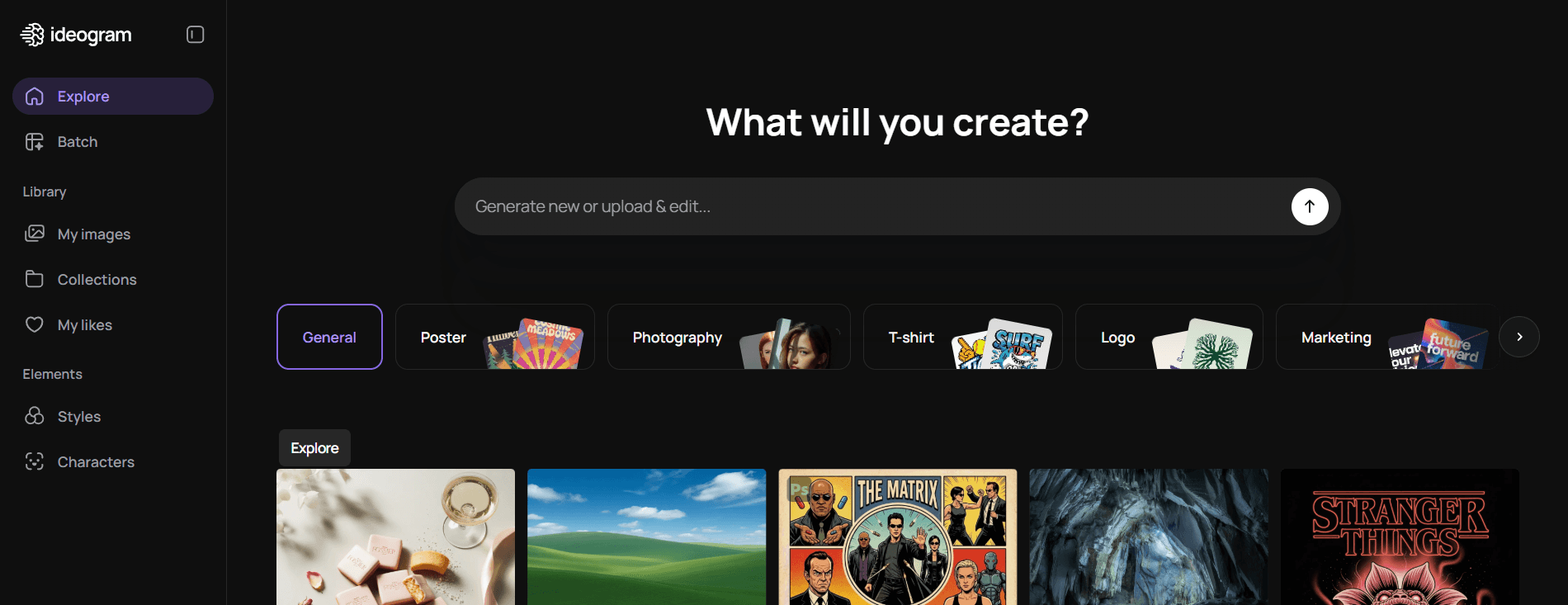

Ideogram 3.0 leads all AI image generators at rendering legible, on-brand text inside images. It is the go-to for posters, logos, and social graphics, though it falls short of Midjourney on photorealism and struggles with faces and non-Latin scripts.
Prompt: "Bold movie-style event poster for a jazz festival, headline reads BLUE HOUR JAZZ, subtitle reads Three Nights in New Orleans, date June 14–16 2026, venue The Saenger Theatre, warm amber and deep navy color palette, vintage letterpress texture." Ideogram 3.0 returned a compositionally integrated poster with every word spelled correctly, the headline set in a heavy serif, the subtitle in a lighter condensed face, and the venue name tucked cleanly into the lower third, all rendered as designed type, not pasted-in text. The same prompt in Midjourney produced an image where "BLUE HOUR JAZZ" became "BLUE HOUP JAZ" and the venue name dissolved into illustrated scrawl. That gap is the whole argument for Ideogram.
Tested in April 2026 across poster, logo, and social graphic prompts, Ideogram 3.0 consistently achieved legible, intentionally styled text output. Short phrases landed on the first generation; longer compositions occasionally needed one or two retries to get capitalization or spacing exactly right. The photorealistic portrait prompts we ran in the same session told a different story. Ideogram is a specialist, and understanding where its specialty ends matters as much as knowing where it begins.
Ideogram's visual signature in April 2026
Ideogram 3.0, launched March 2025 and updated in May 2025, produces images that read as graphic design outputs first and photographs second. The color palette tends toward punchy contrast; compositions feel typographically intentional. Ideogram was built with text rendering as a core capability, which shapes the aesthetic of everything it generates, images look like they were designed, not captioned.
The model lineup gives you practical choices. Ideogram 3.0 (4 credits per generation) handles final-quality creative work: cinematic compositions, multi-element posters, Style Reference-driven brand consistency. Ideogram 2a (1 credit per generation) is a legitimate budget option for simple logo passes and icon concepts. Style References let you upload up to three reference images to steer aesthetic across a batch; Style Codes let you reuse a style from a previous generation via a short code. Magic Prompt, available at all tiers, expands terse inputs into richer instructions for users who know what they want but cannot describe it precisely.
"Ideogram nails typography. text came out legible, on-brand, and (most importantly) usable. No weird spellings, no AI gibberish.". Reviewer at techpoint.africa, 2025
Multiple independent 2025 benchmark reviewers converged on the same quantitative finding: Ideogram achieves approximately 90–95% accuracy on short-phrase text rendering. Midjourney achieves roughly 30–40%. That is a categorical split between tools that can and cannot be trusted with type.
Prompts that actually work (with the quirks)
Ideogram rewards prompts that behave like a design brief rather than a description. The more you specify layout intent, the better the output behaves.
Prompt 1. Social media announcement graphic: "Square Instagram post, white background, large bold headline reads DOORS OPEN AT 8, smaller subtext reads Friday March 7 at The Fillmore, hand-drawn illustrated microphone in lower left, warm gold accent color, clean modern sans-serif typography." Output: Heavy geometric sans headline at roughly 40% canvas height, lighter weight subtext below, microphone illustration in the correct corner, gold accents in the text color and a thin rule separating both elements. First-generation text accuracy: 100%.
Prompt 2. Product label: "Vintage label design for a hot sauce bottle, brand name DEVIL'S MILE in distressed serif lettering, tagline reads Est. 1987 Laredo TX, illustrated flame and pepper motif, red and black color scheme, circular badge format." Output: Convincingly distressed slab serif, correctly spelled and center-weighted in the badge, tagline set cleanly below the illustration. The result looked production-ready, not approximated.
Text accuracy degrades as phrase length grows. A four-word headline is nearly certain to render correctly; a twelve-word sentence spread across three lines introduces risk on punctuation and long proper nouns. Keep critical phrases under eight words. Magic Fill can swap in corrected text regions without regenerating the full image.
"I find that even with different fonts, font sizes and text on different parts of the image, it does a great job 99 percent of the time.". Creator at thetexturequeen.com, after 6+ months of daily use, 2026
Where Ideogram struggles, hands, text, consistency
Ideogram's strength in typography is paired with weakness in photorealism. Ideogram 3.0 scored 3 out of 5 stars on photorealism in multiple 2025 benchmark reviews, a wide gap from Midjourney V7's 5-out-of-5 in the same evaluations. In crowd scenes, faces distort and proportional relationships break down. One reviewer summarized it plainly: "Faces and hands are still a weak point, especially in crowd scenes. Faces get distorted, fingers turn into spaghetti." If realistic portraiture or multi-person compositions are central to your workflow, Ideogram is not the right primary tool.
Character consistency is available via the Ideogram Character model (launched July 2025, updated April 2026), which earns a Tier A benchmark rating but drifts on fine details. In a 2026 test at neolemon.com, a character defined by golden wings generated into new poses with no golden wings retained, the model defaulted to white and tan. For brand mascots or recurring characters, Ideogram Character is a useful starting point that requires active prompt management across a production run.
Non-Latin text is a hard limitation. Ideogram's own documentation recommends using English for best results and adding non-Latin text manually afterward. Arabic and Hebrew misalign due to right-to-left rendering; CJK characters may appear but require manual correction; Cyrillic is inconsistent. The upscaler also fails for precision brand work: setting resemblance to 100 and detail to 10 still produced documented eye color shifts, shading artifacts, and altered lip tones in reviewer testing.
Commercial use: licensing, copyright, and safety filters
Ideogram does not claim ownership of generated images. Commercial use is permitted by default on paid tiers, resale, client delivery, advertising, and print-on-demand all fall within the terms. The responsibility users are expected to carry is ensuring outputs do not infringe existing copyrights, trademarks, or third-party IP. Prompts that reference specific brands or living public figures by name create IP risk that sits with the user, not the platform.
Free-tier generations are public by default and permanently remixable. Private generations require Plus ($20/month) or higher. If you are prototyping client concepts or working on unreleased products, the free tier is not appropriate. Content safety filters reject some prompts without refunding spent credits, aggregate user complaints note rejections on content that does not clearly violate guidelines, and content flexibility has been rated 4 out of 10 by one aggregated review.
Community workflows from Reddit and Discord
The print-on-demand community has built the most organized Ideogram workflows of any user group. The canonical POD approach: browse the public feed for style patterns that appear to be gaining traction, identify a composition or aesthetic that has been remixed multiple times, use the Remix feature to apply that aesthetic to a new subject, then use Magic Fill to adjust specific label or text elements before exporting. One Medium writer tracking this workflow documented the time savings: from 45 minutes per graphic manually to 5 minutes, with approximately 95% text accuracy on first attempts, reducing client revision rounds from 3–4 to 1–2.
The Etsy and Redbubble communities treat Ideogram's public feed as trend-monitoring infrastructure. Experienced sellers scan what is being generated and remixed before committing credits to original work, the default-public model creates a crowdsourced signal that functions as market research. The Batch Generation feature (Pro tier, $60/month) enables CSV-driven runs of 200+ images simultaneously. At 4 credits per 3.0 generation, a 200-row batch costs 800 credits, under a quarter of a Pro account's monthly allocation, making catalog-scale production tractable without a custom API integration.
Ideogram vs. Midjourney vs. Flux
Ideogram 3.0 is the right choice when your output needs to include legible, intentionally styled text. Posters, logos, social graphics, product labels, book covers, event announcements, any use case where the words are load-bearing. Its web-first interface is significantly more beginner-accessible than Midjourney's Discord-rooted workflow. The Canvas editor (inpainting, outpainting, style references) gives non-developers a complete editing environment without leaving the platform. Weakness: photorealism and human anatomy are genuine limitations, not minor gaps.
Midjourney V7 leads on photorealism and artistic rendering quality, rated 5/5 on photorealism vs. Ideogram's 3/5 in multiple 2025 benchmarks. For photorealistic portraits, cinematic landscapes, or anything that needs to look like a photograph, Midjourney is the stronger tool. Its text rendering achieves roughly 30–40% accuracy, making it unreliable for typography-dependent work. Pricing overlaps: Midjourney runs $10–$30/month, comparable to Ideogram Plus at $20. One Reddit user quoted in a 2026 comparison flagged perceived quality drift: "Suddenly the photos are very low quality, not like they used to be", a signal that Ideogram's photorealism reputation is sensitive to model updates.
Flux (Black Forest Labs) is the emerging third option in print-on-demand and design communities. FLUX.1 Kontext Pro leads on ultra-realistic photographic outputs. A 2026 comparison at mydesigns.io summarized the split: "If your design needs to include written words or typography, Ideogram 3 is your go-to for clean results", with Flux positioned for photographic quality. Flux is available via API and third-party interfaces but lacks a consumer-facing Canvas editor or character consistency tool.
Credit economics, what a real project costs
Ideogram's credit system has one important variable: the model you use determines the per-image cost. Ideogram 3.0 costs 4 credits per generation. Ideogram 2a costs 1 credit. This creates a 4x cost multiplier between the flagship and the budget model, a distinction that matters when you are running volume work.
On the Free tier (10 slow-queue credits per week, approximately 40 per month), 3.0 gives you about 10 full-quality generations monthly before you run out. That covers exploration and testing but is not a production-viable volume. Images generate in slow queue, all outputs are public, and downloads are JPG only.
Plus ($20/month) provides 1,000 priority credits monthly, 250 generations at 3.0 quality, or 1,000 at 2a quality. Private generations, PNG downloads, Style References, and the full Canvas editor (Magic Fill, Extend) are included. A POD creator documenting daily Pinterest graphics chose Plus because each design required at least 3 credits across iterations, making Basic's 400 credits insufficient for volume work.
Pro ($60/month, or approximately $42/month on annual billing) provides 3,500 priority credits, 875 3.0 generations or 3,500 2a generations. Batch generation via CSV (200+ prompts at once), custom aspect ratios, color palette locking, and all rendering speeds (Turbo/Default/Quality) are Pro-exclusive. For agencies, volume marketing teams, or print-on-demand businesses running high-output catalogs, Pro's batch functionality changes the economics entirely.
Credit top-ups cost $4 per pack (100–250 credits depending on tier). Unused priority credits expire at month-end with no rollover. API pricing runs significantly higher: ideogram-v3-quality costs $0.090 per image via API vs. approximately $0.023 per image on Plus, a nearly 4x premium over the consumer plan rate.
User Reviews
No reviews yet. Be the first to share your experience!
Sign in to write a review.
Featured in collections
Curated lists that include Ideogram.
Related articles
Guides and articles related to Ideogram.
Wix Logo Maker Review (2026): Real Costs, the Edit Catch, and AI Alternatives
AI Fashion Prompts That Stay Consistent: The Working Formula (2026)
AI Video Generator Prompting: The Filmmaker's Real Workflow
Freepik AI Is Now Magnific: What Changed, What It Costs, and Whether to Stay (2026)
Best AI Fashion Model Generators for Clothing Brands (2026)