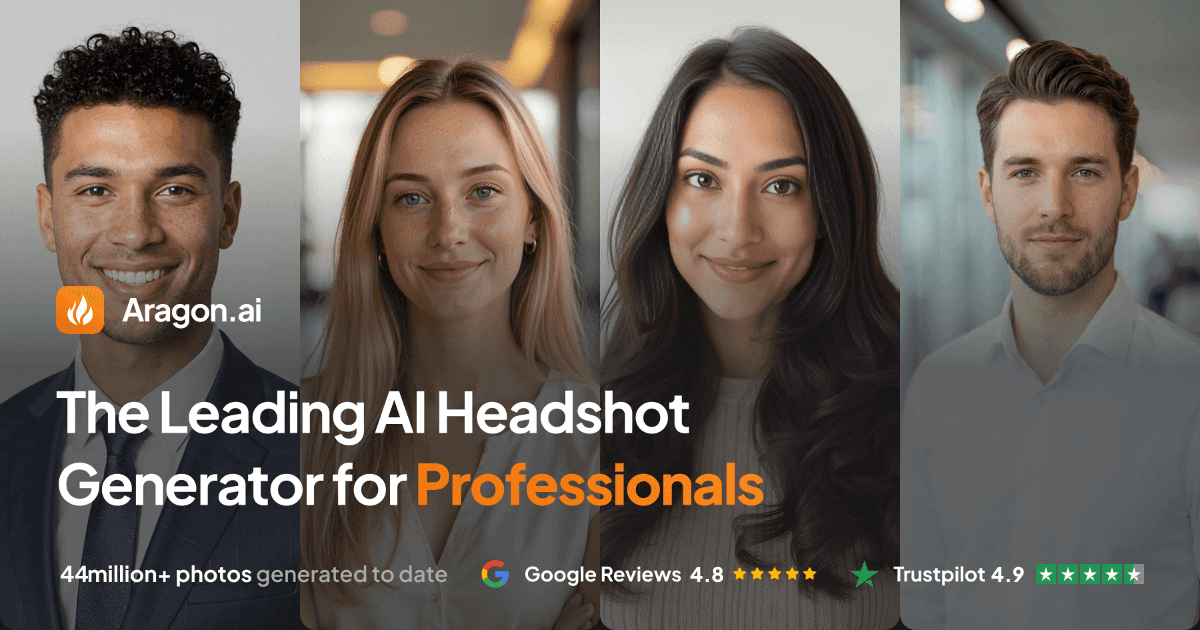

Aragon AI generates studio-quality professional headshots from 6 selfies in 30 minutes or less. SOC 2 Type II certified, used by Fortune 500 teams, with 40 million headshots generated and a 4.9/5 Trustpilot rating from over 5,800 verified reviews.
Aragon AI is an AI professional headshot generator that turns a handful of casual selfies into studio-quality portraits without a photographer, a camera crew, or a $500 booking fee. Founded in 2022 by Wesley Tian and Akhil Nadendla, both MIT and ex-Meta/Google alumni, the San Francisco company built Aragon specifically for the professional photography problem: most people need a great headshot for LinkedIn, a pitch deck, or a job application, and almost no one has one on hand. The tool has generated more than 40 million photos for over 2 million professionals, reached $10 million in annual revenue by April 2025, and did all of it with a team of 11 people and zero outside funding.
The core workflow takes six selfies as input, gives you a choice of outfit styles (Smart Casual, Business Casual, Business Professional) and backgrounds (Office, Nature, City, Studio), then delivers between 40 and 100 high-resolution headshots to your email within 15 minutes to 2 hours depending on your plan. Outputs resolve at up to 2048 x 2560 pixels on the standard plans. A post-generation suite of 50+ editing tools, including a clothing changer, background changer, hair editor, pose editor, and magic eraser, lets you refine individual shots without leaving the platform. For HR teams and talent operations, Aragon offers team plans with bulk onboarding, branded backgrounds, and centralized delivery. The service is SOC 2 Type II certified, uses AES-256 encryption, and grants users full image ownership. Featured in the Washington Post, Business Insider, and Entrepreneur, it holds a 4.9/5 rating on Trustpilot from 5,800+ verified reviews and a 4.8/5 on Google.
What Aragon AI generates in June 2026
Aragon's current generation pipeline takes 6 to 10 selfies as training input and fine-tunes a personalized model on the fly for each session. That per-session fine-tuning is what separates it from tools that apply a generic style filter: the model learns your face, not just the concept of a professional headshot. The result is a batch of 40 to 100 images per order, all depicting your actual likeness rather than an averaged approximation.
Resolution tiers sit at 2048 x 2560 pixels on standard and premium plans. The editing suite adds a second layer of customization: after delivery, you can swap backgrounds, change clothing colors, extend or crop poses, and remove objects from any generated photo. The team plan adds a white-label option where HR departments can pre-set approved backgrounds and outfit styles so every employee gets a consistent branded headshot in the same shoot window.
In February 2026, Aragon published a milestone post marking three years of operation, confirming the 2 million user count and 40 million photos generated. The post previewed a push into AI video portraits, signaling the roadmap is moving beyond static headshots.
"I was genuinely impressed with the quality of headshots from Aragon AI. The process was simple, turnaround was fast, and the images looked professional enough to use across LinkedIn and my pitch deck." - Shashank N., verified Aragon user, 2025
Where Aragon AI sits versus HeadshotPro and BetterPic
The AI headshot category is crowded, but the three most-compared tools are Aragon, HeadshotPro, and BetterPic. Each makes a different technical trade-off.
Aragon vs. HeadshotPro: HeadshotPro requires 15 source images (12 close-ups and 3 full-body shots) versus Aragon's 6. HeadshotPro's delivery window is 1 to 4 hours versus Aragon's 15 to 45 minutes on premium. HeadshotPro generates 40 to 120 photos per session with a usable-image rate that reviewers estimate at 50 to 60 percent. Aragon's comparable figure sits at roughly 90 percent according to independent tests, which matters when you are paying per session rather than per usable image. HeadshotPro offers no post-generation editing; Aragon's 50+ editing tools let you modify outputs after delivery. HeadshotPro prices from $29 to $59, putting it below Aragon's $35 to $75 range at entry level, though the per-usable-photo math often favors Aragon.
Aragon vs. BetterPic: BetterPic positions as the quality-first premium option in the category. BetterPic outputs at true 4K resolution versus Aragon's 2048 x 2560. BetterPic's Expert tier ($79) includes human editorial retouching on one selected photo plus one free redo of the entire session, features Aragon does not offer. BetterPic also supports over 150 style presets versus Aragon's curated outfit and background categories. Where Aragon wins is speed (15 minutes versus BetterPic's sub-1-hour window) and source photo requirement (6 photos versus BetterPic's 8). Both hold SOC 2 Type II; BetterPic also holds ISO 27001. For sheer throughput and speed, Aragon is faster. For output resolution and human editorial oversight, BetterPic has the edge.
If you are generating headshots for a team of 50 and need them today, Aragon's speed and team pricing structure make it the practical choice. If you are a C-suite executive who needs one photograph for a Forbes feature and wants a human editor to sign off on retouching, BetterPic is the better fit. Aragon's mainstream position in the market, 6,260+ Trustpilot reviews, and Fortune 500 client list put it in a different league from niche competitors for most use cases. Tools like Midjourney and Leonardo AI can generate portrait-style images but are not headshot-specific, lack the per-session personalization model, and produce stylized output rather than realistic likenesses.
"For the price and speed, nothing else comes close. My friends couldn't tell the headshots were AI-generated." - Fahim Joharder, AI tools reviewer, 2026
Real cost of running Aragon AI
Aragon uses a one-time pack model, not a subscription. You pay once per session and keep the outputs. There are no monthly fees, no credit rollover complications, and no usage tiers that expire. The three individual plans are:
Starter: $35 one-time, 40 headshots, approximately 2-hour delivery, 1 outfit and background option, standard resolution (896 x 1088 px on entry, higher on premium)
Basic: $45 one-time, 60 headshots, approximately 1-hour delivery, 2 outfits and backgrounds
Premium: $75 one-time, 100 headshots, 15-45 minute delivery, all outfits and backgrounds, enhanced resolution (2048 x 2560 px), fastest processing queue
Teams: $35 per person (minimum varies), bulk delivery, branded backgrounds, centralized admin dashboard, priority support
The 99 percent satisfaction guarantee means you can request free regeneration or a full refund if you are unhappy with results, though the refund process has drawn some criticism in reviews (see below). No subscription means the cost is genuinely predictable: if you need new headshots in 18 months, you pay again at whatever the then-current rate is. There are no lock-in effects.
For context on value: a mid-tier professional photography session in a major US city typically runs $250 to $500 and delivers 10 to 20 edited images within a week. At $35 for 40 headshots delivered in 2 hours, the math is hard to argue with for most use cases. The relevant question is whether AI output quality meets your specific standard, not whether the price is competitive.
Where Aragon AI reliably fails
Aragon's failure modes are consistent and worth understanding before you buy. The most common complaint across Trustpilot and independent review sites involves facial feature accuracy on a minority of outputs: specifically, distortions around the eyes, inconsistent teeth rendering, and occasional skin-smoothing that crosses into uncanny territory. Reviewers who tested Aragon at scale report that roughly 5 to 10 percent of outputs in a batch have some artifact that makes them unusable, which is low but not zero.
Input quality has an outsized effect on output quality. Blurry selfies, photos taken in poor lighting, mirror shots, or images with strong shadows on the face produce noticeably worse results. Aragon's guidance to upload 6 well-lit, varied-angle photos is functional advice, not marketing copy. Users who ignore it tend to write the negative reviews.
The second recurring complaint is the refund process. Aragon advertises a 99 percent satisfaction guarantee, but a non-trivial slice of 1-star reviews describe difficulty obtaining refunds: requests going unanswered, denials because a photo was downloaded, or extended back-and-forth before resolution. This is a customer support friction issue, not a product quality issue, but it does affect trust for first-time buyers.
Pose variety is limited compared to tools built for creative photography. Aragon generates clean professional headshots in standard portrait orientations. If you want editorial-style poses, dramatic lighting, or artistic compositions, you will need to use its post-generation editing tools or switch to a general image editor. Photoroom and Canva both offer background removal and light editing that can extend Aragon outputs, but neither matches a dedicated portrait photography setup for artistic results.
Finally, the tool currently generates static images only. The February 2026 milestone post hinted at video portrait capabilities, but as of June 2026 the product is headshots only. Teams that need motion content (animated LinkedIn profile photos, video bios) will need a separate tool for now.
Who Aragon AI is for, and who should pick something else
Aragon's strongest use cases cluster around a few specific scenarios. Job seekers who need a credible LinkedIn profile photo and do not want to pay for a photographer are the core audience; the 30-minute turnaround and $35 entry price make it an obvious choice for anyone who has been putting off updating their profile photo. HR and talent acquisition teams running onboarding at scale, especially remote-first companies where flying everyone to a studio shoot is impractical, have adopted Aragon's team plan for exactly this reason. Founders who need consistent headshots across pitch decks, press kits, and investor pages but are spending their budget on product rather than photography fit the use case well. The Fortune 500 client base confirms enterprise appetite for the team features.
Content creators who pair AI headshots with other AI tools have found Aragon useful as a source of consistent persona images for YouTube thumbnails, course materials, and social media. Tools like Canva make it easy to drop Aragon outputs into designed templates, and Midjourney users have noted that high-quality Aragon headshots work well as reference images for portrait prompting when they want a consistent likeness across generated scenes.
Skip Aragon if your photos will be scrutinized at the highest professional standard: executive portraits for annual reports, magazine features, or advertising campaigns where a human retoucher is part of the brief. Skip it if you need 4K resolution output for large-format print (BetterPic is the better call). Skip it if you want artistic or editorial photography rather than clean professional portraits. Skip it if you have had poor experiences with the refund policies of SaaS tools and are not comfortable with the risk of that friction.
For the majority of professionals who just need a good headshot they are not embarrassed by, Aragon is the fastest, most battle-tested option in the category. The 40 million photos generated, 5,800+ Trustpilot reviews, and bootstrapped $10 million revenue milestone are not marketing claims; they are evidence that the product works at scale for the people it is built for.
User Reviews
No reviews yet. Be the first to share your experience!
Sign in to write a review.
Related articles
Guides and articles related to Aragon AI.
How to Get an AI Model Wearing Your Clothes (Step by Step)
Best AI Fashion Model Generators for Clothing Brands (2026)
How to Make Money Selling AI UGC Content for Brands (2026)
AI Fashion Prompts That Stay Consistent: The Working Formula (2026)
AI Clothing Photoshoot: What It Really Costs vs a Studio Shoot (2026)