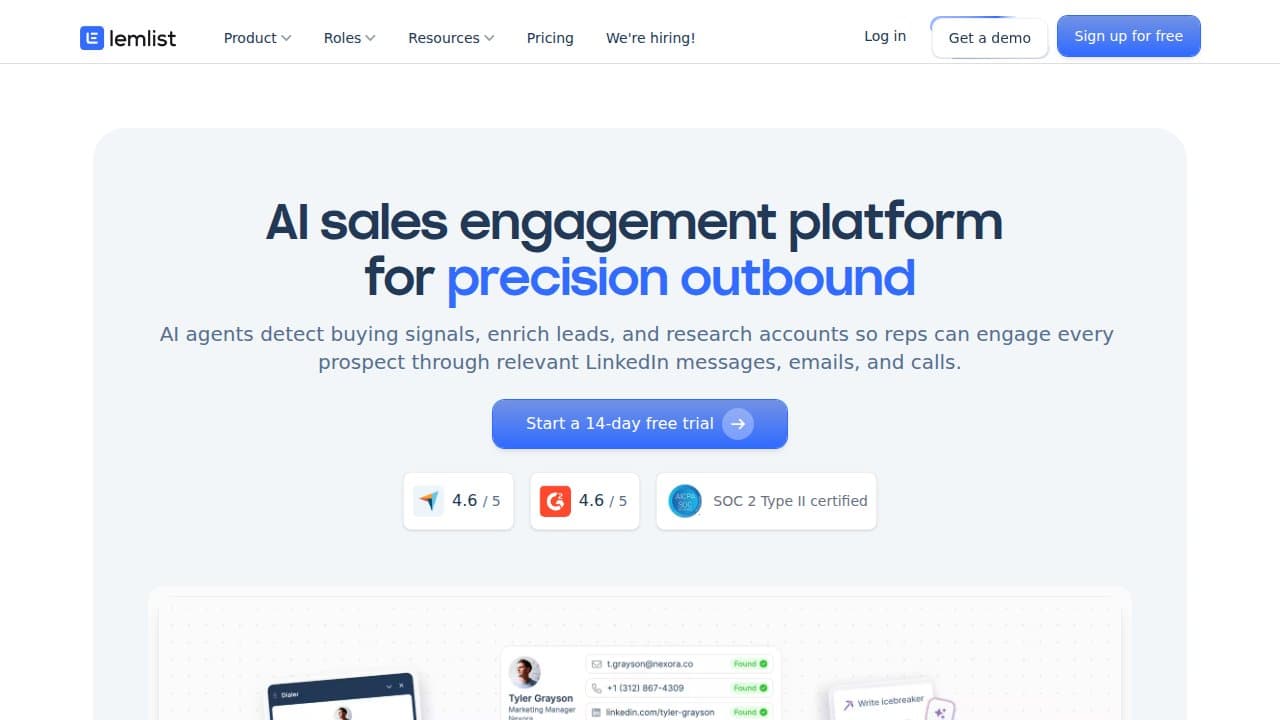
Lemlist is a French-built multichannel sales engagement platform that personalizes cold email at scale using dynamic images, Liquid syntax variables, and AI enrichment agents. Built for teams who need email, LinkedIn, WhatsApp, and calls in one workflow.
Lemlist is a multichannel sales engagement platform built by Lempire, a bootstrapped French company founded in 2018 by Guillaume Moubeche in Paris. It started as a cold email tool with one distinctive feature: the ability to embed dynamically personalized images and video thumbnails directly inside email bodies, making each message visually distinct from the generic cold email flood. By 2026 it has grown into a full outbound stack covering lead discovery, multichannel sequence automation, deliverability monitoring, and AI-powered contact enrichment. The company reached $40M in annual recurring revenue in 2025 without outside funding, serving over 20,000 sales teams globally, and carries a 4.6 out of 5 rating on G2 from more than 1,400 verified reviews.
The platform operates across three functional layers. The first is lead discovery: a 600M+ contact database with filters for job title, industry, company size, and intent signals, plus real-time email verification and phone finder credits. The second is multichannel sequence automation: a visual sequence builder that chains email steps with LinkedIn connection requests, LinkedIn messages, WhatsApp messages, and manual call tasks into a single branching workflow, with condition-based logic at each step. The third is AI personalization: Liquid syntax variables that adjust copy conditionally based on lead attributes, dynamic image personalization that embeds prospect names or LinkedIn photos into graphics inside the email, and AI enrichment agents (launched April 2026) that autonomously research each lead's website, LinkedIn profile, and CRM history before building the first message. Users pair lemlist with tools like Clay for deeper enrichment pipelines and Lavender for pre-send email quality scoring.
What lemlist actually is in April 2026
The core product in 2026 is organized around the "Smartbound" concept that CEO Charles Tenot introduced after acquiring AI meeting-intelligence platform Claap in October 2025 for $25M using company profits. Smartbound is lemlist's positioning for intelligence-driven outreach: rather than blasting a large list with the same sequence, the platform uses external signals (a company's recent funding, new job postings, leadership changes) and internal signals (notes from past calls, CRM fields, previous reply sentiment) to trigger the right sequence at the right moment. The Claap acquisition added conversation intelligence to this stack: Claap records sales calls, generates transcripts, extracts insights using MEDDIC or SPICED frameworks automatically, and fills CRM fields without manual entry, creating a feedback loop between what happened on a call and how follow-up outreach is personalized.
The AI Agentic Enrichment feature, released April 23, 2026, operationalizes this vision: autonomous agents scrape LinkedIn profiles, analyze websites, and review CRM call notes, then populate personalization variables before a human reviews the campaign. The Claude Skills and MCP integrations (released April 2026) connect lemlist to external AI assistants for research and campaign auditing without writing code. These releases represent a meaningful shift: lemlist is evolving from a sending tool with personalization bolted on into a platform where AI handles the research layer and humans focus on ICP definition and sequence strategy.
For day-to-day teams, the practical picture is a visual sequence editor where each node represents a step: email, LinkedIn connection, LinkedIn message, WhatsApp, call task, or a condition (did they open the last email? Are they in a specific company size bracket?). Each step supports AI-generated copy drafts, Liquid syntax conditionals (show one paragraph to CTOs, a different paragraph to VP Sales), and dynamic image variables. The Deliverability Hub monitors domain health, DNS records, and inbox placement rates with real-time scoring, surfacing issues before they damage a campaign's sender reputation. Lemwarm, the warm-up product, runs as a background process warming all connected sending domains through human-like conversation threads.
Where lemlist sits versus Smartlead and Instantly.ai
Smartlead and lemlist solve adjacent problems with fundamentally different architectures. Smartlead is priced on email volume rather than per seat: one Smartlead account serves an entire team starting at $39/month with unlimited connected mailboxes. A five-person team on lemlist's Multichannel Expert plan costs $435-545/month; the same team on Smartlead costs $39-94/month depending on the tier. That pricing gap is Smartlead's biggest structural advantage for email-only workflows. The technical difference that matters for deliverability: Smartlead uses ESP-matching warmup logic, meaning Gmail accounts warm against Gmail accounts and Outlook accounts against Outlook accounts, which produces more consistent inbox placement on Outlook-heavy prospect lists. Lemlist's Lemwarm uses a shared network without that ESP-pairing specificity. The feature Smartlead cannot replicate: lemlist's native image personalization using Liquid syntax. Embedding a prospect's company logo, LinkedIn headshot, or custom graphic inside the email body is built into lemlist's composer and has no equivalent in Smartlead. Agencies needing white-label client dashboards and flat per-account pricing should evaluate Smartlead first; in-house teams who need LinkedIn sequences and image personalization belong in lemlist.
Instantly.ai is lemlist's closest economic competitor in the EU market and the tool most often cited in head-to-head comparisons on Reddit and G2. Instantly uses flat-fee pricing with unlimited connected inboxes: their Hypergrowth plan at $97/month covers 10 operators with unlimited mailboxes, while lemlist at $87/user/month charges for each seat separately. That per-seat versus flat-fee structure is the single biggest mechanical difference. Instantly's AI Reply Agent handles inbound email classification, objection responses, and calendar link delivery autonomously, which lemlist does not offer as of April 2026. Lemlist's differentiator in return: multichannel in the base plan. Instantly's base tiers are email-only; LinkedIn and other channels require third-party tools or an upgrade path. Lemlist includes LinkedIn automation, WhatsApp, and call tasks in Multichannel Expert at $87/user/month. For solo founders and small agencies doing email-only outbound, Instantly's economics are better. For teams where LinkedIn sequences are a core channel and image personalization drives reply rates, lemlist is the stronger choice.
"It's easy to create campaigns with both email and LinkedIn automations in a simple workflow." - Jamie H., Head of Growth, Capterra, April 2024
"The reporting is confusing. Would be nice to have more advanced reporting and ability to create lists." - Kelly K., Marketing, Capterra, January 2025
How AI actually works inside lemlist
Lemlist's AI is not a single model but a layered set of features that operate at different points in the outreach workflow. The distinction matters because the depth of automation varies significantly by feature.
The AI sequence generator takes an ICP description (target role, industry, company size, pain point) and produces a multi-step sequence draft with subject lines, email body variants, and LinkedIn message templates. In practice, users report these drafts are serviceable starting points but require rewriting: the AI output sounds generic without additional personalization, and experienced outreach practitioners typically rewrite 70-80% of generated copy before launching. The Hackceleration review team, which tested 15,000+ emails across actual client campaigns, rated AI-generated copy at "approximately 70% usability" before human editing.
Liquid syntax is where lemlist's AI personalization gets technically interesting. Variables are not just merge tags: they support conditional logic. A single email template can show one opening paragraph to prospects in Series A startups and a different paragraph to prospects at enterprises above 500 employees, all from the same sequence step. This conditional rendering is built into the email composer and requires no external scripting. Combined with dynamic image personalization, which embeds variable content (name, company logo, LinkedIn headshot, or a screenshot of the prospect's website) into a graphic image inside the email body, campaigns can send visually distinct messages at scale. Review forums document reply rate improvements of 10-20 percentage points on targeted campaigns using image personalization versus text-only equivalents.
The AI Agentic Enrichment agents (April 2026) represent the most autonomous layer: agents run research pipelines in the background, scraping data sources and populating structured fields in lemlist's lead database before a human launches the campaign. The Claude Skills and MCP integrations extend this to AI assistant workflows outside the lemlist UI. This agentic direction is early-stage but differentiates lemlist from tools like Klenty and Copy.ai, which either do not have enrichment agents or do not connect them directly to the campaign builder.
The friction and cost reality users keep raising
Per-seat pricing at scale is the complaint that appears most consistently across review platforms. A five-person SDR team on Multichannel Expert costs $435-545/month before enrichment credit top-ups. A ten-person team is $870-1,090/month. At those numbers, lemlist is competing on features, not economics, and the comparison to Smartlead or Instantly is unfavorable for email-only workflows. Aggregated review analysis from trulyinbox.com counts 141 distinct mentions of pricing concerns across collected reviews.
Missing features top the review complaint list with over 200 mentions in aggregated G2 and Capterra feedback. The most-cited gap is a mobile app: lemlist has no iOS or Android application as of April 2026. For sales reps who need to review replies or check sequence progress from a phone, this requires workarounds through mobile browser or forwarding notifications to another app.
Lead database quality is a recurring theme. The 600M+ contact count includes unverified and outdated records: Hackceleration's testing put email and phone accuracy at 65-70%, which means roughly one in three lookups returns a bad result. Users spending enrichment credits on inaccurate contacts have no credit recovery path. Multiple Trustpilot reviews flag billing issues and difficulty getting refunds when purchased leads are invalid.
LinkedIn automation carries an account restriction risk that lemlist does not prominently disclose. The automation tools for LinkedIn connection requests and messages technically violate LinkedIn's Terms of Service. Multiple users on review platforms and in Reddit threads document receiving LinkedIn account restrictions or temporary bans after using lemlist's LinkedIn automation at volume. The risk scales with daily action limits: staying under 20-30 LinkedIn actions per day is the general advice, but the platform does not enforce these limits automatically.
Analytics depth is a recurring frustration at the intermediate user level. Aggregate open, click, and reply rates are available per campaign, but sequence-level trend analysis, A/B test statistical significance indicators, and cohort-level performance breakdowns are absent. Users who need detailed attribution reporting typically build separate dashboards by exporting CSV data from lemlist into Sheets or a BI tool.
Who lemlist is for
Lemlist is best suited for in-house sales teams of three to fifteen reps who need email, LinkedIn, and optionally calls and WhatsApp unified in one platform. The personalization features are most impactful in founder-to-founder outreach and enterprise prospecting where each message needs to feel individually researched. European and French companies benefit from the GDPR-native compliance architecture and a support team operating on CET timezone.
The Claap acquisition and Smartbound roadmap make lemlist an interesting bet for teams that want to move away from spray-and-pray volume outreach toward intelligence-driven prospecting: if conversation data from Claap eventually triggers lemlist sequences automatically based on call outcomes, the platform becomes considerably more powerful than the current feature set suggests.
Skip lemlist when your primary need is email-only at high volume: Smartlead and Instantly are cheaper, offer unlimited inboxes, and produce comparable deliverability results without per-seat fees. Skip it if your team has more than ten reps and a tight budget, as the per-seat model compounds quickly. Skip it if you need a mobile app for daily workflow. Solo founders running 30-50 highly targeted emails per day may find the image personalization worth the price; those doing high-volume automated sequences will find cheaper tools that do the job.
User Reviews
No reviews yet. Be the first to share your experience!
Sign in to write a review.
Related articles
Guides and articles related to Lemlist.

How to Build an AI Outbound Stack From Scratch: The Complete 2026 Playbook

How Clay Actually Works: Waterfall Enrichment and Signal Prospecting Explained

Smartlead vs Instantly (2026): Which Cold Email Platform Fits Your Stack

AI SDR vs Human SDR: The Real Cost, Performance, and What Nobody Tells You

The Signal-Based Outbound Playbook: Use Intent Data to Raise Reply Rates