
OLMo is AI2's fully open language model family, releasing not just weights but the complete Dolma training dataset, all training code, and intermediate checkpoints under Apache 2.0. The research community's go-to for reproducible, auditable LLM science.
OLMo is a family of open language models built by the Allen Institute for AI (AI2), a Seattle-based non-profit research organization. Where most "open" LLMs give you weights and call it a day, OLMo goes further: every release includes the full Dolma pretraining dataset, training code, evaluation suites, optimizer states, and intermediate checkpoints at every stage of training. All components ship under the Apache 2.0 license, meaning no usage restrictions, no commercial gatekeeping, and no mystery about what the model learned or where it learned it. The family spans OLMo 1B, 7B, 13B, and 32B dense models, plus OLMoE, a sparse mixture-of-experts variant with 1 billion active parameters drawn from 7 billion total. Post-training uses the Tulu pipeline, giving instruct variants competitive instruction-following and RLHF alignment.
The current generation, OLMo 2, launched in November 2024 with 7B and 13B models that outperformed Llama 3.1 8B on academic benchmarks. OLMo 2 32B, released March 2025, became the first fully open model to beat GPT-3.5 Turbo and GPT-4o mini on a suite of multi-skill evaluations. AI2 also released OLMoTrace in April 2025, a tool that traces any model output back to the specific training documents that likely contributed to it, using infini-gram indexing across 4.6 trillion tokens. This level of traceability is unique in the LLM landscape and has made OLMo the de facto research platform for AI safety auditors, bias researchers, and anyone who needs to answer "where did the model learn this?"
OLMo at a glance, April 2026
The OLMo family covers three product lines. The base dense models (7B, 13B, 32B) use a transformer architecture with rotary embeddings and trained on the Dolma corpus, a multi-source dataset drawing from web text, code, books, scientific papers, and encyclopedic content. OLMo 2 models train in two stages: Stage 1 on OLMo-Mix-1124 (around 3.9 trillion tokens from DCLM, Dolma, Starcoder, and Proof Pile II), and Stage 2 on Dolmino-Mix-1124 (843 billion tokens of curated high-quality web and domain-specific content). OLMoE is the sparse MoE variant: 1 billion parameters active per forward pass from 7 billion total, trained on 5 trillion tokens, and trained roughly 2x faster per compute unit than a comparable dense model. The Tulu post-training pipeline (SFT, DPO, PPO) produces the -Instruct variants for each size. Context windows are 4,096 tokens for OLMo 2 7B and 13B, extended in later releases. All models target English; multilingual support remains limited. Models are hosted on the allenai Hugging Face organization and load natively through HuggingFace Transformers, vLLM, and Ollama.
What OLMo is actually good at
OLMo's primary strength is not raw generation quality, it is reproducibility and auditability. No other major LLM family lets you replay training from a checkpoint, inspect every data source, and trace an output back to the document it came from. This makes OLMo uniquely suited for academic ML research: studying how different training data mixes change model behavior, identifying bias sources, comparing alignment techniques against a controlled base, and publishing findings others can reproduce.
On generation quality, OLMo 2 7B and 13B are competitive with the leading open-weight models at equivalent scale. OLMo 2 7B posts 63.7 on MMLU, 83.8 on HellaSwag, 79.8 on ARC-Challenge, and 67.5 on GSM8K, outperforming Llama 3.1 8B on these benchmarks. OLMo 2 32B crossed a meaningful threshold in March 2025, outperforming GPT-3.5 Turbo and GPT-4o mini on a suite of multi-skill academic benchmarks, doing so at roughly one-third the training compute cost of Qwen 2.5 32B. The Apache 2.0 license is a concrete advantage for commercial teams that cannot operate under Meta's Community License (which restricts services with over 700 million monthly active users).
"Studying LLMs without access to the training data is the equivalent of drug discovery without clinical trials or studying the solar system without a telescope." - Hanna Hajishirzi, OLMo project lead, AI2, VentureBeat, February 2024
"A giant leap for open science." - Jonathan Frankle, Chief Scientist at Databricks, on the original OLMo release, Business Wire, February 2024
Where OLMo breaks: the failure modes users keep hitting
The most consistent friction point is the 4,096-token context ceiling in OLMo 2's 7B and 13B variants. While Llama 3.1 extends to 128K tokens, a HuggingFace forum thread on OLMo-2-1124-13B includes users explicitly asking whether a long-context release exists and finding none. Document summarization, long-form analysis, and RAG pipelines that push context hard will hit this wall.
English-only coverage is a documented limitation. OLMo's Dolma dataset is English-centric, and the Tulu 3 instruct training confirmed that removing multilingual data degraded performance by around 0.5 points. Teams working in Spanish, French, Chinese, or any other language should not default to OLMo for production applications.
Fine-tuning has a subtle trap: models pretrained for longer can be harder to instruction-tune. AI2's own research documented a "catastrophic overtraining" effect where the OLMo 1B model trained on 3 trillion tokens performed over 2 percentage points worse after fine-tuning than the 2.3 trillion-token checkpoint. Practitioners who grab the final checkpoint assuming it is the best base for downstream fine-tuning may be disappointed.
The community ecosystem is smaller than Llama's by a wide margin. OLMo-2-1124-7B had roughly 37,000 monthly downloads on Hugging Face in early 2026, versus millions for Llama variants. Quantized GGUF files exist (17 quantizations listed) but the range of community fine-tunes (15 listed) is far narrower than the hundreds available for Llama 3. Frontend integrations with consumer tools like LM Studio and Ollama skew heavily toward Llama and Mistral GGUF formats.
OLMo vs. Llama vs. SmolLM
OLMo vs. Llama (Meta): The mechanical difference is training data disclosure and license scope. Llama 3.1 releases weights under a custom Community License that restricts commercial use above 700 million MAU and discloses nothing about training data composition. OLMo releases the full Dolma corpus, training code, and all intermediate checkpoints under Apache 2.0 with no usage restrictions. On context length, Llama 3.1 supports 128K tokens to OLMo 2's 4,096 at 7B/13B scale. On performance, Llama has a larger parameter range (8B, 70B, 405B) and a vastly larger ecosystem of fine-tunes, quantizations, and tool integrations. OLMo narrows the benchmark gap at each scale, and OLMo 2 7B now outperforms Llama 3.1 8B on standard academic benchmarks, but Llama dominates for consumer deployment. The choice depends on whether training data auditability is a requirement.
OLMo vs. SmolLM (Hugging Face): Both are genuinely fully open with Apache 2.0 licenses and disclosed training data. SmolLM targets edge deployment: 135M, 360M, and 1.7B parameters trained on a 252-billion-token corpus (Cosmopedia v2, FineWeb-Edu, Stack-Edu-Python), capable of running in-browser or on CPU. OLMo targets research-scale training at 7B to 32B parameters on a 3.9-trillion-token corpus drawn from a broader source mix. SmolLM 3 extends to 8K context; OLMo 2 7B tops at 4,096 tokens. They are not real competitors: SmolLM is an on-device inference tool, OLMo is a research platform. A team wanting fully open edge inference picks SmolLM; a team wanting a fully reproducible research LLM picks OLMo.
Is the paid tier worth it?
There is no paid tier. OLMo is free in every meaningful sense: the weights download for free, the training data downloads for free, the training code is on GitHub, and the Apache 2.0 license permits commercial deployment without any fees or usage reporting. AI2 is a non-profit; the model's existence is funded by research grants rather than product revenue. Third-party cloud APIs (Together AI, Puter, Replicate) that host OLMo models charge per-token rates typical of those platforms, but that is a hosting cost, not an OLMo license cost. For teams evaluating OLMo against open-weight models that require commercial licensing agreements, the comparison collapses to: OLMo costs zero in legal overhead.
Best use cases, and when to skip it
Use OLMo when: You are conducting academic research on pretraining dynamics, data curation effects, or alignment techniques and need reproducible baselines. You are an AI safety team that needs to trace model outputs to training sources. You need Apache 2.0 licensing without the restrictions Meta's Community License carries at scale. You are building a science-focused application where data provenance is a regulatory or contractual requirement. You want to run controlled ablations and compare checkpoints across the training run.
Skip OLMo when: You need a production-quality chatbot or code assistant with maximum generation quality. Reach for a frontier model or a Llama-based fine-tune instead. You are building multilingual applications. Your pipeline depends on extended context beyond 4K tokens at the 7B/13B scale. You want the broadest possible ecosystem of community fine-tunes, adapters, and quantizations. You need a model small enough to run on a CPU or in a browser: SmolLM fits that need better. General consumer tasks where the full openness of training data is irrelevant to the user experience don't benefit from what makes OLMo distinct.
Getting started with OLMo
Models load directly through Hugging Face Transformers using the allenai/OLMo-2-1124-7B model ID. The standard HuggingFace AutoModelForCausalLM and AutoTokenizer classes work without any custom code. For instruct-tuned inference, the allenai/OLMo-2-1124-7B-Instruct variant applies the Tulu 3 post-training. The AI2 Playground at allenai.org provides a no-setup web interface for testing OLMo 2 32B Instruct, OLMo 2 13B Instruct, and OLMoE 1B-7B Instruct. For fine-tuning, AI2's open-instruct repository on GitHub provides training recipes using the same Tulu pipeline used to produce official instruct variants. OLMoTrace, also accessible through the AI2 Playground, lets you enter any model output and see which training documents contain matching spans, useful for debugging, fact-checking, and auditing model behavior before deployment.
User Reviews
No reviews yet. Be the first to share your experience!
Sign in to write a review.
Featured in collections
Curated lists that include OLMo.
Related articles
Guides and articles related to OLMo.

Nous Hermes 4: The Self-Hosted Open-Weight Agent Brain (2026)
Grok 4.3 API for Agents (May 2026): Pricing, Benchmarks, Migration
Run Open Source AI Models Locally: Battle-Tested Guide
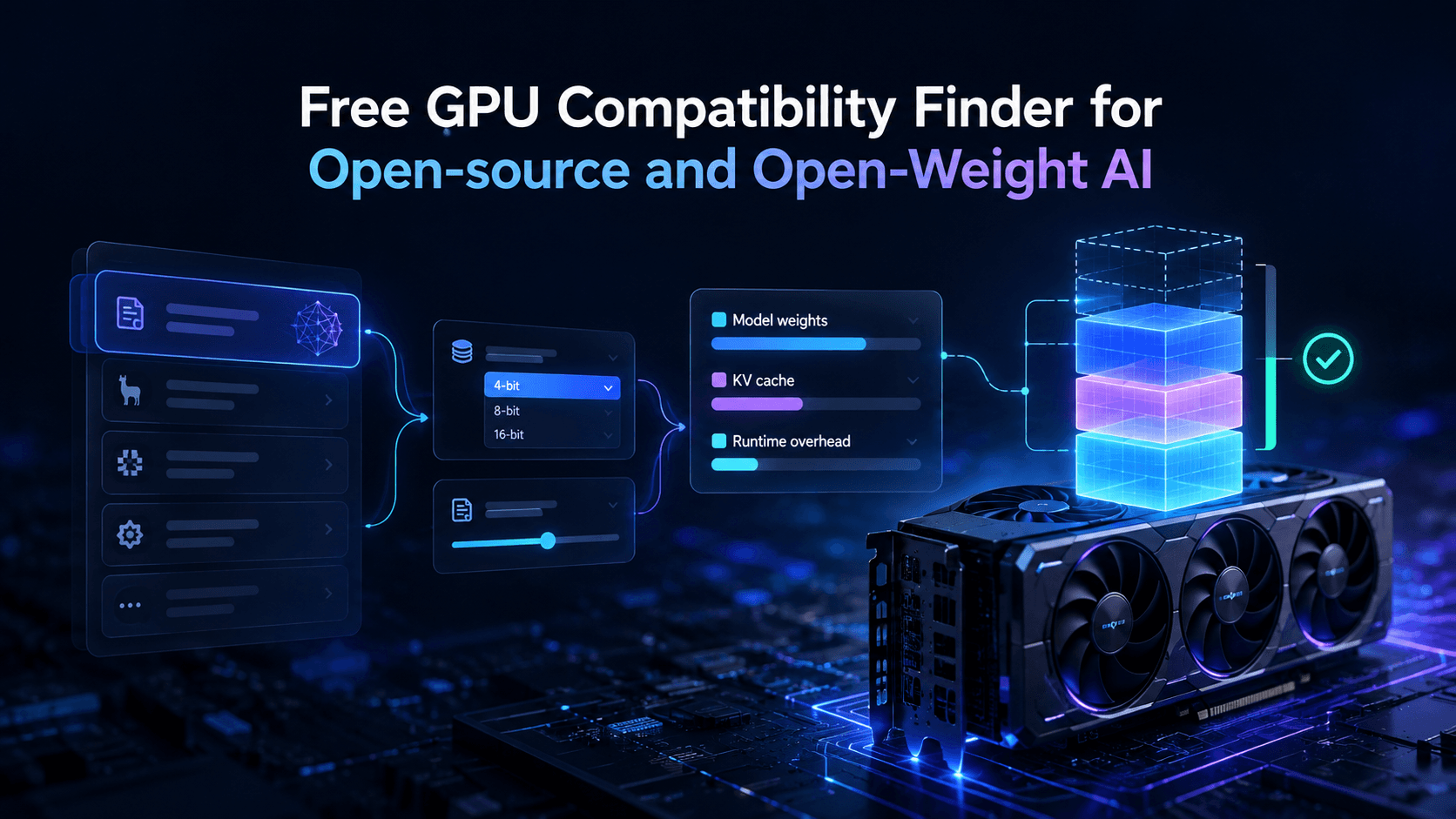
Vantaige Launches the LLM VRAM Calculator: A Free GPU Compatibility Finder for Open-source and Open-Weight AI
DeepSeek V4 Pro vs Claude Opus 4.7: 5-PR Refactor Test (2026)