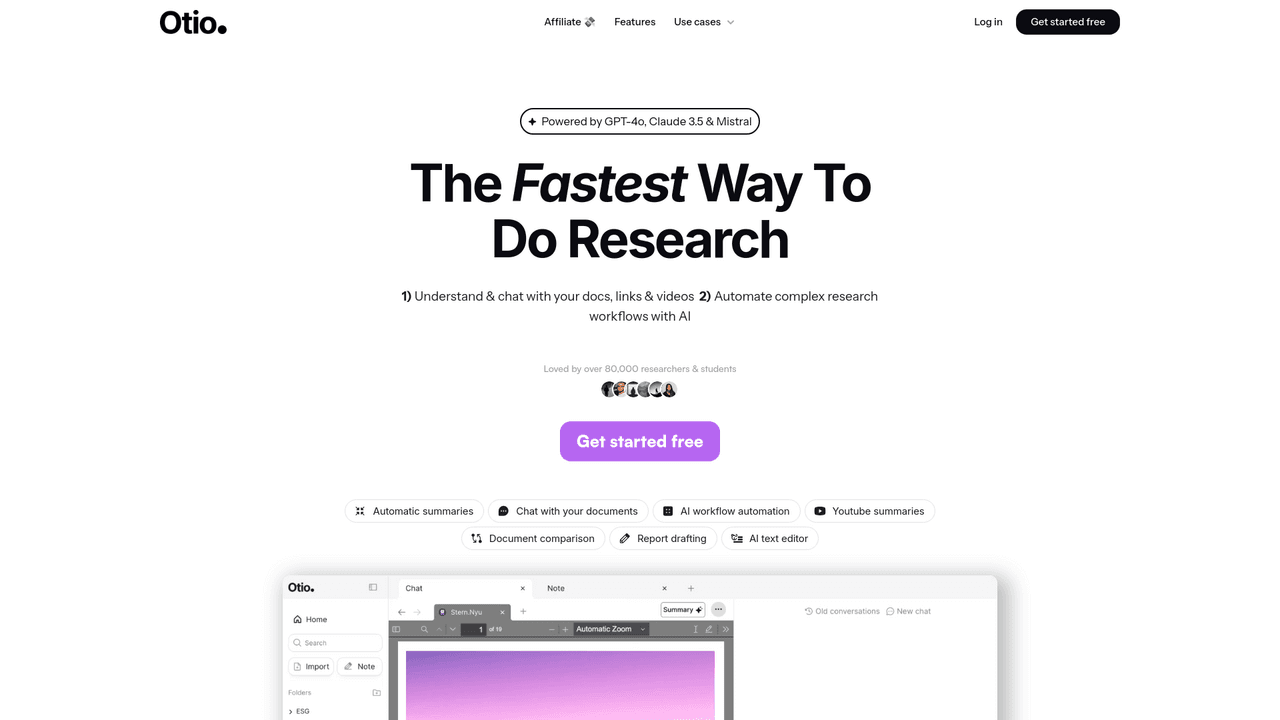

Otio AI is a research workspace that processes large documents and videos to generate summaries with citations. Paid plans start at $10 for 2,000 credits.
What is Otio AI?
How do you reliably extract specific technical requirements from a hundred-page PDF without hallucinating facts? Otio AI answers that exact question by combining a document reader with an AI chat interface. Built by Frontdoor Labs Ltd, this tool falls into the research assistant and AI writing assistant categories. It acts as a localized knowledge base where you upload sources, and the engine restricts its responses to the text provided.
From an engineering and technical evaluation standpoint, the system handles heavy processing loads fairly well. Users upload raw data files up to 100 MB. The underlying architecture connects user data with large language models like GPT-4, Claude 3.5, and Mistral. The system then generates summaries or answers specific chat queries, attaching real text citations to every claim. This design minimizes the risk of false information leaking into production research.
- Primary Use Case: Summarizing and querying large files like 100 MB PDFs and lengthy YouTube videos with grounded citations.
- Ideal For: Academic researchers and technical analysts processing heavy documentation.
- Pricing: Starts at $10 (freemium). The basic tier offers 2,000 credits for moderate users.
Key Features and How Otio AI Works
Document Processing and Summarization
- Large File Handling: The system accepts file uploads up to 100 MB. This supports heavy technical manuals and hour-long video transcripts without throwing payload errors.
- Multilingual Support: Process documents and chat in over 50 languages. The catch: translation accuracy depends heavily on the chosen underlying model.
- Web Scraping Integration: Pull information from bookmarks, tweets, and general web pages directly into the workspace.
Sourced-Grounded AI Editor
- Real Text Citations: The chat interface points directly to the source document for every answer. Think of it like a commercial food processor; you load in raw, bulky ingredients like heavy PDFs, and it outputs refined, structured data that is easy to trace back to its origin.
- Multiple AI Models: Users switch between models like GPT-4, Claude 3.5, and Mistral depending on the complexity of the task.
Workflow Automation Engine
- Automation Builder: Create repeatable scripts for organizing and tagging imported research materials automatically. Here is where it gets interesting. You set logic rules to categorize incoming data, which saves significant manual sorting time.
- Centralized Folders: The system automatically tags sources based on your automation rules. On the flip side, setting up these logic chains requires an initial time investment that frustrates less technical users.
Otio AI Pros and Cons
Pros
- Reduces processing time for hour-long YouTube videos by generating structured summaries immediately upon upload.
- Ensures high accuracy by providing real text citations grounded strictly in user-uploaded documents.
- Handles diverse content formats in one place, accepting PDFs, web links, and social media threads without breaking.
- Supports over 50 languages, expanding utility for international research teams.
Cons
- The built-in workflow automation builder has a steep learning curve for users unfamiliar with conditional logic.
- Lacks deep third-party integrations, forcing users to manually export final drafts to their preferred tools.
- Automatic summaries occasionally omit minor technical details critical for deep academic peer reviews.
- The free plan caps at 50 monthly credits, which barely covers a few test queries before forcing an upgrade.
Who Should Use Otio AI?
- Technical Analysts: Professionals who need to query long software manuals or compliance documents benefit heavily from the 100 MB file limit and grounded citations.
- Academic Researchers: The automatic tagging and real-text citation features help organize extensive literature reviews quickly.
- Light or Casual Users: This tool is not a good fit for someone who just needs a quick grammar check or a basic brainstorm. The 50-credit limit makes it impractical for casual testing, and the interface is over-engineered for simple tasks.
Otio AI Pricing and Plans
The pricing model is freemium, built on a credit system. The Free Plan provides just 50 monthly credits at $0 per month. But do not expect to run a project on this tier. The 50 credits vanish after uploading a couple of large files and asking a few questions. It functions strictly as a limited trial.
Which brings us to the paid options. The Basic Paid Plan starts at $10 per month and upgrades the account to 2,000 credits. This tier supports standard individual research workloads. The Pro Paid Plan costs $20 per month and delivers 4,000 credits. Power users and analysts running complex automated workflows daily will need the Pro tier to avoid hitting rate limits mid-project.
How Otio AI Compares to Alternatives
Elicit focuses heavily on academic paper discovery and data extraction. While Elicit connects directly to semantic academic databases to find papers you do not already have, Otio AI relies entirely on the documents you provide. So, Elicit works better for discovering new literature, while Otio AI is superior for processing a localized, private data set with varying formats like YouTube videos.
Consensus operates as a search engine that queries scientific research to answer yes or no questions. It provides an aggregate view of scientific agreement. Plus, it requires almost zero setup. Otio AI requires you to build your own workspace and upload your own sources. If you want quick answers from general science, Consensus wins. If you need to build custom workflows and query 100 MB internal company documents, Otio AI is the practical choice.
The Right Pick for Data-Heavy Analysts
Otio AI offers a highly capable environment for processing dense information. The ability to load up 100 MB files, run queries using Claude 3.5 or GPT-4, and verify answers with real text citations makes it a strong utility. Still, the lack of broad third-party integrations means your data stays isolated within their platform. Technical analysts and serious academic researchers get the most value out of the $10 Basic plan. Casual users looking for a free study aid should look elsewhere. If you just need to find existing academic papers quickly without building a custom workspace, Elicit is a much better starting point.
User Reviews
No reviews yet. Be the first to share your experience!
Sign in to write a review.
Related articles
Guides and articles related to Otio AI.

Perplexity AI Tutorial: Maximize Your Research Workflows
RFP and Proposal Auto-Fill: The Agent That Handles 80% of the Repeating Questions (2026)

The Personal AI Productivity Stack (2026): One Tool Per Job, Nothing Extra

Gemini Deep Research for a Thesis Literature Review in One Day (2026)

Build an Internal Knowledge Bot (RAG) for Your Company: A No-Nonsense Guide