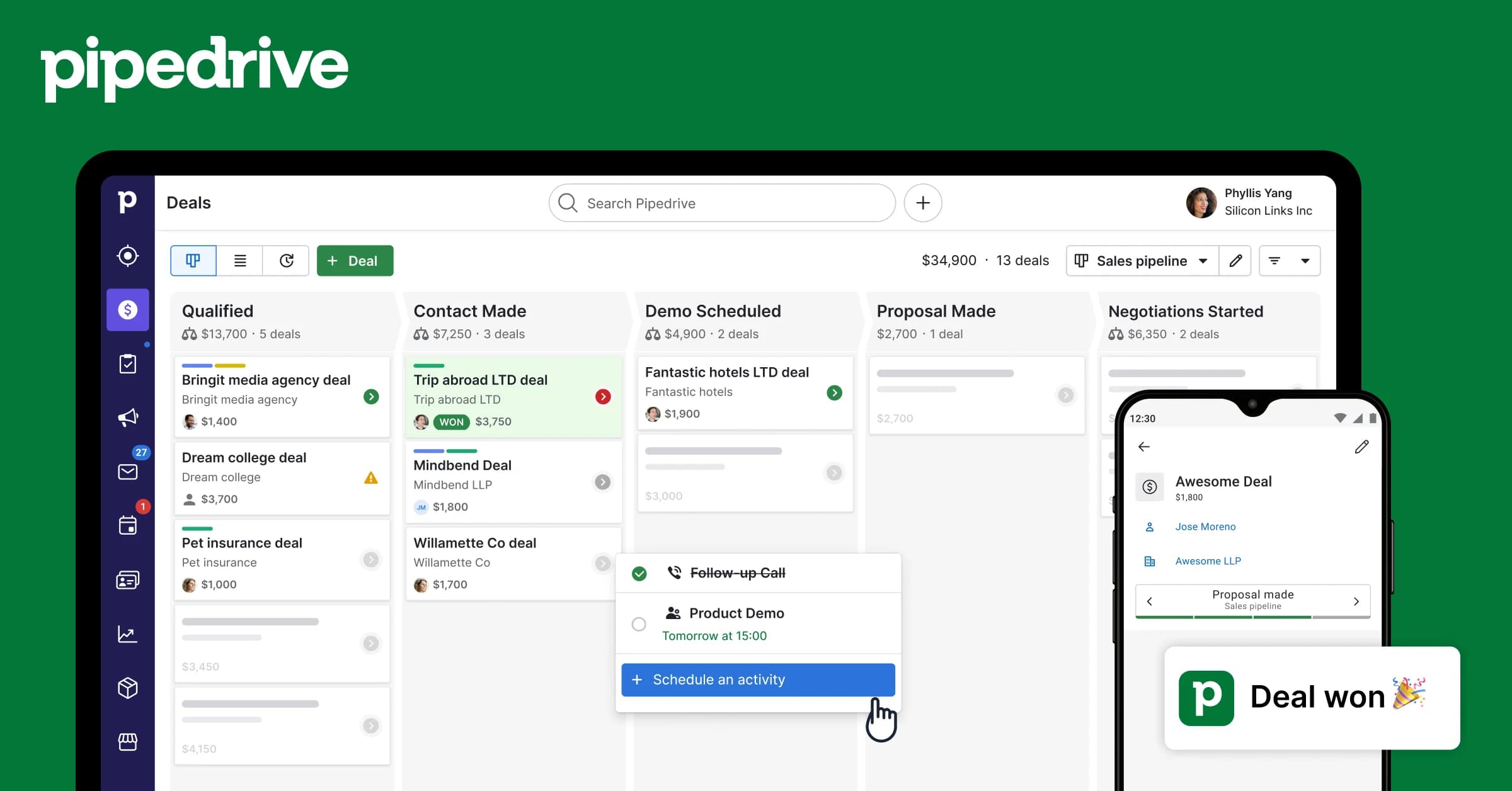

Pipedrive is a sales CRM built around a visual deal pipeline. Its AI Sales Assistant flags high-probability deals and drafts emails in seconds. Starts at $14/user/month, no free tier. Best for B2B teams with structured, repeatable sales motions.
Pipedrive is a sales CRM founded in 2010 in Tallinn, Estonia by five salespeople who were fed up with bloated, expensive CRMs built for executives rather than the people actually closing deals. The company reached unicorn status in November 2020 when Vista Equity Partners took a majority stake at a $1.5 billion valuation. Today it serves 100,000+ companies across more than 170 countries, with headquarters in New York and engineering in Tallinn and Lisbon. The entire platform is designed around one idea: keep your pipeline moving through activity-based selling with a drag-and-drop Kanban view that puts deals, not reports, at the center of the workday.
The core toolset includes visual pipeline management with customizable stages, an AI Sales Assistant that surfaces high-probability deals and recommends next actions, an AI email generator that drafts personalized messages from deal context in roughly 44 seconds, AI email summarization for quick thread digests, win probability predictions per deal, workflow automations triggered by deal stage changes or email opens, and a marketplace of 400+ integrations. The platform runs on four tiers: Lite ($14/user/month annual), Growth ($39), Premium ($59), and Ultimate ($79), with no free plan but a 14-day trial on all tiers.
What Pipedrive actually is in April 2026
Pipedrive is not trying to be HubSpot or Salesforce. It is a sales-execution tool. The pipeline view is still the centerpiece: every deal lives on a Kanban board where reps drag opportunities through stages, log activities, and see deal velocity without needing to dig through reports. Setup is fast compared to most enterprise CRMs, and the learning curve is low enough that new reps can be productive within a day or two.
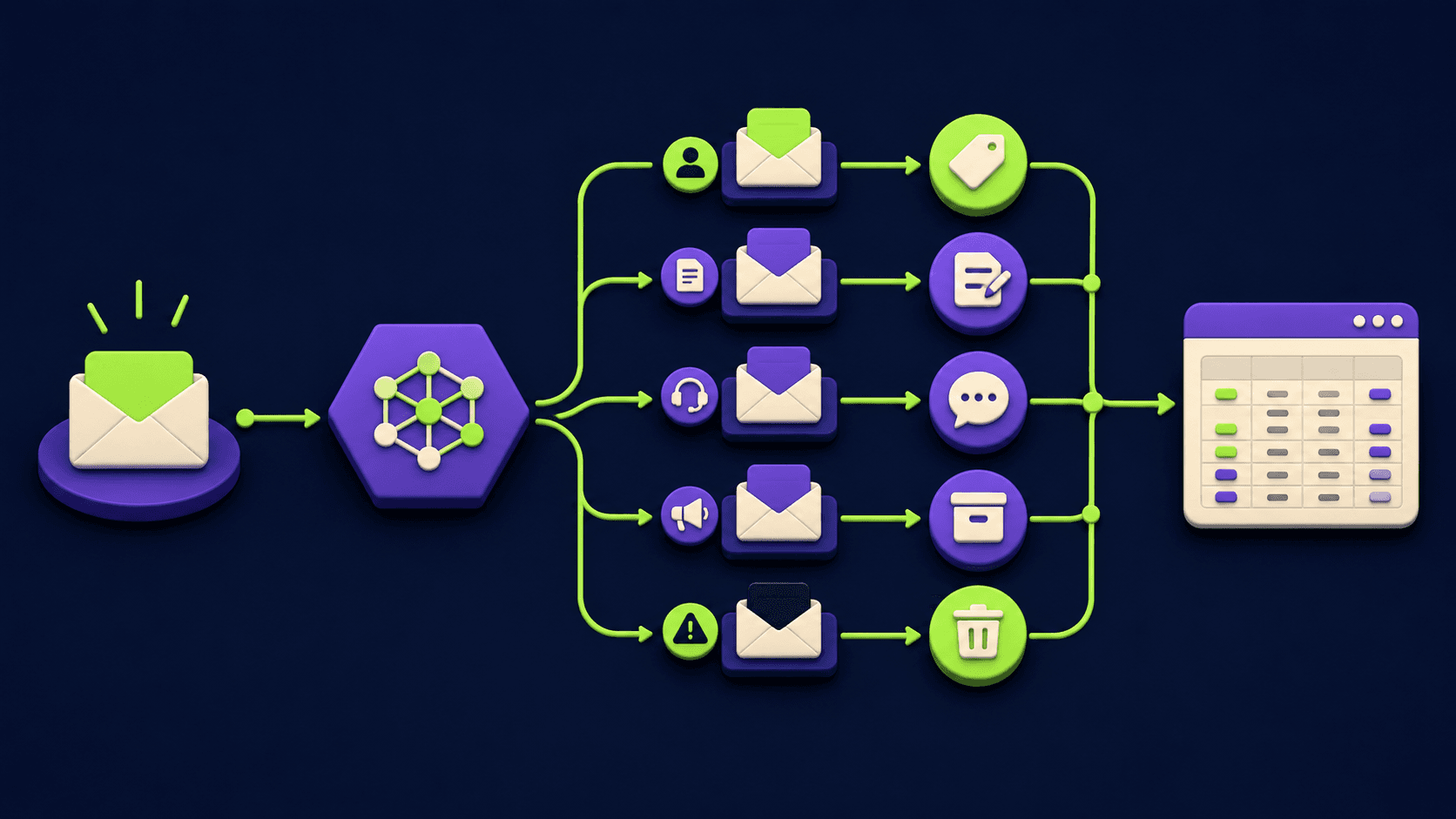
The AI layer, formally launched as "Pipedrive AI" on April 16, 2024 after a beta with over 70,000 customers, adds five distinct features: the AI Sales Assistant (deal prioritization and next-best-action suggestions), an AI email writer (generates outreach from deal data and brief prompts), an AI email summarizer (condenses long threads into one-click digests with sentiment assessment), AI smart app recommendations (suggests marketplace integrations based on your workflow), and an AI-powered marketplace search (find integrations in plain English). The AI Sales Assistant had already launched in beta on October 18, 2023. Over 60% of active Pipedrive customers now use it, and the company reports that teams using it close three times more deals than non-users, though that figure reflects self-selection as much as the feature's efficacy.
Smart Contact Data, the AI-powered contact enrichment feature that automatically pulled prospect information from web sources, was available through 2025 but was discontinued on August 22, 2025 and replaced by a newer Data Enrichment feature with higher data quality and broader sourcing. The transition is worth noting for teams evaluating the platform on the strength of its enrichment capabilities.
"These tools enable us to create messages and offer quick insights into email threads while suggesting actionable next steps." - Oliver Elm, International Sales Consultant, Mazepay, April 2024 (Pipedrive newsroom)
Where Pipedrive sits versus HubSpot and Salesforce Einstein
The two most common alternative paths for a Pipedrive evaluation are HubSpot and Salesforce, and the mechanical differences matter more than the marketing language around each.
Pipedrive vs. HubSpot: HubSpot's most significant structural difference is its free CRM tier with unlimited users. Pipedrive has no free plan. That single difference filters out every budget-constrained team or startup testing the waters. On AI depth, HubSpot's Breeze platform (rolled out through 2024-2025) spans marketing, sales, and service with a Prospecting Agent that researches target accounts and drafts outreach, a Customer Agent that handles inquiries and books meetings 24/7, and a Breeze Copilot for meeting prep and content creation. Pipedrive AI is sales-lane only: deal prioritization, email drafts, pipeline summaries. HubSpot's automation engine at the Professional tier supports multi-branch workflows triggered across the full customer journey, while Pipedrive's workflow builder uses trigger-action logic with no native if/then branching. The cost gap is real: HubSpot Professional runs $100+/user/month versus Pipedrive Premium at $59. For teams that need marketing, sales, and service in one platform with AI across all three, HubSpot is the more complete system. For teams that want a cleaner, cheaper, sales-only interface without the overhead of HubSpot's full suite, Pipedrive wins on simplicity and price. You can also pair Pipedrive with Lavender for AI-powered email coaching that goes beyond what Pipedrive's built-in email tools provide.
Pipedrive vs. Salesforce Einstein: Salesforce Einstein uses supervised machine learning (Random Forests and Naive Bayes trained on historical lead and opportunity data) to produce predictive lead scoring that evaluates conversion probability at the field level. Salesforce's Agentforce platform, launched in 2024-2025, goes further with autonomous AI agents that can respond to customers via email, summarize communications, and surface recommendations without a human triggering them. Pipedrive AI is OpenAI-backed and provides suggestions and summaries but does not take autonomous actions. Architecturally, Salesforce supports custom objects, territory management, and complex approval hierarchies. Pipedrive is locked to its Deal > Person > Organization data model with custom fields but no new object types. Salesforce Enterprise runs $165/user/month; Salesforce's Einstein 1 Sales tier is $500/user/month. Pipedrive Ultimate is $79. The summary: Pipedrive is not competing for enterprise contracts with complex org structures. Salesforce is not trying to onboard a 10-person sales team in an afternoon.
Teams building outbound sequences should also look at Klenty and Gong, which layer onto CRMs like Pipedrive to add call intelligence and cadence management that Pipedrive does not provide natively.
How AI actually works inside Pipedrive
Pipedrive AI is first-party, not plugin-mediated, but it is important to understand what "AI" means in practice here versus the broader category claims.
The AI Sales Assistant analyzes your historical deal data and pipeline activity to surface deals that match patterns correlated with closing, flag deals that show risk signals (no recent activity, slipping stage dates), and recommend the next action (schedule a call, send a follow-up, update a field). It does not automatically take those actions. It is a suggestion engine, not an agent. The win probability score is calculated per deal and updates as deal activity changes. This is genuinely useful for prioritizing a cluttered pipeline but is not the same as the predictive scoring that Salesforce Einstein runs on external behavioral signals.
The AI email generator takes the deal context (name, company, last activity, stage) and a brief prompt from the rep and produces a draft in under a minute. Pipedrive's own data shows median email composition drops from around 9 minutes to 44 seconds. The output quality is functional rather than exceptional, similar to a well-prompted GPT-4o call. The email summarizer distills long threads into a short digest with a sentiment tag (positive, neutral, negative), which is useful for reps returning to a dormant conversation.
AI-generated reports (added in late 2025) let users describe a chart or metric in plain English and the system builds it from pipeline data. This works well when the underlying data is clean and consistently structured. If your stages, custom fields, and deal naming are inconsistent across reps, the AI reports will produce technically correct outputs that answer the wrong questions.
All AI features are available on all plan tiers, with the AI Sales Assistant accessible on Lite. Advanced email and reporting AI tools are available on Growth and above. No separate AI add-on cost is required, which compares favorably to HubSpot where Breeze AI features are concentrated in Professional and Enterprise tiers.
"The task automation is a lifesaver; it saves you tons of time on repetitive tasks." - Daniela L., Sales Manager, Computer Software, Capterra, August 21, 2024
The friction users keep raising
Pipedrive's reviews on G2 (4.3/5 across 2,700+ reviews) and Capterra (4.5/5 across 3,000+ reviews) are broadly positive, but the frustration patterns are consistent across platforms.
Automation logic hits a wall fast. The workflow builder supports trigger-action flows with no native branching. You cannot build "if deal value over $50,000, assign to senior rep; otherwise assign to standard queue" without leaving Pipedrive and connecting Zapier or Make. The Growth plan caps automations at 3 delay steps per path, which is limiting for any sequence with more than a few steps. Automation failures are sometimes silent, with stopped executions not surfacing clearly in the history log.
Add-on costs erode the entry price. The $14/user/month Lite tier looks compelling until you realize that email marketing requires Campaigns ($16/month minimum), lead capture forms and chatbot require LeadBooster ($32.50/month), and website visitor identification requires Web Visitors ($49-$299/month). A small team that needs all three has effectively tripled their monthly cost before adding users. The "base price looks great until you realize everything you actually need is an add-on" frustration appears consistently in user reviews.
No native dialer. Pipedrive does not have a built-in calling tool. Teams that do high-volume phone outreach need to add Aircall, JustCall, or a similar dialer at $20-50/user/month, plus integration setup time.
Duplicate detection is manual. There is no fuzzy-match deduplication. Finding and merging duplicate contacts or organizations requires manual review or a third-party app. As contact databases scale past a few thousand records, this becomes a meaningful time cost.
AI is not agentic. Power users wanting AI that automatically moves deals, creates tasks, or sends messages based on behavioral triggers will be frustrated. The AI surface provides recommendations that a human still has to act on. For teams integrating AI-first outreach, pairing Pipedrive with Reply.io or a dedicated sequencing tool covers gaps that Pipedrive does not address natively. Similarly, for deeper data enrichment, Clay integrates with Pipedrive and provides the kind of contact and company enrichment that Smart Contact Data used to attempt.
Who Pipedrive is for
Use Pipedrive if: You run a B2B sales team with a defined, repeatable sales process on short-to-medium deal cycles. Your reps live in the pipeline view and need to see deal stage at a glance. You want a CRM that takes an afternoon to set up and does not require a dedicated admin. Your primary need is deal tracking, activity logging, and light automation, not full marketing automation or enterprise workflow complexity. You want to keep costs manageable without the full HubSpot suite.
Skip Pipedrive if: You need a free CRM tier (HubSpot covers this). Your team needs native email marketing sequences, advanced lead scoring based on website behavior, or a built-in dialer without add-on costs. You are an enterprise sales org that needs custom objects, territory management, or complex approval hierarchies. You want AI that autonomously takes actions rather than suggests them. You need a single platform to handle marketing, sales, and customer support without integrations. For teams that have outgrown simple pipeline tracking and need AI-first sequencing, look at Gong for call intelligence or dedicated outbound platforms.
User Reviews
No reviews yet. Be the first to share your experience!
Sign in to write a review.
Related articles
Guides and articles related to Pipedrive.

AI SDR vs Human SDR: The Real Cost, Performance, and What Nobody Tells You
NotebookLM Sales Call Prep: 5 Sources, 6 Questions, 60 Seconds (2026)
Discovery Call Prep With ChatGPT: The 4-Prompt Sequence That Wins (2026)

Build and Sell AI Automations as a Service: The Operator Playbook (2026)
How to Sell AI Chatbots to Local Businesses ($1K-$5K Retainers, 2026)