
Sierra is an enterprise AI agent platform founded by Bret Taylor and Clay Bavor. It enables large companies to build, deploy, and optimize AI agents for customer experience across chat, voice, SMS, and email with outcome-based pricing.
Sierra is an enterprise AI agent platform built specifically for customer-facing interactions. The company was founded in early 2023 by Bret Taylor, former co-CEO of Salesforce and chair of OpenAI's board, and Clay Bavor, who led Google's VR and AR division for nearly a decade. Sierra emerged from stealth and launched publicly on February 13, 2024, with four founding customers: WeightWatchers, SiriusXM, Sonos, and OluKai. Its central premise is that AI agents should do more than deflect tickets: they should handle complete customer journeys, take action inside business systems, and carry memory across interactions to build genuine customer relationships.
The platform's core product is AgentOS, a suite covering agent creation, deployment, optimization, and observability. It includes Agent Studio (a no-code interface where CX teams configure tone, knowledge, and monitoring), the Agent SDK (a developer layer for building skills that agents can call), the Agent Data Platform (which unifies unstructured conversation history with structured enterprise records), and Ghostwriter (an AI-assisted builder that generates production-ready agents from SOPs, call transcripts, or plain-English descriptions). Sierra agents operate across web chat, SMS, WhatsApp, email, voice, and ChatGPT integration, and the platform is certified SOC 2, ISO 27001, HIPAA, GDPR, and EU AI Act compliant.
What Sierra actually is in May 2026
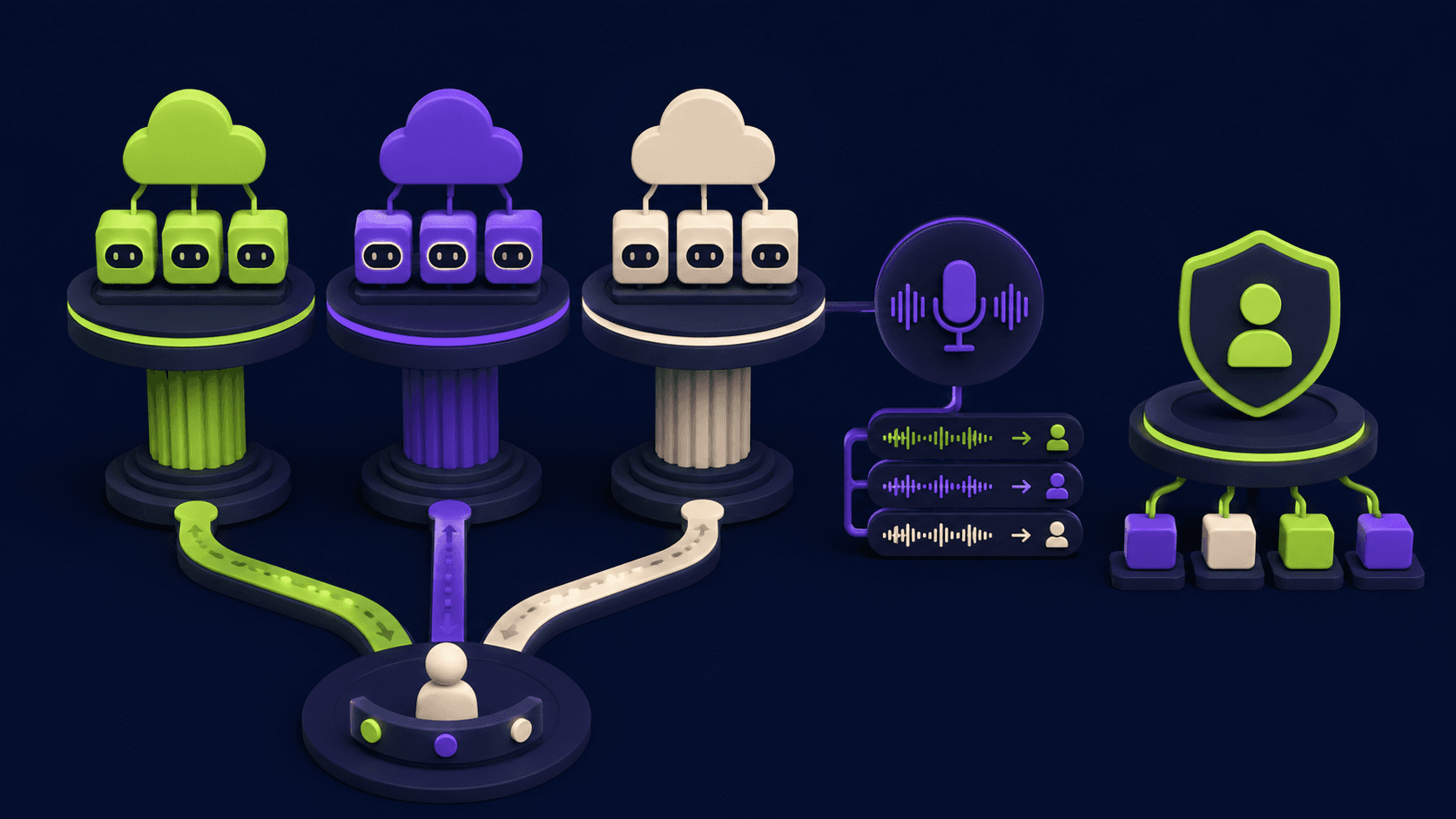
Sierra's product has matured substantially since its 2024 launch. AgentOS now combines three tiers of capability: the front-end conversational layer (handling natural language, tone, and brand voice), a skills layer (where developers write integrations with order management systems, CRMs, and subscription platforms), and the intelligence layer (where Sierra's constellation architecture routes requests across models from OpenAI, Anthropic, and Meta, selecting the model best suited to each reasoning task).
The Agent Data Platform, announced in 2025 with SiriusXM as its first adopter, is the product's most significant recent addition. It enables agents to maintain persistent memory across interactions, moving from transactional one-off conversations to relationship-aware exchanges. SiriusXM's agent, named Harmony, now remembers subscriber preferences, anticipates service needs, and proactively offers tailored content recommendations rather than waiting for customers to open a ticket.
The company's scale is notable. By November 2025, Sierra reached $100 million in annual recurring revenue in just seven quarters, placing it among the fastest-growing enterprise software companies on record. Its customer base spans companies covering more than 95% of U.S. Black Friday shoppers, more than 50% of families in healthcare, and more than 90% of the media ecosystem. Roughly 50% of Sierra customers have revenue over $1 billion, and 20% have revenue over $10 billion.
The October 2024 Series B funding round was a defining moment: Sierra raised $175 million at a $4.5 billion valuation, led by Greenoaks Capital with Thrive Capital and Iconiq participating. The valuation was nearly 4.5 times higher than Sierra's previous raise, just months after its February 2024 public launch, and came when the company's ARR was approximately $20 million. That implied multiple attracted significant attention. By September 2025, Sierra raised $350 million more at a $10 billion valuation in a round again led by Greenoaks, making it one of a small group of AI startups valued at or above $10 billion alongside OpenAI and Anthropic.
Where Sierra sits versus Decagon and Salesforce Agentforce
The enterprise AI agent space has two distinct structural competitors for Sierra, each with different architectural bets.
Decagon (which raised $250 million at a $4.5 billion valuation in January 2026, matching Sierra's October 2024 valuation milestone) uses Agent Operating Procedures: a system where CX teams write plain-English instructions that govern agent behavior. In theory, this gives CX teams direct ownership of logic without needing to write code. In practice, Decagon still requires engineering teams to build core integrations before CX teams can write anything, creating similar bottlenecks to Sierra. The mechanical difference is in decision transparency: Decagon's AOPs produce auditable, readable logic flows. Sierra's constellation routing architecture is less transparent about why a given model handled a given turn, which some compliance teams find difficult. Decagon reports around 70% auto-resolution rates; Sierra claims roughly 90%. Decagon uses per-resolution pricing, which can become unpredictable at scale. Both platforms carry six-figure minimum annual commitments.
For more on Decagon's approach to AI agents, see Decagon's listing.
Salesforce Agentforce occupies a fundamentally different position. Agentforce builds AI agents directly inside the Salesforce CRM, which means organizations already on Service Cloud get agents that natively access all their existing customer records, workflows, and automation without additional integration work. Sierra requires bespoke integrations to connect the same data that Salesforce-native companies already have in place. Agentforce launched at $2.00 per conversation, charging per interaction regardless of resolution outcome. Sierra's outcome-based pricing only charges for resolved interactions, which is a meaningful structural difference for companies with high escalation rates. Agentforce has more than 12,000 implementations and broader platform scope (sales, marketing, service); Sierra focuses exclusively on customer-facing support and engagement. The practical rule of thumb: organizations deeply committed to Salesforce should evaluate Agentforce first. Organizations that want a dedicated, CRM-agnostic customer experience platform should evaluate Sierra.
See also Salesforce Agentforce, Intercom Fin, Ada, and Cresta for other enterprise customer experience AI options with different pricing structures and deployment models.
How AgentOS actually works inside Sierra
Building a Sierra agent involves two teams with separate tools and responsibilities. CX teams work inside Agent Studio, a browser-based interface where they define the agent's personality, load knowledge base documents, set escalation rules, and monitor conversation performance. Agent Studio is relatively approachable for non-technical users and includes monitoring dashboards, conversation replay, and A/B testing through the Experiments module.
The Agent SDK is where engineers live. Every capability the agent needs to actually do something inside a business system, pulling an order status, processing a return, updating a subscription, requires a developer to write a skill, test it in staging, and deploy it to production. This is not a drag-and-drop workflow builder. Skills are code. When a CX manager needs the agent to handle a new action type, they open a ticket with engineering, not Agent Studio. This split is both a strength (clean governance between configuration and code) and a recurring source of frustration for teams that want faster iteration.
The constellation architecture sends different parts of a conversation to different underlying models. A simple FAQ retrieval question might go to a faster, cheaper model; a complex reasoning task involving policy interpretation goes to a more capable model. Sierra's implementation team configures these routing rules during onboarding. The upside is reduced hallucination rates compared to a single-model approach; the downside is reduced visibility into the decision chain for teams that need full audit trails.
"When you give AI agents customer memory and the intelligence to act on it, every interaction becomes an opportunity to deepen loyalty and drive growth." - Bret Taylor, Sierra CEO, Sierra blog, 2025
"SiriusXM isn't just another subscription; it's personal. By expanding our collaboration, we're giving Harmony the intelligence and context she needs to evolve from providing fast, effective support to building deeper, more proactive relationships with our listeners." - Wayne Thorsen, COO, SiriusXM, Sierra blog, 2025
The friction users keep raising
Sierra's enterprise positioning solves real problems but introduces its own set. Here are the recurring patterns from customer reviews and industry commentary:
Engineering bottleneck on new skills. Every time a CX team wants to expand what the agent can do, a developer has to build it. This creates a queue dynamic where agent capabilities lag behind CX team ambitions. Teams that underestimate this during procurement often find their agents stuck doing basic FAQ deflection for months while engineering backlog catches up.
Opaque pricing and unpredictable budgeting. Outcome-based pricing sounds appealing until you try to budget for it. A company that doesn't know its baseline escalation rate can't accurately forecast annual cost. Industry sources report minimums around $150,000 per year plus $50,000 or more in implementation fees, but the total scales with resolution volume in ways that are hard to model before deployment.
Decision opacity for compliance teams. The constellation routing architecture does not expose a clean, human-readable log of which model handled which turn and why. Compliance teams in healthcare, financial services, and insurance have flagged this as a gap when auditing agent behavior for regulatory purposes.
Latency in voice mode. The multi-model routing adds processing time. In text chat this is imperceptible. In real-time voice interactions, the pause while the system routes and responds can feel unnatural, reducing the conversational quality that is Sierra's primary differentiator.
Context drift in long conversations. G2 reviewers note that agents sometimes repeat themselves or revert to generic responses after extended back-and-forth exchanges. This appears to be a context window management issue that Sierra's team continues to work on.
Who Sierra is for
Sierra is built for large enterprises with dedicated engineering teams, compliance requirements, and the budget for six-figure annual software contracts. The clearest fit is a company with millions of customer interactions per year, a support team large enough that automation has obvious ROI, and a brand voice specific enough to justify the customization investment. Retailers like OluKai that need peak-season scale, media companies like SiriusXM managing complex subscriber journeys, and financial services firms like Rocket Mortgage and SoFi where conversion rate improvements directly impact revenue are the archetypes.
WeightWatchers' results are the clearest public proof point: their Sierra agent handles nearly 70% of all customer sessions with a 4.6 out of 5 satisfaction rating, covering everything from membership management to meal coaching. Rocket Mortgage reported users converting 4x faster with the Sierra-powered Digital Assistant compared to the previous web experience.
Skip Sierra if you are a startup, an SMB, or a mid-market company without a dedicated engineering team for agent maintenance. Skip it if you need transparent, reproducible audit logs of every agent decision for regulatory submissions. Skip it if you are already fully committed to Salesforce as your CRM and want agents that work natively with existing Service Cloud data without a separate implementation project. And skip it if your support volume doesn't justify six-figure annual commitments: tools like Intercom Fin or Ada serve lower-volume or mid-market deployments at a fraction of the entry cost.
User Reviews
No reviews yet. Be the first to share your experience!
Sign in to write a review.
Related articles
Guides and articles related to Sierra.
Turn Any AI Agent Into a Superagent: The 12-Integration Stack (2026)
Voice Agent for Missed Calls: Every Service Business Is Bleeding Leads After Hours (2026)
AI Agents for Business: What They Actually Are and 12 Things You Can Automate Today
Google vs OpenAI vs Anthropic Agents: The May 2026 Platform Showdown
AI Customer Support Automation: Cut Ticket Volume 50% Without Hurting CX