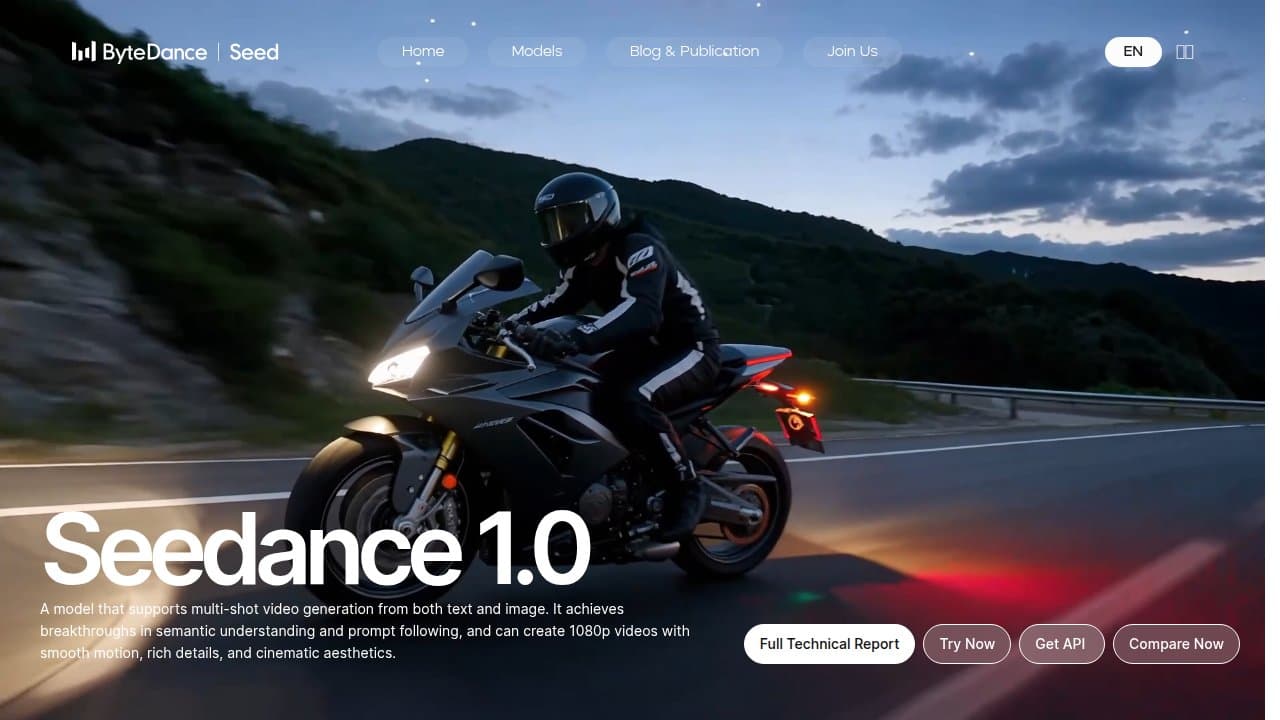
Seedance 2.0 is ByteDance's video generation model and the current benchmark leader on Artificial Analysis. It accepts up to 12 mixed inputs across text, images, video, and audio, generates native synced sound, and costs a fraction of Veo 3. Aggressive content filters are the catch.
Seedance 2.0 is ByteDance's second-generation video model, built by the company's Seed research team and released to Chinese users on February 12, 2026, with global API access following on April 9 through fal.ai. As of June 2026 it holds the number one ELO position on the Artificial Analysis Video Arena in text-to-video with audio (1,215), image-to-video with audio (1,193), and image-to-video without audio (1,344), ahead of Veo 3.1, Kling 3.0, and Runway Gen-4.5. That is not marketing language; it is the crowd-voted leaderboard every serious video AI team watches.
What separates Seedance mechanically from every rival is input flexibility: a single generation accepts up to 12 mixed files spanning text, up to 9 reference images, up to 3 video clips, and up to 3 audio tracks. It generates 4 to 15 second clips at up to 2K resolution with native synced audio (sound effects, music, dialogue with 8-language lip sync) at no extra cost, handles multi-shot sequences with natural cuts in one render, and supports six aspect ratios from 9:16 to 21:9. Access runs through the Jimeng app in China, the Dreamina app and CapCut Pro internationally, the Volcano Engine enterprise API, and third-party APIs at fal.ai, Replicate, and Segmind.
What Seedance outputs in June 2026
Seedance 2.0 generates clips between 4 and 15 seconds. Native output is 480p and 720p, with 1080p on the Pro tier and 2K through the Cinema tier on Volcano Engine. Audio is generated natively rather than bolted on afterward: background music, ambient effects, and spoken dialogue arrive synced in the same render, and the model accepts audio files as reference input, something neither Veo 3 nor Kling can do. Feed it a 30-second track and instruct it to cut visuals to the beat, and the output arrives edited to the music.
The multi-shot capability matters more than it sounds. Ask for a three-shot thriller sequence and Seedance returns one clip with distinct camera setups and natural cuts between them, rather than three disconnected generations you have to stitch manually. Combined with reference locking (the same character face and product held consistent across a batch of generations), this is the closest any current model gets to a directing workflow rather than a slot machine.
Generation takes 90 to 120 seconds for a standard clip, slower than most rivals. The arXiv paper (2604.14148) describes the architecture as a unified framework for multi-modal audio-video joint generation, and ByteDance has since announced Seedance 2.5 on Dreamina and ecosystem platforms in late July 2026, adding native 4K output (about 70 credits per second versus 30 for standard tiers); API access is still in pre-release as of August 2026, and Volcano Engine rates for the Seedance family run $0.09 to $0.21 per second depending on resolution.
Where Seedance sits versus Veo 3 and Kling 3.0
Against Veo 3, the trade is control versus integration. Veo 3 generates audio and video in a single end-to-end pass, so dialogue and ambient sound emerge with natural spatial positioning; Seedance generates audio as a coordinated separate layer, which gives more control over individual elements but slightly less organic blending. Veo 3 has a purpose-built physics simulation for gravity, fluids, and collisions, while Seedance replicates motion from reference video. But Seedance accepts 12 mixed input files where Veo takes a prompt and one image, runs 15-second clips against Veo's 8, and costs roughly $0.60 per 10-second 1080p clip with audio against Veo's $2.50, the most expensive in class.
Against Kling 3.0, the gap runs the other way on raw motion. Kling is the motion master: physics accuracy rated excellent by reviewers, native 4K at 60fps, and the cheapest clips in class at roughly $0.50 per 10 seconds. Seedance answers with the benchmark lead (1,215 ELO versus Kling's 1,099 in text-to-video with audio), audio reference input that Kling lacks entirely, and the 12-input multimodal system against Kling's one or two reference images. Teams that need to lock a character likeness and control the soundtrack in the same generation have no Kling equivalent.
Against Gemini Omni, the comparison Vantaige readers will ask about: Seedance leads on aggregate ELO, anatomy, and high-action cinematics for short clips, which is exactly why multiple reviewers benchmarked Omni against it at launch and found Omni trailing. Omni's counter is conversational iterative editing across multiple turns, which Seedance cannot do; Seedance counters with native editing features like character replacement, scene extension, and style transfer that run as discrete operations. One caveat the leaderboard does not show: in clips pushing 12 to 15 seconds with complex multi-character interaction, reviewers consistently document micro-inconsistencies in limb movement. The anatomy lead is real but strongest under 12 seconds.
"In high-speed action scene tests, Seedance 2.0 demonstrated dynamic camera angles, cinematic motion blur, realistic physics, strong environmental detail, and clear subject readability." - Runbo Li, CEO of Magic Hour, April 2026
The real cost of generating with Seedance
Pricing depends entirely on the door you enter through. The cheapest serious path is fal.ai: $0.022 per second on the Fast tier (a 10-second clip for about 22 cents) and $0.247 per second on Standard, with synced audio included. The official Volcano Engine API prices text-to-video around $0.14 to $0.15 per second, which Chinese finance press dubbed the one-yuan-per-second era. Segmind lands around $0.71 per 8 to 10 second clip and is notable as the only provider running the model without the extra moderation layer.
Consumer access runs through Jimeng in China at roughly $9.60 per month, and internationally through Dreamina with credit plans from $18 to $84 per month, plus CapCut Pro, which began bundling Seedance globally in April 2026. Free daily login credits on Jimeng and trial credits on Dreamina exist but are evaluation rations, not a working tier. The comparative math per 10-second 1080p clip with audio: Seedance about $0.60, Kling about $0.50, Sora 2 about $1.00, Veo 3.1 about $2.50.
Where Seedance consistently breaks
The content filter is the dominant complaint, and it is structural. On most platforms the filter intercepts prompts before the model sees them, rejecting face references, helmet and glasses descriptions, celebrity names, logos, and stylistic requests that ByteDance's own marketing demonstrates as features. Fight choreography, horror concepts, and edgy ad creative get blocked routinely.
"Creators spend excessive time rewording prompts to bypass filters rather than focusing on their actual creative work, fighting the filter instead of making the thing they set out to make." - Rohit Rao, Segmind blog, April 8, 2026
Three more documented patterns. Access friction: from February to April 2026 the full-featured Jimeng app required a Chinese phone number and payment method, with VPN workarounds frequently banned; the fal.ai API and global Dreamina rollout fixed this for developers, but the lost months cost ByteDance early Western momentum. Speed: 90 to 120 seconds per clip means an ideation session yields 6 to 12 clips per 15 minutes where faster rivals double that. Operator complexity: the multimodal input system rewards people who think like directors and punishes casual prompters; weak references produce weak output, and reviewers consistently flag it as not beginner-friendly compared to prompt-first tools like Kling Standard or Runway.
The launch itself was the named incident of the year in AI video. Within 48 hours of the February 12 release, clips of Tom Cruise fighting Brad Pitt and lightsaber duels flooded X and Reddit. Disney issued a cease-and-desist on February 13, Paramount followed on the 14th, the Motion Picture Association and SAG-AFTRA condemned the model on the 15th, and ByteDance added C2PA watermarking and tightened safeguards on the 16th. ByteDance had also suspended a face-to-voice feature two days before launch after a reviewer showed it could reconstruct a person's speaking voice from a photograph. Screenwriter Rhett Reese (Deadpool and Wolverine) posted that week: "I hate to say it. It's likely over for us." The aggressive filter that frustrates creators today is the direct residue of that legal cascade.
Best use cases versus skip-this scenarios
Seedance is the strongest current choice for performance marketing at scale: lock a product image and brand talent across a batch of 9:16, 16:9, and 1:1 variants with music rendered in, no re-shoots, no post-added audio. It is equally strong for pre-visualization, where a three-shot scripted sequence with reference camera movement returns a pitch-ready rough in one render, and it is the only top model for audio-driven content, since it accepts the soundtrack as an input. Developers building video pipelines get the benchmark leader at fal.ai prices, and multilingual teams get 8-language lip sync that neither Hailuo nor Pixverse matches.
Skip it if you want to type a sentence and get a video; Kling Standard and Runway are dramatically friendlier. Skip it for native 4K (Kling), for unrestricted creative range (Veo 3 through AI Studio, or Segmind's unfiltered Seedance if you accept third-party risk), for rapid iteration where the 90-second latency compounds, and for clips beyond 15 seconds without stitching. The score of 4.4 reflects the same equation throughout: the objectively best video model on independent measurement, priced under its rivals, held back from higher by a filter that fights its own users, slow renders, and physics that wobble at the long end of the clip range. Related models worth comparing on Vantaige: WAN for open weights and Jimeng for ByteDance's consumer-facing sibling.
User Reviews
No reviews yet. Be the first to share your experience!
Sign in to write a review.
Featured in collections
Curated lists that include Seedance.
Related articles
Guides and articles related to Seedance.
Sell AI-Generated Short Films on TikTok Shop, Instagram & YouTube (2026)
AI Video Generator Prompting: The Filmmaker's Real Workflow

AI Instagram Reels Factory: 30 Reels/Day on Autopilot (2026)
Grok 4.3 API for Agents (May 2026): Pricing, Benchmarks, Migration

How to Make Money Selling AI UGC Content for Brands (2026)