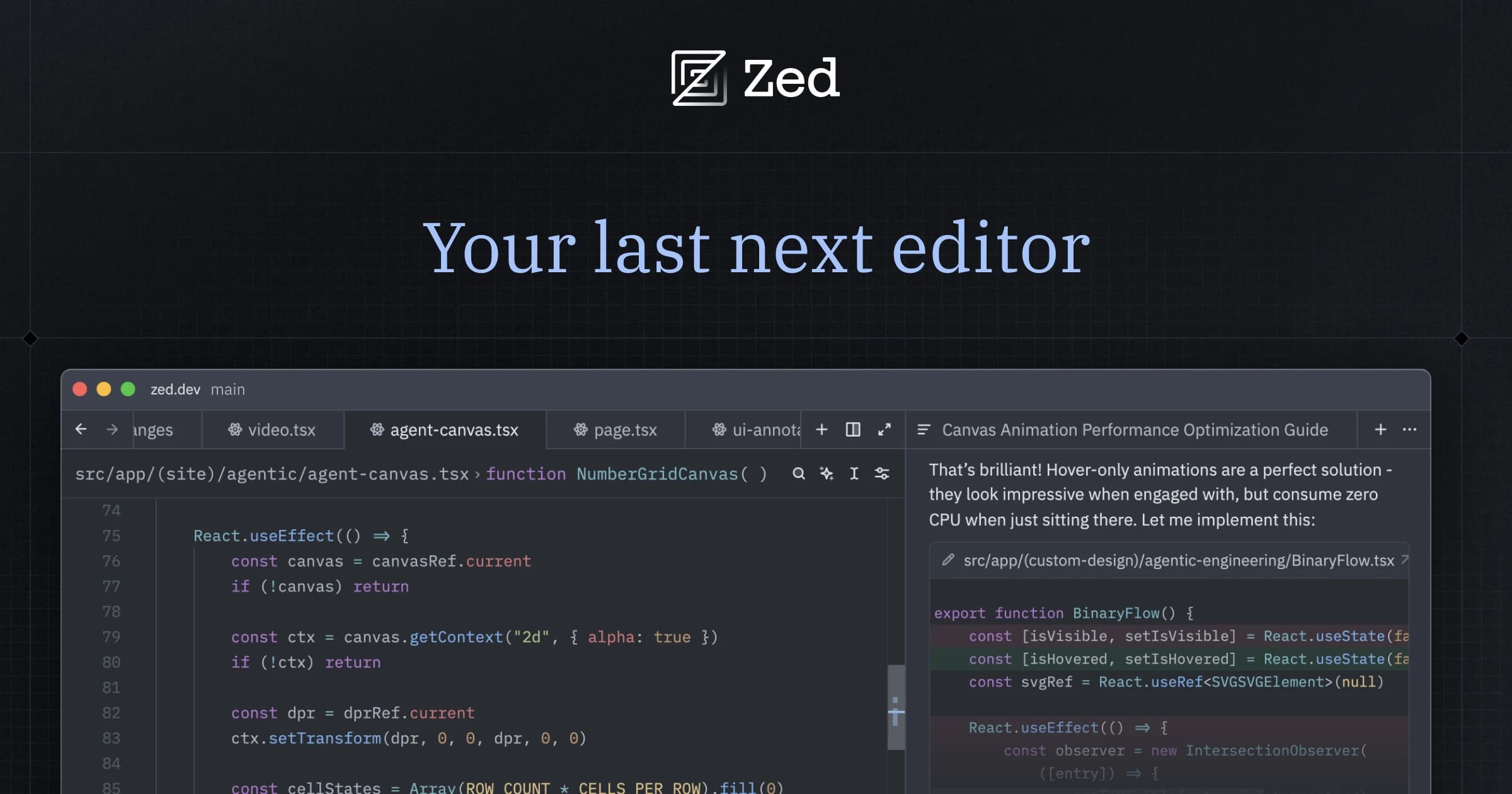

Zed is a GPU-accelerated, open-source code editor built in Rust by the creators of Atom. It pairs 120fps performance with an open AI agent protocol, letting developers bring their own models or agents rather than locking into a single provider.
Zed is a code editor built from scratch in Rust by Zed Industries, the company founded by Nathan Sobo and Max Brunsfeld, two of the engineers behind the Atom editor and the Electron framework. Where most AI code editors layer intelligence on top of VS Code's Chromium-based shell, Zed replaces the entire stack: a custom GPU-accelerated UI framework called GPUI, Rust throughout, and a rendering engine that targets 120 frames per second. The result is an editor that opens in approximately 0.12 seconds and holds under 300MB RAM on typical projects, compared to Cursor's 1GB+ footprint with extensions loaded. The project went open source on January 24, 2024, under a GPL/AGPL/Apache 2.0 license structure, and shipped version 1.0 on April 29, 2026 after two years of public development.
Zed's AI features span three layers. The Inline Assistant lets developers highlight code, trigger a prompt, and receive edits in place without switching windows. Edit Prediction uses the Zeta model (open source, trained on an open dataset) to predict the next edit as a multi-line suggestion rather than just next-token completion. The Agent Panel connects to external AI agents via the Agent Client Protocol (ACP), an open standard Zed published in August 2025 that allows Claude Agent, Codex, OpenCode, and any ACP-compatible agent to plug in. Developers can run multiple agent threads in parallel across projects, review proposed changes in a multibuffer view, and accept or reject diffs inline. On the Personal (free) plan, users can bring their own API keys from Anthropic, OpenAI, Google, or run local models via Ollama, bypassing Zed's hosted service entirely.
What Zed actually does in April 2026
By version 1.0, Zed ships as a full-featured editor covering the common developer stack: built-in LSP support for C, C++, CSS, JavaScript, TypeScript, Markdown, and Python; native Git integration with commit history, file diffs, and word diffs; a native debugger (added June 2025 after thousands of developer requests); a built-in REPL via Jupyter kernels; real-time collaborative editing where multiple developers share a session with cursor presence; and remote development that runs the UI locally while the codebase executes on a remote server.
The AI layer is modular by design. A new "disable all AI features" setting in 1.0 lets developers run Zed as a pure traditional editor. For those who want AI, the options are: use Zed's hosted models (Claude, GPT-5, Gemini 3, Grok 4 all available), bring your own API keys on any plan, or install external agents via the ACP registry. The Zeta edit prediction model is open source on GitHub, trained on an open dataset, and runs locally. The Agent Client Protocol is published as an open standard, meaning any agent developer can write an ACP-compatible integration without Zed's involvement.
Version 1.0 landed 182 stable releases and 261 preview releases in 2025 alone, shipping native Git, a debugger, Windows support, a keymap editor, sticky scroll, dev containers, Helix mode, and agent metrics. The 2025 recap counted 10,300 merged pull requests from a contributor base of 1,100 people.
Where Zed sits versus Cursor and JetBrains Fleet
The comparison to Cursor is the one most developers reach for first, and the mechanical differences are significant. Cursor is a fork of VS Code's Electron/Chromium architecture, which means it inherits the full VS Code extension marketplace (100,000+ extensions) but also the full memory overhead. Cursor's AI is built entirely in-house: its Tab completion uses a fine-tuned model trained on code completions, its background agents run on Anthropic-hosted cloud VMs with up to 8 parallel threads, and its agent integrations are proprietary with no open protocol for third-party agents. Cursor Pro costs $20/month. Zed costs $10/month for Pro ($5 of included token credits, overage billed at provider list price +10%), or $0 with your own API keys. The tradeoff is real: Cursor's AI autocomplete is consistently rated more accurate by users, and its agent infrastructure is more mature. Zed's advantage is architecture: faster startup, lower RAM, open source, and a composable model where you swap in any agent or model rather than depending on Cursor's built-in versions.
"I love Zed and I'm glad you now have native support for Claude. AI autocomplete..still suffers.. Cursor's AI autocomplete and predictions [are] much more accurate. I am glad to hear that Zed got a round of funding. This will go a long way to creating real competition to Cursor in the form of a quality IDE not built on VSCode." -- ppeetteerr, Hacker News, September 2025
JetBrains Fleet offers a different architectural story. Fleet separates its editor frontend from a "smart mode" language intelligence backend that can run locally or scale to a full IntelliJ engine on demand. That distributed design sounds compelling, but in practice Fleet has stalled: it remains in extended public preview in 2026 with no competitive AI agent story, no open-source version, and slower startup than Zed. JetBrains' AI Assistant is bolt-on rather than native, and Fleet has not shipped anything comparable to Zed's ACP or Cline's VS Code agent workflow. Fleet is free while in preview, which keeps some JetBrains loyalists in its ecosystem, but momentum has shifted toward Zed among developers who want a non-VS Code editor.
Against GitHub Copilot, the comparison is apples-to-oranges: Copilot is an AI assistant that lives inside other editors (VS Code, JetBrains, Neovim), not a standalone editor. The relevant comparison is that Zed's Inline Assistant and Edit Prediction serve a similar inline completion workflow, but as first-party features at the editor level rather than an extension that can be disabled or replaced. Developers who use Aider often combine it with Zed: Aider handles longer refactors via CLI, while Zed handles the edit-level predictions and inline asks.
What the agent workflow reality looks like
Zed's Agent Client Protocol is the feature that most distinguishes its philosophy. Rather than building every AI integration in-house, Zed published an open standard in August 2025 and now runs a registry where developers can install Claude Agent, Gemini CLI, Codex, or any ACP-compatible agent with a single command. When an agent runs inside Zed, its output appears as live diffs in the multibuffer editor. The developer sees exactly what the agent proposes to change, across multiple files simultaneously, and can accept or reject individual hunks without leaving the editor. Multiple agent threads can run in parallel, each with its own context.
The reality in daily use has rough edges. Builder.io's 2026 review documented "UI weirdness between agent threads, text threads, and Zed's new CLI integrations, which are still in beta." Not all Claude Code slash commands work inside Zed's Agent window yet. The profile system (which lets developers disable built-in tools and enable only specific MCP server tools per context) is powerful but underdocumented. For developers running complex multi-MCP setups, Zed's composability is a genuine advantage over Cursor's walled garden. For developers who want one-click AI magic, Cursor's more integrated agent experience wins.
"For those who haven't used Zed, it's the first GUI editor I've used in 25-years that wasn't distracting." -- tiffanyh, Hacker News, January 2024
The open-source release on January 24, 2024, was the inflection point. Nathan Sobo framed it plainly on the Zed blog: "we believe that making Zed open source will make it the best product." The announcement hit Hacker News front page within hours, generating over 400 comments. The shift was also a business model change: from selling a proprietary editor to selling AI-powered services around an open core. By August 2025, that bet earned a $32M Series B led by Sequoia Capital (total funding: $42M+), with angels Dylan Field (Figma CEO) and Tom Preston-Werner (GitHub co-founder) participating. The funding is being used to build DeltaDB, an operation-level version control system using CRDTs that would track every edit and every discussion linked to evolving code, making collaboration history auditable at the keystroke level.
Who Zed is built for
The developer who gets the most from Zed is performance-obsessed, already comfortable configuring tooling, and values open-source foundations. Rust and systems developers represent the core community: Zed was built in Rust, its team is active in the Rust ecosystem, and the editor's performance story resonates most clearly on Rust projects where IntelliJ IDEA or Cursor might use 10x the RAM for the same codebase. Go, TypeScript, and Python developers who have outgrown VS Code's Copilot bloat are the next cohort: multiple users describe switching after VS Code began forcing Copilot features into the default toolbar.
Developers who pair program regularly benefit from Zed's built-in real-time collaboration, which is first-class rather than a plugin. Cursor and VS Code have collaboration features, but Zed's were designed at the architecture level. Remote development teams also find value in Zed's remote dev mode, which keeps the editor fast locally while the language server runs on a beefy remote box.
Developers who want to compose their own AI stack fit the Zed model well. If your workflow involves Codeium for one task, Claude Agent for another, and a local Ollama model for sensitive code, Zed's BYO-API-key model and ACP registry make that composable. You pay no Zed markup when using your own keys, and you can swap models per task.
What Zed is not
Zed is not a drop-in VS Code replacement if you depend on its extension ecosystem. The gap is not marginal: VS Code has 100,000+ extensions; Zed shipped 1.0 with approximately 1,000. GitLens-equivalent side-by-side git diffs are absent. Jupyter notebook support is partial. Language server coverage for less common languages (Haskell, Elixir, OCaml) is uneven. If a specific VS Code extension is load-bearing in your workflow, check the Zed extension registry before switching.
Zed is not yet the right choice for Windows-primary development teams. The Windows build launched in October 2025 and is production-usable, but users report WSL path edge cases, non-ASCII font rendering glitches, and occasional behavior differences from the macOS and Linux builds. The team is actively addressing these, but the Windows experience as of early 2026 is still younger than macOS/Linux.
Zed is not a turnkey AI coding environment in the way Cursor is. Cursor ships with a coherent AI layer, trained models, and cloud agent infrastructure that work out of the box. Zed's composable model is more powerful in principle but requires configuration. Users who want to open an editor and immediately have strong AI completions without setup will have a better initial experience with Cursor or tools like v0 for specific workflows. Zed rewards developers who invest in configuring it; it does not hand-hold through that setup.
User Reviews
No reviews yet. Be the first to share your experience!
Sign in to write a review.
Featured in collections
Curated lists that include Zed AI.
Related articles
Guides and articles related to Zed AI.

Zed 1.0 vs Cursor vs VS Code: Real Benchmark on a 50k-LOC Repo (2026)

Claude Code vs Cursor vs Codex vs Devin vs Replit Agent 3: 2026 Scorecard

Replit Pricing Explained (2026): Core vs Pro and Effort-Based Agent Billing

Run a Company With AI Agents: The Open-Source Orchestration Setup (2026)

Run 5 AI Agents in Parallel Without Collisions (2026)