The AI Automation Maturity Model: Where Is Your Business on the Curve?
The AI Automation Maturity Model: Where Is Your Business on the Curve?
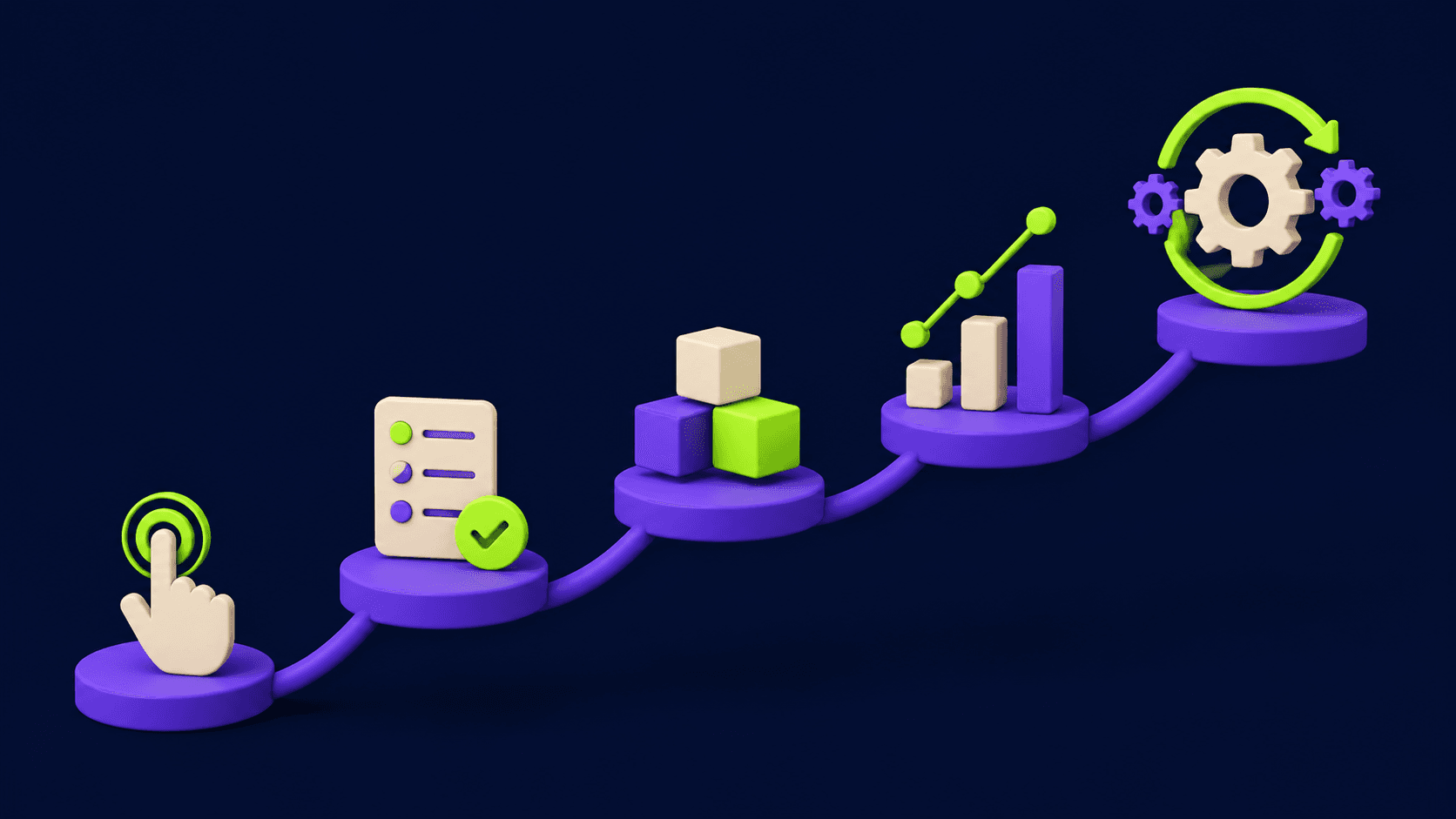
Every business is somewhere on a curve from "all work is manual" to "agents run the back office," and knowing your stage tells you what to build next, not what looks impressive on a conference slide. This is the five-stage maturity model we use to place a business, the signs of each stage, the trap that stalls teams at each level, and the single next move that actually advances you. Find your stage, then act on it.
TL;DR
AI automation maturity has five stages, manual to autonomous
Most businesses sit at stage 1 or 2 and overreach
Each stage has one realistic next move, not ten
Skipping stages is the most common failure
Your stage decides where to start, not the hype
What is an AI automation maturity model?
An AI automation maturity model is a five-stage map of how far a business has moved from manual work to autonomous systems, used to diagnose where you are and what to do next. It exists because the most common automation mistake is not technical, it is sequencing: teams at stage one try to build stage-four agents, fail, and conclude AI does not work for them.
The value of placing yourself accurately is that it converts "we should use AI" into a specific next step matched to your reality. A business still copying data between apps by hand has a different next move than one already running workflows and considering agents. The model below maps each stage to its realistic next move, so you build the thing that actually advances you rather than the thing that sounds advanced.
The five stages at a glance
Here is the full curve. Find the row that sounds like your business day-to-day; that is your stage, and the next-move column is where to point your effort.
Stage | What it looks like | The trap | Next move |
|---|---|---|---|
1. Manual | Work done by hand, knowledge in heads | No documentation to automate from | Document core processes |
2. Assisted | AI used ad hoc (ChatGPT in a tab) | Scattered prompts, nothing connected | Build one real workflow |
3. Automated | Fixed workflows run reliably | Rigid flows break on variation | Add judgment with agents |
4. Agentic | Agents handle variable tasks | Weak guardrails and logging | Harden oversight, expand scope |
5. Autonomous | Agents run functions, humans supervise | Over-automating judgment calls | Keep humans on the high-stakes loop |
Stage 1 and 2: Manual and assisted, where most businesses are
Most businesses are at stage one or two, and the honest first move for both is unglamorous: document, then build one thing. At stage one, work is manual and the knowledge lives in people's heads, so the prerequisite is documentation; you cannot automate a process nobody has written down. Our AI SOP method makes that fast.
At stage two, people use AI ad hoc, a ChatGPT tab here, a prompt there, but nothing is connected or repeatable. The trap is mistaking scattered AI use for an AI system. The move is to pick one high-frequency process and build a single real, connected workflow end to end. That one win teaches the team what a system feels like and earns the trust to expand. Start by finding the right process with our process automation audit.
Stage 3 and 4: Automated and agentic, where it gets powerful
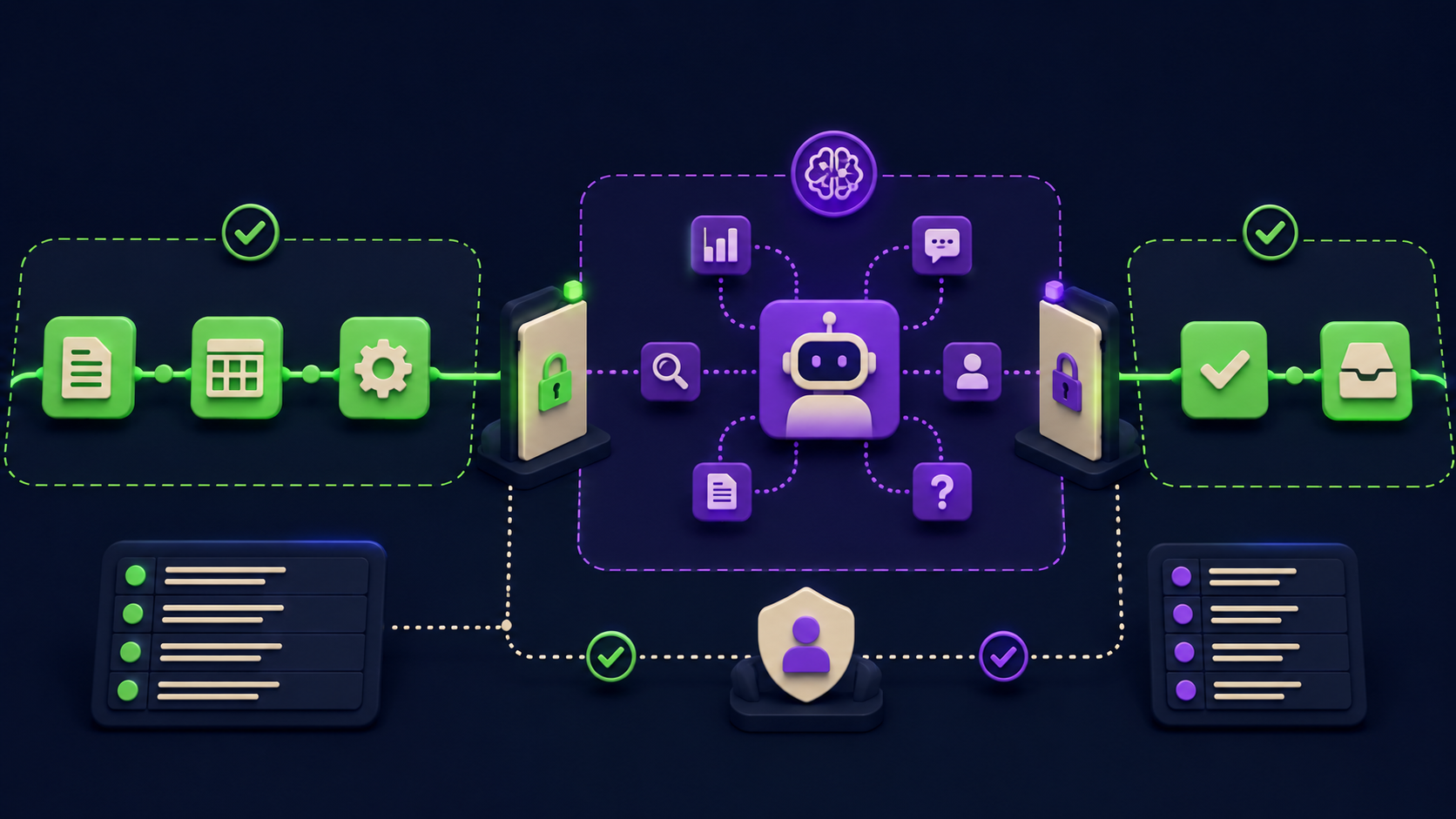
Stages three and four are where automation starts compounding, and the move is to add judgment carefully, not everywhere. At stage three you have fixed workflows running reliably, which is real progress, but rigid flows break when inputs vary. The next move is to add agents to the steps that need judgment, while keeping deterministic automation for the predictable parts. The distinction is in our AI agents for business guide.
At stage four, agents handle genuinely variable tasks, and the risk shifts from capability to control. The trap is thin guardrails: an agent making decisions without logging, approval gates, and scope limits is a liability. The move is to harden oversight (audit logs, human approval on irreversible actions, tight tool permissions) before expanding what agents touch. Power without governance is how stage-four deployments create expensive mistakes.
Stage 5: Autonomous, and why it is not the goal for everyone
Stage five is agents running whole functions with humans supervising, and it is the right target only for the processes that genuinely warrant it, not a trophy to chase across the board. Here the trap inverts: the danger is over-automating, handing judgment calls to agents that should stay with people because the cost of a wrong call is high.
The mature stage-five business is selective: autonomous on high-frequency, well-bounded, low-stakes functions, and deliberately human on the high-stakes ones. Knowing what not to automate is the final skill. Most businesses get enormous value living at stage three or four across most functions and reserving stage five for a few. Chasing full autonomy everywhere is its own immaturity, dressed up as ambition.
How do you actually move up a stage?
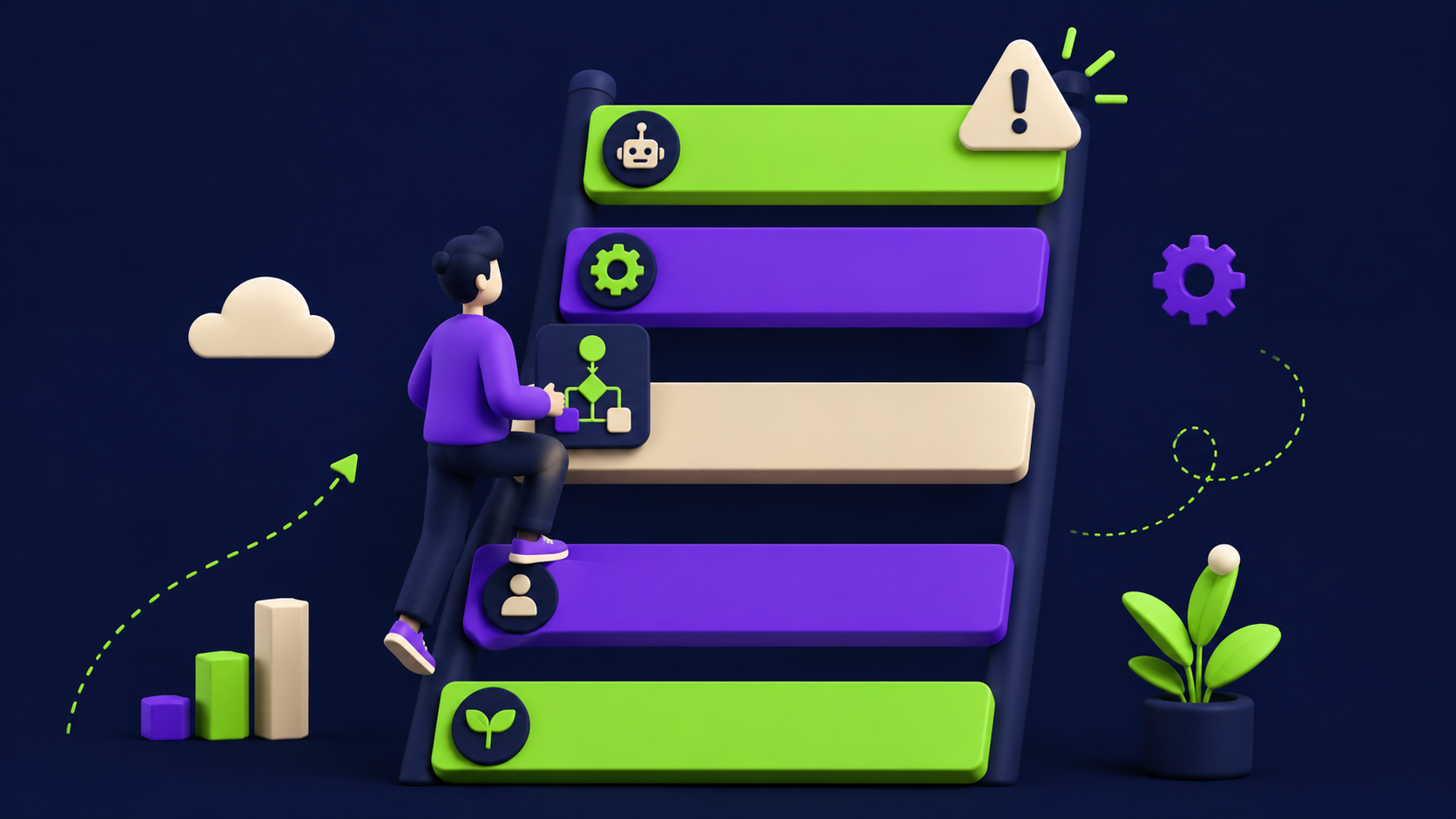
You move up by making the one next move for your current stage, then re-placing yourself, rather than leaping levels. The sequence is the whole point: document (1 to 2), build one workflow (2 to 3), add agents with guardrails (3 to 4), then selectively trust them (4 to 5). Each move builds the foundation the next one needs.
The fastest way to stall is to skip: a stage-two team trying to deploy stage-four agents has no documented processes, no working workflows, and no oversight infrastructure, so the agents fail and the team gives up. An honest outside read of your stage and your next move is exactly what an audit provides, and it is where we start with every client, because building the right next thing beats building the impressive wrong thing every time.
Want help finding and building your next move?
Vantaige audits where your business sits on the curve, finds the hours bleeding into manual work, and builds the next system that actually advances you. Book a free automation audit and we will place your stage and map the first three builds worth doing.
FAQ
What stage are most businesses at in 2026?
Most sit at stage one or two: lots of manual work and ad hoc AI use, little connected automation. That is not a failing, it is the normal starting point. The mistake is not being at stage two; it is trying to act like stage four before doing the stage-two and stage-three work.
Can I skip stages to move faster?
Not reliably. Each stage builds the foundation the next needs: documentation enables workflows, workflows enable agents, oversight enables autonomy. Teams that skip end up rebuilding the skipped layer under pressure. Moving deliberately through the stages is faster than leaping and falling back.
Is stage 5 the goal?
Only for the right processes. Full autonomy suits high-frequency, bounded, low-stakes functions; high-stakes judgment should stay with humans. The mature target is the right stage per function, not maximum autonomy everywhere. Over-automating judgment is its own failure mode.
How do I know my real stage?
Look at your daily work: hand-done with knowledge in heads is stage one; ad hoc AI is stage two; reliable fixed workflows are stage three; agents handling variable tasks are stage four; agents running functions with light supervision is stage five. Be honest; most teams flatter themselves by a level.
What is the highest-return first move?
For stages one and two, it is documenting your core processes and building one real workflow on the highest-frequency one. That single connected win produces more value and learning than a dozen scattered experiments, and it sets up everything above it.
Does this apply to content and sales, not just operations?
Yes. The curve runs through every function. Content maturity goes from manual writing to an automated stack to agentic production; sales from manual outreach to an automated stack to autonomous SDR agents. The flagship guides for each pillar map those paths in detail.
Related from Vantaige
References
Gartner, research on AI adoption and maturity. gartner.com
Anthropic, "Building effective agents." anthropic.com
McKinsey, research on automation of work. mckinsey.com
Get the best new AI tools and guides, weekly
One short email a week. The tools worth trying, the guides worth reading, nothing else.
No spam. Unsubscribe anytime.
Aymen B
Contributing writer at Vantaige, covering the AI tools ecosystem.
Similar articles
AI Agents for Business: What They Actually Are and 12 Things You Can Automate Today
The Free Process Automation Audit: Find the 10 Hours a Week Your Team Is Losing