How to Train AI to Write in Your Brand Voice (Complete Setup Guide)

How to Train AI to Write in Your Brand Voice (Complete Setup Guide, 2026)
Every team that relies on AI for content hits the same wall after a few months: the output is technically correct but reads like it was written by no one. The AI has no idea who you are. This guide gives you the actual five-step process for changing that, from running a voice audit on your best existing content, to choosing the right technical mechanism for your budget and scale, to testing until the output is genuinely yours. According to OmniBound's 2026 brand consistency research, brands that achieve consistent voice see 23 to 33 percent revenue increases, while 95 percent of companies have brand guidelines but only 25 to 30 percent actively enforce them in AI workflows.
Run a voice audit on your top 10 to 15 pieces of content before you write a single prompt.
Build a curated corpus: 15,000-plus words of your best work across formats.
Write a system prompt with tone, vocabulary, banned phrases, and structure rules.
Pick the right mechanism: few-shot prompting, RAG over your corpus, or fine-tuning.
Run a blind scoring test on every major iteration before deploying at scale.
Why Does AI Sound Generic By Default?
AI models are trained to produce statistically probable text, which means they default to the average of everything they have seen. That average is corporate, hedged, and toneless. There is no signal in your training run telling the model that your brand never uses passive voice, always opens with a data point, or uses "operators" instead of "marketers." Without explicit instruction, the model fills those gaps with the median.
This is not a model quality problem. GPT-4o, Claude Sonnet, and Gemini 1.5 Pro are all capable of matching a specific voice very precisely. The gap is configuration. Most teams use AI tools with default system prompts or none at all, then wonder why every blog post sounds like a press release from 2019.
The fix is not finding a better model. It is giving any model enough signal about your voice, and testing until output is reliably on-brand. Content creation tools like Jasper, Copy.ai, and Writesonic all expose some form of brand voice input, but they still require you to have done the upstream work of knowing what your voice actually is.
Step 1: How Do You Run a Brand Voice Audit?
Pull your 10 to 15 best-performing pieces of content, define what makes them yours, and reduce that definition to a concrete list of rules before you write anything for AI. "Best" means pieces your team is proud of, that performed well, and that represent the writing you want to scale, not average output.
Go through each piece and answer these four questions:
Sentence rhythm: Short and punchy, or long and layered? Count average sentence length across five paragraphs.
Opening pattern: Does the piece open with a claim, a question, a statistic, or a scene? Your pattern reveals your instinct.
Vocabulary signals: What specific words appear repeatedly that are distinctly yours? What words are conspicuously absent?
Structural fingerprint: Do you always end sections with a so-what? Do you front-load conclusions? Do you use numbered lists or avoid them?
Document what you find in a plain table: trait, evidence (quote from the content), and rule. That table becomes the foundation of your system prompt. Do not skip this step. Teams that go straight to prompting without an audit produce prompts that describe what they think their voice sounds like, not what it actually is. The two are usually different.
Step 2: How Do You Build a Brand Voice Corpus?
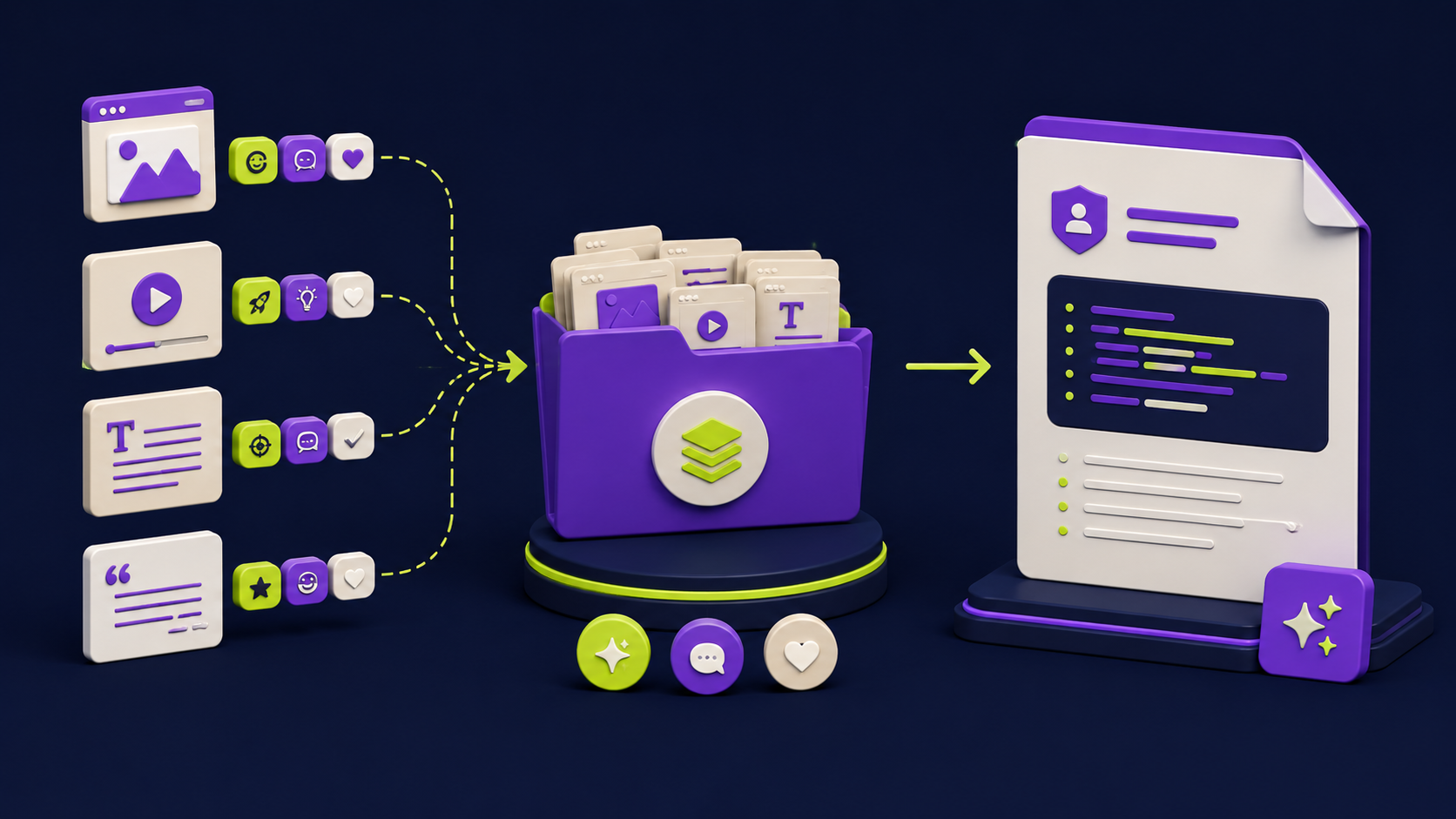
A corpus is a curated set of examples the AI can learn from, either at inference time via few-shot examples, or at training time via fine-tuning. Quality matters more than quantity, but quantity still matters: according to Search Engine Land's guide to training in-house LLMs, you need a minimum of 15,000 words of on-brand content before the model has enough signal to generalize your style reliably.
Build the corpus in three layers:
Tier 1 (your best 20 percent): 5 to 8 pieces that are the clearest expression of your voice. These are the few-shot examples you will paste directly into system prompts.
Tier 2 (the larger library): 40 to 60 pieces covering the range of formats you publish. Blog posts, email subject lines, social captions, landing page copy. This library goes into your RAG index if you choose that path.
Tier 3 (negative examples): 5 to 10 pieces of writing you consider off-brand. Generic, stiff, or produced by a vendor who missed the mark. Labeling what is wrong is as useful as labeling what is right.
Store everything in plain text files or a structured document. Strip formatting artifacts. Add a one-line label to each file: "Tier 1 blog post, technology audience, published 2025, voice rating 9/10." That metadata becomes critical when you start testing and want to understand why certain outputs fail.
Step 3: How Do You Write a Brand Voice System Prompt?
A system prompt for brand voice is not a style guide summary. It is an operational instruction set that the model executes on every generation. The difference is specificity. "Write in a conversational, confident tone" is a style guide description. "Open every piece with a declarative claim of three to eight words. Never open with a question. Use second-person throughout. Replace 'utilize' with 'use'." is an operational instruction.
Structure your system prompt in five named sections:
Role and audience: Who is writing, and for whom.
Tone attributes: Three to five specific adjectives with concrete behavioral translations.
Vocabulary rules: Preferred terms and banned terms, with substitutions for each banned term.
Structure rules: Opening pattern, paragraph length, heading style, closing pattern.
Output constraints: Format, length, what to never include.
Here is a working skeleton you can adapt:
## Brand Voice System Prompt: [BRAND NAME]

### Role
You are a content writer for [BRAND NAME]. You write for [TARGET AUDIENCE] who
[brief audience description: their job, their problem, their sophistication level].

### Tone
- Direct: State conclusions in the first sentence of every paragraph. No throat-clearing.
- Specific: Replace vague descriptors with numbers, names, or examples.
  "Many companies" → "63% of mid-market SaaS teams (Forrester, 2025)."
- Dry wit: Occasional dry observation, never sarcasm, never forced humor.
- Non-corporate: Avoid nominalizations. "We made the decision" → "We decided."

### Vocabulary

PREFERRED TERMS:
- "operators" not "marketers"
- "build" not "deploy" (for non-technical content)
- "real" not "authentic" or "genuine"
- "run" not "execute" or "implement"

BANNED WORDS AND SUBSTITUTIONS:
- utilize → use
- facilitate → help
- best-in-class → name the specific advantage
- seamless → smooth, frictionless, or omit
- empower → help, enable (only if accurate)
- spearhead → lead, run
- state-of-the-art → name the specific technology
- robust → strong, reliable, or name the specific capability

### Structure Rules
- Open with a declarative claim, not a question. Max 10 words in the opener.
- Paragraphs: 2 to 3 sentences maximum. 40 words maximum.
- Headers: Verb-first or question-format. Never noun-phrase only ("Introduction").
- Lists: Use bullet lists for parallel items. Numbered lists only for ordered steps.
- Closing: End sections with a direct so-what, never a transitional summary.

### Output Constraints
- No em dashes. Use a comma, period, or colon instead.
- No passive voice unless the subject is genuinely unknown.
- No rhetorical questions as conclusions ("So what does this mean for your business?").
- No byline filler ("In today's world...", "Now more than ever...").
- Target reading level: Grade 9 to 11. Short sentences are not dumbing down.

### Examples (few-shot)
[PASTE TIER 1 CORPUS EXAMPLES HERE: 2 to 3 full pieces or strong excerpts]
Vantaige clients who complete this prompt before touching any AI tool report that time-to-acceptable-output drops from 4 to 6 revision cycles to 1 to 2. The prompt template above, along with a fill-in-the-blank version for your team, is available as a downloadable PDF via email when you reach out through the contact page. We send it manually to anyone doing this setup seriously.
Step 4: Which Mechanism Should You Use: Few-Shot, RAG, or Fine-Tuning?
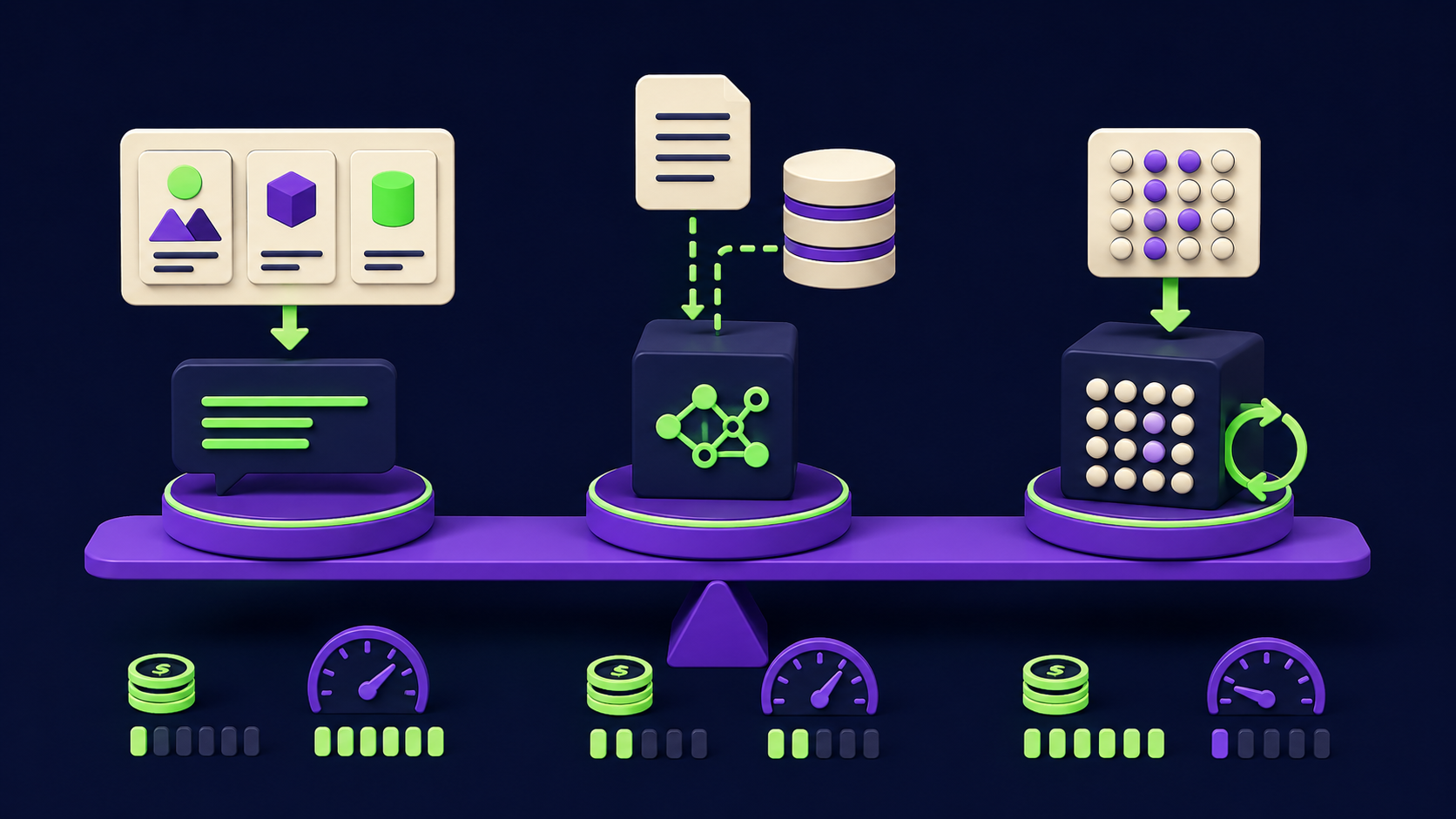
The right mechanism depends on your team size, content volume, and how stable your voice is. Most teams should start with few-shot prompting and only move up the stack when they hit a ceiling. According to the 2026 strategic guide on DEV Community, the recommended sequence is: prompt engineering first, then RAG, then fine-tuning, with fine-tuning reserved for cases where volume and compliance pressure justify the cost.
Mechanism | Setup Effort | Monthly Cost | Voice Consistency | When to Use |
|---|---|---|---|---|
Few-shot prompting | Low (hours) | $0 to $50 (API calls only) | Good for stable formats | Teams under 20 pieces/month, one or two content types |
RAG over corpus | Medium (days) | $50 to $300 (vector DB + compute) | Strong across formats | Teams publishing 50-plus pieces/month across multiple formats |
Fine-tuning | High (weeks) | $500 to $5,000+ (training run + inference) | Very high, but fragile | Agencies or publishers with 500-plus pieces annually and a locked style |
Few-shot prompting means pasting 2 to 3 Tier 1 corpus examples into the system prompt alongside your voice rules. This works well when you produce one or two content types on a predictable schedule. The ceiling is context window length and consistency across very different formats. When you start producing long-form content, email sequences, and social captions from the same voice system, few-shot gets unwieldy.
RAG (retrieval-augmented generation) over your corpus pulls relevant examples from your library dynamically at generation time. The model sees your voice rules plus 3 to 5 retrieved examples that match the current task. As noted in BigData Boutique's 2026 fine-tuning analysis, RAG does not change how the model speaks, it changes what the model knows. You still need a strong system prompt for the how. RAG handles the what: recent product facts, updated terminology, new campaign language. This is why most production content teams use a hybrid: system prompt for voice, RAG for facts.
Fine-tuning bakes voice into the model weights themselves via a training run on your corpus. This produces the highest consistency on the specific format you trained on, but it is expensive, slow to update, and fragile: a voice shift requires a new training run. The 2026 LoRA/DPO fine-tuning guide from Kumar Gauraw recommends thin LoRA adapters on a strong base model rather than full fine-tuning, which reduces training cost by 60 to 80 percent while preserving most of the consistency benefit.
If you are building a content operation from scratch, start with few-shot. If you are scaling past 50 pieces per month across formats, invest two to three days in a RAG setup. Fine-tuning is for mature operations with high volume and a locked, stable voice. For the full picture of what this looks like in a production content stack, see the AI content automation stack and the anti-slop checklist for quality control once output is flowing at volume.
Step 5: How Do You Test and Iterate Until Output Is Actually On-Brand?
Testing is where most teams cut corners. They generate a few pieces, they look okay, and they ship. Six months later the content has drifted and nobody knows when it happened. The fix is a formal blind test at every major version change of your system prompt.
The blind test works like this:
Generate 5 pieces from the same brief using the new system prompt version.
Mix in 2 pieces of genuine, verified on-brand content from your corpus.
Give the 7 pieces to 3 reviewers (ideally including someone outside the content team) with no labels.
Ask each reviewer to score every piece 1 to 5 on four dimensions: tone match, vocabulary, structure, and overall brand feel.
Compare AI-generated scores to corpus scores. If the gap is greater than 0.5 points on any dimension, that dimension needs a prompt fix.
Document every prompt change and the test score it produced. After 3 to 4 iterations you will have a log that shows exactly which rule changes moved scores in which direction. That log is your voice system's audit trail. It is also the artifact that lets you bring in a new team member or a contractor and ramp them up on your voice in a single read.
Common iteration patterns: if the AI keeps producing passive voice despite an explicit ban, add 2 more active-voice examples to the few-shot section rather than just repeating the rule. If vocabulary keeps slipping, convert the banned list to a find-replace table the model can reference. If structure drifts across formats, separate your system prompt into format-specific variants rather than trying to cover all formats in one prompt.
For related workflows on content at scale, see how we approach AI automation pricing for operators and the honest breakdown in B2B niches where AI agent work actually pays.
What Are the Most Common Brand Voice Setup Mistakes?
Most brand voice failures fall into five categories. Naming them here saves you from discovering them after publishing 50 pieces at scale.
Writing from gut, not evidence. Teams describe their voice as "professional but approachable" without ever reading their actual content. The prompt reflects the aspiration, not the reality. Fix: do the audit first, every time.
Too many rules, no hierarchy. A 2,000-word prompt with 40 rules creates conflicts the model resolves arbitrarily. Fix: limit to 8 to 12 structural rules and 15 to 20 vocabulary items. Prioritize ruthlessly.
Skipping negative examples. Telling the model what good looks like is not enough if it does not know what wrong looks like. Fix: add a "do not write like this" section with 2 to 3 labeled bad examples.
Testing on the same format you trained on. Voice consistency on blog posts does not predict consistency on emails or social captions. Fix: test across every format you plan to produce before calling the system ready.
Never updating the prompt. Voice evolves. A campaign shift, a rebrand, a new audience segment, any of these change what on-brand means. Fix: schedule a quarterly voice audit and prompt review, the same way you would review a content calendar.
If you are also running into quality problems at the output level rather than the voice level, the n8n automation workflows we cover elsewhere include a review-gate node that flags low-confidence outputs before they reach editors.
FAQ: Training AI to Write in Your Brand Voice
How long does it take to train AI to match my brand voice?
The setup process takes three to five days for a team doing this properly: one day on the voice audit and corpus curation, one day writing and testing the system prompt, one to three days iterating based on blind test scores. You are not training a model in the ML sense. You are configuring a prompt system. That configuration can reach usable consistency within a week for most content types.
Do I need a developer to set up brand voice AI?
For few-shot prompting, no. Any content manager can write a system prompt and test it using the API or a tool like Copy.ai. For RAG over a corpus, you need either a developer or a no-code setup via a tool like n8n with a vector database connector. Fine-tuning always requires technical resources or a vendor.
What is the difference between a brand voice guide and a brand voice system prompt?
A brand voice guide is written for humans: descriptive, aspirational, and full of examples. A system prompt is written for AI: operational, specific, and constraint-based. Most brand voice guides are useless as system prompts because they describe what the voice feels like rather than what the model should do. You need to translate the guide into a rule set before AI can use it.
Is fine-tuning worth it for brand voice?
Rarely, unless you are publishing 500-plus pieces per year on a locked style with no plans to rebrand. Fine-tuning is expensive to run, slow to update, and fragile to voice shifts. The 2026 consensus among production AI content teams is to get very good at system prompts and RAG before even evaluating fine-tuning. Most teams never need to cross that line.
How do I know when my AI voice setup is working?
Run the blind test described in Step 5. If three independent reviewers consistently score AI-generated pieces within 0.5 points of verified on-brand content across all four dimensions (tone, vocabulary, structure, overall feel), the system is working. If scores improve across three consecutive prompt iterations, you have a working feedback loop, which is the real target.
Can the same system prompt work across all content formats?
A single system prompt can share core voice rules across formats, but structure rules need to be format-specific. A blog post structure rule ("open with a declarative claim") does not translate to email subject lines ("5 to 7 words, benefit-first"). Use a layered approach: one global voice layer for tone and vocabulary, plus format-specific layers for structure and length constraints. Merge them at generation time.
What tools can help enforce brand voice in AI content workflows?
At the generation layer: Jasper and Copy.ai both offer brand voice input fields that accept corpus examples. At the quality control layer: Grammarly Business includes style guides, and plain LLM-as-judge evaluation (send output to a second model call with a scoring rubric) works well in automated pipelines. See the Claude plus Microsoft Office setup guide for how to enforce voice in document workflows specifically.
How does content at scale stay on-brand over time?
Brand drift happens gradually. According to GrowthHakka's 2026 AI content governance research, the first 10 pieces look fine, but by piece 50 the tone has shifted and the audience notices. Prevention requires three things: a quarterly prompt review, a rolling corpus that adds new on-brand examples and removes dated ones, and a scoring audit on a random 5 to 10 percent sample of live output each month.
How do I handle brand voice when multiple team members use AI?
Centralize the system prompt in a shared location, versioned and locked. Never let individual team members edit their own copies. Run training so everyone understands what the prompt does and why specific rules exist. The same discipline that governs a shared style guide applies here, with the added requirement that prompt changes go through a test cycle before deployment.
What is a realistic timeline to see consistent brand voice from AI at scale?
Week 1: audit, corpus, system prompt v1. Week 2 to 3: blind test, first iteration cycle. Month 2: second iteration, first scale test across all formats. Month 3: stable, repeatable output on all core formats. This timeline assumes someone owns the process. If it is a side task, double the timeline.
Should every AI content tool have its own system prompt?
Yes. A system prompt written for the Claude API will not behave identically when pasted into Jasper's brand voice field, because each tool applies its own internal framing. Maintain a master prompt document and adapt it per tool, keeping core rules identical and adjusting only the formatting and instruction phrasing each tool expects.
What happens when brand voice changes during a rebrand?
Treat it like a new product launch. Run the full five-step process from the audit phase. Do not edit the existing system prompt incrementally, that produces inconsistent hybrid output. Archive the old prompt with a dated label, build a new one from the updated corpus, and run the blind test against new brand standards before retiring the old version.
Want this content system built for you?
Vantaige designs and deploys done-for-you AI content operations: the stack, the prompts, and the publishing pipeline, configured to your brand in weeks. Book a free content automation audit and we will map what to automate first.
Related from Vantaige
References
OmniBound: Brand Consistency Statistics 2026, 52+ Data Points on Revenue, Trust, and AI Visibility
Search Engine Land: How to Train In-House LLMs on Your Brand Voice, with Free Prompt Template
DEV Community: RAG vs. Fine-Tuning vs. Prompting, 2026 Strategic Guide
BigData Boutique: Fine-Tuning LLMs in 2026, When RAG Isn't Enough and When It Still Is
Kumar Gauraw: Fine Tuning AI Models in 2026, When You Should (And When You Absolutely Shouldn't)
GrowthHakka: AI Content Quality Control and Brand Consistency (May 2026)
Get the best new AI tools and guides, weekly
One short email a week. The tools worth trying, the guides worth reading, nothing else.
No spam. Unsubscribe anytime.
Aymen B
Contributing writer at Vantaige, covering the AI tools ecosystem.
Similar articles
The AI Content Automation Stack: 7 Tools That Run a Full Blog Without a Team
AI SEO Content at Scale: Publish 20 Posts a Month Without Hiring Writers