CAMEL-AI is the open-source multi-agent framework behind the OWL agent, which ranked #1 among open-source systems on the GAIA benchmark. Built on NeurIPS-published research from KAUST, it supports role-playing agents, 1M-agent society simulation, and autonomous task pipelines.
CAMEL-AI is an open-source multi-agent framework and research collective that originated in a NeurIPS 2023 paper by researchers at KAUST (King Abdullah University of Science and Technology). The name stands for Communicative Agents for "Mind" Exploration of Large Language Model Society. It began as an academic project studying how LLM agents behave, cooperate, and scale when given structured roles and conversational tasks. Since 2023, it has grown into a community of 100+ researchers across MIT, Stanford, Oxford, CMU, and industry partners including Amazon, Apple, Meta, and DeepMind. The core Python library reached v0.2.90 in March 2026 and holds over 16,900 GitHub stars.
CAMEL ships modular components for building multi-agent systems: a RolePlaying framework that uses inception prompting to assign structured personas to cooperating agents; a Workforce orchestration engine for assembling hierarchical agent teams; persistent memory systems; RAG pipelines; and synthetic data generation pipelines. Its OWL sub-project (Optimized Workforce Learning) is a fully autonomous general agent with browser automation, document parsing, code execution, and 20+ toolkits built in. A separate OASIS project enables social simulation of up to one million concurrent agents. The framework is Apache 2.0 licensed with no paid tiers. Users supply their own API keys for the underlying LLMs.
What CAMEL-AI actually does in April 2026
At its core, CAMEL is a Python framework for orchestrating multiple LLM-backed agents that communicate through structured role-based dialogues. Rather than hard-coding task graphs, CAMEL uses inception prompting: agents are given a role (User, Assistant, Critic, Planner, or custom), a context, and constraints, then allowed to negotiate toward task completion through multi-turn conversation. This dialogue-first design distinguishes CAMEL from task-graph-first frameworks and is the mechanism the original NeurIPS 2023 paper studied at scale.
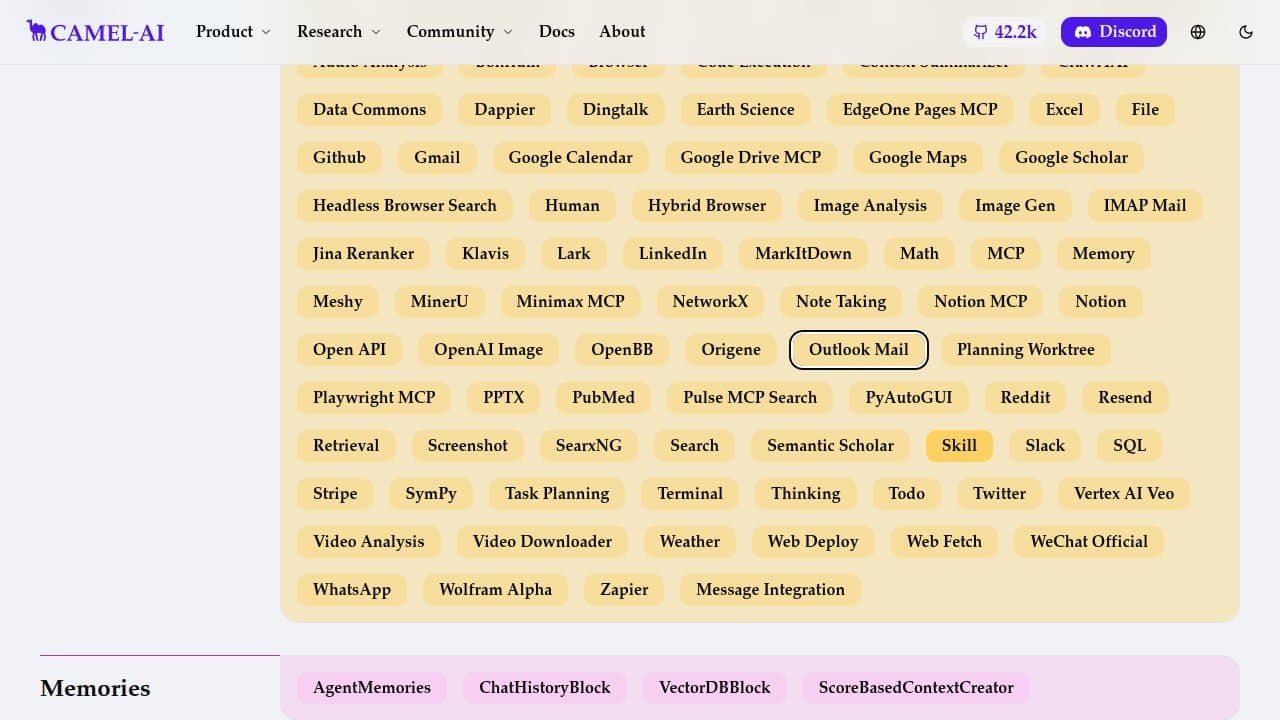
The library's current architecture has five major layers. First, the ChatAgent: a single LLM-backed agent with tool access, memory, and configurable persona. Second, Societies: coordination layers that handle role assignment, task delegation, and agent communication routing. Third, Interpreters: execution backends for Python, shell commands, and browser automation. Fourth, Memory: persistent conversation and context storage using vector backends. Fifth, Synthetic Data Generation: pipelines for creating instruction-following datasets from agent interactions, which power several CAMEL-published research benchmarks.
The OWL agent, released March 2025, packages CAMEL's full Workforce layer into a ready-to-run autonomous agent. It connects multi-search engines, Playwright browser automation, PDF and document parsing, sandboxed code execution, multimodal analysis, and MCP (Model Context Protocol) support for tool interoperability. On the GAIA benchmark, OWL scored 69.09% as of April 2025, ranking first among open-source frameworks. It supports GPT-4o, Claude 3.5 Sonnet, Qwen, DeepSeek, Gemini, and local models via Ollama, vLLM, and SGLang.
OASIS (Open Agent Social Interaction Simulations), released November 2024, extends the framework into a different direction entirely: large-scale social simulation. OASIS can model up to one million concurrent agents on simulated social networks, replicating real user behavior patterns including information spreading, group polarization, and herd effects across platforms modeled on X and Reddit. This is primarily a research tool for studying misinformation dynamics and emergent social behavior at scale.
Where CAMEL-AI sits versus CrewAI and AutoGen
CAMEL-AI vs. CrewAI: CrewAI is a product-focused framework designed for fast deployment. It uses a role/task/process DSL where developers define named agents and assign explicit discrete tasks in sequence or hierarchy. The learning curve is intentionally low, with roughly 20 lines of code to run a working crew. CrewAI also offers a hosted enterprise tier with execution management. CAMEL takes the opposite stance: its Workforce layer allows agents to dynamically delegate and negotiate sub-tasks rather than follow a pre-declared task sequence. This makes CAMEL more flexible for complex, emergent multi-agent workflows, but harder to debug when an agent loop goes wrong. CrewAI thinks in tasks; CAMEL thinks in conversations. For teams that want to ship an agent product in a day, CrewAI has the edge. For teams studying how agents coordinate under novel conditions, CAMEL has the depth. Users who want production orchestration tooling often pair CrewAI with Agno for infrastructure; CAMEL users tend to wire up their own.
CAMEL-AI vs. AutoGen (Microsoft): AutoGen is also research-led, built by Microsoft Research and accepted at NeurIPS 2023 alongside CAMEL. Its GroupChat architecture routes multi-agent conversations through an LLM-mediated turn selector and accumulates full conversation history per turn, which becomes expensive at scale (a 4-agent, 5-round conversation requires 20+ LLM calls minimum). AutoGen also has .NET support and strong enterprise documentation, and has been adopted in Microsoft products. The tradeoff: AutoGen entered a lower-investment maintenance phase in 2025 as Microsoft shifted resources to its broader Agent Framework product. CAMEL, by contrast, has stayed actively research-forward, shipping OWL in March 2025 and LOONG in September 2025. Where AutoGen is optimized for enterprise conversational workflows, CAMEL is optimized for research: scaling laws, benchmarking, and simulation. Developers building on AutoGen often find they also reach for LangGraph to handle the stateful execution layer AutoGen doesn't cover natively.
Against smolagents (Hugging Face), the contrast is starker. smolagents is intentionally minimal: agents write and execute Python code directly in sandboxed environments, and the library keeps abstractions thin. It is the fastest path from zero to a working agent for newcomers. CAMEL offers substantially more infrastructure (persistent memory, RAG, RL training loops, society simulation, 30+ toolkits) but requires proportionally more setup. smolagents connects natively to Hugging Face Hub for model and tool sharing; CAMEL is model-agnostic across all major API providers. The two serve different audiences: smolagents for experimentation with lightweight tasks; CAMEL for research pipelines and long-horizon automation at scale.
"Camel-AI feels lighter and more community-driven, with a sharper focus on dialog roles compared to AutoGen. CrewAI's ergonomics and ecosystem feel more mature, while Camel-AI's open focus on scaling laws and local options like OWL are differentiators." -- Sider.ai comparative review, 2025
What the agent-loop reality looks like
A typical CAMEL workflow starts with installing the library via pip, creating a model configuration through ModelFactory, defining agent roles, then running a RolePlaying session or Workforce pipeline. The modular design means you configure each layer: which LLM backend, which memory store, which tools. For OWL, setup involves configuring an API key and running a Docker container or installing locally, then submitting a task in natural language. The agent handles tool routing internally.
In practice, the experience varies strongly by model choice. With GPT-4o or Claude 3.5 Sonnet as the backbone, OWL performs reliably on the GAIA benchmark category of multi-step research, document, and coding tasks. The README acknowledges directly: "other models may result in significantly lower performance." Using smaller open models via Ollama drops benchmark scores substantially. This model sensitivity is a real constraint for teams on tight inference budgets.
Long-horizon Workforce tasks (multi-agent pipelines that run for minutes or longer) can enter silent failure states when an integration times out or a tool call returns an unexpected response. The GitHub issues tracker shows 224 open issues as of April 2026, with recurring reports around Bedrock integration failures, vLLM compatibility breakage after upstream changes, and Windows installation failures due to missing Visual C++ build tools. Debugging a failed agent loop requires reading raw logs; there is no purpose-built visual debugger comparable to LangGraph's trace viewer.
"Model setup can be tricky and confusing due to extensive LLM integrations available; there can be a lot of mixing and matching with ModelFactory configuration." -- Parth Sharma, Medium, 2025
On the positive side, CAMEL's cookbook documentation is practical and well-maintained, with hands-on examples covering data generation, RAG pipelines, simulation setup, and OWL task examples. The Discord community (4,000+ members) provides active support. Integration with AutoGen workflows is sometimes used by researchers who want CAMEL's simulation layer combined with AutoGen's enterprise tooling patterns.
Who CAMEL-AI is built for
CAMEL's primary audience is AI researchers and developers with Python proficiency who want a framework that was built for research rather than retrofitted for it. If your work involves studying multi-agent emergent behavior, generating synthetic instruction-following data for model fine-tuning, or running large-scale social simulations, CAMEL is the most purpose-built open-source option available. The OASIS project is particularly unique: no other open framework supports simulating one million agents for social dynamics research.
For production automation use cases, OWL is the practical entry point. Teams that want a self-hosted, bring-your-own-key autonomous agent that handles mixed-media tasks (web research plus document parsing plus code execution) can run OWL on their own infrastructure without any vendor subscription. The Apache 2.0 license means full commercial use rights. Some engineering teams use OWL as a self-hosted alternative to cloud-based agent products, valuing the data privacy and cost control of running locally. Developers building agent infrastructure sometimes combine CAMEL's Workforce with CrewAI for the task orchestration layer, using CAMEL for its data generation and simulation capabilities.
CAMEL's connection to the NeurIPS research community and KAUST also means it often surfaces new agent techniques, benchmarks, and datasets before they appear in commercial frameworks. The CRAB benchmark for cross-environment agent evaluation and the LOONG dataset for domain QA were both CAMEL-originating contributions now cited in academic work.
What CAMEL-AI is not
CAMEL is not a no-code or low-code tool. There is no drag-and-drop agent builder, no web dashboard for running workflows, and no hosted execution environment managed by the CAMEL team. Every workflow is coded in Python. If your team needs a hosted multi-agent product with a GUI, this is not the right starting point.
CAMEL is not optimized for Windows. Installation failures due to missing Visual C++ build tool dependencies are a documented recurring issue, and most CAMEL documentation assumes a Linux or macOS environment. Windows users can work around this, but it adds friction that researchers on Linux-first academic clusters don't experience.
CAMEL is not the right choice if you are running budget-constrained inference on small local models. The benchmark-topping results from OWL are achieved with frontier models. Teams expecting GAIA-competitive performance on a 7B or 13B local model will be disappointed. For local-model-first agent work, smolagents or LangGraph with smaller models will serve better.
CAMEL is also not a substitute for a production-grade orchestration layer. The 224 open GitHub issues and active integration churn mean that pinning dependency versions and testing against your specific LLM provider before a deployment matters more here than with frameworks that have a commercial support contract behind them.
User Reviews
No reviews yet. Be the first to share your experience!
Sign in to write a review.
Featured in collections
Curated lists that include CAMEL-AI.
Related articles
Guides and articles related to CAMEL-AI.
Turn Any AI Agent Into a Superagent: The 12-Integration Stack (2026)
Run a Company With AI Agents: The Open-Source Orchestration Setup (2026)
Orchestrator-Workers: The Multi-Agent Pattern That Actually Scales (2026)
How AI Agents Work: Architecture & Implementation Guide (2025)
Grok 4.3 API for Agents (May 2026): Pricing, Benchmarks, Migration