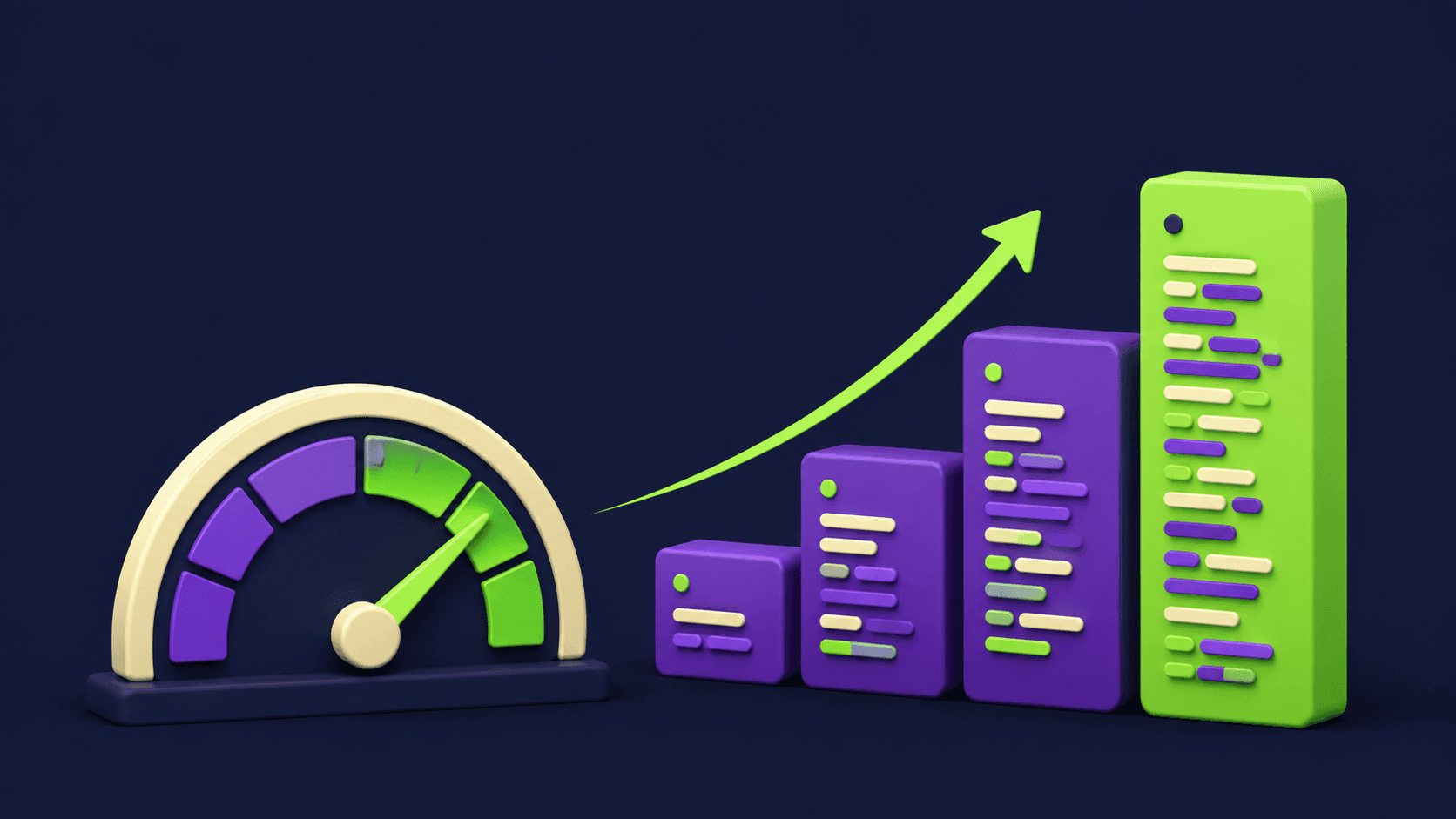

Cerebras Inference is a cloud LLM API powered by the WSE-3 wafer-scale chip, the largest AI processor ever built. It delivers 2,000-3,000 tokens per second on open models, 10-20x faster than GPU-based alternatives, starting at $0.10 per million tokens.
Cerebras Systems is a Santa Clara AI hardware company that built the WSE-3, the largest chip ever manufactured: a single wafer of silicon measuring 46,225 square millimeters, containing 4 trillion transistors and 900,000 AI-optimized compute cores. Instead of dicing a silicon wafer into dozens of small chips, Cerebras treats the entire wafer as one unified processor, storing entire LLM weight matrices in 44 GB of on-chip SRAM at 21 petabytes per second memory bandwidth. The CS-3 commercial system ships this chip as a water-cooled appliance. Cerebras Inference, launched August 27, 2024, is the public cloud API that gives developers access to this hardware for LLM inference at speeds no GPU cluster can match.
The inference API serves a rotating catalog of frontier open models including GPT-OSS-120B (hitting roughly 3,000 tokens per second), Qwen3-235B (up to 2,500 tokens per second with 262K context), Llama 4 Maverick (~2,522 tokens per second), and Llama 3.1 8B (2,337 tokens per second at $0.10 per million tokens). The API is OpenAI-compatible, so integration requires changing a base URL and API key. A free tier provides 1 million tokens per day with no waitlist. Enterprise and developer tiers unlock higher rate limits and priority scheduling. In January 2026, OpenAI signed a $10 billion deal for 750 megawatts of Cerebras compute through 2028, and AWS deployed CS-3 appliances in its data centers making Cerebras available through AWS Bedrock.
What Cerebras Inference actually does in April 2026
Cerebras Inference is a pure inference API, not a training platform or fine-tuning service. It runs open-weight language models at speeds that change the economics of real-time AI applications. When a GPU cluster returns a Llama 70B response in 12-15 seconds, Cerebras returns the same response in under 2 seconds. When a GPU cluster completes a 405B reasoning trace in 45 seconds, Cerebras completes it in 3-4 seconds. The throughput numbers from Artificial Analysis benchmarks (2025) are not theoretical: GPT-OSS-120B at ~3,000 tokens per second, Llama 3.1 8B at ~2,337 tokens per second.
The current model catalog (April 2026) includes GPT-OSS-120B in high and low variants, GLM-4.7 (131K context), Qwen3-235B and Qwen3-32B, and Llama 4 Scout. Context windows range from 33K to 262K tokens depending on the model. All models run at 16-bit precision natively, meaning no quantization tradeoffs on output quality. The API follows the OpenAI Chat Completions format, supports function calling and streaming, and is accessible through OpenRouter and HuggingFace as well as directly. Meta partnered with Cerebras to power the Llama API, giving developers inference speeds up to 18 times faster than traditional GPU solutions for Llama model access.
"Cerebras has been a true revelation when it comes to inference. I have a lot of respect for their founder, team, innovation, and technology.", maz1b, Hacker News, October 2025
Where Cerebras sits versus Groq and SambaNova
Three companies built custom silicon specifically to beat NVIDIA at inference: Cerebras, Groq, and SambaNova. Their chip architectures are fundamentally different, and the differences matter for how you'd use each one.
Cerebras vs. Groq: Groq's Language Processing Unit (LPU) is a linear pipeline design where data streams through functional units in lockstep. Each Groq chip carries only 230 MB of SRAM, so running a 70B model requires hundreds of Groq chips networked via proprietary fabric, and a 400B model requires thousands of chips, pushing rack-level power into hundreds of kilowatts. Groq optimizes for determinism and 8-bit inference; 16-bit runs significantly slower on Groq hardware. Cerebras WSE-3 eliminates inter-chip networking entirely: 44 GB of on-chip SRAM holds the model on a single wafer, and 16-bit precision runs natively. Independent Artificial Analysis benchmarks (2025) show Cerebras 6x faster than Groq on identical models: GPT-OSS-120B at ~3,000 vs. ~493 tokens per second, Llama 3.3 70B at over 2,500 vs. ~403 tokens per second. NVIDIA acquired Groq in late 2025 for $20 billion; Groq's independence as a competitor has ended, though the product continues operating.
Cerebras vs. SambaNova: SambaNova's SN40L chip uses a Reconfigurable Dataflow Unit (RDU) with a three-tiered memory hierarchy: SRAM, HBM, and DRAM. The RDU maps an AI model's full computational graph directly onto the chip as a custom dataflow pipeline. This tiered memory means SambaNova can hold multiple large models simultaneously and serve them without reloading weights. An entire SambaNova system fits in 16 chips drawing around 10 kW average, compared to Cerebras needing full water-cooled CS-3 appliances drawing 20-27 kW each. SambaNova claims 40x better performance per area than Groq and 10x better than Cerebras on Llama 3.1 70B. The critical difference for buyers: SambaNova supports enterprise on-premises deployment; Cerebras is cloud-only. SambaNova's per-user throughput for individual requests runs lower than Cerebras on raw tokens per second, but SambaNova can serve more simultaneous users without model reloading overhead.
What the inference API reality looks like day-to-day
The speed advantage is real and immediately observable. Developers building coding assistants (Cline added Cerebras support in v3.20.4, Roo Code in v3.25.5) report near-instant model responses compared to GPU-based providers. For interactive applications, the difference between a 2-second response and a 0.15-second response is not a benchmark stat. It changes what product interactions are possible. At 2,337 tokens per second for Llama 3.1 8B, a 500-token response arrives in about 0.2 seconds.
However, the daily reality includes friction that the benchmarks do not capture. The free tier's 30 requests-per-minute cap means any application with more than one concurrent user will hit limits immediately. Because the inference is so fast, clients can inadvertently send burst traffic that trips rate limits before a human has even read the previous response. Developers need to build explicit retry logic with delays. Prompt caching, which Anthropic and OpenAI both offer to reduce costs on repeated context, does not exist on Cerebras. For agentic loops that rebuild full message history on each tool call, token costs accumulate at full price on every round trip. One developer reported: without caching, you are sending the entire previous message history as input tokens on every call. This is not a theoretical concern, it is the dominant cost driver for complex agent deployments on the platform.
"Rate limits seem to kick in extremely quickly and the results are less good than Claude Code and it ends up more expensive.". Hacker News commenter, Cerebras Code thread, 2025
Model availability is also less stable than GPU-cloud providers. Cerebras actively rotates model support as its engineering team optimizes new checkpoints. Llama 3.1 8B and Qwen3-235B both carry a deprecation notice for May 27, 2026. Developers building production applications need to monitor model availability and handle deprecations. The model catalog is also narrower than GPU cloud alternatives: five active models versus dozens available on Together AI or Replicate.
Who Cerebras is built for
Cerebras Inference is purpose-built for use cases where latency is the bottleneck, not cost or model diversity. Real-time voice agents that need sub-200ms model turns, live coding assistants where users perceive the difference between 2-second and 0.1-second completions, and agentic systems that chain dozens of model calls in sequence. These are the workloads where Cerebras's speed changes what is possible, not just what is convenient. The early customer roster confirms this: GlaxoSmithKline for drug discovery (complex protein-domain inference), Cognition for code agents, and now OpenAI for production ChatGPT serving at massive scale.
Researchers and data scientists running large-scale inference experiments benefit from the free 1M-token-per-day tier, which allows genuine prototyping of speed-sensitive applications at no cost. The $0.10/M tokens pricing for Llama 3.1 8B is among the lowest in the industry for any hosted model, making high-throughput experiments tractable.
Skip this when: you need multi-modal inputs (images, audio, video): Cerebras is text-only. Skip it for on-premises deployment, which is physically impractical given the CS-3 system's form factor and power requirements. Skip it for agentic applications relying on prompt caching to control costs. Skip it if consistent model availability is critical to your production stack: the model rotation schedule is aggressive enough to require maintenance overhead. Teams needing extensive fine-tuning, specialized model customization, or a wide model catalog should look at GPU clouds or SambaNova's enterprise platform instead.
What Cerebras is not
Cerebras is not an AI model company. It does not train foundation models or own model weights. It serves open models built by Meta, Alibaba, and others, running them faster than any other platform can. If the open model ecosystem stopped producing competitive weights, Cerebras would have no models to serve. The company is entirely dependent on the continued release of open-weight models it can optimize for its hardware.
Cerebras is not a GPU-compatible ecosystem. Its software stack is proprietary and not CUDA-based. While developers access the API through the standard OpenAI-compatible interface, any custom kernels, quantization schemes, or model modifications optimized for CUDA will not transfer. This matters for teams with existing GPU-optimized inference pipelines that they want to migrate.
Cerebras is not an on-premises hardware vendor for most buyers. The CS-3 is a water-cooled appliance drawing 20-27 kW, requiring purpose-built data center infrastructure. Unless you are AWS-scale, you are using Cerebras as a cloud API, not deploying its hardware. This means your inference latency and throughput depend on network conditions to Cerebras data centers (six across North America and Europe as of early 2026).
User Reviews
No reviews yet. Be the first to share your experience!
Sign in to write a review.
Related articles
Guides and articles related to Cerebras.
Grok 4.3 API for Agents (May 2026): Pricing, Benchmarks, Migration
Does API Cost More Than a Subscription for Claude Opus 4.8, GPT-5.5, and Grok?
OpenAI GPT-Realtime-2 (May 2026): Pricing, Latency & 30-Min Voice Agent

Nous Hermes 4: The Self-Hosted Open-Weight Agent Brain (2026)
Claude Code New Limits (May 2026): Per-Plan Changes & SpaceX Deal