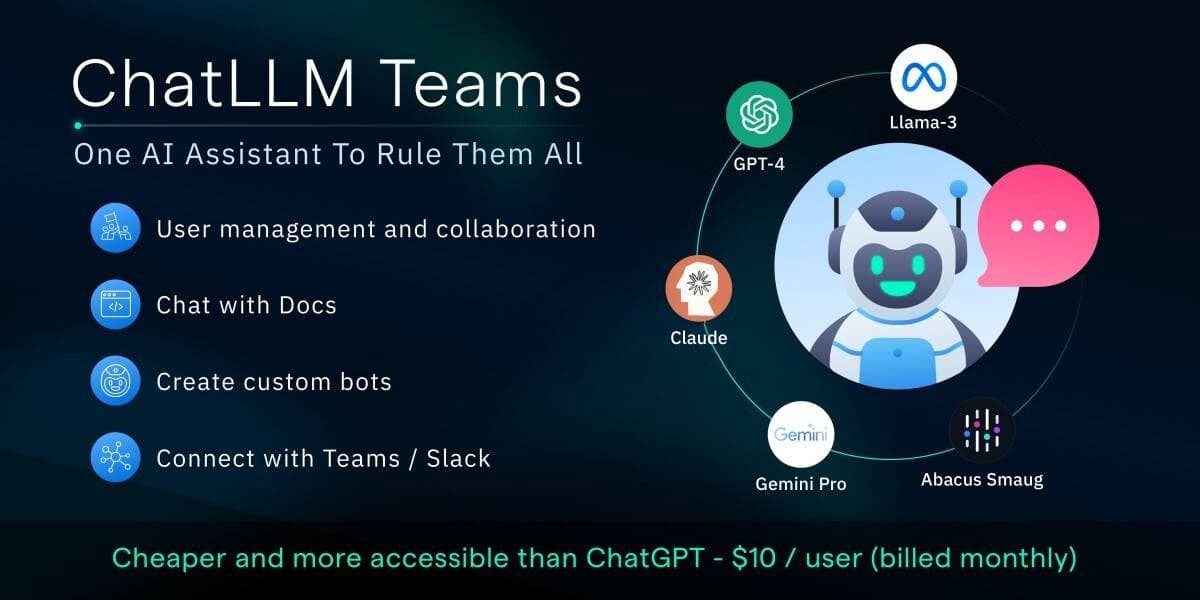

ChatLLM by Abacus AI bundles 100+ AI models including GPT-5, Claude, Gemini, DeepSeek, and Grok into a single $10/month plan, plus image generation, video generation, document tools, and autonomous agents.
ChatLLM is Abacus AI's multi-model AI platform that gives individuals and teams access to over 100 language, image, and video models for a flat $10 per month. Built by Bindu Reddy, a former Google product and applied AI lead, and co-founder Arvind Sundararajan, Abacus AI launched ChatLLM Teams in May 2024 as a direct answer to the fragmented AI subscription problem: why pay $20 each for ChatGPT Plus, Claude Pro, and Gemini Advanced when you need all three for different tasks? The platform is backed by $90.2M in total funding, with a $50M Series C from Coatue in October 2021.
At the Basic tier ($10/month), you get access to GPT-5.5, Claude Sonnet 4.6 and Opus 4.7, Gemini 3.1 Pro, DeepSeek v4, Grok-4.2, Kimi, Qwen, and Abacus's own Smaug open-weight models. Image generation runs FLUX.1 Pro, GPT Image, and Ideogram. Video generation supports KlingAI and RunwayML backends. Productivity tools include document chat (PDF, DOCX, Excel, PowerPoint), a Python code execution playground, real-time web search, and DeepAgent, a multi-step autonomous agent that can build web apps, create dashboards, run research pipelines, and automate workflows. The platform integrates natively with Slack, Microsoft Teams, Google Drive, Gmail, Confluence, and GitHub, making it a genuine workplace tool rather than just a consumer novelty. New models are added within 24-48 hours of release. Mobile apps for iOS and Android include voice mode.
ChatLLM at a glance, April 2026
ChatLLM's model roster as of April 2026 covers every major frontier lab: OpenAI (GPT-5.5, GPT-5.5 Thinking), Anthropic (Claude Sonnet 4.6 and Opus 4.7), Google (Gemini 3.1 Pro), xAI (Grok-4.2), DeepSeek v4, Mistral, Kimi 2.6, Qwen, Meta Llama, and Abacus's own Smaug series. The platform advertises 100+ models total across text, image, and video categories.
The RouteLLM feature automatically selects the most appropriate model for a given prompt, routing coding questions differently than creative writing tasks or data analysis, without requiring you to manually switch. Context windows vary by underlying model but follow the source models' limits (Claude Opus 4.7's extended context is available within the interface). The ChatLLM Operator handles computer-use style task execution. DeepAgent handles multi-step autonomous workflows, including AppLLM for generating functional web applications from natural language descriptions.
On the creation side: image generation spans FLUX.1 Pro (~40 credits/image on Basic), GPT Image, and Ideogram; video generation includes KlingAI and RunwayML backends (text-to-video, with premium video being credit-intensive). Text-to-speech and text humanization are included. Document tools support uploading PDFs, Word documents, spreadsheets, and PowerPoints for chat-based analysis, summarization, or content generation. The full suite is available on web, iOS, and Android.
What ChatLLM is actually good at
The clearest strength is subscription consolidation. If you currently pay separately for multiple frontier AI services, ChatLLM's value proposition is genuinely hard to argue with at $10/month. Reddit discussions frequently surface comparisons like: "This is a freaking bargain. You get access to basically every major AI model that exists for $10 a month. Compare that to paying $20 for ChatGPT Plus, $20 for Claude Pro, and another $20 for Gemini Advanced." (Aggregated Reddit sentiment, r/ChatGPTPro, November 2025.)
The multi-model comparison workflow is genuinely useful: you can run the same prompt against GPT-5.5, Claude Opus, and Gemini simultaneously to compare outputs, something no single-vendor subscription offers. For tasks where model selection matters (legal reasoning, creative writing, code review), this is a real advantage.
The platform excels at document-heavy workflows. Document chat for PDFs, spreadsheets, and presentation files is well-implemented. The Python code execution environment supports data analysis with visualization, covering a workflow that previously required Jupyter plus a separate LLM subscription. DeepAgent, when it works, handles multi-step research tasks that would take significant manual effort: pulling data, structuring findings into a presentation, and producing a written summary in sequence.
Model currency is a genuine differentiator. Because Abacus AI integrates new models within 24-48 hours of release, ChatLLM users got access to models like DeepSeek v4, Grok-4.2, and Kimi 2.6 before many single-vendor platforms updated their rosters. For researchers and AI enthusiasts who want to test cutting-edge models without paying for separate accounts, this matters.
"Even with the occasional quirks, the value is undeniable. You're getting access to every major AI model, a ton of valuable tools, and team collaboration features for less than a single ChatGPT Plus subscription." - KDnuggets reviewer, November 2025
Where ChatLLM breaks: the failure modes users keep hitting
Customer support is the most consistently documented problem. Multiple reviewers across Trustpilot, Reddit aggregations, and independent reviews describe submitting support tickets and receiving no response over days to weeks. One reviewer cited on deeperinsights.com wrote: "Since November 5, I have contacted their support team several times and received zero responses." (deeperinsights.com review, 2025.) Documentation is described as outdated, and there is no live chat option on consumer plans. For a platform handling billing and access to business-critical AI tools, this is a significant gap.
The credit system remains opaque for advanced features even after the late-2025 unlimited positioning. Text chat on efficient models (GPT-mini, Llama variants, Gemini Flash) approaches unlimited in practice, but image generation, video generation, and complex DeepAgent tasks consume credits rapidly. "Making a single short video used up 70% of my monthly credits," one user reported (indishmarketer.com, 2025). The 20,000-credit Basic plan sounds generous until you try video generation or run several DeepAgent tasks in a day. Credits are not carried over between billing periods.
Interface polish lags behind dedicated single-model services. Chat history does not always record which model was used for a given response, making it hard to reproduce good results. Mobile apps on iOS and Android lag and freeze in heavy use sessions. Multiple reviewers describe the overall experience as "clunky" and "unfinished." For comparison, ChatGPT's interface and Claude's interface both feel considerably more refined in daily use.
DeepAgent reliability is a recurring concern. Complex multi-step tasks stall or fail partway through while still consuming credits. A dev.to reviewer who tested it in 2025 found: "The AI agents couldn't perform more than basic tasks. Long prompts were cut off, and response speed was painfully slow." (Jules Ndanga, dev.to, 2025.) The platform works better for power users with a high tolerance for inconsistency than for teams needing reliable, predictable automation.
Finally, billing practices draw complaints: some users report access cuts immediately upon cancellation without refund of the remaining prepaid period. The initial credit-based pricing model (before the 2025 unlimited pivot) was described as particularly frustrating because costs per action were not disclosed upfront, and API access was excluded from consumer plans without prominent disclosure.
"The AI agents couldn't perform more than basic tasks. Long prompts were cut off, and response speed was painfully slow." - Jules Ndanga, dev.to, 2025
ChatLLM vs. ChatGPT Plus vs. Anakin AI
ChatGPT Plus ($20/month, OpenAI): The most important mechanical difference is model exclusivity. ChatGPT Plus gives you access only to OpenAI's model family: GPT-4o, GPT-4o mini, o3, o4-mini. You cannot run Claude, Gemini, Grok, DeepSeek, or Llama through ChatGPT Plus. In exchange for that single-vendor constraint, you get a substantially more polished experience: better UI, reliable support, a mature plugin/GPTs ecosystem, and consistent performance. ChatGPT Plus's memory features, custom GPTs store, and tool use are native to GPT-4o's architecture and work seamlessly. For users whose workflow centers on one provider's strengths (OpenAI reasoning models, DALL-E for images, Sora for video), ChatGPT Plus is more coherent. For users who genuinely need multiple frontier models, ChatLLM wins on breadth at half the price.
Anakin AI ($9.90-$19.90/month): Anakin is the closest structural competitor to ChatLLM, offering multi-model bundling including GPT-4, Claude, Llama 3, and Stable Diffusion at a comparable price point. The key mechanical difference is in how non-technical users interact with automation. Anakin's primary differentiator is its visual no-code app builder with a pre-built app template library, making workflow creation accessible to users who do not want to write any code or configure agents in natural language. ChatLLM's DeepAgent requires more setup and rewards a developer mindset. Anakin also includes uncensored model options more prominently. However, Anakin lacks ChatLLM's enterprise integrations (SOC-2, native Slack/Teams/GitHub/Drive), has smaller user traction (traffic spiked to 110,000 searches in May 2025 then fell to 33,000 by early 2026 per toolsforhumans.ai), and does not match ChatLLM's model currency (new models within 24-48 hours). If you need a no-code first approach, Anakin. If you want the broadest possible model access with some enterprise connectors, ChatLLM.
Perplexity is sometimes compared to ChatLLM but serves a different core job: Perplexity is a research and search tool that uses multiple models to produce cited, web-grounded answers. ChatLLM is a general-purpose multi-model workspace. They are complements more than direct competitors for most workflows.
Is the paid tier worth it?
At $10/month for the Basic plan, the value calculus is straightforward if you currently pay for two or more single-model subscriptions. Replacing a $20 ChatGPT Plus and a $20 Claude Pro with a $10 ChatLLM pays for itself in savings alone, even if the experience is slightly rougher. For casual users who primarily need one model for writing or coding, the value is weaker because the interface complexity and credit learning curve add friction they do not need.
The $20 Pro plan makes sense if you regularly use video generation or run DeepAgent tasks that hit the Basic limits. Video generation is where the credit math gets painful on Basic, 500+ credits per standard video clip against a 20,000-credit monthly allocation means fewer than 40 videos before you exhaust the plan.
The Enterprise tier adds SAML SSO, dedicated support, advanced admin reporting, and API access. For teams that need API integration, the consumer plans explicitly exclude it, a fact that frustrated early adopters who assumed $10/month included programmatic access comparable to the OpenAI API. Enterprise pricing is custom and starts around $5,000/month per available reports.
One consideration: the platform serves best as a complement to, rather than a replacement for, primary tools. Many users combine ChatLLM's breadth with a primary Claude or ChatGPT subscription for tasks requiring the best-in-class experience from those specific models.
Best use cases (and when to skip it)
Best for: Budget-conscious AI power users who rotate between multiple models and want to stop paying $60+ in fragmented subscriptions. Small teams (3-10 people) who need document analysis, multi-model drafting, and basic automation without enterprise pricing. Developers and builders who want to experiment broadly across LLMs, image generators, and autonomous agents in one interface. AI researchers who want access to every major frontier model within 24-48 hours of release.
Skip it when: You need reliable customer support, especially for business-critical workflows. You depend on autonomous agents for anything where failure has real consequences. You want one best-in-class experience rather than broad access (a single Claude Pro or ChatGPT Plus subscription is more polished and supported). You need API access as part of your plan, consumer tiers exclude it. Your workflow is centered on one vendor's ecosystem, ChatGPT's custom GPTs, Anthropic's extended thinking, or Google's Workspace integrations are all deeper in their native homes than in ChatLLM's unified wrapper.
Getting started with ChatLLM
Sign up at chatllm.abacus.ai. The first month is occasionally offered at a promotional $7 rate. Start with the Basic $10/month plan before committing to Pro. The web interface is where the full feature set is available; mobile apps cover chat and voice mode but lack some advanced features.
For first-time use: test the model switching to compare GPT-5.5, Claude Opus, and Gemini on the same prompt. Upload a PDF and use document chat to explore the document analysis. Try RouteLLM on a few different task types to understand how it routes. Avoid running video generation or complex DeepAgent tasks before you understand the credit consumption rate, especially on Basic. Connect Slack or Teams integration if you are using it for team collaboration.
For deeper automation: DeepAgent setup requires defining a task in plain English, setting any relevant data sources or file uploads, and letting it execute. AppLLM (web app generation) works best with specific, detailed prompts. The GitHub integration allows PR submission from the code agent, which is useful for developer workflows that want to keep ChatLLM in their existing version control loop.
Compare directly against Gemini and Perplexity for research tasks, where those tools' native web grounding may outperform ChatLLM's web search implementation for citation-heavy work.
User Reviews
No reviews yet. Be the first to share your experience!
Sign in to write a review.
Related articles
Guides and articles related to ChatLLM.
Grok 4.3 API for Agents (May 2026): Pricing, Benchmarks, Migration
Replit Pricing Explained (2026): Core vs Pro and Effort-Based Agent Billing
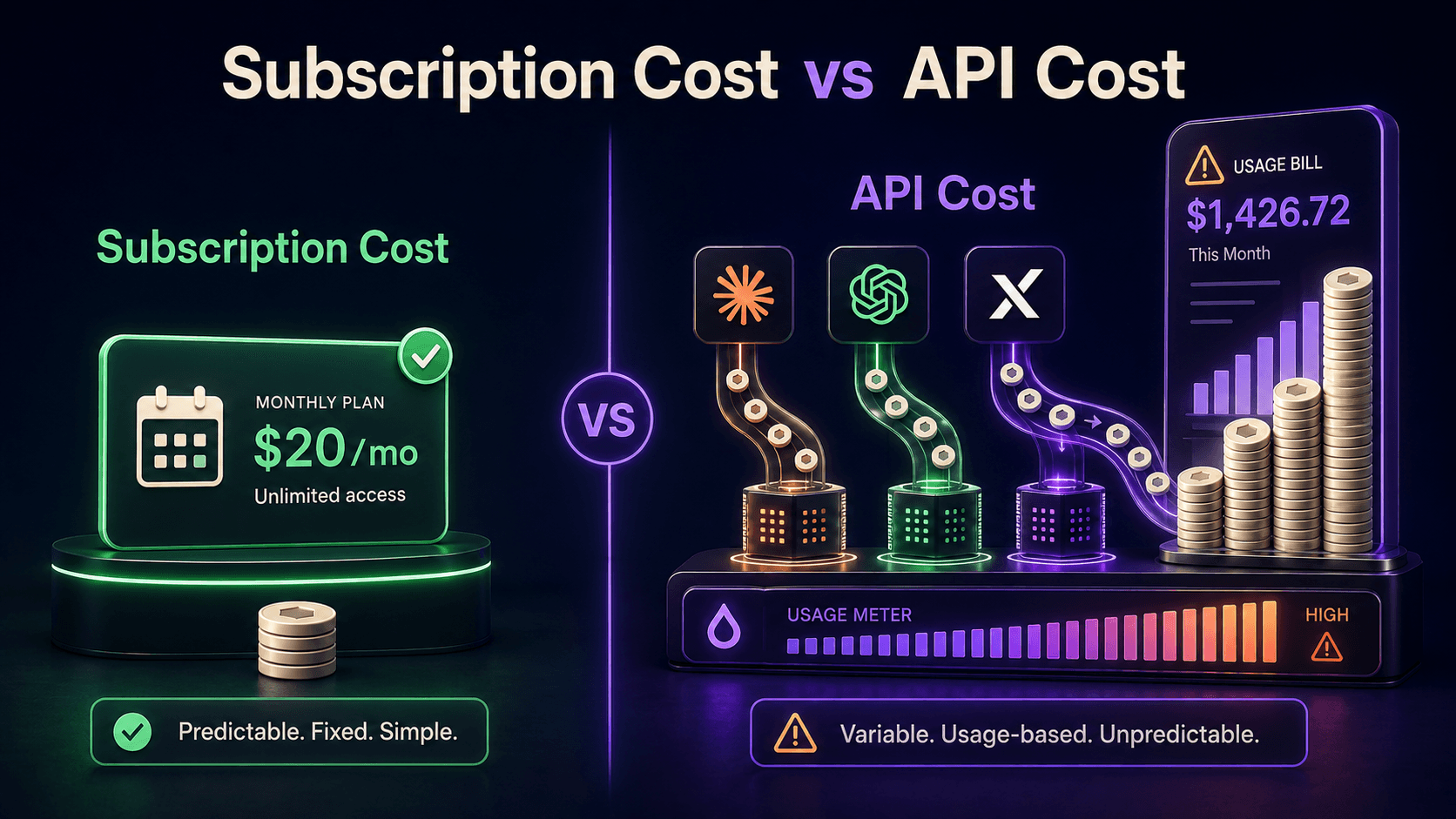
Does API Cost More Than a Subscription for Claude Opus 4.8, GPT-5.5, and Grok?
Turn Any AI Agent Into a Superagent: The 12-Integration Stack (2026)
Google Vision AI Explained (2026): Pricing Per 1,000 Units, Free Tier, and Alternatives