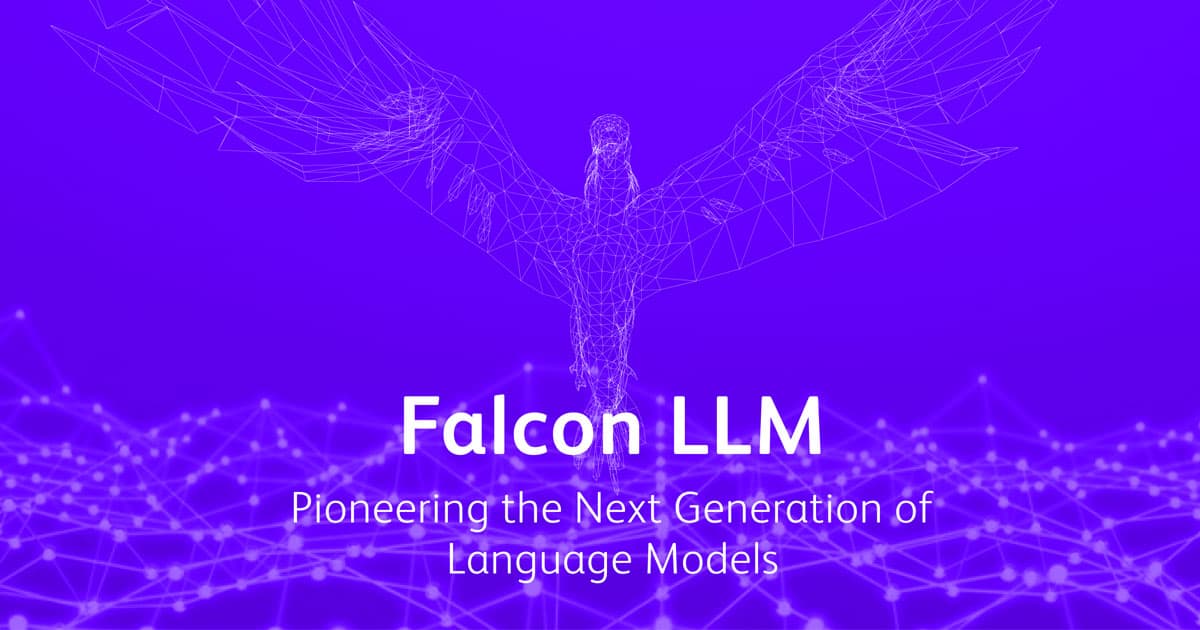
Falcon is the UAE government-backed open-weight LLM family from the Technology Innovation Institute, spanning dense transformers, Mamba state-space models, and hybrid architectures. It is the leading open-source option for Arabic NLP, free to download and self-host.
Falcon is a family of open-weight large language models built by the Technology Innovation Institute (TII), a UAE government-backed research center operating under Abu Dhabi's Advanced Technology Research Council. TII's AI and Digital Science Research Center leads development across a team of 64 researchers whose stated goal is making frontier AI accessible globally, independent of Western or Chinese lab dominance. The Falcon family runs from sub-1B edge models to a 34B hybrid flagship, all freely downloadable from the tiiuae organization on Hugging Face with no vendor subscription required.
The family spans several distinct architectures: the original dense transformer line (Falcon 1 through Falcon 3), the Falcon Mamba 7B state-space model released in August 2024, the Falcon 2 11B VLM for vision-language tasks, Falcon Arabic targeting Arabic NLP, and the Falcon H1 hybrid series launched in May 2025, which combines transformer attention with SSM layers running in parallel for up to 262K token context windows. All weights are released under TII's Falcon License (Apache 2.0-based) with an acceptable use policy, making them commercially usable with caveats discussed below.
Falcon at a glance, April 2026
The active Falcon model lines as of April 2026, with their key specifications:
Falcon 3 (Dec 2024): 1B, 3B, 7B, and 10B dense transformers. Trained on 14 trillion tokens. 32K context window. Falcon3-10B held the top position on Hugging Face's open LLM leaderboard for models under 13B parameters at launch. Base and Instruct variants, plus quantized GPTQ-Int4/Int8 and AWQ versions for memory-constrained hardware.
Falcon Mamba 7B (Aug 2024): A pure state-space model using the Mamba architecture, departing entirely from transformer attention. Seven billion parameters, constant memory overhead regardless of context length, verified by Hugging Face as the top open-source SSLM at launch.
Falcon 2 11B VLM (May 2024): Eleven billion parameters, 8K context, CLIP ViT-L/14 vision encoder integrated with the base model. Processes image and text inputs together for document understanding, image captioning, and visual Q&A tasks.
Falcon Arabic (May 2025): Seven billion parameters, built on the Falcon 3-7B backbone with 32,000 Arabic-specific tokens added to the vocabulary and a novel embedding initialization from textual similarity mapping. Achieves 32K context and outperforms dedicated Arabic models up to 4x its size on Arabic MMLU, MadinahQA, and Aratrust benchmarks.
Falcon H1 (May 2025): Hybrid architecture: transformer attention and SSM run concurrently per layer, outputs concatenated before projection. Sizes from 0.5B to 34B. Context up to 262K tokens. Available on AWS Bedrock Marketplace and NVIDIA NIM. The H1R 7B reasoning variant scored 88.1% on AIME-24 maths benchmarks.
What Falcon is actually good at
Falcon's clearest competitive advantage in April 2026 is Arabic NLP. Falcon Arabic 7B is the only purpose-built, open-weight Arabic model that consistently leads OALL (Open Arabic LLM benchmark) rankings among models under 30B parameters. It handles Modern Standard Arabic alongside regional dialects, supports retrieval-augmented generation via its 32K context window, and is genuinely free to run locally, which matters for MENA-region deployments with data residency requirements.
The Mamba and H1 hybrid lines fill a real research gap. Mamba inference is O(1) in memory regardless of sequence length, making Falcon Mamba 7B practical for long-context tasks that make transformer KV-cache growth prohibitive on smaller GPUs. Falcon H1 extends this with a hybrid design that preserves attention for local context while Mamba handles global sequence memory, producing context windows up to 262K tokens in a 7B-class model.
"Falcon 3 pushes the boundaries of small LLMs further, contributing to the open-source community by providing access to a better-performing AI. We are confident that this latest release will open an unlimited range of opportunities." -- Dr. Hakim Hacid, Chief Researcher, AIDRC/TII, December 2024
Falcon 3-10B's performance on math reasoning (83.0 GSM8K) and coding (73.8 MBPP) is competitive within its parameter class. The model family also supports quantized deployment (1.58-bit, GPTQ, AWQ) more comprehensively than many peers, targeting the laptop and edge inference use cases TII explicitly designed for.
Where Falcon breaks, the failure modes users keep hitting
The most consistent complaint from production developers is the license. TII's Falcon License is Apache 2.0-based, but it includes an Acceptable Use Policy that TII can update unilaterally and that users are required to monitor independently. This is the opposite of what "perpetual, irrevocable" license language normally implies.
"They can deny your use-case at any time without even notifying you." -- JimDabell, Hacker News, May 2024
The Hacker News thread on Falcon 2's launch saw substantial debate about whether the terms are even enforceable given the internal contradiction between irrevocable grant and modifiable AUP. In practice, most enterprise legal teams treat it as a blocker and default to Llama or Qwen instead.
A second persistent frustration is ecosystem thinness. The tiiuae Hugging Face org has 136 models published, but the downstream community of fine-tunes, LoRA adapters, quantizations, and application integrations is a fraction of what exists for Llama or Qwen. Developers building on Falcon often find they need to do work the community would have already completed for a more popular base model.
Benchmark-to-chat quality gap is the third recurring theme. Community members testing Falcon 2 and early Falcon 3 models note that leaderboard numbers look stronger than subjective chat quality, particularly for creative writing and multi-turn reasoning. One Hacker News commenter observed at Falcon 2's launch that the 11B result was "roughly on par with Mistral 7B and Llama 3 8B" despite the larger parameter count, undercutting TII's positioning claims.
Finally, rapid model churn creates build-on-what risk. TII has released six distinct architecture families since 2023: Falcon 1, Falcon 2 (with VLM), Falcon Mamba, Falcon 3, Falcon Arabic, and Falcon H1 (with the H1R reasoning variant). Each launch displaces the prior recommendation. Teams that built pipelines on Falcon 40B in 2023 found themselves with a legacy model within a year.
Falcon vs. Llama 4 vs. Qwen 3
Llama 4 (Meta): The most critical mechanical difference is architecture. Llama 4 Scout uses Mixture of Experts with 109 billion total parameters but only 17 billion active per token, reducing inference cost dramatically at scale. Llama 3-8B uses a dense transformer with 8 billion parameters, simpler to fine-tune but computationally proportional. Llama 4 trains on 40 trillion+ tokens across 200+ languages, versus Falcon 3's 14 trillion tokens with four primary languages. Llama's downstream ecosystem is the dominant factor in practice: hundreds of thousands of community fine-tunes, LoRAs, and application integrations exist for Llama models that simply do not exist for Falcon. Llama licenses (Llama 4 Community License) have their own restrictions above 700M monthly active users, but the terms are stable and predictable in a way Falcon's modifiable AUP is not. Where Falcon wins: Arabic specialization, Mamba/hybrid architectures for long-context efficiency, and smaller model tiers (1B) that Llama 4 does not currently offer.
Qwen 3 (Alibaba): Qwen 3 is the most direct competitor to Falcon on the open-weight, Apache 2.0, multilingual axis. Qwen 3 releases carry genuine Apache 2.0 licensing (no modifiable AUP), a model range from 0.6B to 235B (including MoE variants), and over 300 million downloads as of mid-2025. Qwen 3.5-9B scored 81.7 on GPQA Diamond, outperforming models with 13x more parameters. Qwen's multilingual depth covers 29+ languages with strong Chinese support; Falcon Arabic is more specialized for Arabic-first deployments but Qwen lacks an equivalent dedicated Arabic model. On code benchmarks (HumanEval, MBPP), Qwen consistently outperforms Falcon at comparable parameter counts. The core choice: Qwen for clean licensing, broader model selection, and stronger code/Chinese support; Falcon for Arabic-first applications and Mamba/hybrid architecture research.
Is the paid tier worth it?
There is no paid tier from TII. Falcon models are free to download and self-host, with no vendor API required. Third-party hosting is available through AWS Bedrock Marketplace (Falcon H1), NVIDIA NIM, and AI71 (a separate Abu Dhabi AI company), each with their own compute-based pricing.
For most users, the cost of Falcon is the compute to run it. Falcon 3-1B and Falcon H1-0.5B run on consumer GPUs and even laptop CPUs in quantized form. Falcon 3-10B requires a mid-range GPU (RTX 3090 or equivalent) for fp16 inference, or can run quantized on 8GB VRAM. Falcon H1-34B needs a multi-GPU setup or a cloud instance.
The practical cost tradeoff versus hosted API services (OpenAI, Anthropic) favors Falcon for high-volume, cost-sensitive Arabic NLP applications where a hosted equivalent would be expensive and may not match Falcon Arabic's benchmarks in that language domain.
Best use cases (and when to skip it)
Reach for Falcon when: you are building Arabic-language applications (Falcon Arabic 7B is the strongest open-weight option in its class), you are researching or deploying non-transformer architectures (Mamba, H1 hybrid), you need a sovereign or UAE-governed model for regional compliance reasons, or you are targeting edge/offline inference with quantized small models (Falcon 3-1B, H1-0.5B).
Skip Falcon when: your legal team needs stable, predictable open-source terms (the modifiable AUP blocks enterprise adoption), you need a large community ecosystem of adapters and fine-tunes (Llama or Qwen have far more), you are building primarily in Chinese or code-heavy tasks (Qwen outperforms Falcon on both), or you need a single model serving 200+ languages natively (Llama 4 trained across more languages than any Falcon 3 model).
Getting started with Falcon
All Falcon models are available at huggingface.co/tiiuae. The Falcon 3-7B-Instruct model is the recommended starting point for general chat use: 14T token training, 32K context, compatible with the Llama architecture for easy framework integration (Hugging Face Transformers, Ollama, llama.cpp). For Arabic applications, Falcon-Arabic-7B-Instruct is the dedicated choice. For long-context or memory-constrained deployments, Falcon H1-7B is the current recommended option.
TII maintains a hosted playground at falconllm.tii.ae for interactive testing without local setup. For production self-hosting, Falcon 3 models are compatible with standard quantization tooling (GPTQ, AWQ, llama.cpp GGUF), and TII publishes pre-quantized checkpoints including a 1.58-bit variant for extreme memory constraints.
Review the Falcon License and Acceptable Use Policy at falconllm.tii.ae/terms-and-conditions.html before building commercial applications. Given the modifiable AUP, legal review is recommended for any embedded or hosted product use.
User Reviews
No reviews yet. Be the first to share your experience!
Sign in to write a review.
Featured in collections
Curated lists that include Falcon.
Related articles
Guides and articles related to Falcon.
Nous Hermes 4: The Self-Hosted Open-Weight Agent Brain (2026)
Grok 4.3 API for Agents (May 2026): Pricing, Benchmarks, Migration
Google Vision AI Explained (2026): Pricing Per 1,000 Units, Free Tier, and Alternatives
Run Open Source AI Models Locally: Battle-Tested Guide
Mistral Medium 3.5 Self Host: 77.6% SWE-Bench on 4 GPUs (2026)