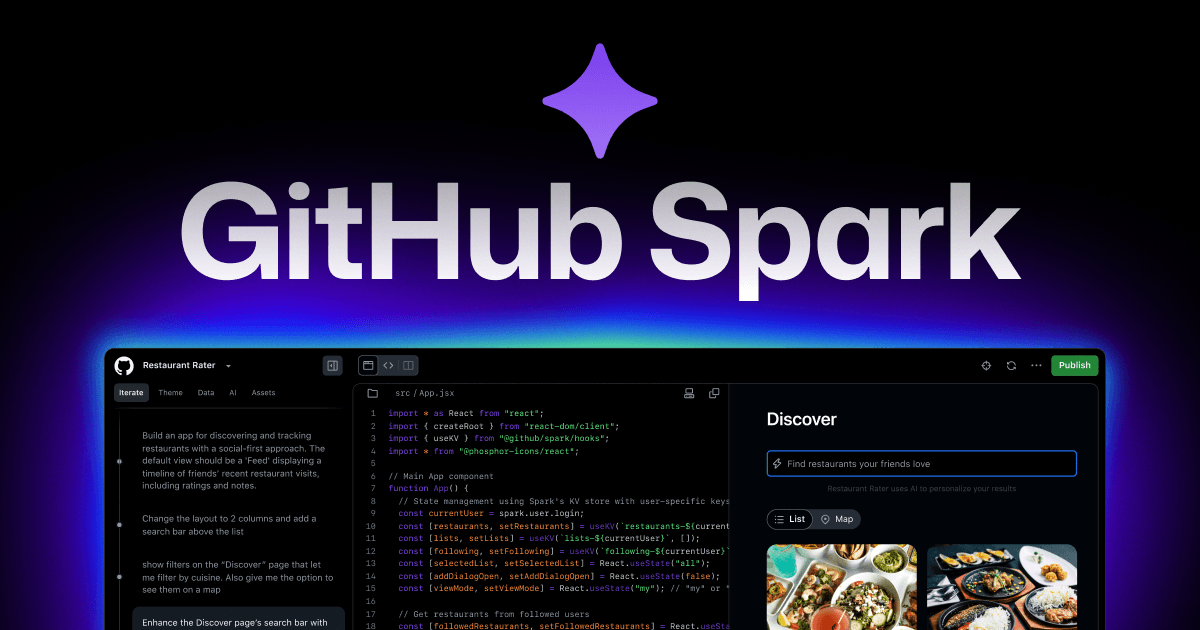

GitHub Spark is GitHub's AI micro-app builder, announced at GitHub Universe 2024 and in public preview since July 2025. Describe your app in plain language, get working React/TypeScript code with hosted deployment, bundled inside a Copilot Pro+ subscription at $39/month. ---
Inside a GitHub-authenticated team, spinning up an internal status dashboard used to mean wrangling a cloud console, configuring a domain, and writing at least a few hundred lines of boilerplate before anyone saw a UI. GitHub Spark changes that sequence: describe the tool you want in plain language, and within minutes a working full-stack React app is running on Microsoft Azure with GitHub login baked in. No DNS, no deployment pipeline, no npm install on your local machine. That frictionless path from idea to deployed URL is the core bet Spark makes, and in the narrow context where it lands well, it lands very well.
Announced at GitHub Universe on October 29, 2024, Spark took until July 2025 to reach public preview for Copilot Pro+ subscribers, and September 2025 to open for Copilot Enterprise. As of April 2026 it is still in public preview, not generally available. The platform generates React/TypeScript frontends backed by a managed key-value store, handles GitHub OAuth authentication, and exposes user-selectable models including Claude Sonnet, GPT-4o, o1-preview, and o1-mini. Apps (called "sparks") are PWAs deployable from the Spark dashboard and accessible on desktop and mobile. An escape hatch to GitHub Codespaces lets developers pull the generated code into a full dev environment when the micro-app grows past Spark's scope.
What GitHub Spark can actually ship in April 2026
The honest answer in April 2026 is: small, self-contained tools for GitHub-authenticated audiences. A habit tracker shared with a team. An internal link manager. A lightweight dashboard that reads from a key-value store and displays status. A prototype with a clean UI that you can hand off to Codespaces or a local IDE once it needs relational data or custom auth.
What stands out technically is the quality of the generated UI. Simon Willison, who reverse-engineered Spark's own system prompt in July 2025, noted the 5,000-word system prompt is "absolutely top tier," covering design principles including typographic excellence and spatial awareness. The result is apps with strong default aesthetics, micro-interactions, and pixel-perfect component rendering. For throwaway tools, that visual quality out of the box is genuinely ahead of most no-code competitors.
The functional scope is more limited than the keynote suggested. Persistent data works through key-value storage, not relational tables. No SQL, no complex queries, no many-to-many relationships. Storage entries cap at roughly 512 KB. The shared-by-default datastore also means any user with app access can read, write, and delete other users' data unless the developer explicitly isolates records. For anything beyond personal or small-team utilities, this is a real constraint.
Where GitHub Spark shines, and where it silently hurts you
Spark's sharpest edge is zero-infrastructure deployment for GitHub-native teams. The managed runtime provisions web servers, applies SSL, configures security headers, and handles Azure hosting automatically. For a team that lives inside GitHub and needs internal tooling without a devops budget, the one-click publish cycle is genuinely useful. The auto-generated GitHub repository with Actions and Dependabot is a thoughtful detail that makes the generated code a real artifact, not a black box.
The failure modes are specific and worth knowing before you commit. The key-value store's security model caught attention from technical reviewers: Willison documented that without careful per-record isolation, the store "can be read, updated and deleted by anyone with access to the app." GitHub's managed runtime also wraps a proprietary library, `@github/spark`, which cannot be installed outside the platform. If you deploy a spark and later need to move it elsewhere, you're rewriting the storage and model integration layers, not just copying files.
"I have been a loyal Spark user since day 1 and now my access is terminated" mid-project due to premium usage limits. GitHub Community Discussions user, 2025
Deployment-level rate limiting is a separate pain point. Users have documented HTTP 429 errors during app publishing that persist for hours, even after extended inactivity. GitHub support confirmed the limits originate from Spark activity and stated that "API limits cannot be adjusted," directing affected users to community forums. The message quota (375/month for Pro+) is also easier to exhaust than it sounds during heavy iteration sessions.
Language and framework support: the reality check
Spark supports React and TypeScript. That is the complete list. No Vue. No Svelte. No Angular. No Next.js server-side rendering. No Remix. No native mobile apps. Community discussion threads document users requesting Rails, Angular, and Svelte support, receiving confirmation that only React/TypeScript is available, with no public roadmap for expansion as of April 2026.
The React-only constraint is a deliberate choice: GitHub uses the opinionated stack to ensure generated code is professional-grade and portable. That reasoning is sound for the escape-hatch use case. But it means Spark is not a fit for teams with existing Vue or Svelte codebases who want to prototype in the same ecosystem, and it rules out any situation requiring SEO-optimized server-side rendering, since all Spark output is client-side rendered.
External npm packages can technically be added, but compatibility is not guaranteed by the platform. The shadcn v4 component library is pre-installed and powers the strong default UI quality. Adding packages that conflict with the managed runtime dependencies is an unsupported path.
A real workflow: using GitHub Spark on an internal admin tool
A product manager on a GitHub Enterprise team needs a lightweight sprint tracking tool, accessible on mobile, visible only to team members. The Copilot Pro+ subscription is already paid. The workflow: open Spark, describe the tool ("a sprint tracker where my team can log tasks, mark them done, and see a progress bar for the week"), select Claude Sonnet, and iterate through three or four prompts refining the UI and data model. Total time: under 30 minutes to a deployed URL behind GitHub auth.
The team accesses it as a PWA from any device. Data persists in Spark's managed key-value store. Nobody configured a database, a server, or a deployment pipeline. For this specific use case, the stack is invisible in the best way.
The same PM later needs to add Slack notifications when tasks are marked done. This is where Spark hits its current ceiling: no webhook integrations, no OAuth to external services beyond GitHub. The tool goes to Codespaces, a developer extends the generated code manually with a webhook call, and the spark becomes a regular GitHub repo. The escape hatch works, but it is an escape hatch, not a feature of Spark itself.
"Spark asserts success even though the UI remains broken" despite requests to fix bugs and integrate APIs. GitHub Community Discussions user, 2025
Security, licensing, and code leakage
Spark generates a real GitHub repository for every app, which means the code is yours, versioned, and inspectable. This is a meaningful advantage over tools that hide generated code entirely. GitHub's DPA coverage for Spark began October 27, 2025, giving enterprise customers contractual data protection coverage.
Privacy concerns about Microsoft's use of prompts and generated code for model training are similar to those for any GitHub Copilot product. Enterprise plans carry the additional data handling guarantees under the GitHub Copilot Enterprise agreement. For personal or small-team use on Pro+, the standard Copilot terms apply.
The key-value data security issue noted above is worth emphasizing in a production context: the managed store does not isolate user data by default. The platform's system prompt is designed to encourage per-user key namespacing, but enforcement depends on the generated code, not the infrastructure. Any sensitive user data stored in a spark accessible to multiple users requires careful review of the generated storage logic.
GitHub Spark vs. Lovable vs. Bolt.new
The three tools share a natural-language-to-app premise but diverge substantially on execution targets, database capability, and framework flexibility.
Lovable (Supabase-first, full-stack) auto-provisions a full PostgreSQL backend for every workspace: tables, row-level security policies, auth flows, and client-side code all generated from a single prompt. Lovable supports Vercel, Netlify, and custom hosting with full code export and ownership. Auth options include OAuth, email, and social logins. At $25/month starter, it costs $14/month less than Spark's bundled price. The Supabase integration is the decisive mechanical difference: if your app needs relational data, joins, or complex queries, Lovable is the direct path and Spark is a workaround at best.
Bolt.new (WebContainers, broader frameworks) supports 50+ JavaScript frameworks (React, Vue, Next.js, Svelte, Remix) and the full npm ecosystem, plus Expo for mobile-native output. Deployment targets include Netlify, Vercel, AWS, and custom Node.js hosts. Bolt's "diffs" feature updates only changed code rather than rewriting full sections, giving it a speed edge in rapid iteration. The free tier offers 1 million tokens/month; Pro is $20/month, with token rollover. Spark at $39/month is meaningfully more expensive, bundled with Copilot features that may or may not be relevant to every user's workflow.
Where Spark wins the comparison: GitHub ecosystem integration (Codespaces handoff, Actions, Dependabot, GitHub auth out of the box), zero infrastructure surface area, and the quality of default UI design. For teams already paying for Copilot Pro+ who need GitHub-authenticated internal tools, Spark is the lowest-friction option. For anything that needs relational data, external auth, or deployment flexibility, Lovable and Bolt.new cover ground Spark cannot yet reach.
Pricing for solo devs, teams, and enterprise
GitHub Spark is available exclusively through GitHub Copilot subscription tiers. There is no standalone Spark purchase option and no free tier.
Copilot Pro+: $39/month (or $390/year), includes 375 Spark messages/month, unlimited manual edits, 10 active building sessions, unlimited app creation. Intended for individual developers.
Copilot Enterprise: $39/user/month, includes 250 Spark messages/month per seat, same session and app creation limits, plus DPA coverage, dedicated billing SKU visible in org dashboards, and granular budget controls per Spark activity. Intended for organization-wide deployment.
The 375-message limit is the usage ceiling most individual users hit first during active development. Messages are consumed by each AI generation request; manual edits (typing directly in code or the visual editor) do not count against the quota. Heavy iteration across multiple sparks in a single billing period can exhaust the quota in under two weeks. No mechanism exists to purchase additional messages above the plan limit without upgrading plans.
For teams already subscribed to Copilot Pro+ for code completion and Copilot Chat, Spark is included at no additional charge, which changes the cost calculus significantly: if the Copilot subscription is already a line item, Spark is free to try. For teams evaluating Copilot Pro+ solely to access Spark, the $39/month is roughly double Bolt.new's Pro tier and $14/month above Lovable's starter.
``` ---User Reviews
No reviews yet. Be the first to share your experience!
Sign in to write a review.
Related articles
Guides and articles related to GitHub Spark.

Replit Pricing Explained (2026): Core vs Pro and Effort-Based Agent Billing

AI Security Tools for Small Teams (2026): The Stack That Doesn't Need a SOC

What People Are Building With Claude Fable 5 (And Which Viral Demos Are Fake)

The Personal AI Productivity Stack (2026): One Tool Per Job, Nothing Extra
Coding Ate Enterprise AI (2026): The $4B Use Case, Anthropic’s Share, and Seat vs API Math