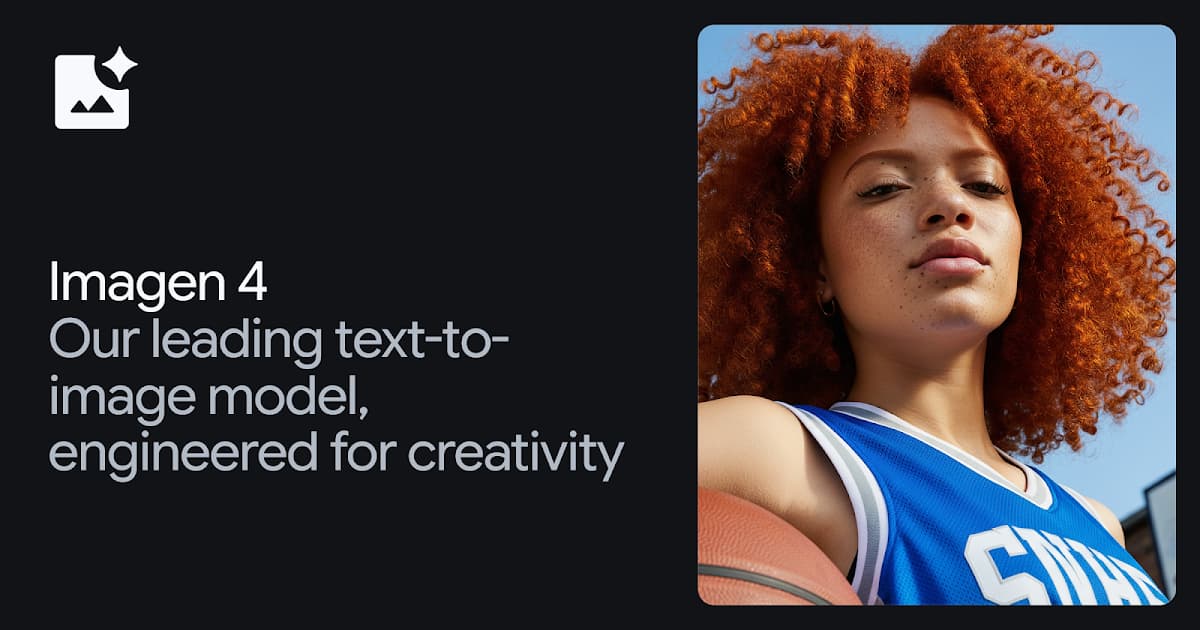

Google Imagen 4 is Google DeepMind's text-to-image model, offering the strongest in-image text rendering of any major AI image generator. Accessible free via Google AI Studio or as a paid tier through Gemini Advanced and Vertex AI.
Google Imagen is the image generation model family developed by Google DeepMind. The current production version, Imagen 4, launched at Google I/O on May 20, 2025, and replaced Imagen 3 across Google's consumer and enterprise products. It powers the Gemini app's image generation, Google Workspace integrations in Docs and Slides, the (now-closing) ImageFX Labs tool, and is available to developers through the Vertex AI API. The model is built as a Latent Diffusion Transformer, using T5 as its primary text encoder, and every output is watermarked with SynthID, Google's imperceptible pixel-level watermark for AI content provenance.
Imagen 4 ships in three tiers: Imagen 4 Fast (generates in approximately 2.7 seconds at $0.02 per image via API), Imagen 4 standard ($0.04/image), and Imagen 4 Ultra ($0.06/image) for maximum detail and prompt adherence. The model supports up to 2K resolution, generates four image variants per prompt by default, and handles a wide range of styles from photorealism to oil painting, claymation, and sketch. Its headline technical capability is in-image typography: rendering legible text inside complex compositions at a level that exceeds DALL-E 3 and matches or beats FLUX for practical commercial use cases like social banners and signage.
What Google Imagen generates in April 2026
As of April 2026, the Imagen 4 family is the production backbone for image generation across Google's product stack. Imagen 4 Fast is designed for high-volume, speed-sensitive workflows; the standard Imagen 4 handles the bulk of consumer and professional generation; and Imagen 4 Ultra is reserved for cases where prompt adherence and maximum visual detail justify the higher per-image cost.
Resolutions go up to 2048x2048 (2K), and the model handles aspect ratios of 1:1, 4:3, 3:4, and 16:9 natively. Style coverage is broad: photorealism with accurate material rendering (glass, fabric, water, skin tones), photographic styles (35mm, macro, depth-of-field cues), illustration, and a range of art styles specified through natural language. The model's most differentiated technical capability remains text rendering: generating readable, correctly spelled text inside images, whether short labels on product packaging, full sentences on posters, or menu-style typography at small font sizes. This makes Imagen 4 the practical choice for marketing-adjacent use cases where every competing model historically struggled.
Consumer access runs through multiple surfaces. Free image generation is available in Google AI Studio's browser interface, with quotas between 500 and 1,000 images per day depending on server demand (though in practice, free users report being limited to as few as 10-20 during peak periods after Google's quota reductions in December 2025). The Gemini app provides free tier access with restrictions on people generation in some regions. Paid tiers unlock higher priority and full people generation. Note: Google announced in early 2026 that ImageFX, the standalone Google Labs image tool, will shut down on April 30, 2026, with image generation migrating to a new platform called Flow.
On the developer side, the Vertex AI API and Gemini API support Imagen 4 with straightforward per-image pay-as-you-go pricing. All outputs include the SynthID watermark, which is embedded in the pixel data rather than as a visible overlay.
Where Google Imagen sits versus DALL-E 3 and FLUX
The two most relevant mechanical comparisons for Imagen 4 are DALL-E 3 (OpenAI's image model, now embedded in ChatGPT's GPT-4o) and FLUX (Black Forest Labs' open-weight model family).
Versus DALL-E 3: DALL-E 3 uses GPT-4 as a text preprocessor that rewrites user prompts before image generation, with the goal of improving compositional accuracy. This rewriting happens invisibly and cannot be disabled, which means the final image sometimes diverges from the user's exact prompt wording. Imagen 4 does not rewrite prompts. For text rendering specifically, the gap is significant: DALL-E 3 achieves roughly 60-70% text accuracy (correct spelling, readable placement) in community benchmarks, while Imagen 4 reaches above 90% and handles full sentences rather than just single words. For creative narrative compositions with soft, stylized lighting, DALL-E 3 is a peer or better; for any output where legibility of text inside the image matters, Imagen 4 is the practical choice.
Versus FLUX: FLUX (currently FLUX.2, a 32B parameter rectified flow transformer from Black Forest Labs) uses flow matching rather than cascade diffusion, with a dual-stream attention mechanism that processes image and text tokens in separate streams before merging them. This architecture achieves near-peer text rendering compared to Imagen 4 and delivers strong prompt adherence. The key mechanical difference is access: FLUX.1 Schnell is Apache 2.0 open source and self-hostable with no content restrictions. FLUX.1 Dev is available for non-commercial research. The FLUX ecosystem on Hugging Face includes thousands of community-trained LoRA adapters for specific styles, subjects, and domains. Imagen 4 has no equivalent fine-tuning ecosystem, no open weights, and runs only through Google's infrastructure. FLUX is the correct choice for anyone who needs style customization, offline use, or prompts that Google's safety filters would block.
"Really impressive. The fonts were readable and aligned well." - Aisha Imtiaz, AllAboutAI editor, text rendering review, November 2025
"The censorship tends to be a little crazy sometimes" - user Katje, Google AI Developers Forum, September 18, 2025
Real cost of running Google Imagen
The pricing structure has two distinct modes depending on whether you are a consumer or a developer.
Consumer access is bundled into Google One subscriptions. The free tier gives access to Imagen 4 generation with restrictions (people generation is limited or blocked by region; quotas are unpredictable). The lowest paid tier with full image generation capability is Gemini Advanced at $19.99/month, which also includes 2TB Google One storage and Workspace integration. The Google AI Plus tier at $7.99/month provides 200 monthly AI credits that can be used for image generation, but the access level is more restricted than Gemini Advanced.
Developer access through Vertex AI is strictly pay-per-image with no subscription required. The rate is $0.02 per image for Imagen 4 Fast, $0.04 for Imagen 4 standard, and $0.06 for Imagen 4 Ultra. Image upscaling costs $0.06 per image. The free API tier allows 2 images per minute, which is impractical for any production workflow; upgrading to Tier 1 (link a billing account, no minimum spend) raises that to 10 images per minute.
For reference, generating 1,000 images at the standard API tier costs $40. At the Fast tier it drops to $20. These rates are competitive with DALL-E 3 API pricing and lower than Midjourney's per-image equivalent on subscription plans.
Free (Gemini / Google AI Studio): $0/mo, limited Imagen 4 access, restricted people generation in some regions, unpredictable quota (500-1,000 images/day advertised, typically less during peak)
Google AI Plus: $7.99/mo, 200 monthly AI credits for media generation, 200GB storage, enhanced Gemini model access
Gemini Advanced (Google One AI Premium): $19.99/mo, full Imagen 4 access including people generation, high-priority generation, 2TB Google One storage, Workspace integration (Docs, Slides, Vids)
Google AI Ultra: $41.66/mo (billed $124.99/3 months), 25,000 monthly AI credits, highest-tier Gemini model access, 30TB storage
Vertex AI API (pay-per-image): $0.02/image (Imagen 4 Fast), $0.04/image (Imagen 4 standard), $0.06/image (Imagen 4 Ultra), no monthly subscription required
Where Google Imagen reliably fails
The safety filter is the most commonly cited friction point. Google applies content moderation at two stages: the prompt input and post-generation image review. Users report that identical prompts succeed in one interface (the Gemini web app) while being silently blocked via the API. The refusals arrive without specific explanation, just a generic block message. This inconsistency and opacity frustrates developers building production pipelines and creators working in edge cases that should clearly be benign. The pattern traces back directly to the February 2024 controversy that forced Google to pause people generation entirely and redesign its moderation layer with a more conservative posture.
On quality, Imagen 4 improved significantly over Imagen 3 in most areas, but the launch in mid-2025 produced a wave of user complaints, particularly on r/Bard. Multiple threads labeled it "Worse Than Imagen 3" for portraits, citing "blurry, grainy, or distorted results especially in human faces." These complaints were prominent enough to be compiled in review publications by November 2025. Skin textures in photorealistic outputs can trend toward the smooth, plastic look that has been an Imagen-family criticism since Imagen 3.
Anatomical consistency in complex scenes remains an issue. Multiple human subjects in a frame, small faces in the background, fine details on hands, and intricate geometry (circuit board microtext, jewelry filigree, crowded interiors) all produce artifacts more frequently than in simpler compositions.
The model has no in-painting, out-painting, or regional masking capability in any consumer interface. This is a significant gap compared to competitors: FLUX.1 Kontext supports in-context image editing; Midjourney offers vary-region masking; even DALL-E 3 supports inpainting via the API. If you need to fix a specific element in an image without regenerating everything, Imagen 4 cannot do it natively.
Finally, the quota reliability on free and lower paid tiers is poor. Google reduced free tier image quotas by 50-80% in December 2025 without prominent announcement. During peak hours, users on free tiers sometimes find they have effectively zero capacity.
Who Google Imagen is for, and who should pick something else
Imagen 4 has a clearer value proposition than almost any other image model: it is the best choice for anyone generating images with embedded text. Social media managers producing banners, marketers building promotional graphics, content creators designing thumbnails with typography, and document workers who want image generation without leaving Google Workspace all benefit directly from Imagen 4's core strength. It is also the obvious choice for teams who are already paying for Google One or Gemini Advanced and want to avoid an additional subscription to Midjourney or another tool.
For developer teams building image generation pipelines on a cost basis, the Vertex AI API pricing is competitive and the SynthID watermarking is useful for compliance and AI content labeling requirements.
Skip Imagen 4 if your work requires granular image editing. The absence of in-painting, masking, or regional control makes it unsuitable for photo retouching workflows. Skip it if your content reliably triggers Google's safety filters without good reason. Skip it if community-driven style development matters: there are no public LoRA fine-tunes, no community model hub, no shared presets. FLUX with its Hugging Face ecosystem is dramatically more community-rich. Skip it if you need to run image generation locally or offline. And if you primarily generate anime-style, stylized illustration, or highly specific artistic genres, the fine-tuned Stable Diffusion and FLUX communities will produce better on-target results than any Google model.
User Reviews
No reviews yet. Be the first to share your experience!
Sign in to write a review.
Related articles
Guides and articles related to Google Imagen.
Google Vision AI Explained (2026): Pricing Per 1,000 Units, Free Tier, and Alternatives
AI Fashion Prompts That Stay Consistent: The Working Formula (2026)
Freepik AI Is Now Magnific: What Changed, What It Costs, and Whether to Stay (2026)
AI Video Generator Prompting: The Filmmaker's Real Workflow
Best AI Fashion Model Generators for Clothing Brands (2026)