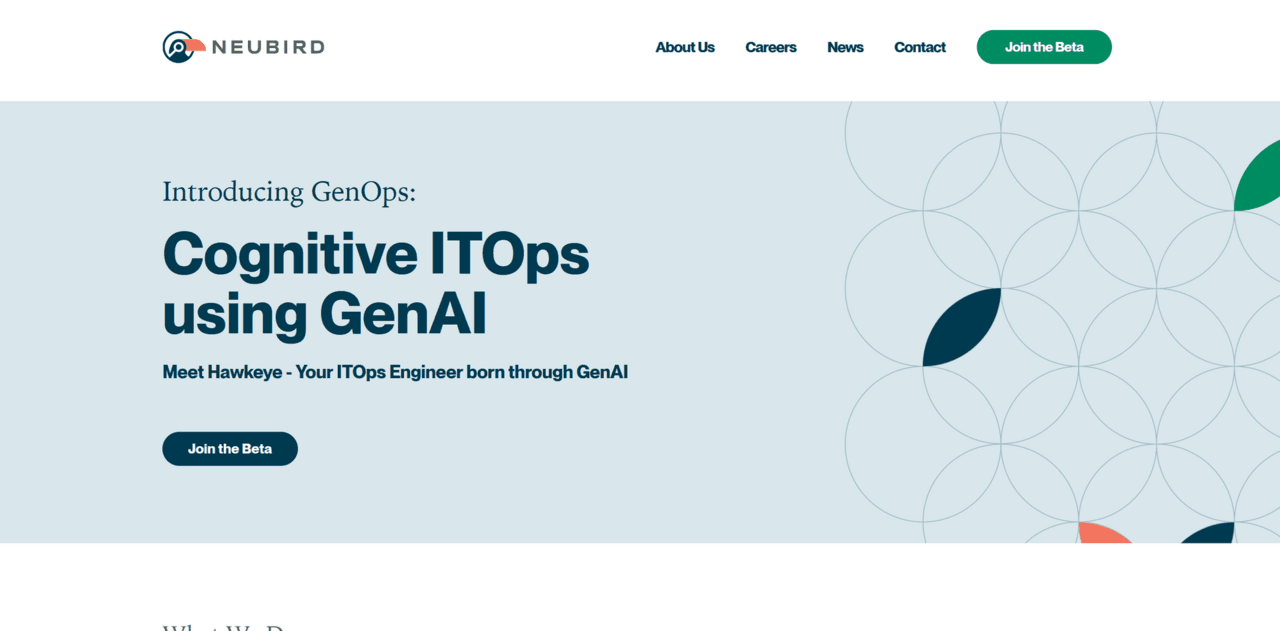

NeuBird is an AIOps observability platform that automates incident root cause analysis. It starts at $25 per investigation but requires broad cloud access.
What is NeuBird?
Why do teams still spend hours manually grepping logs during a Kubernetes crash? NeuBird fixes exactly this problem by automating root cause analysis. Built by NeuBird Inc., this AIOps observability platform targets DevOps engineers managing complex cloud-native architectures. The tool connects to AWS, GCP, Azure, and existing monitoring agents to analyze failing microservices. Think of it like a warehouse management system tracking thousands of individual pallets across multiple distribution centers to find exactly where a supply chain bottleneck occurred.
The platform functions as an automated digital investigator. It ingests distributed traces and generates accurate root cause summaries. This eliminates the manual toil of switching between different monitoring dashboards during an active outage.
- Primary Use Case: Automating root cause analysis for Kubernetes pod crashes and service failures.
- Ideal For: Cloud-native DevOps teams and Site Reliability Engineers managing highly distributed microservices.
- Pricing: Starts at $25 (Pay-as-you-go). This low-cost entry point makes it accessible for small teams.
Key Features and How NeuBird Works
Hawkeye AI Agent and Investigation Triage
- Rapid Correlation: The Hawkeye agent starts analyzing logs, metrics, and traces across stacks within 60 seconds of an alert. This speeds up initial triage drastically.
- Log Summarization: It condenses thousands of log lines into short readable sentences. (These summaries are highly accurate for standard database timeouts but occasionally hallucinate on niche custom application errors).
- Production Load Handling: Under heavy production load, the API handles thousands of concurrent traces without severe rate limiting. This ensures reliability during massive cascading outages.
Multi-signal Correlation and Integrations
- Simultaneous Data Ingestion: The platform pulls data simultaneously from Datadog, New Relic, and CloudWatch. This provides a unified timeline of events across disconnected systems.
- Deep API Integration: The integration depth allows the agent to read highly specific configuration changes in real-time.
- Security Permissions: It requires broad read-access permissions across your entire cloud environment. Which brings us to. This broad access requirement will definitely trigger a lengthy security audit.
Natural Language Querying and Automated Runbooks
- Plain English Queries: Users can ask performance questions in natural language instead of writing complex PromQL statements. This lowers the technical barrier for junior engineers.
- Automated Post-mortems: The tool generates step-by-step remediation guides for every detected incident automatically. This saves senior developers hours of manual documentation work.
NeuBird Pros and Cons
Pros
- Reduces Mean Time to Resolution rapidly with the Hawkeye AI agent performing initial triage in under 60 seconds.
- Lowers the technical barrier for junior engineers by translating natural language queries into complex PromQL automatically.
- Ingests data natively from established tools like Datadog, New Relic, and CloudWatch without requiring custom scripts.
- Saves DevOps teams hours of manual post-mortem writing by automatically generating detailed incident runbooks.
Cons
- Demands broad read-access permissions to cloud environments, which severely complicates security audits for compliance-heavy teams.
- Suffers a massive price jump from the pay-as-you-go tier to the $480 monthly Starter plan.
- Requires manual verification for AI-generated insights during highly complex, undocumented edge cases.
- Fails to support legacy on-premise systems adequately due to its strict focus on cloud-native environments.
Who Should Use NeuBird?
- Cloud-Native DevOps Teams: They will get the fastest mean time to resolution reductions using the built-in integrations.
- Junior SREs: They benefit heavily from natural language querying to avoid writing complex SQL or PromQL during high-stress outages.
- Legacy On-Premise Enterprise Teams: NeuBird is entirely unsuited for these organizations. It optimizes heavily for cloud environments and struggles with older, disconnected mainframes.
NeuBird Pricing and Plans
NeuBird utilizes a freemium model with a highly flexible entry point. The Pay-as-you-go plan costs $25 per investigation. This base tier includes core monitoring and standard runbook generation. Here is where it gets interesting. This per-incident pricing provides incredible value for highly stable systems.
The cheapest dedicated paid tier is the Starter plan at $480 per month. This tier includes 20 investigations per month, automated triage, and multi-signal correlation. But. The massive price jump from $25 to $480 limits accessibility for mid-sized startups running volatile staging environments.
Finally, the Enterprise plan requires a custom quote. It introduces custom volume tiers, multi-region support, and a dedicated success team. The free trial is fully functional, allowing teams to test the API quality directly against production loads before purchasing.
How NeuBird Compares to Alternatives
Shoreline.io offers better automated remediation capabilities natively built into its platform. NeuBird relies heavily on generating runbooks for engineers to execute manually. Plus. Shoreline targets larger enterprise deployments directly with custom execution scripts. NeuBird provides a much simpler setup process for mid-market teams.
BigPanda acts as a broader event correlation engine for massive IT operations. NeuBird focuses much deeper on microservice code-level root cause analysis rather than just grouping alerts. BigPanda handles legacy infrastructure significantly better than NeuBird. So. Teams migrating slowly to the cloud might prefer it. Still. BigPanda costs significantly more upfront.
The Right Pick for Cloud-Native Teams on AWS, GCP, or Azure
NeuBird shines when pointed at a fully modern Kubernetes environment. The Hawkeye agent accurately diagnoses common pod crashes fast while maintaining high API reliability under production load. The catch: Teams with strict data security requirements might reject the necessary read-access API permissions. On the flip side. Teams relying entirely on on-premise servers should skip this completely. They should look at BigPanda instead to handle their legacy incident correlation efficiently.
User Reviews
No reviews yet. Be the first to share your experience!
Sign in to write a review.
Related articles
Guides and articles related to NeuBird.

The Personal AI Productivity Stack (2026): One Tool Per Job, Nothing Extra
Google Vision AI Explained (2026): Pricing Per 1,000 Units, Free Tier, and Alternatives
AI User Testing in 2026: The Tools That Test Your Product While You Sleep
AI Security Tools for Small Teams (2026): The Stack That Doesn't Need a SOC
How AI Agents Work: Architecture & Implementation Guide (2025)