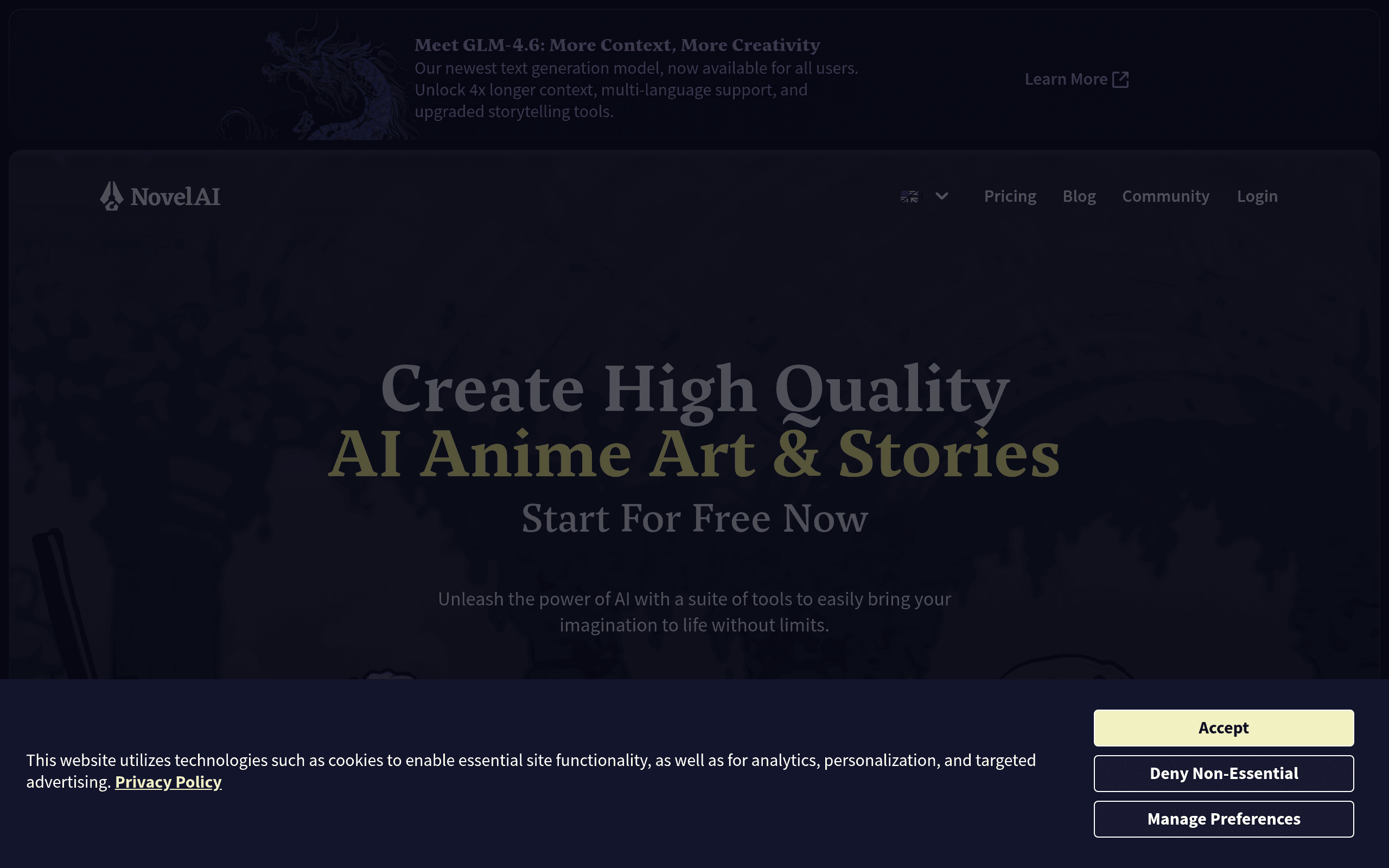

NovelAI is an unfiltered creative writing assistant and image generator built for fiction authors. It uses a 13B parameter model trained specifically on literature to produce high-quality prose. While its Lorebook maintains excellent character consistency, mastering the advanced generation settings requires a steep learning curve.
What is NovelAI?
Unlike mainstream language models that refuse dark themes or adult content, this fiction generator operates completely without censorship filters while storing all stories locally via end-to-end encryption. Developed by Anlatan Inc., NovelAI functions as an AI writing assistant and image generator. It solves the problem of generic, robotic prose by using a 13B parameter model named Kayra, trained specifically on literature. Fiction authors and interactive text-adventure players form its primary audience.
Here is where it gets interesting.
Users can draft long-form novels, generate anime-style character illustrations, or play RPG-style games from a single interface. But. The platform relies entirely on web access. It lacks a native mobile application for offline writing.
- Primary Use Case: Drafting unfiltered long-form fiction with persistent world-building details.
- Ideal For: Fiction authors writing dark or mature themes who require absolute privacy.
- Pricing: Starts at $10 per month (Tablet plan). This is a competitive entry point considering it includes unlimited text generations.
Key Features and How NovelAI Works
Narrative Control and Memory
- Lorebook: A structured database storing character profiles and locations. It forces the AI to reference specific details during writing. (Setting up a new character profile often takes twenty minutes before you even start writing).
- Context Window: The Opus plan offers up to 8,192 tokens of memory. This maintains long-term narrative consistency across multiple chapters.
- AI Modules: Pre-set style filters mimic authors like Edgar Allan Poe. Users can also fine-tune the prose style by uploading personal writing samples.
Custom AI Models
- Kayra Model: A 13B parameter model trained specifically on literature. It avoids the robotic tone common in general-purpose assistants. (You will notice the AI rarely uses generic transition words when drafting dialogue, a common flaw in standard models).
- Tokenizer: A custom-built tokenizer handles creative writing nuances. It processes fiction formats more efficiently than standard LLMs.
Multimedia Generation
- Image Generation: Custom-trained Stable Diffusion models create character art and environmental concepts. High-resolution outputs consume Anlas currency quickly.
- Text-to-Speech: Over 20 distinct AI voices narrate stories. Users can adjust pitch and speed for audiobook creation.
Privacy and Interface
- End-to-End Encryption: All stories are encrypted locally on the user device. The developers cannot access your content.
- Adventure Mode: A specialized UI offers RPG-style gameplay. It uses ‘Do’, ‘Say’, and ‘Story’ input modes for interactive sessions.
NovelAI Pros and Cons
Pros
- Unfiltered content allows for NSFW and dark themes without any censorship blocks.
- Local encryption ensures that user stories are never accessible to the company or third parties.
- The Lorebook system provides better character and world persistence than generic chat-based AIs.
- Models fine-tuned specifically on fiction avoid the robotic tone of general-purpose assistants.
- Users can purchase Anlas currency separately for image generation without needing a high-tier subscription.
Cons
- Mastering the Lorebook and advanced generation settings requires significant time and experimentation.
- High-resolution image generation consumes Anlas quickly. This gets expensive on lower-tier plans.
- The AI can still lose track of complex plot logic in very long sessions.
- The platform is web-based only. It lacks a dedicated mobile application for offline writing.
Who Should Use NovelAI?
- Solo fiction authors: Writers drafting long-form novels benefit from the 8,192-token memory and Lorebook character tracking.
- NSFW and dark fantasy writers: Authors exploring mature themes need the completely unfiltered generation capabilities.
- RPG enthusiasts: Players wanting a dynamic dungeon master can use Adventure Mode for interactive text-based games.
- Visual novel creators: Developers needing both prose generation and anime-style character art get both tools in one subscription.
- Privacy-conscious users: Writers who refuse to store unencrypted drafts on corporate servers rely on the local encryption.
- NOT for casual bloggers: Users looking for quick SEO articles or marketing copy will find the fiction-trained models frustrating and overly descriptive.
NovelAI Pricing and Plans
The Paper tier acts as a free trial rather than a usable free plan. It limits users to 50 text generations, 30 image generations, and 100 TTS generations for a one-time use. So. Users must upgrade to the Tablet plan at $10 per month to do any serious work. This cheapest paid tier provides unlimited text generations, 3,072 tokens of memory, and 1,000 monthly Anlas for image creation.
The Scroll plan costs $15 per month. It doubles the memory to 6,144 tokens while keeping the 1,000 monthly Anlas limit. Which brings us to the Opus plan. At $25 per month, it maximizes memory at 8,192 tokens and grants 10,000 monthly Anlas. Plus. Opus users get unlimited small image generations and access to experimental features.
The catch: High-resolution image generation drains Anlas quickly. Users on lower tiers often need to purchase Anlas currency separately to continue generating art.
How NovelAI Compares to Alternatives
Similar to AI Dungeon, NovelAI offers a dedicated text-adventure mode for RPG gameplay. But. NovelAI focuses heavily on high-quality prose and complex world-building for serious authors. AI Dungeon leans more toward casual, gamified experiences with less emphasis on literary style.
Unlike Sudowrite, which uses mainstream models with strict content filters, NovelAI operates completely unfiltered. Sudowrite provides a more intuitive interface for outlining and rewriting specific story beats. On the flip side, NovelAI requires users to manage the Lorebook manually to maintain story logic.
HoloAI serves as another budget-friendly fiction generator. Both platforms offer encrypted, unfiltered writing. Still. NovelAI pulls ahead with its custom 13B Kayra model and integrated Stable Diffusion image generation. This makes it a more complete package for visual novel creators.
Is NovelAI Worth It for Fiction Authors?
NovelAI delivers unmatched privacy and creative freedom for serious storytellers. The custom Kayra model produces literature-quality prose that avoids the sterile tone of standard assistants. Solo authors writing dark fantasy or mature romance get the most value here. The lack of censorship filters means your drafts remain entirely under your control.
Casual users needing quick marketing copy should look elsewhere. The interface demands patience. Setting up the Lorebook requires real effort before the AI starts generating accurate character interactions.
If you write unfiltered fiction and need strict privacy, NovelAI is the pick. If you want an intuitive outliner with pre-built story beats, Sudowrite is the better call.
User Reviews
No reviews yet. Be the first to share your experience!
Sign in to write a review.
Related articles
Guides and articles related to NovelAI.

Perplexity AI Tutorial: Maximize Your Research Workflows
The Personal AI Productivity Stack (2026): One Tool Per Job, Nothing Extra

How to Get an AI Model Wearing Your Clothes (Step by Step)

The AI Content Automation Stack: 7 Tools That Run a Full Blog Without a Team
AI Content Automation Services: What a Done-For-You Setup Includes (and Costs)