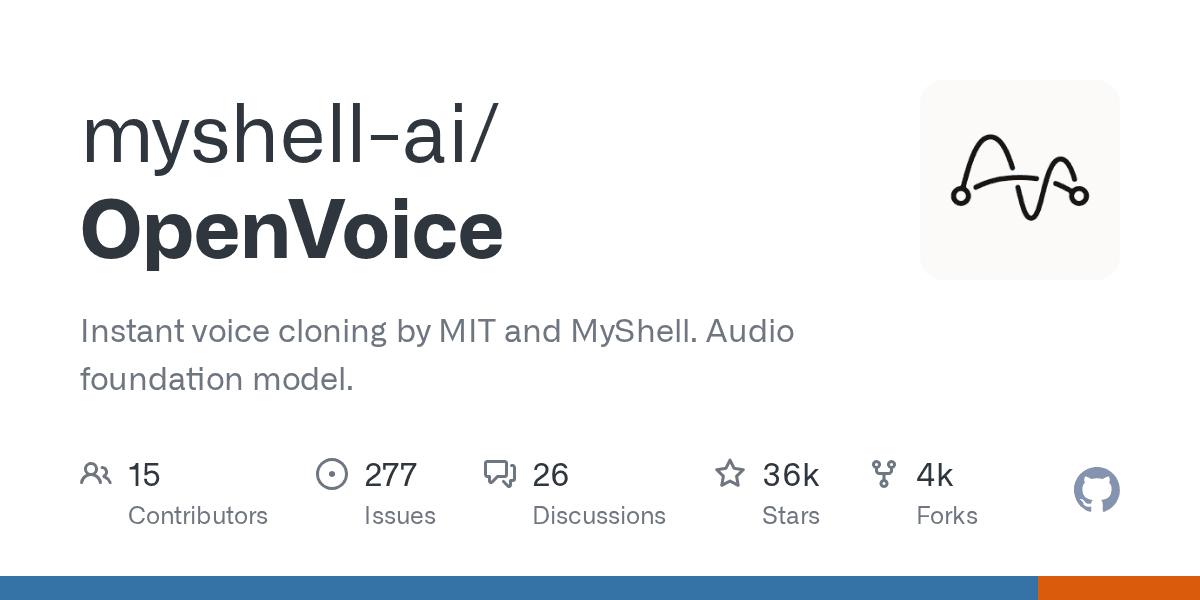

OpenVoice is an MIT-licensed instant voice cloning model from MIT and MyShell AI. It clones a voice from a short reference clip, supports English, Spanish, French, Chinese, Japanese, and Korean, and is free to use commercially with no API fees.
OpenVoice is an open-source instant voice cloning model developed jointly by researchers at MIT and MyShell AI. Published in December 2023 (arXiv 2312.01479) and improved with a V2 release in April 2024, it solves a specific problem: replicating a speaker's vocal tone from a short reference clip and generating new speech in that voice, including in languages the original speaker has never spoken. The project is backed by MyShell AI, a platform with 5M+ users that uses OpenVoice as a core voice technology, and carries a full MIT license, meaning the model weights are free for commercial use with no attribution or royalty requirements.
The V2 model natively supports English (British, American, Indian, and Australian accents), Spanish, French, Chinese, Japanese, and Korean, with zero-shot cross-lingual cloning for additional languages. Beyond tone copying, OpenVoice provides granular control over voice style: emotion, accent, rhythm, pacing, and intonation can each be adjusted independently of the base voice. The model runs locally on a CUDA-capable GPU, integrates with Python pipelines via pip, and is available as a hosted demo on HuggingFace Spaces for no-install testing. As of April 2026, the GitHub repository holds 36,400+ stars.
What OpenVoice produces in May 2026
OpenVoice V2, released April 2024, is the current stable version. It outputs synthesized speech in the cloned voice using a two-stage architecture: a VITS-based voice generator handles base TTS output, while a separate tone color converter maps the reference speaker's vocal characteristics onto that output. This separation is what enables cross-lingual cloning, the tone mapping operates independently from the language model, so a French voice can speak Japanese without the reference speaker ever having done so.
Supported languages include English (four regional accent variants), Spanish, French, Chinese (Mandarin), Japanese, and Korean. Zero-shot cloning for languages outside this set is claimed in the research paper and works with variable reliability depending on phonetic distance from training data. Style controls cover: emotion (cheerful, sad, angry, neutral, etc.), speaking rate, pitch, and intonation intensity. These controls are exposed via a Python API and in the Gradio-based local demo. The HuggingFace space at huggingface.co/spaces/myshell-ai/OpenVoiceV2 provides a no-install interface for quick testing across all six supported language pairs.
The model is computationally efficient by design. The MyShell team claims costs "tens of times less" than commercial APIs. On a mid-range NVIDIA GPU (e.g., RTX 3070), processing runs at roughly 1-2 seconds per sentence. On entry-level hardware, expect 8-12 seconds per sentence. CPU inference is technically possible but prohibitively slow for practical use due to a hardcoded CUDA default in the tone extractor module.
Where OpenVoice sits versus F5-TTS and Coqui XTTS-v2
F5-TTS uses a fundamentally different generation mechanism: flow matching, a diffusion-based approach that refines random noise iteratively into coherent speech. This produces more expressive and natural-sounding prosody than OpenVoice's VITS backbone in most side-by-side comparisons, and F5-TTS processes text in under 7 seconds while requiring just 2,994 MB GPU memory. The critical practical difference is licensing. F5-TTS code is MIT, but the pre-trained model weights are CC-BY-NC-4.0 because training used the Emilia dataset, which carries non-commercial restrictions. Building a commercially usable F5-TTS deployment requires training new weights from scratch on a permissive dataset, a significant engineering investment most teams cannot make. OpenVoice V2's MIT weights mean commercial deployment from day one.
Coqui XTTS-v2 has the broadest language support of the three: 16+ languages including German, Arabic, Polish, Turkish, and Russian that OpenVoice does not natively cover. Its streaming support and strong benchmark RTF (0.482, latency 3.36 seconds) make it competitive for real-time-adjacent applications. However, Coqui AI shut down as a company in late 2023 after failing to find a sustainable business model despite raising $3.3M in funding. The codebase is now maintained by the Idiap Research Institute as a community fork. For teams building on a long-term horizon, OpenVoice's backing from an active, funded platform (MyShell raised $11M in 2024) provides more institutional continuity than a company-defunct project maintained by academic volunteers.
In practice: choose F5-TTS for best audio quality in a non-commercial research setting. Choose Coqui XTTS-v2 if you need languages like Arabic or German and accept the defunct-company risk. Choose OpenVoice when the combination of MIT commercial weights + multilingual + reasonable quality + zero cost is the deciding criteria. For professional-grade quality without setup friction, ElevenLabs and Resemble AI are the commercial benchmarks OpenVoice is measured against, and they remain clearly ahead on naturalness and accent fidelity.
"The key weakness is syllable timing and inflection -- the system mimics a human attempting robotic speech rather than natural prosody." -- amluto, Hacker News, January 2024
"Tested with multiple audio samples. Open-source version: terrible. Absolutely terrible." -- RossDCurrie, Hacker News, January 2024
The licensing and copyright reality
OpenVoice launched in late 2023 under CC-BY-NC-4.0, a license that explicitly bars commercial use. On Hacker News, commenters immediately flagged this: "The license violates Open Source Initiative definitions requiring commercial use allowance." This was not a minor gripe; it meant any company wanting to productize voice cloning using OpenVoice was legally blocked from doing so.
In April 2024, MyShell released V2 and simultaneously relicensed both V1 and V2 to MIT. This resolved the commercial use question entirely. MIT imposes no restrictions on commercial use, modification, or distribution. The relicense triggered immediate integration activity in the open-source community, including a tracking issue in the LocalAI project titled "openvoice v1 and v2 now MIT licensed, let local ai support them." For any team evaluating OpenVoice for commercial deployment, the answer as of April 2024 is unambiguous: the weights, code, and outputs are yours to use commercially.
One nuance: the voice cloning capability itself raises separate legal questions around consent and deepfakes that MIT licensing does not address. OpenVoice, like Whisper and other audio AI tools, can theoretically be used to clone voices without the speaker's consent. This is a policy and ethics concern, not a licensing concern, but teams building consumer-facing products should implement consent verification on the reference audio input side. MyShell's own platform requires users to confirm they have rights to the reference voice.
Where OpenVoice reliably falls short
The most consistent complaint across GitHub issues, the Hacker News launch thread, and third-party reviews is accent flattening. Non-American English speakers find OpenVoice converts their accent toward American English rather than preserving it. One GitHub issue reads: "I recorded my own voice, but inference gave me an american-sounding output -- I'm British." This is a direct consequence of the training data distribution; the model has seen proportionally more American English than other English accents. Spanish, French, Chinese, and Korean outputs are generally better, but native speakers in those languages also report occasional prosody artifacts.
Local install quality consistently underperforms the hosted demo. The MyShell app.myshell.ai and HuggingFace space produce better results than a self-hosted install running identical checkpoint weights. The gap is suspected to come from different post-processing pipelines in the hosted version, but MyShell has not documented this. For teams where privacy requires self-hosting, the quality they test in the demo is not necessarily what they will get in production.
Setup friction is significant for non-Python-native teams. OpenVoice requires Python 3.9 precisely (not 3.10, not 3.11, not 3.12), a CUDA-compatible NVIDIA GPU, conda environment management, and separate installation of MeloTTS dependencies. GitHub issues document failures across conda, miniconda, Docker, and Windows installations. As of late 2025, users report errors from deprecated `pkg_resources` and `ctranslate2` version conflicts, indicating the dependency management is falling behind the Python ecosystem. The HuggingFace space is the practical entry point for evaluation; local installation is a non-trivial engineering task estimated at 2-4 hours even for experienced developers.
Real-time voice cloning is not viable. Latency is 1-12 seconds per sentence depending on hardware, which eliminates live conversation or streaming use cases. Tools like PlayHT and ElevenLabs have streaming APIs with sub-second first-token latency that OpenVoice cannot match as a self-hosted batch model.
Windows support is limited. Most GitHub issues documenting successful installs are on Linux. Windows users report additional dependency failures related to PyTorch CUDA version mismatches and torchvision incompatibilities. There is no official Docker image for V2, and community-maintained Docker solutions vary in reliability. For Windows-only teams, the HuggingFace hosted space is the more realistic path to evaluation.
Who OpenVoice is for
OpenVoice's strongest users are developers and content teams who need a commercially usable, self-hosted voice cloning baseline at zero cost. Game studios using it to generate NPC dialogue variations from a single voice actor session get the most value: MIT license eliminates legal risk, multilingual support lets one recording span markets, and high-volume generation makes per-character API fees nonviable anyway. E-learning and automated narration pipelines that can tolerate some prosody imperfection in exchange for 60-95% cost reduction versus ElevenLabs or Resemble AI APIs are another strong fit. Researchers studying voice cloning architecture will find the codebase well-documented and the MIT license enabling for derivative work. Developers building multilingual content pipelines for markets like China, Japan, or Korea benefit from V2's native coverage of those languages alongside English, Spanish, and French in a single unified model.
Skip OpenVoice when quality consistency is non-negotiable. Professional audiobook narration, character-driven podcast production, and any product where end users directly hear the output and compare it to human speech will expose OpenVoice's prosody and accent weaknesses. Non-technical users should use the HuggingFace demo or MyShell platform rather than attempting local installation. Teams that need more than six native languages and cannot accept the maintenance risk of Coqui's defunct status should evaluate commercial alternatives. For real-time voice transformation or live conversation use cases, OpenVoice is architecturally unsuited; the latency floor is too high.
User Reviews
No reviews yet. Be the first to share your experience!
Sign in to write a review.
Featured in collections
Curated lists that include OpenVoice.
Related articles
Guides and articles related to OpenVoice.
OpenAI GPT-Realtime-2 (May 2026): Pricing, Latency & 30-Min Voice Agent
Build a 70-Language Live Voice Agent With GPT-Realtime-Translate (2026)
Run Open Source AI Models Locally: Battle-Tested Guide

Nous Hermes 4: The Self-Hosted Open-Weight Agent Brain (2026)
Grok 4.3 API for Agents (May 2026): Pricing, Benchmarks, Migration