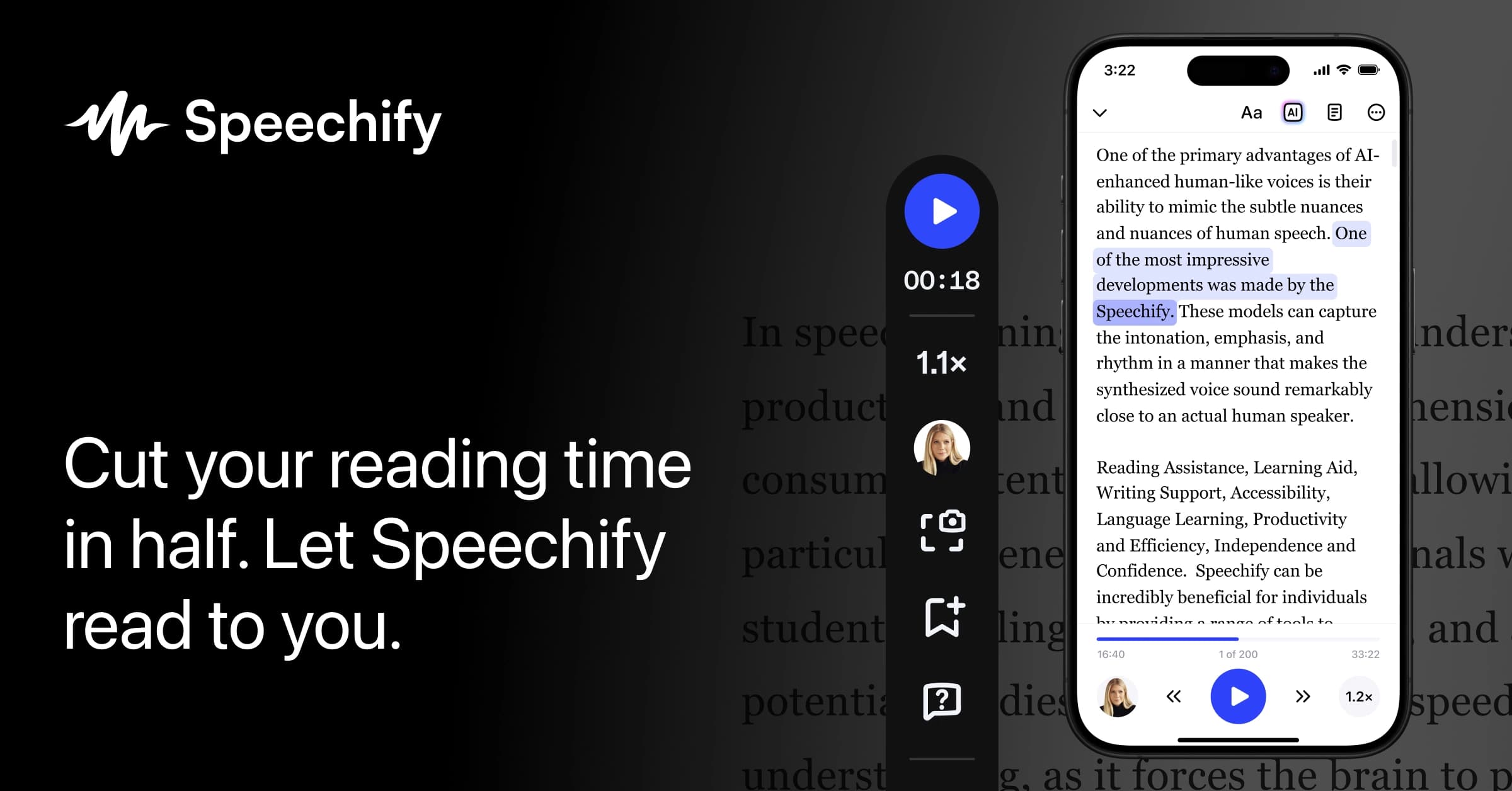
Speechify is the leading text-to-speech reading app, converting PDFs, web pages, emails, and physical text into natural AI audio. With 1,000+ voices, 5x playback speed, voice cloning, and cross-platform sync, it serves 55 million users including students, professionals, and people with dyslexia or ADHD.
Speechify is a text-to-speech platform built by Cliff Weitzman, who created the first version to manage his own dyslexia during college. Founded in 2017 and now serving over 55 million users, it converts documents, PDFs, emails, web pages, and physical text into spoken audio using AI-generated voices. It operates as two distinct products: Speechify Reader, the core accessibility and productivity reading app, and Speechify Studio, a creator-focused platform for generating voiceovers, dubbing video in 150+ languages, and building branded audio content.
The Reader app works across iOS, Android, macOS, Chrome, and Edge with seamless cross-device sync. Premium unlocks 1,000+ AI voices in 60+ languages, playback speeds up to 5x, OCR camera scanning to convert physical pages into audio, AI summaries, cloud integrations with Google Drive, Dropbox, and OneDrive, offline downloads, and a Voice AI Assistant for hands-free Q&A on any document. Speechify Studio adds voice cloning from a 20-second sample, one-click AI dubbing, 68 AI avatars, and granular pitch and tone controls for production-grade content.
What Speechify produces in April 2026
The core output is natural-sounding spoken audio from text of any kind. The Premium voice library spans 1,000+ voices including expressive neural models, HD voices, and licensed celebrity voices such as Snoop Dogg, Gwyneth Paltrow, and MrBeast. Playback speed goes up to 5x (approximately 900 words per minute), which is well beyond what any competing reading app offers for mobile use. Text highlighting follows along in real time so users can read and listen simultaneously, a feature that research consistently ties to improved retention for dyslexia and ADHD.
OCR scanning uses the phone camera to convert printed pages, whiteboards, and physical documents into audio in seconds. AI Podcasts turn any document or topic prompt into a natural two-host podcast. Voice Typing captures dictation at roughly 5x typing speed with automatic grammar correction. The Audiobooks plan adds a 60,000-title library of professionally narrated books at $9.99 per month on annual billing.
On the Studio side, voice cloning requires just a 20-second audio sample and produces a custom voice model for branded content, e-learning narration, or social video. The November 2024 Fall update expanded this to 200+ voices in 150+ languages and accents, added granular line-by-line editing of pitch, tone, speed, and pronunciation, plus automated filler word removal for cleaner production output.
"It's been a lifesaver. I can do hours of tedious book studying and take notes while the narrator continues. I speed it up to x1.5 and read a long while taking notes." - u/someones_dad, r/ADHD
Where Speechify sits versus ElevenLabs and NaturalReader
The three tools occupy meaningfully different product positions, and choosing between them comes down to whether you are consuming text or creating audio content.
ElevenLabs is a generative voice AI engine built API-first for creators and developers. Its Professional Voice Cloning achieves a 2.83% word error rate with approximately 135ms API latency, and it offers 1,200+ voices across 29 languages with a voice design lab for precise emotional tuning. ElevenLabs does not have a reading app: it has no document import, no OCR scanning, no cross-device sync, and no offline mode. If you need to output audio content for an audience, ElevenLabs produces more technically precise voice clones. If you need to consume text as audio throughout your day, Speechify's reading infrastructure wins by a wide margin. Users who need both workflows may use Speechify for daily reading and ElevenLabs for final production output.
NaturalReader is a desktop-first accessibility tool with fully offline TTS using local voice models, no internet required. It has 1,000+ voices, a Pronunciation Editor for custom word handling (useful for technical terms and names), and a more generous free tier than Speechify. The tradeoff: NaturalReader's mobile app is significantly less polished, its cross-device sync is limited, and its OCR camera scanning struggles more with complex page layouts. Speechify's SIMBA voice cloning model is also integrated across mobile in a way NaturalReader's commercial offering is not. For privacy-conscious users who work predominantly on desktop and need offline-first reliability, NaturalReader holds an edge. For everyone else using a phone as their primary reading device, Speechify's experience is more complete.
Murf AI and PlayHT are worth noting as Studio alternatives: both focus on professional voiceover production with higher voice fidelity claims, but neither offers a reading/accessibility app. AudioRead converts newsletters and web articles to podcast-style audio episodes but lacks Speechify's document scanning, OCR, and voice cloning depth.
The licensing and copyright reality
Speechify's Premium and Studio subscriptions include commercial use rights for generated audio, meaning voiceovers and cloned voices created within paid plans can be used in published content, ads, and e-learning courses. The Speechify API at $10 per million characters includes commercial licensing for business integrations.
Voice cloning raises the most important legal question: Speechify requires users to certify that they have the right to clone a voice before creating a custom voice model. Cloning another person's voice without consent violates Speechify's terms of service and, depending on jurisdiction, may violate emerging AI voice impersonation laws. The platform added consent warnings as part of the Speechify 3.0 rollout in February 2024.
Celebrity voice licenses (Snoop Dogg, MrBeast, Gwyneth Paltrow) are available for personal listening only. Using celebrity voices in commercial content is not permitted under any Speechify plan. This is an important boundary for content creators who discover celebrity voices on the Premium plan and assume they can use them for YouTube narration.
Where Speechify reliably falls short
The free plan is intentionally limited to the point of discouraging use. Ten robotic-sounding voices, a 1.5x maximum speed, a five-file library cap, and no offline or OCR features means the free tier functions more as a demo than a viable tool for anyone with a real reading workload. This is a deliberate conversion strategy that frustrates users who encounter it via accessibility recommendations before realizing the best-in-class experience requires $11.58 per month.
Billing practices are a persistent concern. Speechify carries an F rating with the Better Business Bureau as of 2025, with over 80 documented complaints. The most common issue: users start a three-day free trial, the trial auto-converts to a full annual subscription at $139 (or more for older price points), and cancellation on mobile is reportedly not available, requiring desktop or tablet access. A May 2025 Reddit thread documented a $229.99 charge after a user received what appeared to be a cancellation confirmation email. The mobile cancellation gap is especially problematic because the product's primary audience, accessibility users, skews heavily toward phone-only interactions.
Premium voices have a monthly word limit (1,000,000 words per month under 2025 policy). Users who hit this cap are dropped to the robotic-sounding basic voice library for the rest of the billing period. For students doing heavy-volume listening sessions on medical or law textbooks, this cap can be reached in three to four weeks of intensive use.
OCR is useful but not flawless. Complex table layouts, mathematical formulas, handwriting beyond basic print, and low-resolution scans all cause recognition failures. PDF handling produces intermittent arbitrary pauses. Kindle integration has a known bug where reading stops after a paragraph in some editions. Battery drain during long listening sessions is reported on current-generation iPhones.
"I like how seamless and natural the premium voices sound." - u/Winter-Ad6197, r/Dyslexia
Who Speechify is for
Speechify is most clearly built for people who need to consume large volumes of text but struggle with sustained silent reading. Students in high-reading-load programs (medicine, law, grad school) represent the core use case: importing PDFs from Google Drive, scanning physical textbooks with OCR, and listening at 2x-3x speed during commutes or exercise. People with dyslexia, ADHD, or low vision benefit from the combination of highlighted text scrolling in sync with audio, which research supports as beneficial for both comprehension and retention.
Knowledge workers with heavy article and document reading loads use Speechify as a background "reading while doing" tool: listening to research papers or long email threads during walks or routine tasks. The Voice AI Assistant adds a layer of utility by letting users ask questions about a document without pausing the audio. The Gmail integration, introduced with Speechify 3.0 in February 2024, extends this to the inbox, so professionals can process email by ear during non-screen time.
Content creators use Speechify Studio for faceless YouTube channels, e-learning courses, and multilingual content. The one-click dubbing into 150+ languages at a price point far below professional translation services makes it practical for mid-size creators targeting international audiences. Studio's 68 AI avatars and stock media library round out a production workflow that previously required separate tools for script narration, visual presentation, and translation.
Older adults and people transitioning away from heavy screen time also represent a growing segment. The clean mobile UI, large text controls, and ability to listen to long-form news and books without squinting at a screen make Speechify functional as a general-purpose listening companion, not just a productivity tool for professionals.
Skip Speechify if you primarily read on desktop and need a fully offline tool with local voice models for sensitive documents: NaturalReader handles that better. Skip it if you need professional-grade voice cloning for character voices in games, films, or high-production podcasts: ElevenLabs produces more precise results. Skip it if billing friction or subscription management is a concern for your organization: the BBB complaint pattern suggests the trial-to-paid conversion is an ongoing problem that Speechify has not resolved at scale.
"I've been using Speechify for college for about a year now and decided the premium package was well worth the cost because I struggle to sit down, focus, and read. And the voices make a huge difference." - Em Ma, Trustpilot
User Reviews
No reviews yet. Be the first to share your experience!
Sign in to write a review.
Featured in collections
Curated lists that include Speechify.
Related articles
Guides and articles related to Speechify.

The Personal AI Productivity Stack (2026): One Tool Per Job, Nothing Extra
Google Vision AI Explained (2026): Pricing Per 1,000 Units, Free Tier, and Alternatives

Perplexity AI Tutorial: Maximize Your Research Workflows
Undetectable AI Review (2026): What It Does, What It Costs, and 7 Alternatives
OpenAI GPT-Realtime-2 (May 2026): Pricing, Latency & 30-Min Voice Agent