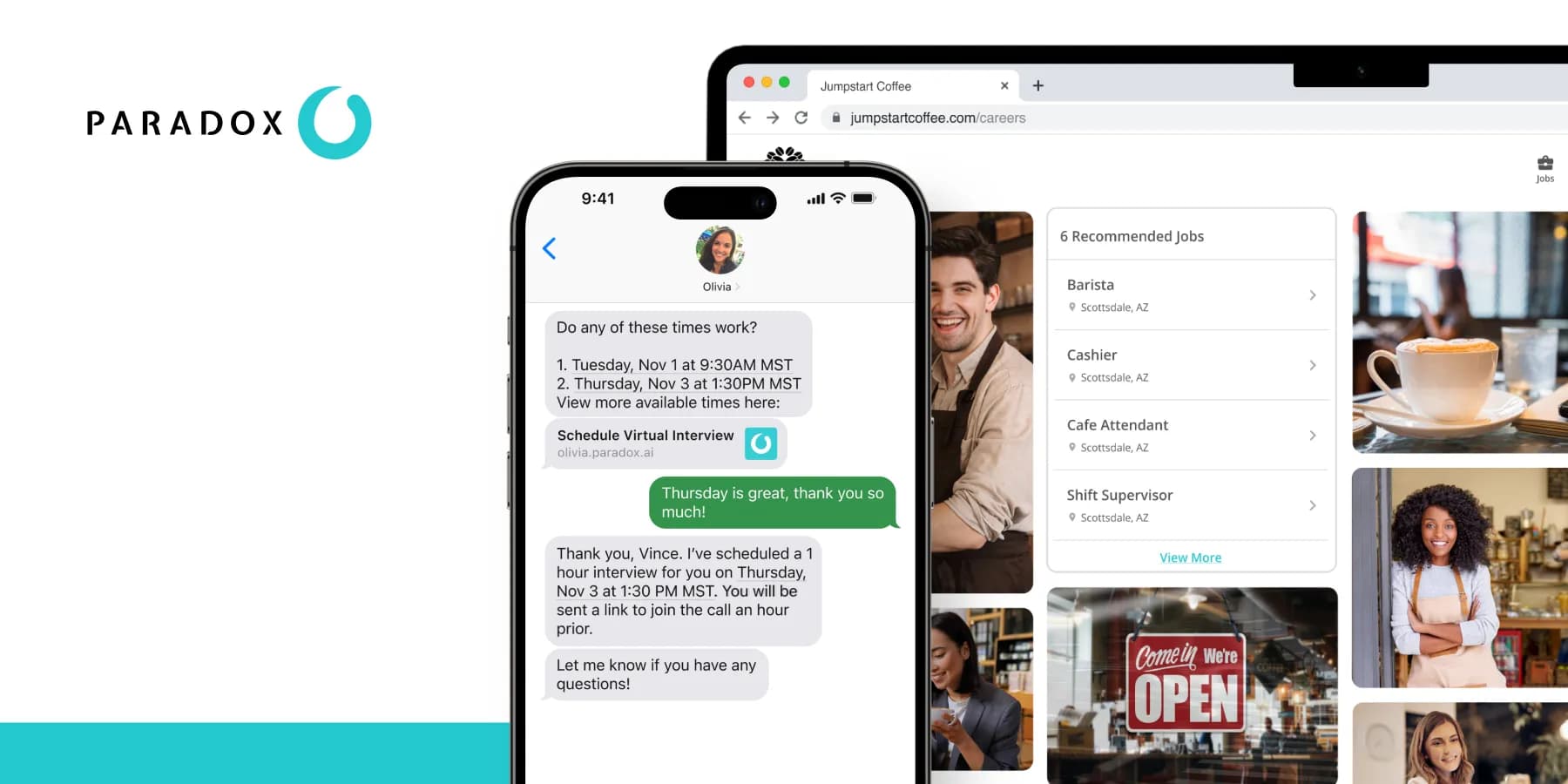

Paradox is an enterprise conversational AI platform for high-volume hiring. Its AI assistant, Olivia, automates candidate screening, interview scheduling, and follow-up via SMS and web chat, helping companies like Chipotle and GM cut time-to-hire by 75%.
Paradox is a Scottsdale-based enterprise software company that builds conversational AI for recruiting, founded in 2016 by Aaron Matos. The platform centers on an AI assistant named Olivia, which handles the repetitive, high-volume tasks that consume recruiting teams: answering candidate questions around the clock, collecting application information via text chat, scheduling interviews against live calendar availability, and re-engaging applicants who drop off mid-process. In October 2025, Workday completed its acquisition of Paradox for $1 billion USD, making Olivia a core part of Workday's talent acquisition suite while keeping it available as a standalone product for non-Workday customers.
The platform spans six product lines: Conversational ATS (mobile-first application flow via SMS or web chat), Conversational Scheduling (automated calendar matching), Conversational CRM (pipeline nurturing and candidate re-engagement), Conversational Career Sites (live chatbot on careers pages), Conversational Screening (NLP-based pre-qualification), and Conversational Events (hiring event logistics). Olivia supports 100+ languages and connects with 200+ enterprise systems including SAP SuccessFactors, Oracle Taleo, ADP, Workday, Indeed, Microsoft Teams, and Slack. As of May 2026, the platform has powered more than 189 million AI-assisted candidate conversations across 500+ enterprise customers.
What Paradox AI actually is in May 2026
Paradox sits at the top of the hiring funnel. Where most ATS platforms assume a recruiter is managing every interaction, Paradox assumes a recruiter should not have to. Olivia acts as an autonomous front-end layer: when a candidate texts a number from a "Now Hiring" sign, visits a careers page, or registers for a hiring event, Olivia handles the conversation without human involvement unless a flag is raised.
The core mechanism is NLP-based conversational qualification. Olivia collects the information required for a specific role through dynamic chat questions, checks responses against pre-set criteria, and either moves the candidate forward to scheduling or declines them with a notification. Once qualified, Olivia queries the hiring manager's calendar in real time and proposes interview slots, confirms the booking, and sends reminders to both parties. The whole cycle, from first contact to confirmed interview, can complete in under 15 minutes.
The 2025-2026 product generation introduced what Paradox calls "agentic recruiting." Olivia can now take actions without a human trigger: proactively flagging candidates who ghost a scheduled interview, surfacing warm applicants from past pipelines when a matching role opens, and re-engaging incomplete applications after a set number of days of inactivity. This shifts the tool from reactive automation to proactive pipeline management.
Post-acquisition by Workday, Paradox has deepened its integration with the Workday HCM suite. Organizations already running Workday for HR can enable Olivia directly within their existing environment, with bi-directional data sync across candidate records, requisitions, and onboarding workflows.
Where Paradox sits versus HireVue and Eightfold AI
HireVue and Paradox both target enterprise recruiting, but they operate at different stages and through fundamentally different mechanisms. HireVue's platform is built on video interview analysis: it processes 30 million+ data points per session, evaluating 100+ trait dimensions from recorded candidate interviews using behavioral signal extraction. HireVue enters the funnel after a candidate applies; its job is to assess fitness through video, not to capture the application in the first place. Paradox does the opposite: it captures, screens, and schedules at scale before a human ever gets involved, but it does not do video. Organizations running both tools typically use Paradox to fill the top of the funnel quickly and HireVue to assess shortlisted candidates for complex roles. Delta Airlines cut pilot evaluation time by 70% using HireVue's structured video assessments; General Motors saved $2 million annually using Paradox for scheduling and screening volume.
Eightfold AI takes a different approach entirely. Where Paradox optimizes throughput using conversational workflows, Eightfold's Talent Intelligence Platform operates on a proprietary skills graph trained on over 1 billion professional profiles. It uses deep learning to model career trajectory and identify latent, transferable competencies that keyword matching misses. Eightfold covers the full talent lifecycle: external recruiting, internal mobility, succession planning, and reskilling. Paradox does none of that; it is explicitly a top-of-funnel throughput and scheduling engine. Companies with complex knowledge-worker hiring use Eightfold for matching quality; companies with high-volume frontline hiring use Paradox for speed. Some enterprises run both in parallel, with Eightfold handling professional hiring and Paradox handling hourly and frontline hiring. Eightfold is used by Chevron, Vodafone, and Nutanix; Paradox by Chipotle, 7-Eleven, and Tractor Supply.
How Olivia actually works inside the recruiting process
The practical workflow begins at candidate touchpoints. Paradox deploys Olivia via a shortcode for SMS, a chat widget on career pages, and integration with job board apply flows (Indeed Apply, LinkedIn Easy Apply). A candidate texting "JOBS" to a Chipotle shortcode is immediately in an Olivia conversation: the AI collects location preference, availability, prior experience, and age verification, then presents matching openings and books an interview within the same message thread.
On the recruiter side, the interface is a dashboard showing pipeline status, interview calendars, and conversation logs. Recruiters intervene only when Olivia escalates: a candidate asking a question Olivia cannot answer, a disqualified candidate requesting a manual review, or a scheduling conflict that automated matching could not resolve. For a 300-location QSR chain, this means a five-person recruiting team can manage 10,000 applications monthly without drowning in calendar coordination.
"Olivia helped us shave our response time from 7 days to under 24 hours. You can also use Olivia when you're hosting virtual hiring events.". Derek B., Head of Recruitment, Enterprise (G2, 2024)
"The use of Paradox and the virtual recruiter Olivia has increased my interview rate, saved an enormous amount of time and drastically shortened my days from apply to offer.". Verified G2 reviewer, enterprise HR team, 2024
Analytics track 1,000+ metrics covering funnel drop-off, time-to-schedule, candidate response rates, and interview conversion. The platform generates compliance reports relevant for EEOC audits, logging every question Olivia asked and every candidate response, creating an auditable record of the screening process.
The security and reliability concerns users keep raising
The most significant incident in Paradox's history occurred in June 2025, before the Workday acquisition closed. Security researchers Ian Carroll and Sam Curry discovered critical vulnerabilities in the McHire platform, which is Paradox's AI hiring chatbot deployed for McDonald's franchise locations. An abandoned administrator test account from 2019 with the password "123456" had never been decommissioned. Combined with an IDOR (Insecure Direct Object Reference) vulnerability that allowed manipulation of applicant IDs to access other records, the flaw exposed data from up to 64 million McDonald's job applications, including names, email addresses, phone numbers, and in some cases virtual interview transcripts.
Paradox and McDonald's patched the vulnerabilities within 24 hours of disclosure and subsequently launched a bug bounty program. The incident drew coverage from CSO Online, Malwarebytes, and cybersecurity researchers at the Inland Cyber Defense Clinic. No evidence emerged of mass data exfiltration in the wild before the patch, but the scope of potential exposure (64 million records) made it one of the larger AI-adjacent security events of 2025.
Beyond the security incident, users consistently flag several operational frustrations. Automated scheduling depends entirely on hiring managers maintaining accurate calendar availability. Teams with inconsistent calendar hygiene report frequent scheduling failures and double-bookings. Olivia's conversational AI handles structured question-answer flows well but struggles with nuanced, role-specific, or location-specific questions from candidates, often looping or deflecting rather than escalating to a human. A recruiter on G2 noted: "Works well for basic screening but lacks the flexibility we need for professional roles requiring video interviews or skills assessments."
Post-acquisition uncertainty is a newer concern. Paradox is now a Workday subsidiary, and standalone customers not running Workday report uncertainty about future pricing, roadmap, and whether Workday will eventually push Paradox-only customers toward its broader platform.
Who Paradox AI is for
Paradox earns its pricing for enterprises running high-volume, repetitive hiring cycles at scale. The ROI math works when a recruiting team is processing thousands of applications monthly for frontline, hourly, or shift-based roles: fast food, retail, logistics, healthcare, hospitality, and light manufacturing. Chipotle cut time-to-hire from 12 days to 4 days. General Motors saved $2 million annually in recruiter time. 7-Eleven saved 40,000 interview-hours per week. Johnson Controls increased hire rates by 14% through timely SMS follow-ups.
Organizations already running Workday for HR get the tightest integration and the clearest path to value. SAP SuccessFactors and Oracle customers are well-served too. If your ATS is a legacy on-premise system with limited API capability, implementation will be significantly harder.
Skip Paradox if your organization hires fewer than 200 people per year. The pricing floor (estimated $12,000-$25,000/year at minimum, custom-quoted) and the 2-3 month implementation timeline do not amortize at low hiring volume. For knowledge-worker recruiting where video screening or technical skills assessment is central to the evaluation process, Paradox is the wrong tool: Olivia is text-only, and you will need a separate platform for assessment. Startups and companies without dedicated recruiting operations staff will find the implementation demands exceed their capacity.
Paradox is sometimes compared to tools like Clay for sales and outreach automation or UserTesting AI for user research synthesis. The surface similarity is workflow automation, but Paradox is narrowly purpose-built for recruiting and does not generalize. Its competitors are recruiting-specific platforms, not horizontal automation tools.
The Workday acquisition positions Paradox as the AI-native front end for one of the world's largest HR software platforms. For enterprise Workday customers evaluating talent acquisition improvements in 2026, Olivia is now the path of least resistance. For everyone else, the evaluation question remains: does your hiring volume justify the investment, and can your IT team handle a 3-month rollout?
User Reviews
No reviews yet. Be the first to share your experience!
Sign in to write a review.
Related articles
Guides and articles related to Paradox AI.
Voice Agent for Missed Calls: Every Service Business Is Bleeding Leads After Hours (2026)

How to Sell AI Chatbots to Local Businesses ($1K-$5K Retainers, 2026)

The Personal AI Productivity Stack (2026): One Tool Per Job, Nothing Extra

AI Agents for Business: What They Actually Are and 12 Things You Can Automate Today
AI User Testing in 2026: The Tools That Test Your Product While You Sleep