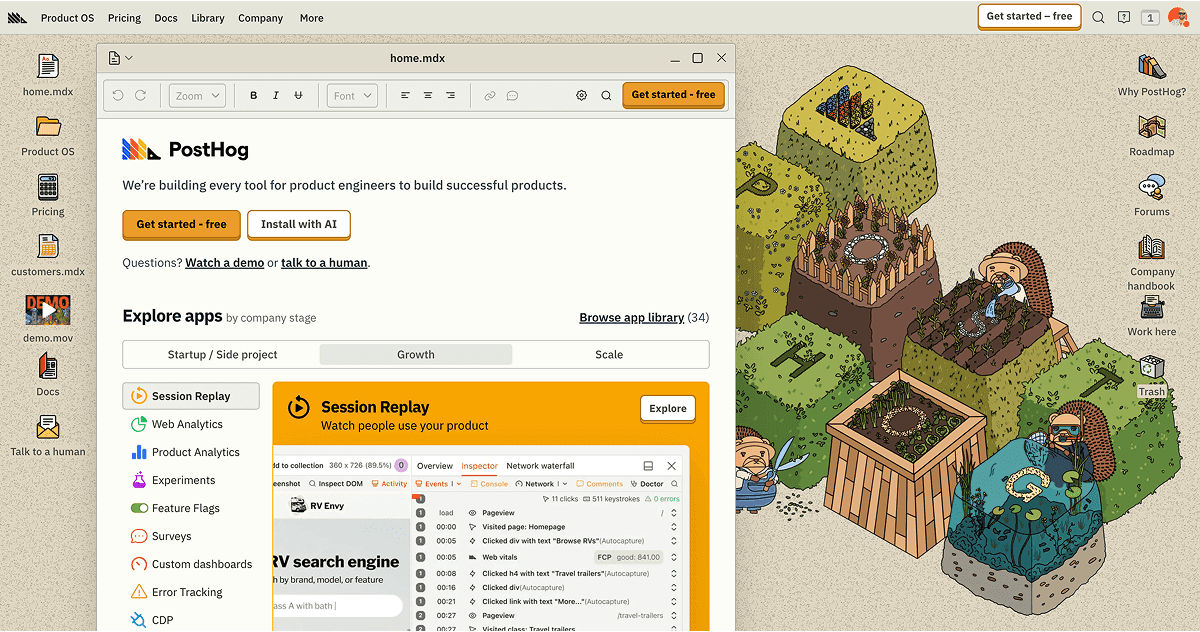

PostHog is the open-source, all-in-one analytics platform built for engineers. It replaces Mixpanel, Hotjar, LaunchDarkly, and more in a single stack, with a free tier generous enough that over 90% of teams pay nothing.
PostHog is an open-source developer analytics platform built by James Hawkins and Tim Glaser, launched through Y Combinator's W20 batch in 2020. The company's pitch is simple: every customer-related software product an engineering team needs, in one place, on one data model, with transparent pricing and no per-seat charges. Over 190,000 teams use PostHog today, including 65% of every Y Combinator batch, and the platform has grown to serve roughly 250,000 engineers worldwide.
The platform integrates product analytics, web analytics, session replay, feature flags, A/B experimentation, error tracking, user surveys, a built-in data warehouse, customer data pipelines, and LLM observability under a single SDK and dashboard. Engineers instrument once and get access to the full stack: they can write SQL directly against the data warehouse without a separate ETL pipeline, tie session recordings to specific funnel drop-offs, run A/B tests against feature flag cohorts, and now trace LLM call costs and latency alongside product behavior metrics. The core codebase is MIT-licensed with 34.2k GitHub stars; a fully FOSS version (posthog-foss) is available stripped of all enterprise code.
What PostHog actually does in April 2026
PostHog has expanded from a single-product analytics tool into what the company calls "customer infrastructure." As of April 2026, the platform ships as eight integrated products running off the same event ingestion layer:
Product analytics: trends, funnels, retention, paths, correlation analysis, and custom SQL queries. Up to 1M events/month free.
Session replay: full video recordings of user sessions with event timelines, network requests, and console logs. 5,000 recordings/month free. Desktop replay is high quality; mobile replay has known limitations.
Feature flags: percentage rollouts, user property targeting, local evaluation for zero-latency reads, early access management, and scheduling. 1M requests/month free.
A/B experimentation: statistical significance testing built directly on feature flag cohorts, with funnel and trend analysis as the primary metric types.
Error tracking: exception capture with stack traces and event correlation. 100K exceptions/month free.
Surveys: in-product micro-surveys tied to user properties and feature flags. 1,500 responses/month free.
LLM observability: captures every LLM call as a PostHog event, recording model, latency, token usage, cost, input, and output. Dashboards break usage down by model, provider, feature, user, and organization. Prompt management (beta) lets teams create and version prompts fetched at runtime. 100K LLM events/month free.
Data warehouse and pipelines: built-in columnar storage that allows direct SQL queries across all product data without exporting to a third-party warehouse. Supports data pipelines for ingestion from external sources.
The platform raised a $70M Series D in June 2025 at a $920M valuation, led by Stripe (the story behind this is worth knowing: in November 2023, Stripe CEO Patrick Collison spontaneously tweeted that PostHog's website was "very well done," which the founders used as an opening to eventually land Stripe as their lead investor). Y Combinator, GV, and Formus Capital participated. At the time of the raise, PostHog reported multiple tens of millions in ARR and 3x year-over-year growth.
Where PostHog sits versus Mixpanel and Amplitude
The three platforms compete for the same user behavior analytics budget but are architecturally quite different, and those differences have real consequences for data ownership, pricing, and team fit.
PostHog vs. Mixpanel: Mixpanel is a closed-source, cloud-only SaaS with no self-hosted option. Its data model requires routing data through an external warehouse before it can be combined with other sources, whereas PostHog's built-in data warehouse lets teams query across all product data in-place via SQL. Mixpanel charges uniformly for all events regardless of user identification status (growth plans starting around $28/month per 10K events); PostHog charges up to 80% less for anonymous user events and includes session replay, feature flags, and surveys in the same free tier. Mixpanel relaunched experimentation and added feature flags in late 2025, but those features are newer and less mature than PostHog's equivalents, which have supported local evaluation, bootstrapping, and early access management for years. The core trade-off: Mixpanel is more polished for product managers who want point-and-click reports; PostHog gives engineers direct data access and tool consolidation.
PostHog vs. Amplitude: Amplitude is also cloud-only and closed-source, processing 10+ trillion user actions monthly across regional data centers built for enterprise compliance. Amplitude's differentiation is predictive analytics and advanced user segmentation, including behavioral forecasting capabilities that PostHog does not offer. Amplitude charges per Monthly Tracked User (50K MTUs free), which can become expensive at scale compared to PostHog's event-based model. Amplitude has added session replay and heatmaps but remains analytics-first rather than engineering-infrastructure-first. The core trade-off: Amplitude serves enterprise teams that need predictive cohorts, behavioral forecasting, and strict data governance; PostHog serves engineering teams that want code-level control and don't want to pay for five separate tools.
"The depth of understanding I get about user behaviour from recordings, etc is utterly transformative. Pretty much always have a tab open. PostHog drives major decision-making." - Markham Nolan, Product Hunt, 2025
What the all-in-one platform reality looks like
In practice, adopting PostHog means instrumenting once and unlocking all eight products simultaneously. An early-stage startup can replace Mixpanel, Hotjar, LaunchDarkly, and Typeform with a single SDK integration, a single data model, and a single bill (usually zero). The event that fires when a user completes checkout is the same event that populates an analytics funnel, triggers a session replay bookmark, qualifies the user for a feature flag cohort, and counts as a conversion in an A/B test.
For AI product teams, the LLM observability layer extends this integration further. Every call to OpenAI, Anthropic, or a self-hosted model becomes a PostHog event, which means teams can build funnels combining model performance metrics with user behavior, watch session replays where users encountered slow or failed LLM responses, and A/B test prompt variants against retention metrics, all within one platform. PostHog claims this approach delivers cost tracking roughly 10x cheaper than dedicated LLM observability tools because it reuses the existing event ingestion infrastructure.
The free tier is genuinely the product, not a trial. PostHog reports that over 90% of companies use the platform entirely for free because their volume falls within the monthly limits. The pay-as-you-go tier activates automatically when a team crosses any free limit, with no upfront commitment required.
"The setup with PostHog was so easy we just kept on going, and the free tier is pretty good." - Hadar Sharvit, Product Hunt, 2025
What PostHog is not
Despite the "all-in-one" positioning, there are categories where PostHog trails purpose-built competitors:
Self-hosting at scale is harder than marketed. The self-hosted option requires running ClickHouse, PostgreSQL, Redis, Kafka, and Zookeeper, a stack that multiple engineers on Hacker News describe as impractical on hardware below 64GB RAM. One user reported their 64-core Hetzner server "running all 16 cores at 100% and didn't end up working." PostHog now recommends their managed cloud for volumes above 100K events/month. The community open-source (posthog-foss) repository exists for teams that need 100% FOSS, but the main repo includes a proprietary ee/ directory.
An October 2024 security disclosure added context: researchers found a chain of vulnerabilities in the self-hosted deployment including SSRF in webhook configuration, a ClickHouse SQL escape flaw, and default PostgreSQL credentials enabling RCE. PostHog patched the SSRF within 24 hours, and cloud customers were unaffected (cloud had SSRF protections since May 2024), but the incident highlighted the operational risks of self-hosting a complex multi-service stack without dedicated infrastructure expertise.
LLM observability is broad, not deep. Compared to Langfuse (the open-source LLM engineering platform), PostHog's LLM-specific tooling lacks mature evaluation suites, LLM-as-judge workflows, detailed trace visualization, and prompt management depth. Langfuse lists 78+ LLM-specific features. PostHog recommends using Langfuse alongside PostHog for teams with serious LLM evaluation needs, and an official integration exists. This means teams building LLM-heavy products often run both tools in parallel rather than consolidating into PostHog alone.
No predictive analytics. Amplitude offers behavioral forecasting and predictive cohorts that PostHog does not match. Enterprise teams that need to predict churn, forecast engagement, or build ML-driven segmentation will find PostHog's analytics layer insufficient.
Mobile session replay is immature. Desktop replay is a genuine product strength. Mobile recording quality is widely criticized: the experience of watching mobile app sessions involves scroll-trapping and limited fidelity compared to the web version.
The honest skip-this scenarios: non-technical teams that want a polished analytics dashboard without SQL; enterprise procurement teams that need predictive analytics and SOC2-compliant data governance; organizations that require full self-hosting at scale without dedicating engineering time to infrastructure; and teams building LLM-first products who need deep evaluation tooling rather than broad product analytics.
User Reviews
No reviews yet. Be the first to share your experience!
Sign in to write a review.
Featured in collections
Curated lists that include PostHog.
Related articles
Guides and articles related to PostHog.

Replace 6 SaaS Subscriptions With 4 n8n AI Agents (2026)

AI User Testing in 2026: The Tools That Test Your Product While You Sleep
Google Vision AI Explained (2026): Pricing Per 1,000 Units, Free Tier, and Alternatives

Replit Pricing Explained (2026): Core vs Pro and Effort-Based Agent Billing
Grok 4.3 API for Agents (May 2026): Pricing, Benchmarks, Migration