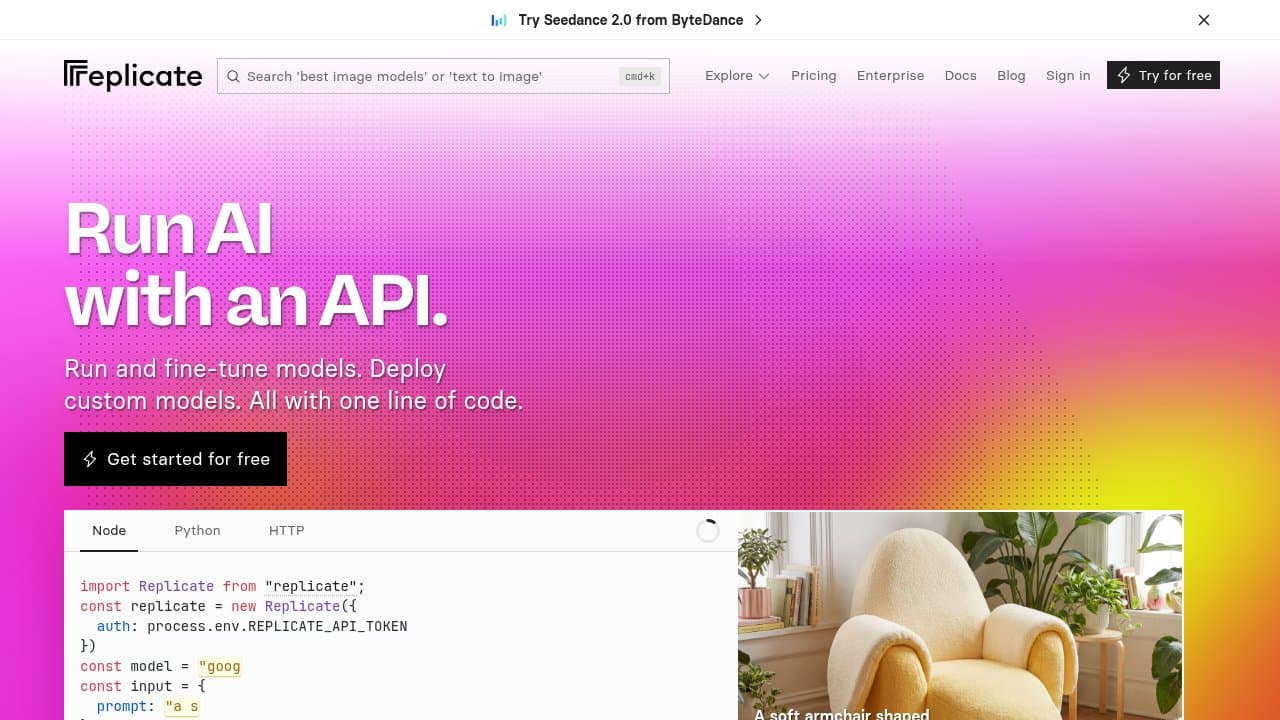

Replicate is a cloud API platform that lets developers run over 50,000 open-source machine learning models without managing GPU infrastructure. Built around Cog, its open-source model packaging tool, it covers image, text, audio, and video models on a pay-per-second billing model.
Replicate is a cloud inference platform and model marketplace built for developers who want to run open-source machine learning models via API without configuring Kubernetes clusters, installing CUDA drivers, or managing GPU servers. Founded in 2019 by Ben Firsh and colleagues, Replicate hosts over 50,000 community-contributed models packaged with Cog, its Apache 2.0-licensed containerization tool, alongside around 100 curated "Official Models" maintained in collaboration with model authors. In November 2025, Cloudflare acquired Replicate; the platform continues operating under its own brand with the API and model catalog unchanged.
The platform covers the full range of open-source AI modalities: image generation (FLUX.1 [pro], FLUX.1 [dev], Stable Diffusion XL), language models (Llama 3, Mistral), audio transcription (Whisper), and video generation. Developers integrate in minutes using Python, JavaScript, or Go SDKs and call any model with a single function. Cog, the underlying packaging tool with 9,400+ GitHub stars, lets ML researchers wrap a PyTorch model into a production-ready Docker container and publish it to Replicate's marketplace in one command. Fine-tuning on FLUX or SDXL is available directly through the platform, with fine-tuned model cold boots now under one second for supported architectures.
What Replicate actually does in April 2026
At its core, Replicate is two things: an inference API and a community model marketplace. On the inference side, it runs Cog-packaged models on cloud GPUs and bills by the second based on which hardware tier you select: T4 ($0.000225/sec), L40S ($0.000975/sec), A100 ($0.001400/sec), or H100 ($0.001525/sec). For curated Official Models, pricing is output-based: FLUX.1 [pro] costs $0.04 per image, FLUX.1 [dev] runs around $0.025 per image, and Stable Diffusion XL on an A100 comes out to roughly $0.003 per image.
On the marketplace side, anyone can publish a model to Replicate using Cog. You write a predict.py, define typed inputs and outputs, run cog push, and Replicate handles the Docker build, hosting, and endpoint provisioning. The result is a public API endpoint other developers can call. This cycle is why the catalog has reached 50,000+ models: community contributors, researchers, and companies publishing fine-tunes and novel architectures in a standardized format.
Replicate was one of the two launch partners for FLUX.1 in August 2024 (the other was fal.ai), when Black Forest Labs released the model series that quickly displaced Stable Diffusion as the community's preferred open-source image generation stack. FLUX immediately became one of the most-called model families on the platform.
In September 2023, Replicate shipped sub-one-second cold boots for fine-tuned models built on Llama 2 and SDXL, resolving one of the most-cited friction points for users running custom models. The improvement applies to models created after that date using Replicate's fast-boot fine-tune pipeline.
Where Replicate sits versus Fal.ai and Together AI
Fal.ai focuses narrowly on generative media with an architecture optimized for low-latency image, video, and audio inference. On fal.ai, FLUX.1 [schnell] can complete in under one second on warm infrastructure, and the platform's per-output pricing makes it 30-50% cheaper than Replicate for image generation workloads. Fal.ai's catalog covers around 985 curated endpoints, all maintained to production standards, and the company claims 50% market share for image generation APIs. The tradeoff: you cannot run a community-published niche NLP model or a custom Cog-packaged computer vision model on fal.ai the way you can on Replicate.
Together AI is purpose-built for LLM inference with per-token pricing rather than per-second GPU billing. Llama 70B on Together AI costs approximately $0.90 per million tokens versus roughly $2.75 per million tokens on Replicate: a 67% cost advantage for text workloads. Together AI also offers dedicated GPU endpoints, batch processing, and fine-tuning specifically for language models. The ceiling is narrower: Together AI is text-first and does not host community image, audio, or video models. Replicate wins on breadth; Together AI wins decisively on LLM price-performance.
The positioning is clear: Replicate is the widest catalog (image, text, video, audio, community niches all in one API) with middle-of-pack pricing. Fal.ai is faster and cheaper for media generation. Together AI is cheaper for language models. Neither alternative offers the same model diversity or the community publishing workflow that Cog enables.
"Replicate has really long boot times for custom models - 2/3 minutes if you are lucky.. we actually find replicate to be an amazing platform [but] you pay a lot of $ for a single request." - moscicky, Hacker News, February 2024
What the developer workflow reality looks like
The typical onboarding path takes under an hour. Install the SDK (pip install replicate), set your REPLICATE_API_TOKEN environment variable, and call a model:
import replicate
output = replicate.run(
    "black-forest-labs/flux-dev",
    input={"prompt": "a red fox in snow"}
)
For public, well-warmed models like FLUX.1 [dev], the first call returns in 3-10 seconds. For less-frequently-called community models or large custom Cog deployments, cold starts can reach 2-4 minutes. Replicate's founder acknowledged this directly on Hacker News in February 2024: "Yeah, our cold boots suck." Progress has been made for fine-tunes (sub-one-second for supported architectures) but cold start remains the platform's most-discussed limitation for large custom models.
For developers publishing their own models, the Cog workflow is where Replicate's value becomes tangible. You define inputs and outputs with Python type annotations, and Cog generates an OpenAPI schema and a high-performance HTTP server (Rust/Axum backend). Running cog push builds a Docker image, uploads it, and provisions an API endpoint automatically. Model versioning is built in: every push gets a unique ID for reproducibility, and callers can pin to specific versions.
Webhooks handle async inference for long-running jobs. Server-Sent Events enable real-time streaming for text generation. The web playground at replicate.com lets you test any model's parameters in a browser before writing code, which is useful for scoping what inputs a model actually accepts.
"replicate is also very hard to predict costs on, I've found their salespeople are reluctant to make any predictions" - dcsan, Hacker News, February 2024
Who Replicate is built for
Replicate is built for developers who need to run AI models without becoming ML infrastructure specialists. The clearest fit is solo developers and small teams building AI-powered applications: image editors, transcription tools, custom chatbots, creative apps. The pay-per-second model with no upfront cost works well for applications with low or unpredictable traffic volume, where provisioning dedicated GPU instances would be wasteful.
ML researchers and model authors who want to publish their work benefit from Cog and the community marketplace. Replicate gives a model an API endpoint, a web playground, and an audience without the researcher running any servers. The FLUX fine-tune workflow is specifically useful for teams building personalized image models without managing training infrastructure.
Prototyping across multiple modalities is another strong use case. If a product team needs to evaluate text generation, image generation, and speech transcription options before committing to a stack, Replicate lets them test all of these through one API with one account rather than signing up for three separate specialized platforms.
What Replicate is not
Replicate is not the right choice for production LLM workloads at scale. If your application is primarily text generation at volume, Together AI's per-token pricing is 50-70% cheaper, and the infrastructure is purpose-optimized for language models. Replicate's per-second GPU billing becomes expensive relative to token-priced alternatives the moment LLM inference is your primary workload.
It is not a low-latency media API. For image generation pipelines where sub-second response time matters, fal.ai's architecture is faster and cheaper. If you are building a real-time generative app where the user expects image results in under two seconds on a cold call, Replicate's cold start behavior is a structural problem.
It is not a no-code tool. There is a web playground for testing, but production use requires writing code. The entire value proposition assumes basic programming knowledge and comfort with API integration.
Teams with high-volume, predictable GPU workloads should look at reserved instances on AWS or GCP. The pay-per-second model costs more than reserved compute once you are running models at consistent scale. RunPod and Lambda Labs offer cheaper dedicated GPU rentals for teams that can manage the infrastructure complexity themselves.
Post-Cloudflare-acquisition, teams building on Replicate should note that the platform's trajectory is now tied to Cloudflare's product roadmap. The API and pricing are unchanged as of April 2026, but the community concern about future pricing shifts and feature prioritization is legitimate and worth monitoring before committing to Replicate as a core production dependency.
User Reviews
No reviews yet. Be the first to share your experience!
Sign in to write a review.
Featured in collections
Curated lists that include Replicate.
Related articles
Guides and articles related to Replicate.
Replit Pricing Explained (2026): Core vs Pro and Effort-Based Agent Billing
Grok 4.3 API for Agents (May 2026): Pricing, Benchmarks, Migration
Does API Cost More Than a Subscription for Claude Opus 4.8, GPT-5.5, and Grok?
OpenAI GPT-Realtime-2 (May 2026): Pricing, Latency & 30-Min Voice Agent
Google Vision AI Explained (2026): Pricing Per 1,000 Units, Free Tier, and Alternatives