
ResearchRabbit is a free citation mapping tool that helps researchers discover academic papers through visual citation networks and semantic similarity. Trusted by researchers at Harvard, Stanford, and beyond, it connects to 280+ million articles and exports directly to Zotero.
ResearchRabbit is a web-based academic literature discovery tool built around citation network exploration and semantic similarity matching. Developed by a Seattle team and launched in 2021, it was acquired by New Zealand-based Litmaps in May 2025 in a deal that included a USD $1 million funding round, and the combined platform serves over 2 million users globally. The core problem it solves is the dead end of keyword search: when you already have a few relevant papers and need to systematically map everything connected to them, ResearchRabbit replaces hours of manual forward and backward citation chasing with an interactive visual graph.
The tool covers 280+ million articles, drawing on Semantic Scholar and PubMed, and lets users start with up to 50 seed papers on the free tier. From those seeds, it expands outward through six discovery modes: Similar Work, Earlier Work, Later Work, Citations, References, and Authors. All collections sync with Zotero at no cost. The 2025 revamp added configurable citation graph axes (publication year, citation count, reference count), semantic similarity search via title/abstract embeddings, and an optional RR+ subscription ($10/month, annual) that raises the seed limit to 300 and unlocks journal quartile and H-index filters. The free tier retains unlimited searches, unlimited collections, and the full Zotero integration.
What ResearchRabbit actually is in April 2026
ResearchRabbit is primarily a citation network engine, not an AI assistant. It does not summarize papers, answer questions, or generate text. The "AI" label in its marketing refers to its recommendation algorithm, which combines citation relationships with semantic similarity (likely SPECTER-style title/abstract embeddings post-merger with Litmaps). That distinction matters: researchers expecting Elicit-style synthesis will be confused, but researchers who need to map a literature landscape will find it genuinely effective.
The product shipped its most significant update on October 30, 2025, following the Litmaps acquisition. The new interface organizes work around three concepts: Collections (persistent paper folders), Seeds (the starting papers for a given search), and Input Sets (seeds plus selected candidates for iterative refinement). Each click of the "Search" button creates a checkpoint in your exploration path, allowing you to "hop back" to earlier branches. The previous version's "Network Graph" view was removed in this update, replaced with a configurable citation map that plots papers on X/Y axes you define.
Database coverage is now backed by Litmaps' pipeline (Crossref, Semantic Scholar, OpenAlex), which substantially improves on the original Microsoft Academic Graph data that stopped updating in 2021. The coverage still skews heavily toward sciences, engineering, and medicine. Humanities, non-English literature, books, and conference proceedings remain underrepresented.
"ResearchRabbit is a cool web app, especially useful for medical postgraduates." - Karthik Balachandrand, Endocrinologist, ResearchRabbit Reviews
"I am calling it a hard stop to my hunt in Environmental Research." - Mu Yang, Ph.D., Behavioral Neuroscientist, ResearchRabbit Reviews (after 80+ flagged papers organized into distinct research clusters)
Where ResearchRabbit sits versus Connected Papers and Litmaps
These three tools are the main options for citation-based literature mapping, and their mechanical differences are significant enough to affect which one fits your workflow.
Connected Papers uses bibliographic coupling and co-citation analysis through Semantic Scholar. Its graph is unordered and spatial: papers cluster based on how often they are cited together, even without direct citation links between them. The hard constraint is its single-paper input limit. You cannot provide three known papers as starting points, which makes it unsuitable for researchers who already have a working bibliography and need to expand from it. It also lacks Zotero integration and has not received significant updates since around 2022. Its advantage is speed: a single-paper visual snapshot loads in seconds and the interface is the simplest of the three.
Litmaps is ResearchRabbit's parent company and the more feature-complete product. It uses SPECTER-based dense embedding semantic search alongside citation networks, generates ordered timeline-style graphs with fully customizable axes, and includes a "Monitor" feature that sends automated weekly email alerts about newly published papers matching your collection. Litmaps accepts BibTeX, RIS, and PubMed file uploads, and its filter suite (journal quartile, H-index, retraction flags, open-access) is the most granular of the three. It also allows co-authorship searches. The tradeoff is a steeper learning curve and a more aggressive paywall on advanced features.
ResearchRabbit, post-merger, occupies the middle position. It runs on Litmaps' infrastructure but keeps a simpler entry point. The iterative "rabbit hole" UX, where each Search creates a branching checkpoint you can return to, is its most distinctive design concept and does not exist in the same form in either competitor. The free tier seed limit (50 papers) is more generous than what either competitor offers for free. Think of it as the friendlier on-ramp to the same underlying discovery graph that Litmaps provides at the expert level.
How discovery actually works inside ResearchRabbit
Starting a session means seeding the tool with one to fifty papers you already know. You can paste DOIs, search by title, or import directly from a Zotero folder. Once your seeds are loaded, the tool generates a citation graph and a list of recommended papers sorted by connection strength.
The six discovery modes serve different research goals. "Earlier Work" traces the intellectual ancestors of your seed papers, useful for building a theoretical genealogy. "Later Work" finds papers that cite your seeds, surfacing how the work has been applied or challenged since publication. "Similar Work" uses the semantic embedding layer to find papers with comparable abstracts even without direct citation links. "Authors" generates a network of researchers in the space, letting you identify the most active contributors and follow their full publication histories.
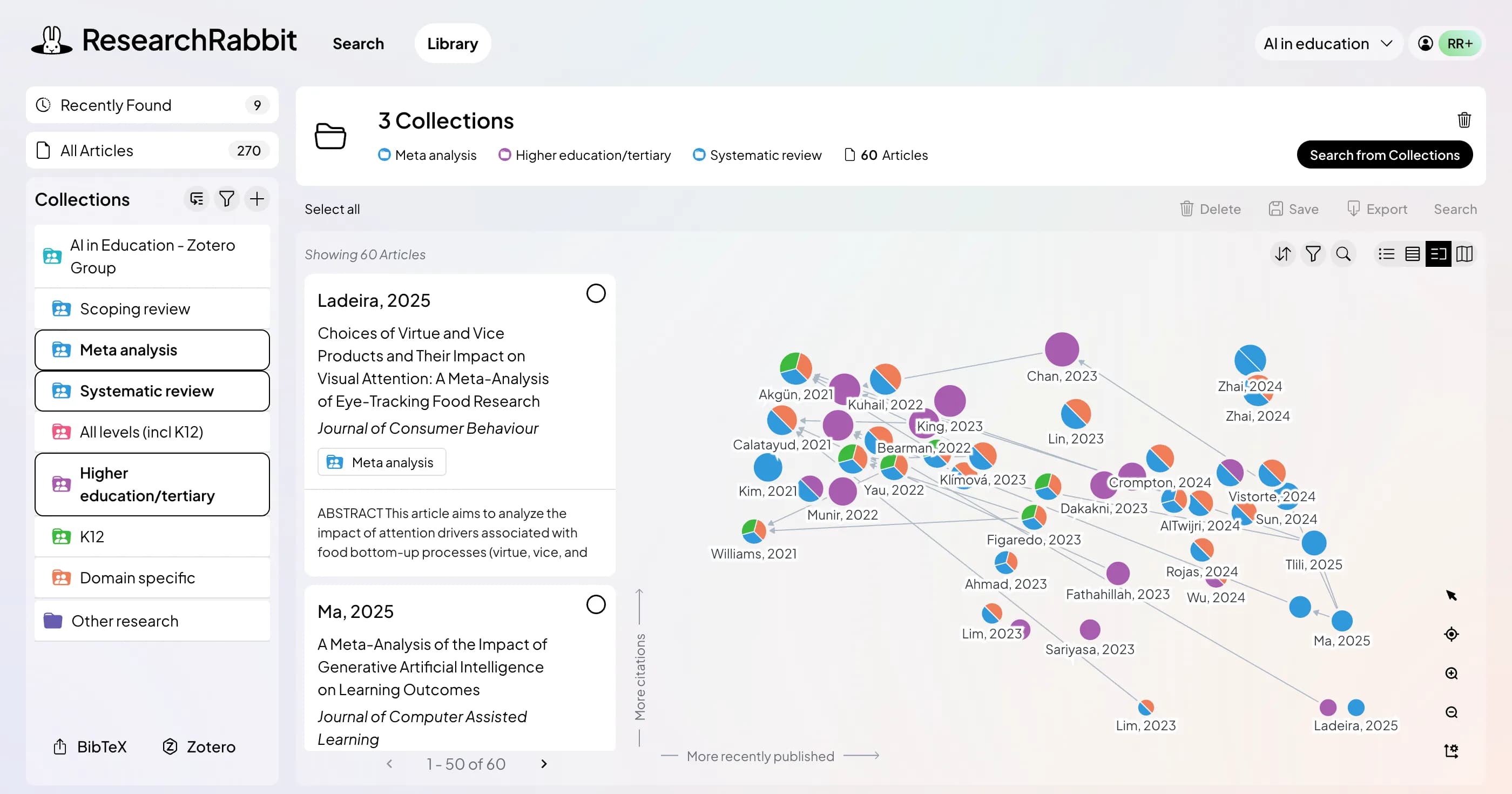
The configurable citation graph plots each paper as a node sized by citation count. You set what the X and Y axes represent: publication year, citation count, or reference count. Papers in the upper right of a year vs. citations graph are recent and heavily cited. Hovering a node shows abstract and key metadata. Clicking it expands to that paper's own citation neighborhood.
The Zotero sync is bidirectional: import an existing Zotero folder as seeds, or push any paper from ResearchRabbit directly into a Zotero collection. This is the most friction-free reference manager integration of the three tools reviewed, and it is fully free.
The friction researchers keep raising
The deepest structural complaint is the "rabbit hole" problem that the product's name inadvertently describes. Because every node in the graph is a clickable expansion point, sessions without a tight research question can sprawl for hours without producing a usable bibliography. Rachael Griffiths, writing in The Digital Orientalist in March 2025, warned that "you could easily lose days to playing with all its features and lose track of what you're doing and why," and recommended using the tool only "when one has a firm focus."
The 2025 interface overhaul created a second category of friction: learning curve churn. Users who built systematic workflows around the original Network Graph view had to completely relearn the tool after October 30, 2025. Community threads in researcher forums flagged that "Research Rabbit AI sucks after update," with longtime free users feeling that the arrival of a paid tier broke the trust built by the "free forever" positioning. The removal of collaborative annotation features in the new version also affected research teams who used it for shared bibliography work.
Database gaps remain a real limitation for certain fields. Like all Semantic Scholar-based tools, ResearchRabbit underrepresents humanities scholarship, non-English publications, books, and conference proceedings. Researchers in specialized areas found metadata errors where journal names replaced article titles in citations from niche publications. The recommendation algorithm's opacity compounds this: there is no explanation of why specific papers surface or why gaps exist, making it hard to tell whether a missing paper reflects genuine thin coverage or a blind spot in the engine.
Finally, ResearchRabbit does not help you read or synthesize the papers it finds. It is a discovery and mapping tool. Users wanting AI-assisted reading, quote extraction, or literature synthesis need a separate tool (Elicit, Consensus, SciSpace) alongside it.
Who ResearchRabbit is for
ResearchRabbit earns its place most clearly for graduate students conducting dissertation literature reviews in STEM fields. The combination of zero cost, Zotero integration, and iterative citation chaining covers the core systematic review workflow without requiring budget approval or institutional access. A typical session: seed with 3-5 foundational papers, trace "Earlier Work" to build the theoretical genealogy, use "Later Work" to surface recent applications, export the resulting collection to Zotero.
Medical and clinical researchers doing pre-surgery literature checks, grant writers mapping research gaps, and faculty entering a new sub-discipline all describe similar workflows. The author network view is specifically useful for identifying who the active researchers in a space are, which matters when evaluating whether a field is saturated or emerging.
Skip ResearchRabbit when your research is primarily in humanities, social sciences, or relies heavily on books and non-English sources. The Semantic Scholar coverage gap is real and will leave significant literature unmapped. Skip it also when you need AI-generated summaries, answer synthesis, or question-answering against a corpus. Tools like Elicit or Consensus handle those use cases. And skip it for preprint-heavy fields (machine learning, physics) where arXiv coverage is inconsistent: the citation graph will miss a substantial portion of the active literature.
For researchers at institutions, the Institution tier adds LibKey integration, which surfaces open-access and library-accessible versions of papers. That removes the friction of hitting paywalls during exploration. The free tier is genuinely complete for individual use.
User Reviews
No reviews yet. Be the first to share your experience!
Sign in to write a review.
Related articles
Guides and articles related to ResearchRabbit.

Gemini Deep Research for a Thesis Literature Review in One Day (2026)

Perplexity AI Tutorial: Maximize Your Research Workflows
Replit Pricing Explained (2026): Core vs Pro and Effort-Based Agent Billing
Turn Any AI Agent Into a Superagent: The 12-Integration Stack (2026)

The Personal AI Productivity Stack (2026): One Tool Per Job, Nothing Extra