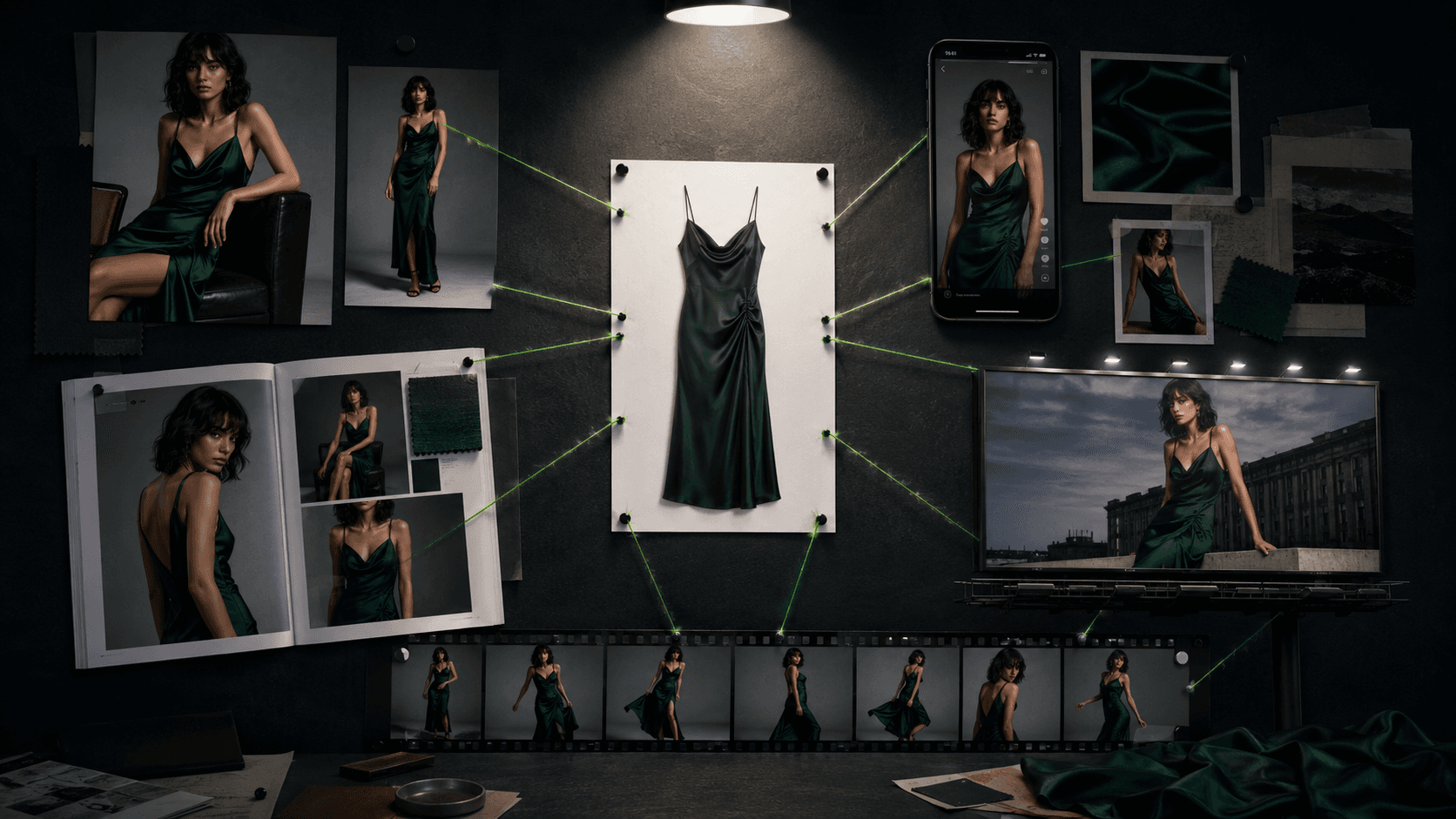

Google Whisk is a free image remixing experiment from Google Labs that generates new images by combining three reference photos: one for subject, one for scene, and one for style. Powered by Imagen 4 and Gemini, no text prompting required.
Google Whisk is a browser-based image remixing tool from Google Labs, launched on December 16, 2024. Where most AI image generators demand detailed text prompts, Whisk takes a different approach: users drag in up to three reference images representing a subject, a scene, and a style, and the system produces an original image that blends all three. The pipeline uses Google's Gemini model to auto-caption each uploaded image, feeds those captions into Imagen (upgraded to Imagen 4 in May 2025), and delivers results in seconds. No prompt writing required, though users can view and edit the underlying auto-generated prompts at any time.
Whisk's core features include the three-slot subject/scene/style input system, a Precise Mode added in 2025 that better preserves facial features and subject identity across generations, Whisk Animate for producing 8-second Veo 2-powered video clips from still outputs, and support for up to eight total reference images in a single session. It operates entirely in the browser with a Google account and has been free throughout its lifespan. As of this writing, Whisk is closing April 30, 2026, with its core remixing capability migrating into Google Flow.
What Whisk generates in April 2026
As of its final weeks, Whisk produces still images at up to 2K resolution using the Imagen 4 backend. The core output is a remixed image that captures the visual "essence" of the three reference inputs: the model is not attempting pixel-accurate reproduction but rather a creative synthesis. You can tweak the aspect ratio before generating, and the Precise Mode toggle instructs the system to weight identity preservation more heavily, reducing the variability that made early Whisk results feel unpredictable.
The Whisk Animate feature converts any Whisk-generated still into an 8-second video clip via Veo 2. Free accounts receive ten animation credits per month. Beyond basic remixing, users can refine the underlying Gemini-generated prompt directly, effectively merging image-driven input with text prompt control. The system accepts up to eight subject images in a single generation (one scene, one style), allowing complex character blending from multiple reference photos.
The Precise Mode update, announced on X by Google Labs in 2025, was a direct response to the tool's most common complaint: "This new feature gives you greater control over preserving facial features, scenes, and styles in your creations," the post read. Refinement in Precise Mode routes through Gemini 2.5 Flash for the final polish pass.
Where Whisk sits versus Midjourney and FLUX Kontext
Midjourney, the most widely used paid image generation platform, handles style and character referencing through its --sref (style reference) and --cref (character reference) URL parameters appended to Discord text prompts. The --sw parameter controls style weight on a 0-1000 scale, and users can blend multiple reference images by assigning relative weights (--sref urlA::2 urlB::3). This gives Midjourney granular, composable style control that Whisk's binary Creative/Precise mode toggle cannot match. The mechanical trade-off is that Midjourney demands fluency with Discord command syntax and a monthly subscription starting at $10, while Whisk required only a Google account and a drag-and-drop interaction. Midjourney also produces outputs intended as final assets; Whisk was explicit that it was built for ideation, not production.
FLUX.1 Kontext from Black Forest Labs operates on a different premise entirely. Its 12B-parameter generative flow matching architecture accepts a reference image plus a text instruction and performs in-context editing: changing specific regions while preserving the rest, applying style transfers, maintaining character identity across iterative edits without quality degradation. Where Whisk blends three separate reference images into a new output from scratch, FLUX Kontext modifies an existing image based on instructions. FLUX Kontext [dev] is Apache 2.0 licensed and self-hostable; Whisk was a closed Google cloud service. FLUX Kontext suits iterative refinement workflows; Whisk suited rapid first-draft exploration when no image exists yet.
"We built it for rapid visual exploration, not pixel-perfect edits.". Google Labs, official announcement, December 2024
That design intent is the key differentiator. Neither Midjourney nor FLUX Kontext are positioned as "sketching" tools. Whisk was, consciously and explicitly.
Real cost of running Whisk
Whisk has been free throughout its Labs lifespan. A Google account is the only requirement. Free-tier users receive a daily generation allowance (the exact cap is unpublished) and ten Whisk Animate credits per month. Google One AI Premium subscribers, at approximately $19.99/month, receive a larger monthly AI credits pool shared across Gemini Advanced, Whisk, Veo, and other Google AI services. Since Whisk and Flow share the same credits backend, any credits held at Whisk's April 30 shutdown transfer automatically to Flow without user action.
There is no API access and no standalone mobile app. The tool runs entirely in the browser. For users who only need occasional concept images, the free tier has been genuinely capable. Heavy users, particularly those relying on Whisk Animate or generating dozens of images daily for client work, reported hitting daily limits without clear warning.
Where Whisk reliably fails
The most consistent complaint across reviews is identity drift. Whisk's model targets the "essence" of a subject rather than an exact replica, which means generated characters may differ in height, weight, hairstyle, or skin tone from the reference. The 2025 Precise Mode update reduced this problem but did not eliminate it. For any workflow requiring strict character consistency across multiple generations, Whisk remained an unreliable choice even after the Precise Mode launch.
Geographic exclusion has been a persistent structural failure. Despite expanding to 100+ countries in February 2025, Whisk never became available in the EU, UK, India, or Indonesia. Regulatory delays tied to GDPR and the EU AI Act kept some of the largest creative markets locked out for the tool's entire lifespan. Users in those regions had to use VPNs to access a free Google product, a friction point that generated consistent frustration in forums throughout 2025.
"When references are busy or contradictory, Whisk can struggle, overemphasizing one source or averaging them into something that feels generic.", story321.com, Whisk AI review, 2025
Additional failure modes: complex inputs with multiple competing visual elements tend to produce outputs that feel like averaged composites rather than creative blends. The single scene/style slot limit (only one scene image, one style image per generation) prevents the kind of multi-reference style blending that Midjourney's multi-URL --sref flag handles. The tool's explicit "experimental" status was backed up by a 16-month lifespan before shutdown, making any investment in Whisk-based workflows a calculated risk that has now materialized.
Who Whisk is for, and who should pick something else
Whisk found its clearest audience among visual thinkers who resist writing prompts. Concept artists building mood boards, product designers mocking up merchandise styles (enamel pins, stickers, digital plushies were common use cases at launch), and social media creators exploring thumbnail directions without committing to a full shoot all benefited from the visual-first interface. For early-stage ideation where speed matters more than precision, Whisk's seconds-per-image generation with zero prompting overhead was genuinely useful.
Skip Whisk if you need final production assets, brand-consistent character outputs, access from EU or UK, or any form of API integration. Since Whisk closes April 30, 2026, new users should go directly to Google Flow, which inherits the core remixing capability. For users who need Whisk-style ideation on a tool with a longer shelf life, Adobe Firefly's reference image features or Midjourney with --sref and --cref offer comparable visual referencing within production-grade platforms. FLUX Kontext is the right choice when you want to modify and refine an existing image with precise text instruction rather than remix three separate references into something new.
User Reviews
No reviews yet. Be the first to share your experience!
Sign in to write a review.
Related articles
Guides and articles related to Whisk.
AI Fashion Prompts That Stay Consistent: The Working Formula (2026)
AI Video Generator Prompting: The Filmmaker's Real Workflow
Google Vision AI Explained (2026): Pricing Per 1,000 Units, Free Tier, and Alternatives
Wix Logo Maker Review (2026): Real Costs, the Edit Catch, and AI Alternatives
Freepik AI Is Now Magnific: What Changed, What It Costs, and Whether to Stay (2026)