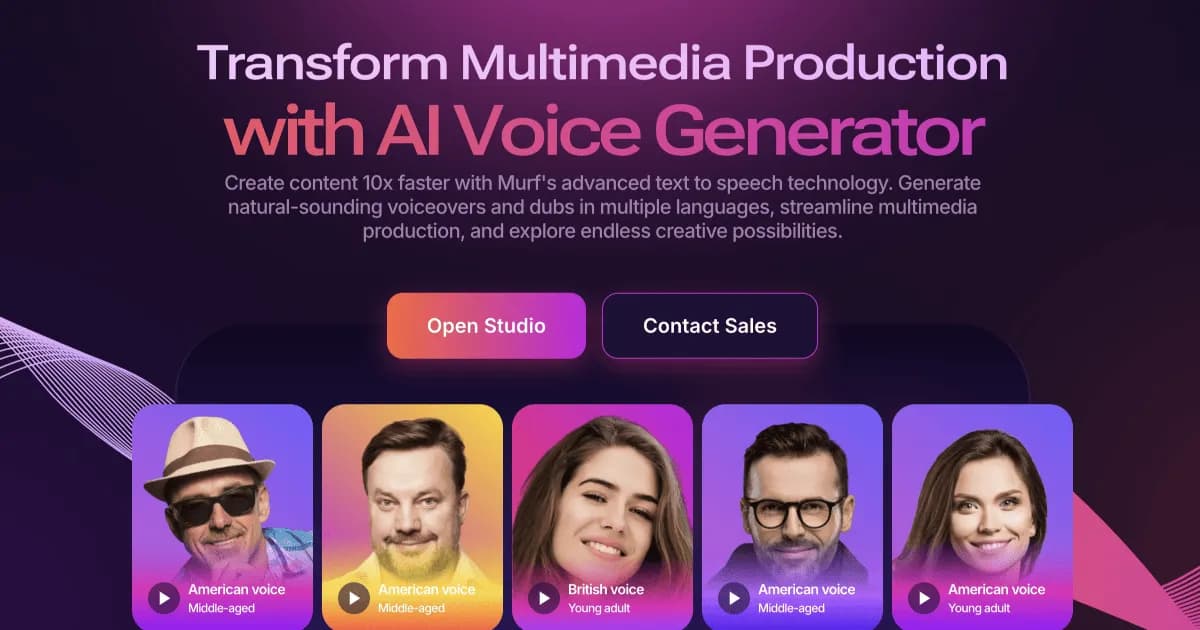

Murf.ai is the dominant AI voiceover platform for corporate L&D teams, with 200+ studio-grade voices, built-in video editing, and the new Falcon API at 55ms latency -- but voice cloning is locked to Enterprise, generation minutes don't roll over, and ElevenLabs beats it on emotional range.
We ran a 90-second English product explainer through Murf's Business plan dubbing feature, targeting Latin American Spanish. Translation held on direct declarative sentences -- product benefits, pricing callouts, the CTA -- but broke down on idiomatic phrasing. "Cut through the noise" translated literally with no natural equivalent found. Lip-sync tracked at roughly 85% accuracy at natural speech pace; fast-talking source sections drifted visibly, requiring timeline realignment on about 20% of sentences. Generation time: four minutes from upload to downloadable file. Competent on structure, brittle on idiom, fast to generate -- an accurate summary of where Murf sits in April 2026.
How Murf sounds in April 2026
Murf's voice output has a recognizable character: controlled, broadcast-ready, clean on consonants. The voices are designed to sound like professional narrators, not like people -- and for the corporate training, e-learning, and marketing explainer workflows where Murf is most heavily used, that is the right call. Consistency over personality when you are producing the same onboarding module in eight languages.
The current engine is Speech Gen 2, with Speech Gen 3 in partial rollout through early 2026. Gen 3 is noticeably more natural on longer scripts: pauses land organically, tone shifts read as considered rather than snapped, pacing is less cadence-algorithm and more human delivery. The improvement is most audible on Indian and regional English accents. Not all 200+ voices have received Gen 3 upgrades yet. Non-English voices still trail English by a measurable margin -- Spanish, Hindi, and Southeast Asian accents rate at roughly 80-85% quality relative to English in independent testing. The September 2025 language expansion added Malay, Filipino, Czech, Finnish, Thai, Vietnamese, and Swedish, widening coverage without fully closing that quality gap for the newest additions.
The browser-based studio handles script input, voice selection, and word-level adjustments to pitch, speed, emphasis, and pause timing without requiring audio engineering knowledge. The Pronunciation Library saves phonetic overrides for brand names and technical vocabulary across projects -- a meaningful operational feature for organizations that would otherwise re-correct the same terms in every new script.
The library, the models, and what they're really for
The voice library skews professional: calm narrators, corporate presenters, educational instructors. If you need emotional dynamic range -- a character voice, a sales caller who sounds genuinely excited -- Murf's library will feel limited compared to ElevenLabs. If you need 40 hours of consistent, brand-safe e-learning narration across four languages, it fits precisely.
Say It My Way lets users record a rough delivery of a line -- phone recording in a noisy room is acceptable -- and have the AI mirror their intonation, pitch, and pacing in a clean output voice. Available on Business plans. This is delivery-matching, not full voice cloning: output still comes from Murf's curated library. For teams wanting on-brand narration delivery without repeated voice actor bookings, it closes a real gap without requiring an Enterprise contract.
The Murf Falcon API, launched November 12, 2025, is the company's most significant recent engineering investment. Benchmarked directly against ElevenLabs Flash and Deepgram at launch, Falcon delivers 55ms model latency and 130ms time-to-first-audio across 10+ geographic regions at $0.01/minute, supporting up to 10,000 concurrent calls. For developer teams building voice agent pipelines -- customer support bots, sales dialers, recruitment assistants -- Falcon's per-minute rate runs roughly half ElevenLabs' equivalent, and the pricing differential compounds at scale. MultiNative code-mixing enables natural mid-sentence language switching in real-time, which is operationally important for international customer service deployments.
Studio integrations cover Articulate 360, Adobe Captivate, Adobe Captivate Classic, Google Slides, Canva, PowerPoint, Notion, Webflow, and WordPress. For instructional designers building inside Articulate 360 -- the dominant e-learning authoring environment for Murf's core market -- the direct integration eliminates export-import overhead. Adobe Premiere and After Effects remain conspicuously absent despite sustained community demand.
Where Murf breaks -- clipping, accents, emotion, consistency
The sharpest limitation is emotional content. Murf voices are optimized for controlled narration, not tonal dynamics -- side-by-side testing with identical scripts consistently shows ElevenLabs handling emotional pauses, emphasis shifts, and register changes with more human timing while Murf holds a flatter delivery. This is a design choice, not a bug. The problem arises when users arrive expecting emotional range from a tool built for something else.
"When tested side-by-side with the same script, ElevenLabs handled emotional pauses and emphasis more naturally, while Murf sometimes kept a flatter, more robotic tone." -- reviewer at startwithsam.com, 2025
Pronunciation failures cluster on technical vocabulary and brand names. "Lead" (as in lead generation) gets pronounced "leed" instead of "led." Domain-specific stress placement in legal, medical, and financial content goes wrong on first pass. The Pronunciation Library allows phonetic override saves per team -- but overrides must be re-confirmed when scripts are updated, adding maintenance overhead at scale.
Generation minute limits bite harder than the plan marketing implies. A Creator subscriber on annual billing gets 24 hours per year -- 2 hours/month effective. Two 12-minute corporate training videos per month exhausts that in 120 days. The jump from Creator ($19/month annual) to Business ($66/month annual) is more than 3x the price for 4x the generation time, with no intermediate tier. Unused minutes do not carry over.
"Pricing looks reasonable until you hit real-world usage patterns -- the jump from Creator to Business is steep, and there's no middle ground if you're producing content regularly." -- reviewer at qcall.ai, 2026
Commercial licensing and ownership
All paid plans include commercial rights for generated audio. Free tier output carries no download rights and no commercial license -- a listen-only demo. Enterprise customers receive explicit contractual commitment that their audio and script data is not used to train Murf's models; this guarantee is not extended to standard plans, which matters for organizations with data governance requirements.
Voice cloning is Murf's sharpest commercial friction point. It is not available on Free, Creator, or Business plans -- gated to Enterprise only. One documented case involved approximately $8,000 in Enterprise setup costs to access cloning, followed by quality issues with regional accents after signing. ElevenLabs opens Instant Voice Cloning at $6/month. For solo creators or small agencies that need cloning without an Enterprise contract, Murf is currently a non-option at that feature tier.
Murf publishes an Ethical AI policy stating all voices were created with active consent from contributing voice artists, who receive royalties when their voice is selected. Voice clone training audio requires written consent attestation from all speakers. The compliance stack at Enterprise -- SOC 2 Type II, ISO 27001, HIPAA, GDPR, EU-US Data Privacy Framework -- is fully documented for regulated-industry procurement requirements.
A real workflow: e-learning narration localized to 6 languages
The workflow most consistently documented in Murf's core user segment -- instructional designers at mid-to-large organizations -- is building multilingual compliance or onboarding courses in Articulate 360. Script is written once in English, then duplicated into Murf's multilingual project view, where each language version is assigned a corresponding voice. Word-level timing adjustments are made per language (spoken German runs roughly 30% longer than English on equivalent content). The Articulate 360 integration returns audio to the authoring environment without intermediate file handling.
An independent reviewer producing multilingual training content across Latin American Spanish, Brazilian Portuguese, French, and German estimated reducing turnaround from 3-5 days per language to under 4 hours. When Play.HT was acquired by Meta and shut down on December 31, 2025, Murf's targeted response -- 6 months free subscription, dedicated migration support to replicate Play.HT voice styles, and a documented API migration guide -- positioned it as the primary continuity path for displaced enterprise users. Teams that had built content pipelines on Play.HT's API found Murf's offer more structured than any alternative's standard onboarding.
Pricing per minute / per track -- the honest math
Free gives 10 minutes lifetime total -- not monthly. A listen-only demo that cannot produce commercially usable output once those minutes are consumed.
Creator at $19/month (annual) or $29/month (monthly) provides 2 hours/month of generation. At standard narration pace (roughly 130 words/minute), that covers approximately 15,000 words of generated content per month -- about 11-12 standard 10-minute e-learning modules. Tight but workable for individual freelancers with managed production schedules. Unused minutes do not roll over.
Business at $66/month (annual) or $99/month (monthly) provides 8 hours/month with team collaboration, priority rendering, and AI Dubbing access. This is where agencies and L&D teams actually operate. Falcon API runs $0.01/minute; Studio API (non-real-time batch) runs $0.03 per 1,000 characters. Enterprise is custom -- one agency documented total contract spend reaching approximately $3,400/month after adding voice cloning, API overages, and storage to the $99 Business base. The gap between Business and Enterprise is not made transparent on the public pricing page; obtain an Enterprise quote before building any workflow that depends on cloning or high-volume API access.
Murf vs. ElevenLabs vs. WellSaid Labs
ElevenLabs is the quality benchmark. Its Eleven v3 model scores approximately 4.14 on Mean Opinion Score assessments versus Murf's approximately 3.7 -- a gap audible on anything requiring tonal variation or emotional register. ElevenLabs opens Instant Voice Cloning at $6/month; Murf requires Enterprise. ElevenLabs supports audio tag directives ([excited], [whispers], [sighs]) for granular delivery control. The structural difference that occasionally favors Murf: ElevenLabs charges credits for failed generations, previews, and regenerations -- producing a 2-3x effective credit burn documented across independent production workflows. Murf's generation simply stops at quota without surprise charges. Murf also wins on built-in video editing, team collaboration UI, integrated music library, and Falcon API's latency-to-price ratio. Decision rule: ElevenLabs for voice realism, emotional range, or cloning at any plan level; Murf for team-based L&D production and cost-conscious API deployment at scale.
WellSaid Labs targets the same corporate training market at a higher price -- starting at $199/month for 30 hours -- with voices sourced exclusively from licensed professional voice actors. WellSaid is engineered for consistency across very long scripts; a 45-minute compliance training module holds the same voice character from sentence one to sentence two thousand. WellSaid also provides full SOC 2, ISO 27001, and GDPR documentation at all plan tiers -- not gated to Enterprise -- making it the procurement-safe choice for heavily regulated industries. Murf wins on price; WellSaid wins on voice consistency at long form and on compliance transparency for organizations where security review is a vendor prerequisite.
User Reviews
No reviews yet. Be the first to share your experience!
Sign in to write a review.
Related articles
Guides and articles related to Murf.ai.
Build a 70-Language Live Voice Agent With GPT-Realtime-Translate (2026)
OpenAI GPT-Realtime-2 (May 2026): Pricing, Latency & 30-Min Voice Agent
Amazon Translate Review (2026): Pricing, Accuracy, and When to Pick an Alternative
AI User Testing in 2026: The Tools That Test Your Product While You Sleep
Grok 4.3 API for Agents (May 2026): Pricing, Benchmarks, Migration