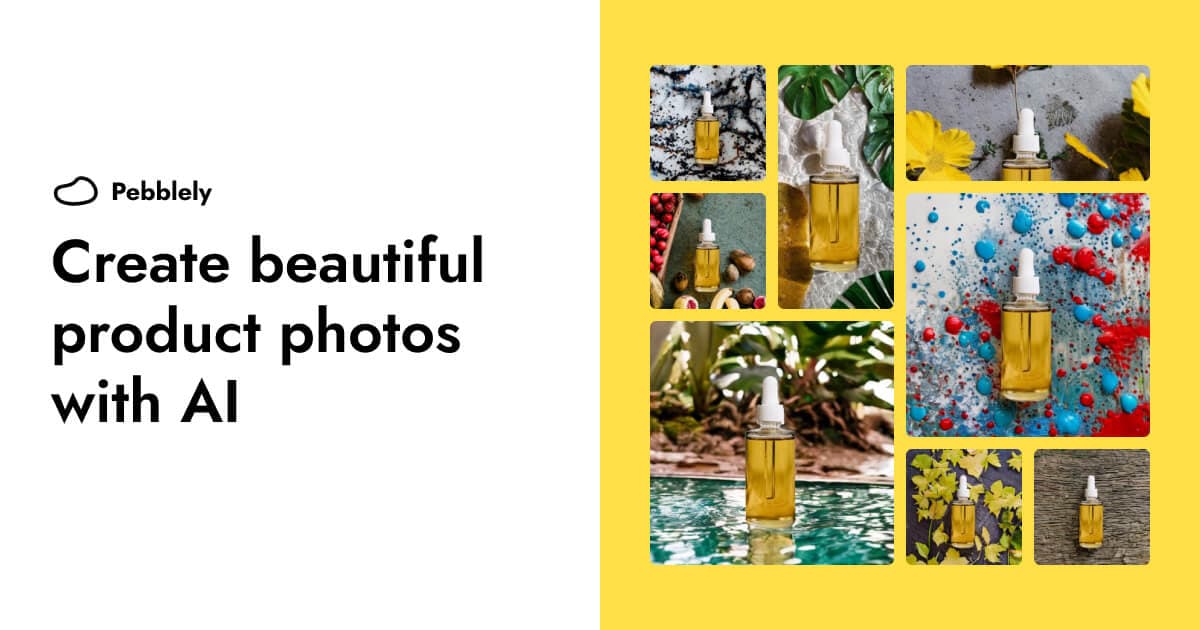

Pebblely removes product backgrounds and generates matched lifestyle scenes using AI, targeting ecommerce sellers who need professional product imagery without a studio. The free tier is stingy at 40 images, but the $19/month Basic plan delivers real volume for small store owners.
Pebblely is an AI product photography tool built to solve one specific problem: ecommerce sellers need professional lifestyle imagery, but professional photoshoots are expensive and slow. The Singapore-based bootstrapped company launched on January 4, 2023, built by co-founders Alfred Lua (a former ecommerce store owner) and Swee Kiat (who studied AI image generation at Stanford). The tool automatically removes the product background, then generates a realistic scene around the isolated product, complete with shadows and reflections matched to the new environment. As of April 2026, the platform has processed over 25 million images for more than one million users globally.
Core capabilities include automatic background removal, over 40 pre-built lifestyle and studio themes, custom text prompts for unique scene descriptions, real-time canvas editing to position and scale products before rendering, bulk generation of multiple scene variations from a single product photo, and an open API supporting enterprise-scale catalog automation. Images generate in three to five seconds, and all paid plans include commercial usage rights with no download restrictions.
What Pebblely generates in April 2026
The generation pipeline works in a fixed sequence. You upload a product photo, the engine strips the existing background with automatic segmentation, you position the isolated product on a canvas, then select either a pre-built theme (holiday, kitchen, nature, spa, luxury) or write a custom text description of the scene you want. The AI places the product into that scene and renders shadows and reflections calibrated to the background lighting. Final output goes up to 2048x2048 pixels on paid plans.
The template library has grown from the original 40 themes at launch to 90+ pre-built options spanning lifestyle, studio, seasonal, and holiday categories. Themes act like a lightweight art director: selecting "cozy home" applies warm ambient light, wooden surfaces, and soft bokeh; "spa and wellness" applies clean white marble with neutral tones. You do not need to write prompts to get consistent, on-brand results for common product categories. For candles, beauty products, jewelry, and packaged food, the output is fast and usable without iteration.
Bulk generation lets you create 25 product variants simultaneously. The API extends this further, supporting up to 200,000 image generations per day for developers building automated catalog pipelines. The platform also supports placing multiple products on the same canvas, useful for bundle or gift set photography.
"I can now easily create multiple pictures with just one or two quality photos." - Bernfried Warning, Duckshop (Pebblely customer testimonials)
Where Pebblely sits versus Booth.ai and Photoroom
Pebblely, Booth.ai, and Photoroom all work in the AI product photography space, but their underlying mechanisms target different workflows.
Photoroom is the most widely deployed tool in this category, with 150 million+ mobile downloads since founding in Paris in 2019. Its background removal engine is trained on a proprietary segmentation model with strong semantic understanding tuned for fine edges: hair, fur, bike spokes, packaging text, and low-contrast scenes where the product blends into the original background. After isolation, Photoroom offers 1,000+ marketplace-specific templates calibrated for Amazon, Etsy, Depop, and Shopify product pages. It also provides layer editing after AI generation, allowing manual masking corrections. A full mobile app handles the entire workflow on a smartphone. Pebblely offers none of these: no dedicated mobile app, no layer editing, no marketplace-specific template library, and weaker edge preservation on complex shapes. What Pebblely does better than Photoroom is lifestyle scene generation: generating a complete environmental backdrop with matched lighting and shadows from a simple packshot is faster and more natural in Pebblely's workflow, especially for sellers who want a range of lifestyle contexts rather than clean white-background marketplace images.
Booth.ai, backed by Y Combinator, uses a Subject Preservation architecture built on background removal combined with depth mapping and Stable Diffusion checkpoints. The result keeps the product pixel-accurate while generating a contextually appropriate scene around it. Booth.ai was specifically trained on high-end commercial photography conventions, including lighting setups, composition rules, and staging principles from professional fashion and product catalogs. Its key differentiator is on-model apparel placement: it can dress AI-generated human models in clothing products, solving the expensive model-hiring problem for fashion brands managing hundreds of SKU variations. Pebblely has no human model generation capability at all. Pebblely is stronger for packaged consumer goods (candles, beauty, food, jewelry, beverages) where lifestyle theming and shadow fidelity matter most. Booth.ai is the better choice for fashion brands needing scalable model photography.
"I definitely saw an increase in sales once I implemented Pebblely-generated images." - Lynn Seresin, Ruby Hummingbird Shop (Pebblely customer testimonials)
Real cost of running Pebblely
The free plan gives 40 images per month with access to basic themes. In practice, 40 images vanishes fast during initial testing. Multiple reviewers on Product Hunt have noted running out of credits within ten minutes of signing up, because the natural workflow when learning the tool involves generating several variations per product to find the right scene. The free tier functions as a trial, not as a viable ongoing plan for any serious ecommerce operation.
Free: $0/mo, 40 images/month, 40+ background themes, no bulk generation, no custom sizing
Lite: $9/mo (or ~$7.50/mo on annual billing), 30 images/month, themes plus custom text prompts
Basic: $19/mo (or $179/year, ~$14.92/mo), 200 images/month, bulk generation, custom sizing up to 2048x2048, commercial rights
Pro: $39/mo (or $379/year, ~$31.58/mo), 500 images/month, all features, priority support
All paid tiers include reference image uploads, multiple format resizing for different social platforms, and commercial usage rights. There is no refund policy due to immediate digital delivery. The API pricing is separate from subscription tiers; enterprise and developer usage scales independently.
For a solo ecommerce founder needing 10-20 product images per month across multiple themes, the Basic plan at $19/month makes economic sense compared to any physical photoshoot alternative. For agencies running client catalogs at volume, the API is the path; subscription caps constrain batch workflows too much at the Pro level.
Where Pebblely reliably fails
Input quality is not optional. If the product photo you upload is poorly lit, blurry, or shot against a complex background where product edges blend in, Pebblely's output will fail visibly. The shadow matching engine calibrates to the product's own lighting, so an inconsistently lit input produces inconsistent or physically implausible shadows in the generated scene. The tool cannot compensate for bad source photography the way a professional retoucher can.
Text on packaging is a known failure mode across AI image generators, and Pebblely is no exception. Labels, product names, ingredient lists, and brand text on packaging get garbled or altered in generated outputs. Pebblely published a blog post specifically addressing this in March 2026 ("Why Your AI Product Photos Keep Getting the Text Wrong"), confirming it remained an active problem into early 2026. If your product's visual identity depends on readable label copy, verify outputs carefully or avoid generation around text-heavy surfaces.
Mobile usability is poor for custom prompting. The custom text description field does not render consistently in mobile browsers, so users relying on smartphones for workflow steps hit dead ends. This is notable because Pebblely's own co-founder acknowledged discovering that most users accessed the platform via mobile, and the team worked on mobile experience improvement. Theme selection on mobile works; custom prompt input on mobile does not always work.
The reference image feature, which lets you upload a stylistic reference to guide scene generation, is inconsistent. Users have reported that the engine sometimes ignores the reference entirely and generates unrelated scenes. This means you cannot reliably use reference images to maintain strict brand aesthetic consistency across a large catalog.
The Shopify app integration, launched May 24, 2023, was no longer available on the Shopify App Store by 2024. Merchants who had built generation workflows tied to that native Shopify integration lost access. Direct web app use and API remain available, but the one-click in-Shopify workflow is gone.
Who Pebblely is for, and who should pick something else
Pebblely is the right tool for solo ecommerce founders and small store owners who sell physical consumer goods in categories where lifestyle staging drives purchase decisions: candles, skincare, food and beverage, jewelry, home goods, pet products. The three-to-five second generation time and theme-based workflow mean you can produce a week's worth of social media assets in an hour, without hiring a photographer or touching design software.
Dropshippers benefit specifically from Pebblely's ability to take generic supplier packshots and place them into unique lifestyle contexts, differentiating listings that would otherwise look identical to competitors sourcing from the same supplier. Social media managers running Instagram, Pinterest, and Facebook for product brands get direct value from the platform sizing tools and theme variety.
Developers and agencies building automated catalog pipelines should evaluate the API, which scales to 200,000 daily generations and eliminates per-image subscription constraints for volume workflows.
Skip Pebblely if you sell fashion apparel and need on-model photography at scale: Booth.ai handles human model generation and Pebblely does not. Skip it if you need granular masking, fine edge control on complex shapes, or layer-level editing after generation: Photoroom's editing tools are substantially more capable. Skip it if you rely primarily on a smartphone for your workflow: the mobile browser experience for custom prompts is unreliable. And skip it if your products have text-heavy packaging where label copy accuracy matters in the final image.
User Reviews
No reviews yet. Be the first to share your experience!
Sign in to write a review.
Related articles
Guides and articles related to Pebblely.
AI Fashion Prompts That Stay Consistent: The Working Formula (2026)

Best AI Fashion Model Generators for Clothing Brands (2026)
AI Clothing Photoshoot: What It Really Costs vs a Studio Shoot (2026)

How to Get an AI Model Wearing Your Clothes (Step by Step)
One Product Photo, Full Fashion Campaign: AI Images and Video That Sell (2026)