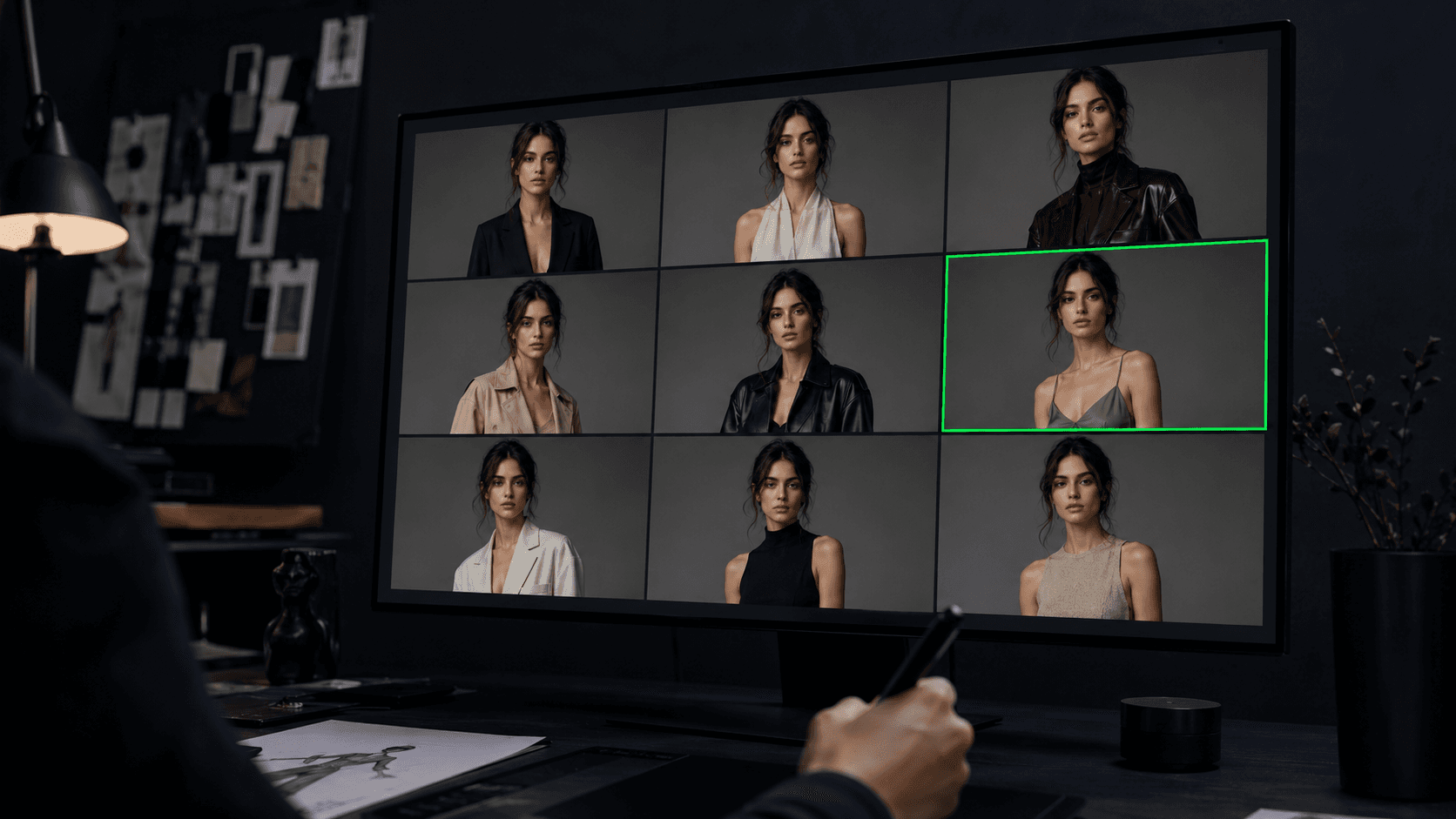

Recraft is the only AI image generator that produces true native SVG vector files directly from text prompts. Built for designers and brand teams, it adds brand kit controls, batch generation, and an API on top of a quality raster engine that topped the Artificial Analysis leaderboard in October 2024.
Recraft is a professional AI image generation platform founded in 2022 by Anna Veronika Dorogush, co-creator of the CatBoost machine learning library at Yandex. The company, headquartered in London, solves a problem no other AI image tool has fully addressed: producing editable, production-ready SVG vector files directly from a text prompt, without requiring a raster-to-vector conversion step after the fact. It emerged from stealth in May 2023 and has since grown to over 4 million registered users across 200 countries, raising $42 million in total funding including a $30M Series B led by Accel in May 2025.
The platform runs two concurrent model lines as of April 2026. Recraft V4 (released February 17, 2026) is the current standard model, available in V4 and V4 Pro variants with resolutions up to 2048x2048. Both raster and vector versions are available at each tier. Alongside generation, Recraft includes a Brand Kit for locking brand colors and style references across sessions, a batch generation mode producing up to 20 images per request, background removal and replacement, Creative Upscale, inpainting, mockup tooling, and a web-based collaborative canvas. An API gives developers programmatic access to generation, vectorization, and background removal at pay-per-use rates.
What Recraft generates in April 2026
Recraft V4, released February 2026, is the current primary model. It comes in four configurations: V4 Standard (raster, approximately 10 seconds per generation), V4 Pro (raster at higher resolution, approximately 28 seconds), V4 Vector, and V4 Pro Vector. The vector variants produce actual SVG files with structured paths and shapes, not rasterized images run through an after-the-fact trace algorithm. Standard outputs go up to 1024x1024; Pro outputs reach 2048x2048. The previous generation, Recraft V3 (codenamed "red_panda," October 2024), remains accessible for users who prefer its output characteristics.
Beyond text-to-image generation, the platform's toolset covers the full brand asset production pipeline: inpainting for selective region edits, outpainting to extend image boundaries, background removal and replacement (1 credit for raster, 2 for vector), Creative Upscale for high-quality enlargement (20 credits), and a mockups tool for placing generated graphics into real-world product contexts. Batch generation on the Pro plan processes up to 20 images per request. The collaborative canvas supports real-time multi-user work. API endpoints expose generation, vectorization, and background removal to developer pipelines at documented per-call rates.
The Brand Kit is the feature most frequently cited as differentiating Recraft from every raster-only alternative. Upload logo files and reference images, define hex-code color palettes, and set line weight preferences. The platform trains a custom style from those assets and applies it automatically to subsequent generations in the same session. For teams, the Team plan extends Brand Kits into shared workspaces accessible to all members with role-based permissions.
Where Recraft sits versus Midjourney and Ideogram
Midjourney is the aesthetic benchmark for photorealistic and illustrative image generation, but it outputs raster PNG files only. There is no native SVG path in Midjourney's pipeline. Brand consistency requires workarounds: manually seeding style parameters, uploading reference images each session, or using third-party style seeds that only approximate reproducibility. The standard workflow for a designer who needs a vector logo from Midjourney involves generating a PNG, running it through an external vectorizer, importing to Illustrator, manually cleaning anchor points, and fixing color drift. That full path typically takes 2-3 hours. Recraft's equivalent: select vector style, set brand colors, generate, download SVG. Midjourney's text rendering, while improved in V8, remains unreliable for client-facing typography. Midjourney also lacks a developer API in the conventional sense, instead routing generation through Discord or a limited web UI. For pure photorealistic art where vector output is irrelevant, Midjourney V8 remains a stronger aesthetic choice.
Ideogram occupies a different lane: it is the best-in-class model for rendering readable text within raster images. Ideogram 3.0 correctly renders text with proper spelling, consistent font style, and readable sizing approximately 82% of the time in comparative tests, outperforming every other image model including Recraft on pure typography tasks. However, Ideogram generates raster images only. It has no SVG output, no vector pipeline, and no Brand Kit equivalent. For poster design and marketing graphics where legible text is the primary output requirement, Ideogram is the stronger choice. For logo systems, iconography, and any deliverable that needs to scale to print or large-format output without quality loss, Ideogram cannot replace Recraft's vector capability.
The mechanical gap is specific: Recraft wins on vector fidelity and brand system persistence. Ideogram wins on text legibility within images. Midjourney wins on photorealistic aesthetic range. A professional design operation often uses all three for different deliverable types.
"The images it generates feel unique and easy to prompt compared to Midjourney." -- Luc Gagan, Product Hunt, 2023
"I used to bounce between three or four different tools just to finish a single visual. Recraft changed that." -- Daria Cupareanu, AI blew my mind (Substack), 2025
Real cost of running Recraft
Free tier users receive 30 daily credits, resetting each day. One raster generation costs 1 credit; one vector generation costs 2 credits. The Creative Upscale feature costs 20 credits per use. Free images are public by default, visible in the community gallery, and carry no commercial license. This tier is usable for personal exploration only. Any client work, private assets, or commercial use requires a paid plan.
The first paid tier (Basic, approximately $20/month based on multiple third-party sources; verify on recraft.ai/pricing for current rate) grants private images, a commercial license, and access to Creative Upscale. The Pro plan at $25/month ($20/month billed annually at $240/year) adds high-resolution output, batch generation, Brand Kit, all export formats including SVG and EPS, and 100 API requests per day. Team plan is $45/user/month ($36/user/month annually) with a 3-user minimum, adding shared Brand Kits, collaborative workspaces, usage analytics, and 500 API requests per day per user.
The credit system has a well-documented friction point: credits reset monthly and do not roll over. Annual subscribers receive their credits in monthly allotments, not as an annual lump sum. Users who switch from a monthly plan to an annual plan mid-cycle report losing accumulated credits. Top-up credit packs (available to paid subscribers only) never expire, which partially addresses the rollover issue but requires additional spend beyond the subscription. This structure has generated sustained complaints on feedback.recraft.ai since late 2024.
Where Recraft reliably fails
The vector output is the platform's headline feature, but the SVG files it produces often require significant post-processing before professional use. Generated vectors can contain excessive anchor points and redundant layers that require an hour or more of cleanup in Illustrator or Inkscape for complex compositions. The output is not always print-ready without manual path optimization. For simple icons and logos, the output is cleaner; for complex illustrations converted to vector, the quality drops sharply.
Dimension control is inconsistently enforced. Multiple review sources document image sizes changing unpredictably after generation despite explicit width and height settings. This is a repeatable bug that affects workflows requiring precise output dimensions for templated designs.
Service reliability has been a documented concern. In February 2025, the platform experienced a complete outage lasting more than five days. During this period users could not access previously generated content, and there was no official announcement from Recraft during the outage. Support responses were described as having no information about the problem. The platform has since continued operating without a reported similar incident, but the event was serious enough to affect the platform's reputation with professional users who depend on availability.
The mobile and tablet experience is functionally broken for most users. The interface is designed for a large monitor and a high-end device. Low-end devices produce interface bugs. This is not a mobile-friendly tool.
Free-tier images are public. Any professional work started on the free plan is visible to the community gallery. This is not a free trial in the conventional sense; it is a public shared workspace. Users generating anything confidential must be on a paid plan from the first session.
Who Recraft is for, and who should pick something else
Recraft fits best when: your deliverables are logos, icons, brand assets, or packaging graphics that need to scale. You are a graphic designer, brand team, or agency maintaining visual consistency across a client library. You need SVG output that can go directly to print production without a separate vectorization workflow. You want to enforce brand colors and style parameters across generations automatically. You are a developer building a design pipeline that needs programmatic access to generation and vectorization. You manage a team of designers who need shared brand resources and collaboration on a canvas.
Skip Recraft when: your output is primarily photorealistic imagery or fine art. Midjourney V8 and FLUX.1 Pro produce better photorealistic results with more aesthetic depth. Skip it when text-heavy compositions are your main output; Ideogram 3.0 outperforms Recraft on legibility and typographic accuracy for posters and social graphics. Skip it if you rely on mobile or tablet access. Skip it if you need guaranteed availability SLAs without committing to an Enterprise contract. Skip it if your workflow requires bulk automated downloads; the platform prohibits programmatic bulk downloads and requires per-image manual downloads at certain tiers.
The red_panda leaderboard moment in October 2024 put Recraft on the map for users who had not encountered it. A model submitted anonymously under the name red_panda appeared at the top of the Artificial Analysis Text-to-Image Leaderboard on Hugging Face, approximately 40 Elo points ahead of FLUX 1.1 Pro and outranking Midjourney, DALL-E 3, and Stable Diffusion simultaneously. Recraft subsequently confirmed the model was Recraft V3. The episode confirmed that a 50-person London team had produced a model competitive with the biggest labs. TechCrunch covered the reveal the same day. Recraft followed with a $30M Series B in May 2025 and V4 in February 2026. The progression from stealth leaderboard move to funded category contender in 18 months is a meaningful signal about where this team is going.
"As a Product Manager, I've found immense value in using Recraft to generate icons for my mock-ups." -- Maria Litvinova, Product Hunt, 2024
User Reviews
No reviews yet. Be the first to share your experience!
Sign in to write a review.
Featured in collections
Curated lists that include Recraft.
Related articles
Guides and articles related to Recraft.
Wix Logo Maker Review (2026): Real Costs, the Edit Catch, and AI Alternatives
Freepik AI Is Now Magnific: What Changed, What It Costs, and Whether to Stay (2026)
Grok 4.3 API for Agents (May 2026): Pricing, Benchmarks, Migration
Best AI Fashion Model Generators for Clothing Brands (2026)
Google Vision AI Explained (2026): Pricing Per 1,000 Units, Free Tier, and Alternatives