
Stack AI is a no-code visual platform for building enterprise AI agents and workflows. Founded by MIT PhDs and backed by Y Combinator, it connects 30+ LLMs to 100+ enterprise data sources with built-in compliance and governance. Starts at $199/month.
Stack AI is a no-code enterprise AI agent platform built by Toni Rosinol and Bernardo Aceituno, two MIT PhDs who founded the company in 2022 after identifying the gap between raw LLMs and the messy reality of enterprise data. The company went through Y Combinator's Winter 2023 batch and has since grown to serve customers including Nubank, SmartAsset, MIT Sloan, LifeMD, and a Top 5 US Defense agency. It raised a $16M Series A in May 2025, bringing total funding past $19M, with backing from Lobby Capital, Gradient Ventures, Guillermo Rauch (Vercel CEO), and returning investor Y Combinator. The core problem Stack AI solves: most enterprises cannot connect their institutional knowledge, systems, and workflows to AI without writing substantial infrastructure code. Stack AI handles that plumbing through a visual canvas.
The platform provides a drag-and-drop workflow builder that connects 30+ LLM providers (OpenAI, Anthropic, Mistral, Google, and others) to 100+ enterprise data connectors spanning Salesforce, SharePoint, HubSpot, BigQuery, Notion, Airtable, and SAP. Workflows publish as internal chat interfaces, embeddable website chatbots, REST API endpoints, batch processors, or Slack and Microsoft Teams apps. Built-in compliance certifications (SOC 2 Type II, HIPAA, GDPR, ISO 27001) and governance tooling (RBAC, audit logs, multi-environment management, SSO) make it one of the few no-code agent platforms that enterprise IT departments can approve without needing a parallel security review. Stack AI also supports native RAG pipelines with document chunking, embedding, and knowledge base management, plus multi-agent orchestration and, as of 2025, computer use and web browser navigation capabilities for agents.
What Stack AI actually does in May 2026
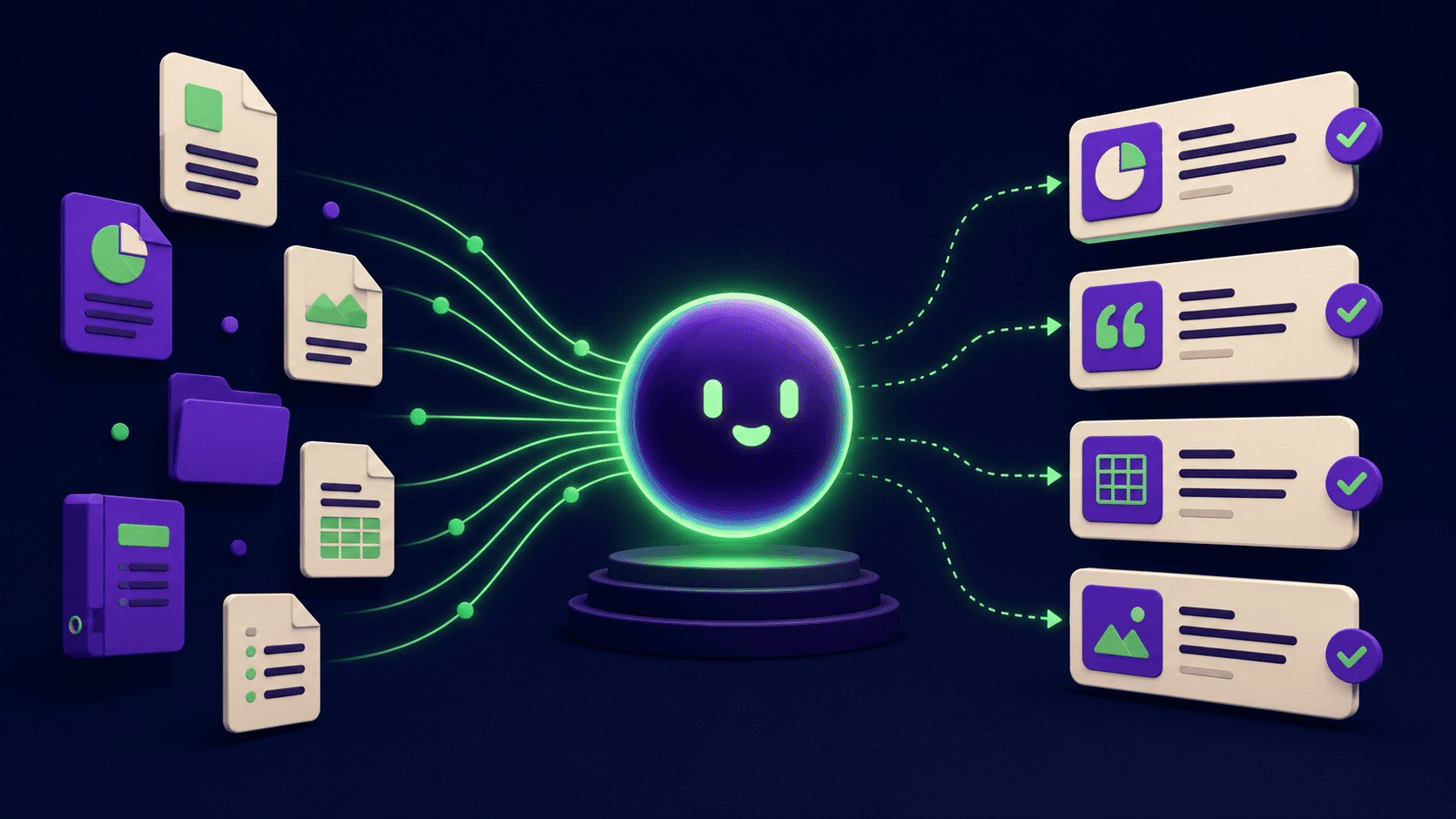
Stack AI's canvas builder is the product's primary surface. Users drag pre-built component nodes onto a 2D canvas and wire them together: a document loader connects to an embedding step, which connects to a retrieval node, which connects to an LLM call, which outputs to a chat interface. The platform describes this as the "Agentic Development Life Cycle" (ADLC), their framing for governance-first AI development. Practically, that means every workflow gets versioned environments (development, staging, production), role-based permissions, and audit trails from the start, not as an afterthought.
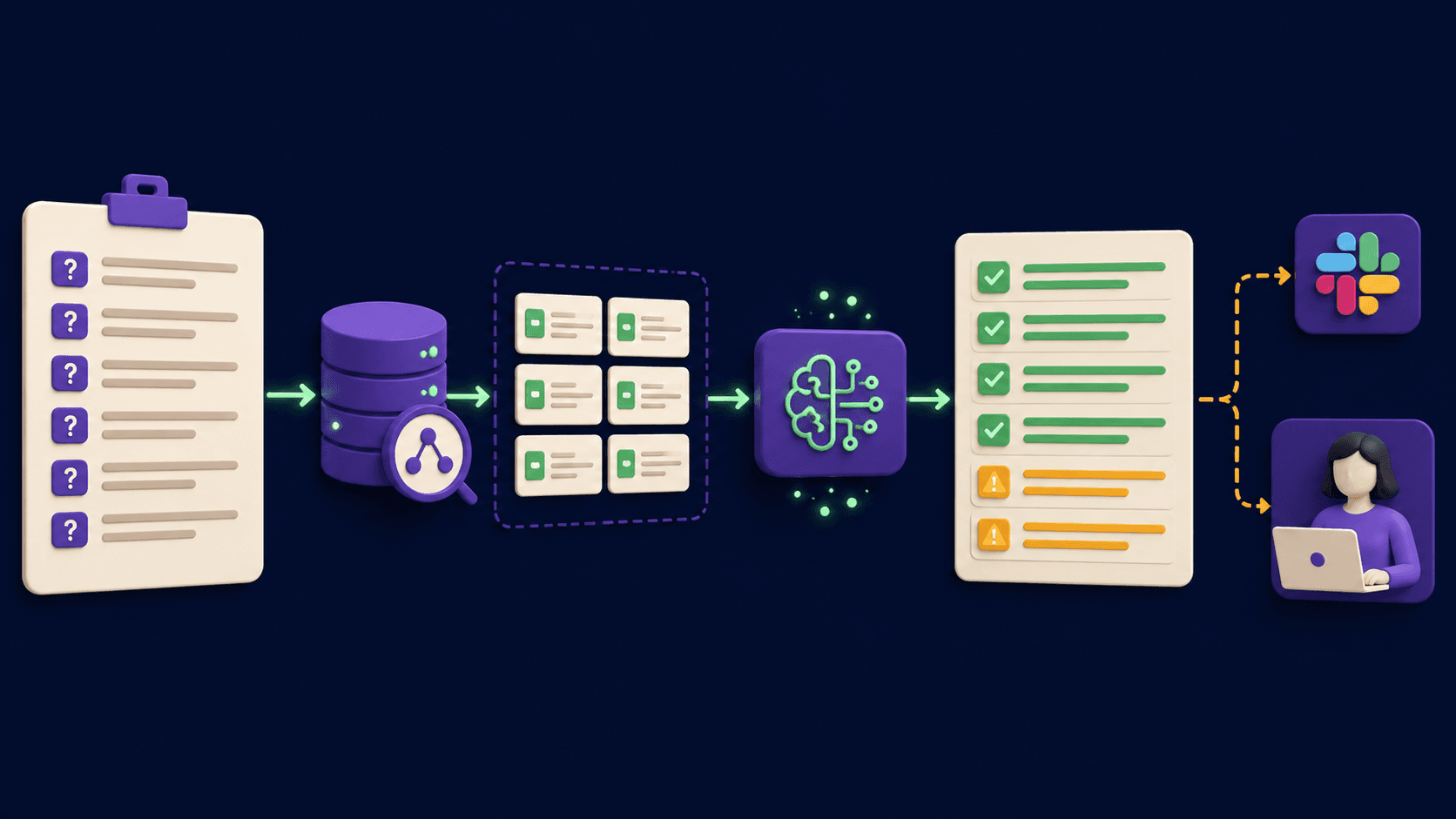
Use cases documented across customer deployments include: RFP generation (legal teams uploading proposal templates and knowledge bases, agents drafting custom responses), investment memo research (finance teams querying multiple data sources for structured summaries), insurance claim processing (document extraction plus routing to human review), staff training assistants, and sales call auditing. The pattern across these is consistent: data-heavy internal processes that used to require analysts or junior staff to manually synthesize information.
As of 2025, Stack AI added three capabilities that expand its scope: computer use (agents can interact with web UIs and desktop applications as if using a keyboard and mouse), web navigation (agents can browse and extract live web data), and sub-agent coordination (one agent can spin up and direct other agents as part of a larger pipeline). These features move it closer to autonomous agent territory rather than just structured workflow automation.
"Our platform allows people to build workflows that require connecting different tools to work together. We focus on connecting data sources and LLMs." - Bernardo Aceituno, Co-founder, TechCrunch, May 21, 2024
Where Stack AI sits versus Dify and Langflow
The no-code AI builder space has three distinct architectural philosophies, and Stack AI occupies a specific position in that triangle.
Stack AI vs. Dify: Dify is open-source (MIT/proprietary dual license) and self-hostable via Docker Compose, running multiple microservices (API worker, web UI, NGINX, Redis, PostgreSQL). Dify includes a dedicated prompt IDE for version-controlled prompt engineering and A/B testing across models, a built-in vector database layer that handles embedding and indexing without requiring an external vector store, and a Backend-as-a-Service model that auto-exposes every workflow as a secure API. It supports if/else branching plus both sequential and parallel iteration loops with per-node tracing. Crucially, Dify can be self-hosted, giving enterprises full data residency control. Stack AI is SaaS-only: you cannot pull it onto your own infrastructure unless you negotiate an enterprise on-premises contract. Dify's GitHub repository has 60,000+ stars; Stack AI has no open-source component. The tradeoff is operational overhead: self-hosting Dify requires DevOps capacity that Stack AI eliminates.
Stack AI vs. Langflow: Langflow is an open-source visual framework built natively on LangChain and LlamaIndex, meaning every canvas node maps to an actual LangChain component or agent primitive. Developers who want to expose LangChain's full integration ecosystem via drag-and-drop, with complete visibility into chain construction and outputs, find Langflow a natural fit. Langflow was acquired by Datastax in 2024, adding enterprise backing. However, Langflow is a development tool, not an operations platform: there are no built-in environments, no RBAC, no audit logs, no SSO. Monitoring and user management must be built separately. Stack AI's built-in governance layer is the clearest mechanical differentiator: if your IT department requires SOC 2 audit trails and production/staging separation before approving deployment, Stack AI provides that out of the box. Langflow does not.
Both Dify and Langflow are better choices if you want open-source freedom, developer-level control, or self-hosted data residency without enterprise pricing. Stack AI is the right call if governance and compliance are first-class requirements and your team cannot or will not build that operational layer themselves.
For teams that want to build customer-facing chatbots specifically, Botpress and AnythingLLM are worth evaluating alongside Stack AI, as both offer more purpose-built flows for conversational customer interfaces.
What the workflow-building reality looks like
The onboarding experience is smoother than most enterprise platforms. Stack AI offers quick-start templates for common patterns (knowledge Q&A assistant, writing feedback tool, document extraction pipeline) that can be launched directly or reverse-engineered. The UI is genuinely modern: multiple reviewers and one Marketer Milk write-up described it as "buttery smooth" and noted it contrasts sharply with the dated interfaces typical of enterprise middleware software.
"Most enterprise software looks like it was designed in 2003, but Stack AI's interface is buttery smooth, modern, and actually enjoyable to use." - Marketer Milk reviewer, marketermilk.com, 2025
Where friction surfaces: initial learning curve on complex multi-agent workflows, integration setup that can be confusing for less common connectors, and a billing model that adds LLM API costs on top of the platform subscription if you use Stack AI's API keys (users can supply their own keys to avoid this). The platform also requires more structured planning than lighter-weight tools. Enterprise implementations routinely take 8-16 weeks from contract to production, which is not unusual for the compliance and access provisioning involved, but it does mean Stack AI is not a "live in an afternoon" tool at scale.
The support quality receives consistent praise across review platforms. Users report same-day response when new LLM models release, scheduled calls with solution engineers, and active responsiveness to feature requests via Discord.
One underappreciated feature is the built-in evaluation framework. Stack AI provides hooks for comparing prompt variants and tracking answer quality over time, something that Langflow requires external tooling (like Langfuse or a custom logging layer) to replicate. For enterprise teams running dozens of workflows, being able to monitor which prompt version performed better on last week's batch without standing up separate observability infrastructure is a concrete time saving. Similarly, the multi-environment setup (dev, staging, production with separate permission sets) maps to how enterprise IT departments actually manage software deployments, reducing the political friction of getting AI tooling approved alongside traditional software.
Who Stack AI is built for
Stack AI is a fit for: enterprise and mid-market teams in finance, insurance, healthcare, legal, or defense who need AI automation with compliance certifications already in place; non-technical operations and business teams who want to ship agents without writing code or waiting for developer bandwidth; IT architects who need governance tooling (audit logs, RBAC, multi-environment management) before they can approve AI tooling for production; and AI agencies building custom internal tools for enterprise clients without wanting to maintain open-source infrastructure. The company's $16M Series A in May 2025 adds runway for roadmap investment, and named enterprise customers in banking (Nubank), defense, and healthcare suggest the platform has cleared the procurement scrutiny those sectors require.
Named customers reinforce this: Nubank (fintech, document workflows), LifeMD (telehealth, clinical data processing), MIT Sloan (education, staff training assistants), and a Top 5 Defense agency (document classification and retrieval under strict data handling requirements). Stack AI's compliance trifecta of SOC 2 Type II, HIPAA, and GDPR means it can be deployed in environments where tools like Flowise would require significant security review before approval.
What Stack AI is not
Stack AI is not a customer-facing chatbot builder in the Botpress or Voiceflow sense. It lacks the conversation design primitives, channel-native integrations, and handoff flows that customer service automation requires. Teams building external-facing bots will find purpose-built tools more efficient.
It is not a developer tool in the Langflow or LlamaIndex sense. Developers who want to understand and control the underlying chain construction, inspect LangChain primitives, or build custom components in Python will hit walls. Stack AI abstracts that layer by design.
It is not affordable for small businesses or early-stage startups at transparent pricing. The Free plan limits you to 500 runs per month and 2 projects, which is fine for evaluation but not production. The $199/mo Starter plan and $899/mo Team plan are calibrated for SMB-to-enterprise budgets. There is no $20-50/mo tier for solo builders or small teams.
It is also not a real-time communication automation platform. If your use case is scheduling, social media workflows, or marketing automation, other tools serve that space better. Stack AI is optimized for data-intensive analytical and document processing workflows, not campaign management. For broader automation use cases, pairing Stack AI outputs with something like Botpress for the conversation layer is a pattern some enterprise teams follow.
User Reviews
No reviews yet. Be the first to share your experience!
Sign in to write a review.
Related articles
Guides and articles related to Stack AI.
Turn Any AI Agent Into a Superagent: The 12-Integration Stack (2026)

15 AI Agent n8n Workflows You Can Build This Weekend (2026)
AI Agents for Business: What They Actually Are and 12 Things You Can Automate Today
RFP and Proposal Auto-Fill: The Agent That Handles 80% of the Repeating Questions (2026)

The Personal AI Productivity Stack (2026): One Tool Per Job, Nothing Extra