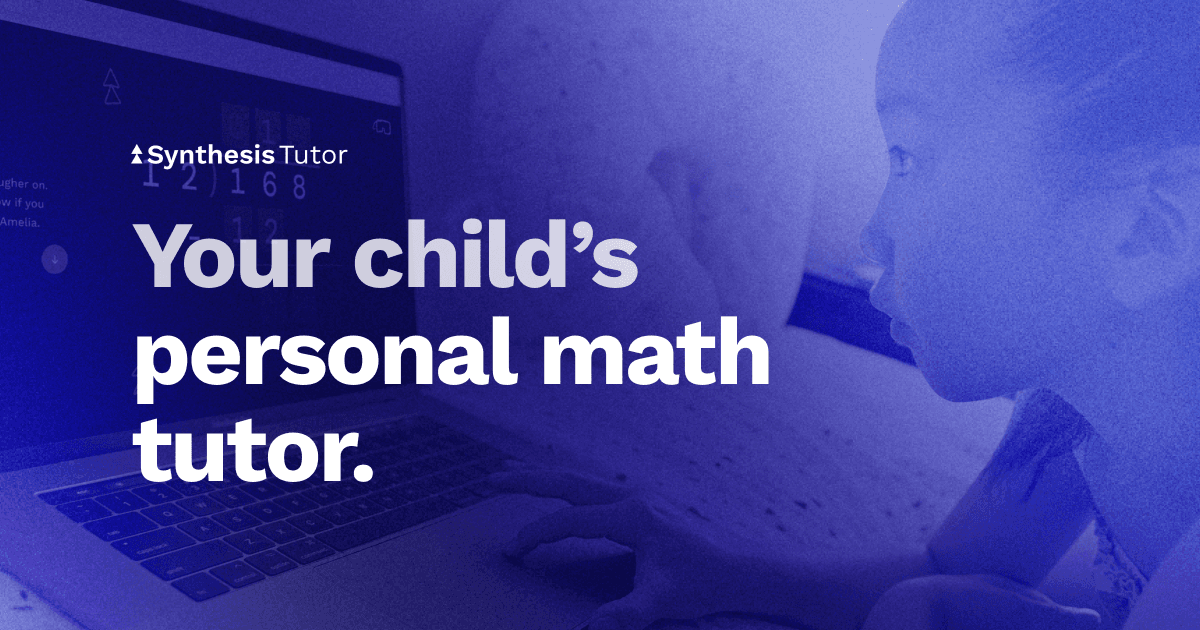

Synthesis Tutor is an AI math tutor for children ages 5-11 that uses visual manipulatives, adaptive difficulty, and voice narration to teach K-5 math concepts. Built from the curriculum that started at Elon Musk's experimental SpaceX school.
Synthesis Tutor is an AI-powered math tutoring application for children ages 5-11, built by Synthesis, the company founded in 2020 by Josh Dahn and Chrisman Frank. Dahn previously ran Ad Astra, the experimental school Elon Musk set up at the SpaceX rocket factory in Hawthorne, California, starting in 2014. That school's weekly collaborative problem-solving sessions were called "Synthesis," and the name carried over when Dahn and Frank brought the model to a global audience. The product is not a general-purpose chatbot bolted onto a worksheet library. It is a purpose-built adaptive AI tutor, grounded in DARPA-funded research on digital tutoring systems and curriculum developed by Dr. James Tanton, a Princeton-trained mathematician with multiple teaching excellence awards.
The tutor covers K-5 math: counting, place value, addition, subtraction, multiplication, division, fractions, and introductory algebraic thinking. It uses on-screen visual manipulatives (fraction boxes, number line models, array blocks) combined with voice narration, so pre-readers and young children can engage without needing to read text or type answers. The AI assesses each child's performance in real time and adapts difficulty within the session, re-approaching concepts through different modalities when a child struggles. Parents receive weekly progress reports. The family plan (up to 7-10 children) runs $99/year, and a 7-day free trial requires no credit card. The platform runs on iPad, desktop web, and Chromebook, with Android tablet support in development as of May 2026.
What Synthesis Tutor actually is in May 2026
Synthesis Tutor sits in a narrow but well-defined product category: real-time AI tutoring for young children, focused exclusively on mathematics. It is not a course library you work through at your own pace. It is not a quiz app with a leaderboard. The AI functions more like a patient one-on-one tutor who watches each response, decides what the child understood, and chooses the next question or teaching approach accordingly.
The DARPA research connection is specific. DARPA funded a digital tutoring program whose students, after 16 weeks of instruction, outperformed students who had 36 weeks of traditional classroom instruction, and also outperformed Navy technicians with an average of 10 years of experience. Synthesis partnered with the team that built that original DARPA program and extended it for children ages 5-11 using modern AI. The DARPA research was primarily conducted on Navy technical training, not elementary math, so the direct translation is an application of the methodology rather than a replication of the study. Still, the underlying tutoring architecture is based on peer-reviewed findings about one-on-one digital instruction, not a general-purpose language model guessing at pedagogy.
The product serves over 25,000 families as of 2026. There is also a classroom-facing tier, available by inquiry, aimed at school districts and homeschool co-ops. The core consumer product has three price points: monthly individual, annual family, and lifetime. The annual family plan at $99/year is the most-cited figure in third-party reviews and the price most families encounter when subscribing.
"My son went from hating math to asking to do Synthesis Tutor ALL. THE. TIME." - Ayden's parent (age 10), Synthesis Tutor testimonials, synthesis.com
"My son has ADHD and ASD. Synthesis makes math fun and engaging for him!" - Boone's parent (age 9), Synthesis Tutor testimonials, synthesis.com
Where Synthesis Tutor sits versus Khanmigo and Brilliant
The three tools that parents most commonly compare when looking for AI math help for children are Synthesis Tutor, Khanmigo, and Brilliant. Each targets a different audience with a different underlying architecture, and the differences are mechanical, not just presentational.
Synthesis Tutor vs. Khanmigo: Khanmigo is Khan Academy's AI tutor, built on GPT-4 running on Microsoft's Azure OpenAI infrastructure (Microsoft partnership announced May 2024). Khanmigo works through Socratic text-based dialogue: it asks guiding questions rather than providing answers, and it covers K-12+ across math, science, writing, coding, and history. But it requires reading fluency and the ability to type, which means children under approximately 9 struggle to use it effectively. Synthesis has no minimum reading requirement because the AI narrates everything and accepts spoken or click-based responses. The subject scope is the inverse: Synthesis covers math for ages 5-11 only; Khanmigo covers almost every subject for K-12 and beyond. On price, Khanmigo's learner plan runs $44/year, less than half of Synthesis's $99/year family plan. For a family with one older child who needs multi-subject help, Khanmigo is the stronger choice. For a family with young children who struggle with reading-heavy interfaces, Synthesis fills a gap Khanmigo cannot reach.
Synthesis Tutor vs. Brilliant: Brilliant targets ages 13 and older (account minimum age is 13) and primarily serves self-directed learners who want to build STEM fundamentals through interactive problem-solving courses. Its catalog includes math, physics, computer science, and quantitative finance. Brilliant is structured like a course library with interactive puzzles; you move through content at your own pace, not in response to an AI assessing your live performance. There is no voice narration, no visual manipulative model, and no real-time adaptation within a single session. Brilliant's premium plan runs $13-25/month depending on billing cycle. The audiences essentially do not overlap: Synthesis is for a parent's 7-year-old, Brilliant is for a teenager or adult learning calculus or data science. The mechanical difference is that Brilliant's AI layer is embedded within pre-built course sequences, while Synthesis's AI is the tutor driving each session from start to finish based on real-time assessment.
A third comparison parents often make is to Photomath, which scans handwritten or printed math problems and explains solutions step by step. Photomath is a homework-solver and explainer; it does not adapt instruction or track learning over time. It answers questions on demand rather than building a curriculum around a child's current ability level. For a struggling student who needs homework support tonight, Photomath fits. For a parent who wants their child to genuinely learn math over a school year, Synthesis addresses a different, longer-horizon need.
How the AI actually works inside Synthesis Tutor
The product is not powered by a large language model answering freeform questions. The AI is an adaptive engine built on top of the DARPA tutoring research methodology, which tracked student mastery states across specific knowledge components and dynamically sequenced instruction based on where each gap existed. In practice, the child sees on-screen manipulatives they interact with (dragging fraction pieces, placing number tiles, arranging blocks in arrays), hears voice narration walking them through each step, and then responds through touch or voice. The AI evaluates the response, updates its internal model of what the child knows, and selects the next problem or instruction segment accordingly.
This is architecturally different from Khanmigo, which generates a fresh text response to each student input through a language model. Synthesis's adaptive engine does not hallucinate wrong math answers in the way LLM-based tutors can, because it is not generating free-form explanations. The curriculum is authored by Dr. James Tanton and pre-built; the AI selects and sequences from that curriculum rather than generating new instructional content on the fly.
The voice narration uses text-to-speech that parents describe as warm and non-robotic. The AI addresses children by name, which is a notable personalization feature for young learners, though the speech engine has documented trouble pronouncing uncommon names correctly (more on this in the frustrations section). The AI incorporates light humor, which parent reviews cite as a key engagement factor beyond what worksheet apps accomplish.
Progress data flows to parents through weekly email reports listing concepts covered, problems attempted, and accuracy rates. The product does not offer a human-tutor escalation path at any subscription tier.
Friction users keep raising
Synthesis Tutor has strong overall satisfaction scores (4.7 stars on the App Store from over 8,000 reviews), but specific friction patterns repeat consistently across reviews and forum posts.
Cancellation process: The most-cited complaint is that cancellation requires contacting Synthesis support directly. There is no in-app cancellation button. The terms allow cancellation only within the first 7 days of a billing cycle, but this process is not surfaced clearly in the product UI. Multiple parents have reported being charged for an additional month after attempting to cancel, and the process is described on Reddit as intentionally friction-heavy.
Speech recognition errors: The AI accepts spoken answers from children, but the speech recognition system has documented problems with uncommon names, younger children's pronunciation, and accents. The AI mispronouncing a child's name despite multiple re-recording attempts was called out by aitoolsforkids.com as "frustrating for a product claiming to be personalized." Correct spoken answers marked wrong is also a recurring report, requiring a parent to be nearby to override the system.
Content exhaustion for advanced learners: Synthesis covers K-5 math. Children at the higher end of that range (ages 10-11) or with strong math foundations can complete all available curriculum within 1-3 months of regular use. No publicly posted roadmap addresses when or whether the curriculum will extend to middle school content. Families paying $99/year for a 10-year-old may find the value proposition diminishes quickly if the child exhausts the content library.
Age floor discrepancy: The product is marketed as suitable for ages 5-11, but reviewer testing with 5-year-olds consistently finds the minimum effective age is closer to 6-7 for children without prior exposure to basic number concepts. Very young children get frustrated with the interaction model before they can benefit from the instruction.
Pricing changes without clear notice: At least one parent reviewer documented paying $79.20 for an annual plan in May and finding the price had increased to $119 by October. Whether the current $99/year figure represents stabilized pricing is unverified.
Who Synthesis Tutor is for
Synthesis Tutor works best for parents who want focused, daily math instruction for children ages 6-10, and who value a visual, audio-first interface that requires minimal reading skill or parental involvement per session. It is particularly well-suited to visual and auditory learners, children with ADHD, ASD, dyscalculia, or dyslexia who struggle with text-heavy programs, and homeschooling families who want an AI to function as the primary math teacher rather than a homework-help supplement.
The $99/year family plan covers multiple children, which makes the per-child cost competitive for households with 2-3 kids in the 6-10 age range. At a single-child household with a 10-year-old, the content exhaustion risk within a year makes the value case weaker. Pairing Synthesis with Quizlet for broader study topics or Coursera for more advanced or adult STEM learning addresses the single-subject limitation.
Skip this when: Your child is under 6 and not yet comfortable with numbers. Your child is 11+ and needs math beyond basic fractions and early algebra. You need a multi-subject AI tutor (look at Khanmigo instead). Your household budget is a constraint (Khanmigo covers more at $44/year). You want a human escalation path. You are not prepared to be nearby for occasional speech recognition errors or to handle the cancellation process proactively.
User Reviews
No reviews yet. Be the first to share your experience!
Sign in to write a review.
Related articles
Guides and articles related to Synthesis Tutor.
AI User Testing in 2026: The Tools That Test Your Product While You Sleep
Replit Pricing Explained (2026): Core vs Pro and Effort-Based Agent Billing
Turn Any AI Agent Into a Superagent: The 12-Integration Stack (2026)

Perplexity AI Tutorial: Maximize Your Research Workflows
TAM SAM SOM Market Sizing With Perplexity: The Sourcing Pattern That Survives Pushback (2026)